Richard Cortez, the Mayor of McAllen, Texas, called a news conference earlier this week to announce that city officials were in talks with an unnamed automaker to build a new manufacturing facility in the Rio Grande Valley. Interestingly enough, he gave few other details as he was worried about upsetting the "customer" as they have asked for silence on the project. Not to surprise anyone, but all signs are pointing at Hyundai Motor Company.
The Mayor has good reason to keep his mouth shut. Just two years ago, the South Korean automaker was in talks with local area officials about a similar project. Those plans fell through when early media leaks identified Hyundai as the potential automaker, and they chose West Point, Georgia, instead. (You are probably asking yourself, as we are, why would the Mayor call a news conference about this in the first place...)
Regardless, analysts say the Rio Grande Valley would be a good fit for Hyundai. The location is close to Mexico, so components could be assembled on the other side of the border and shipped to the United States for final assembly. If Hyundai chooses Texas for their new plant it would be their fourth facility in the United States following plants in Alabama, Georgia, and California. That is, if the Mayor can keep a secret. Thanks for the tip iSpec!
Hyundai, now a world-class engine manufacturer, may lend engine technology to Mercedes-Benz for a future four-cylinder powerplant. It was just a few short years ago that DaimlerChrysler, Mitsubishi, and Hyundai banded together in the Global Engine Manufacturing Alliance (GEMA) to build the so-called World Engine (pictured at right). The GEMA engine, with displacements ranging from 1.8-liters up to 2.4-liters, is found under the hood of more than a handful of Chrysler, Dodge, Jeep, Mitsubishi, and Hyundai products.
While word isn't official, Dr. Hyun-Soon Lee, President of the R&D and Corporate Product Planning and Strategy Divisions of Hyundai-Kia Motors, told Automobile Magazine that he had been approached by Dr. Dieter Zetsche, Chairman of Daimler AG, at the Beijing Auto Show about partnering on a four-cylinder powerplant. Dr. Lee didn't disclose the rest of the conversation, but he did add, "I am not sure we want to share our technology." With the hot Genesis Coupe and luxurious Genesis Sedan ready to roll, and distinguished Mercedes-Benz knocking on the front door, it appears Hyundai's hard work is paying off.
Hyundai's on-again, off-again plans to bring a pickup to the U.S. market are... um, off again, and possibly for good this time. The news that neither Kia nor parent company Hyundai will offer a pickup should not come as much of a surprise, considering the sorry state of affairs in the U.S. truck market. Timing, as they say, is everything, though Honda's unibody Ridgeline pickup has actually weathered the storm well. A possible front-wheel-drive unibody truck competitor from Korea could have offered another fuel-saving choice for U.S. consumers who like the utility of a pickup but balk at the poor fuel mileage of the standard-fare full-frame rear-wheel-drive platform. Hyundai's not ready to take that bet, though, according to company CEO Kim Dong-Jin, who says, rather succinctly, "now is not the right time to produce a pickup truck." The Kia plant in West Point, Georgia will likely be used instead for the production of Hyundai passenger cars like the Sonata, which shares a platform with the Kia Optima that's already planned to be built at the plant.
Click above for more shots of the Genesis Coupe at the Busan Auto Show.
Two things revealed at this year's New York Auto Show had our salivary glands working overtime. The first was the Hyundai Genesis Coupe, which proved that at least one automaker (and now, two and possibly three) is getting hip to the idea that a rear-wheel-drive, two-door coupe with a turbocharged four-cylinder is needed in the marketplace. The second was over at the Kia booth, where Hyundai's sub-brand revealed its Koup concept, powered by a turbocharged 2.0-liter gasoline direct-injected (GDI) four-cylinder. According to Kia, this new mill makes 290 hp and 289 lb.-ft. of torque and could power several different models in both automaker's lineups.
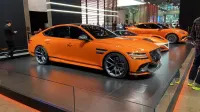
Fast-forward to yesterday when we received a couple of tips about a green Genesis Coupe shown at the Busan Auto Show in South Korea. The coupe supposedly shared display space with the same THETA turbocharged GDI 2.0-liter on a separate stand, causing some members of GenFans to assume that the 290 ps (285 hp) engine was fitted to the green coupe. However, the "380GT" badge on the back reveals that the coupe is actually powered by the run-of-the-mill 3.8-liter V6.
We called up Hyundai to ask about the engine and the Coupe on display. Their response: "We're not commenting on it at this time." While we understand that certain cards have to be kept close to one's chest, it would have been easier just to tell us that the coupe on display and the engine at its booth have nothing in common. Since they're remaining disconcertingly tight-lipped, can we assume that the turbocharged 2.0-liter GDI will find its way into the Genesis Coupe in the future? We hope so. And with Hyundai's recent announcement that direct-injected engines are going to find their way into several of its models, it adds that much more fuel to the fire.
While Ford has enjoyed a year of exclusivity with its SYNC-branded version of Microsoft's in-car connectivity technology, the Redmond-based company has been itching to expand the availability of its in-car gadget integration system to other marques. According to the AP, the first post-Ford carmakers to use the platform in the U.S. will be sister companies Hyundai and Kia.
According to the report, the Korean automakers will have the right to offer the technology on its cars in November, but probably won't do so. The AP report quotes Velle Kolde, senior product manager for Microsoft Auto, saying the two companies are busy developing their own custom applications and don't plan to be ready until after that date.
There is no word yet on what the new system will be named, its cost or what vehicles it will be offered on. Currently the only automaker offering Microsoft's system in the U.S. is Ford. Fiat has rights to sell it internationally and calls its version Blue&Me.
UPDATE: Ford reminded us that only its version of Microsoft Auto's technology is called SYNC, so other brands will have to come up with and market their own names for it.
Like every other automaker that intends to do business in the U.S., Hyundai is planning for the future and the proposed fuel economy standards that are expected to hit in 2015. Currently, Hyundai's passenger cars average 32.4 mpg, while its trucks average 25.5 mpg. When the new regulations are in place, those numbers will have to increase to 37.5 mpg and 31.0 mpg, respectively. Hyundai's approach involves two separate strategies that will work together to achieve those figures.
The first step is to increase electrical efficiency by utilizing more LED technology that puts less strain on the powertrain, along with the use of electric power steering systems (in place of hydraulic units), direct-injection engines and six-speed transmissions. Those changes will be accompanied by the use of lightweight materials, aerodynamic enhancements and low-rolling resistance tires. While the electric power steering system only adds around one mpg overall, the combination of DI engines and six-speed 'boxes should increase fuel economy by between three and six percent.
Within the next two years, Hyundai plans to equip all of its V6-powered vehicles with six-speed gearboxes, while smaller models, with four-cylinder mills, will be upgraded to five-speed transmissions. All of this should help Hyundai achieve its goals, but more needs to be done, and Hyundai's senior manager of the powertrain department, Timothy White, says, "There is really no home run out there." Incremental are what it's about for the time being, and Hyundai seems to be making the first of many steps to accomplish that goal.
In recent months, Hyundai has made a big splash with the introductions of the Genesis sedan and coupe. While those two models will likely do wonders for Hyundai's street cred, they will definitely be niche players when it comes to volume. Among passenger cars in the US market, the midsize segment has been the highest volume category for nearly two decades. Since the mid-nineties, the Toyota Camry and Honda Accord have been the primary players with everyone else having been an also-ran. In recent years, however, Hyundai's entrant in the segment, the Sonata, has put up an increasingly aggressive challenge to the big dogs. The current generation Hyundai Sonata debuted for the 2006 model year and the company unwrapped its mid-cycle refresh back in February at the Chicago Auto Show.
The 2009 Sonatas have been in production since before the Chicago debut and they should be in stock at Hyundai stores around the country now. We went out to the Hyundai-Kia America Technical Center (HATCI) outside of Ann Arbor, MI for a tour of the facility where the new Sonata was created and then set out for a couple of hours to see how it behaves in the real world. Find out if the new Sonata is for you after the jump.
Click above for a high-res gallery of the 2008 Hyundai Tiburon.
The news came courtesy of John Krafcik, Hyundai's product development veep, who told Automotive News that the 2008 model year of the Tiburon would be its last. However, that doesn't mean the Tiburon is down for the count. Krafcik is insistent that the Genesis Coupe, which will be coming out about the same time the Tibby is euthanized, isn't a Tiburon replacement. "We are seriously looking at a small front-wheel-drive coupe to replace the Tiburon," Krafcik told AN, but he wouldn't give a time frame for its replacement. He did say that the Veloster coupe concept that debuted at the Seoul motor show last April would be the inspiration for Hyundai's new FWD, two-door offering. Hopefully, when the production version of the Veloster is unveiled, it'll carry the same turbocharged 2.0-liter four-pot found in its RWD sibling.
Front seat cushions are under a lot of pressure these days. It is a strenuous job, as they are tasked with determining how heavy the derrière sitting on them actually is. According to Hyundai, passenger seat sensors in the cushions of some 2006-2008 Hyundai Sonatas may not be up to the task of distinguishing between a child and an adult, so they are sending out recall notices to 394,000 Sonata owners. Weight sensors in the passenger seats of most late-model vehicles are designed to disable the passenger-side airbag when a child is riding up front. However, Hyundai told the NHTSA that an error with some of its sensors may keep the passenger airbags off when small adults are occupying the seats, as well.
Notified Sonata owners are being asked to check whether or not the airbag is activated when the seat is occupied by an adult. If their vehicle is among the estimated 1 percent of vehicles that have "confused" airbag sensors, the seat cushions will be removed and sent to the West Coast for reprogramming. Owners will receive a rental car while their cushions are in California getting reprogrammed -- and some R&R, of course.
As we learned at the New York Auto Show, the fanciest or funniest videos don't always take home the trophies. Hyundai's recent "Big Duh" ads won the IAG Research ad award by being the one ad the really stuck in the skull of folks at home from Nov 1, 2007 through Jan 26, 2008 . The "Big Duh" year end sales event spots were recognized as the most effective car ads because it's apparently hard to forget a choir singing the word "Duh" to "O Christmas Tree" while a Hyundai Azera rotates on screen.
Hyundai's ads were also effective because the "Big Duh" theme was used over a period of several months, which helped viewers better associate the 30-second spots with the Korean automaker. A few of the "Duh" themes carried out over the past few months are "Pink Panther" and "2001 Space Odyssey", and the obvious point of the commercials is that getting a great deal on a Hyundai is a no-brainer. With improving ads and some hot new products on the way, it seems Hyundai has a lot to celebrate of late. We added a few of the "Big Duh" commercials after the jump so you can see why they're so memorable.