


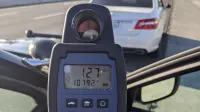
A pair of Pittsburgh Revenue Officers misunderstood the rules surrounding the use of some LIDAR gear loaned to the department for testing and issued a raft of tickets that the Pittsburgh Bureau of Police now has to retract. Apparently LIDAR is only approved for use when teamed with other systems like VASCAR and ENRADD, which measure speed in different ways, and these boys in blue were using it solo. Their mistake instantly invalidates about 650 speeding fines that were issued on account of the loaned LIDAR equipment.
Pittsburgh police chief Nate Harper has apologized for the erroneous tickets, and motorists with LIDAR-only tickets were encouraged to request a court hearing. If the citation has already been paid, the unlawfully caught speeders will be reimbursed. A full refund for a speeding ticket is novel, but our sarcastic side wants to make a crack about the payouts being funded by shortening yellow lights at intersections with camera-bots. Thanks for the tip, Eddy!
Most of us have gotten speeding tickets before, and it's usually not a pleasant experience. It's "Yes sir" and "No, sir" and "Thank you" while the officer is chastising us for whatever minor infraction we've incurred. All the while, you're thinking to yourself, "I was doing 8 mph over the speed limit. Shouldn't he be out chasing terrorists or something?"
So this video is for all of us who would have so very much enjoyed telling off the guy or gal about to make us pay potentially hundreds of dollars in fines and insurance costs just because we were in a little bit of a hurry to get to the house/work/that big sale at Autozone/etc. We held our tongues, took our punishment and probably avoided higher fines or, worse, jail time.
How the alleged offender in this video manages to keep his freedom is a complete mystery. That is one patient cop, and I hope he got a raise for putting up with this driver's degrading diatribe. The man's choice of adjectives earns it a NSFW, btw.
If you like this sort of thing, be sure to check out our source, Bluetube, for more .
Neenah, Wisconsin has such a speeding problem that it can't keep up. Even with a full court press of law enforcement, drivers continue to speed and have even sped by other motorists receiving their obligatory revenue-production invoice. In an effort to keep drivers on their toes while also leaving time to fight real crimes, the Neenah PD will post cardboard cutouts that look like an officer pointing a radar gun in strategic locations. Like something out of Weekend At Bernie's, the paper tigers will be rotated with living, breathing officers so that the ruse has a chance of effecting change. At this point, it's less about filling the coffers and more about quelling an epidemic of overly-velocitized drivers.
Not so long ago, Ontario, Canada drafted a law to curb racing and excessive speeding on its highways. Things were getting so out of hand that stretches of road were called the Ontariobahn. In a campaign they call "shock and awe," they jacked the maximum fine up to $10,000, and threw in a 7-day suspended license and vehicle impound for anyone doing more than 50-KPH over the posted limit.
Since the traps were laid, they have been full. A recent catch was an 85-year-old man who was doing 161 kph -- 61 over the limit -- on roads with ice and snow. He wasn't racing -- he was simply "going to the bank and shopping," albeit rather quickly. So he was immediately relieved of his license and his Oldsmobile.
Since the law took effect on September 30, 2007, 2,300 Canadians have met the same fate -- 1,300 of them in the first five weeks. On average, every day 24 drivers have to learn bus routes, and 24 cars get parked somewhere for a week. The 85-year-old gent has the honor of being the oldest arrested so far, a 16-year old girl was the youngest, and the fastest driver was going 230 kph (142 mph). If your travels take you through Ontario while the shock and awe continues, try not to get frisky with the go peda else you'll be down with a very different O.P.P. -- the Ontario Provincial Police.
Highway 401 in Ontario, Canada runs from Windsor all the way across to the Quebec border and on to Montreal. Since the 1970s, the speed limit has been 100 km/h (about 62 mph), but actual average speeds along long stretches in the rural southwestern part of the province are often considerably higher, leading to the nickname Ontariobahn.
To combat late night street racing and excessive speeds everywhere, a new extreme driving law went into effect a week ago. The maximum fine for violating the law has now been bumped from $1,000 to $10,000 along with an instant seven-day license suspension and seven-day impound of the vehicle. What can earn you such a punishment? Any number of offenses from racing or even showing the intent to race to simply exceeding the posted speed limit by more than 50 km/h (30 mph). Over 100 drivers had their cars impounded during the first week under the new rules.
Next you take a shortcut through Canada on the way from Buffalo to Detroit, you might want to ensure your cruise control is set right at the speed limit.
We understand a lot of strange urges, especially when it comes to cars. What we don't understand is the urge to do something illegal, commit it to video, and then upload that video to one of the world's most famous broadcast mediums.
A teenage mechanic in England took his dad's MR2 for a high speed run on the M65 and, recording the event for posterity on his cell phone, got to an indicated 140 mph. An off-duty police officer watched him thread traffic and use the shoulder for his run, and got his license plate number but didn't follow and arrest. A week later, the officer was told about a YouTube video, and it turned out to be the teen in question on that very drive. Campbell told the court that he didn't upload the video, but he sent it to a friend who did. The court did give him a small break, shaving 20 MPH off his offense, and charged him for driving 120 instead of 140. For his friend's efforts, Campbell gets to spend a stint in the brig while he contemplates his next feature film.
As Americans are well aware, angry drivers are a dedicated, relentless, and unpredictable bunch. Angry drivers in Britain, fed up with the scourge of Gatso speed cameras, have destroyed them in all manner of ways. How are the authorities (or rather, capitalism) fighting back? A Dutch company has created a camera it wants to sell in Britain that could actually survive a day on the corner of a Baghdad street, let alone whatever purturbed British motorists can throw at it.
The camera is 13-feet tall, sits on a steel base placed in the ground, has cameras hidden behind strengthened glass, and has a fire-resistant body. It can monitor four lanes of traffic moving in both directions and doesn't use flashes so you don't know when you've been caught. And due to new regulations, it can be painted to blend in with its surroundings. Not only is it practically indestructible, but if it senses a threat via onboard smoke and vibration detectors, it will alert the nearest police station and upload all of its data to a central database so that no scofflaw gets away. Pending Home Office approval in England, it will be one giant leap for law enforcement, and one step closer to Robocop. We can think of only one achilles heel for this indestructible speed camera... a setp ladder and some spray paint.
An old friend of mine used to have a trick for getting out of tickets. She would flick her long blonde hair back over her shoulder, blink a lot and emphasize the ending of any word that concluded with a long "e" sound. "Sorryyyyyyy," she would say, and the cop's pen would never touch pad. Unfortunately, my bag of tricks is missing a few of those tools, so I've gotten a ticket for every time my car has been motioned to the shoulder.
Perhaps, however, there are strategies to get out of a ticket for those of us who are not blessed with long blond hair and a cute voice. Our brand new sister site, DIY Life, has somewhat of an ex-cop on staff who offers his own How To on getting out of a ticket by being respectful. Yes, respectful. If you've been pulled over, you should suck it up and own your mistake, then go about seeing how the officer's attitude towards you can be improved. Among DIY Life's best pieces of advice is submitting to the cop's authority by having both hands on the wheel before he or she arrives at your window. That gesture alone will make the cop feel much more comfortable approaching the situation, and a comfortable cop that sees you don't intend to be confrontational may be more lenient. There's plenty more good advice available by clicking the Read link below, but let us know in the comments some of your own tips that have proven successful.
It seems a little unreasonable and over the top to us. UK drivers pinched for speeding may soon be compelled to surrender a swab, too. If the authorities get their way, it's not just speeders they'll nab to build their DNA database, but even litterbugs will be asked to "donate."
The UK's DNA database has recently come under fire for concerns that the stockpile is overly heavy with children and minorities. Treating everyone like a fugitive shows the government's basic contempt for its citizenry, and collecting reams of biometric data on the population is fraught with the potential for future abuse or invasion. While having DNA on file will likely lead to the solution of some crimes, it seems out of the scope of consequence for speeding. It's one thing if you can opt out, but if it becomes compulsory, we'll remain glad to stay in the Colonies.
The question of the day is, "If you're tasked with teaching a three-time Formula One champ to drive, what's the curriculum?" Some instructor in Brazil will be forced to answer that very query when he gets Nelson Piquet behind the wheel for a refresher on the rules of the road.
Piquet, who's racked up quite a collection of speeding offenses and parking tickets, is being forced by a Brazilian judge to go back to school for 30 hours over the course of eight days, after which he'll be required to re-take the driving test.
The 54-year old F1 wiz seemed rather jovial when asked to comment on the matter, simply saying that, "I think we have to pay for our mistakes." We're more than interested to see how it turns out, and we'd expect his instructor to come away with a host of intriguing stories and maybe a few new skills of his own.