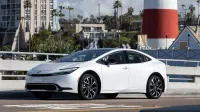
Toyota lawyers arrived at the U.S. Supreme Court today and were denied an appeal to overturn a ruling originally upheld by a federal appeals court in Washington last year. The case involved a technology patent held by a company named Paice LLC, which contended that Toyota used the same microprocessor developed by the McLean, Virginia-based company on its hybrid vehicles that inputs torque information for both the gasoline-powered engine and the electric motor. The $4.3 million dollar award against Toyota will stand, and Toyota is required to pay royalties to the firm to the tune of $25 for every Prius, Highlander Hybrid and Lexus RX400h sold. Ouch. Sometimes the price of success is steep.
Click on the image above for our Toyota Prius gallery
When an eight-year-old boy on a bicycle gets hit by a car while riding in the middle of the street, the blame often points directly at the youth. However, if the car in question just happens to be a quiet hybrid-electric... there just may be reason to accuse the vehicle.
Last weekend, a youthful Owen Erickson was riding his two-wheeler with a friend when he was struck by a Toyota Prius and tossed onto the hood of the popular hybrid. Thankfully, he was unhurt. His mother, however, was quick to place some of the blame on the "totally silent" Prius, claiming her son never heard it coming. As a scapegoat, the hybrid-electric vehicle is taking more than its fair share of heat. Two years ago, we blogged about the silent danger of hybrids. Earlier this year, Maryland launched a study, and passed legislation aimed at vehicle noise levels(more specifically, the "lack of" audible decibels), citing a legitimate concern for the blind. Just last month, a bill was introduced in the House of Representatives to study whether or not a "minimum sound level" needs to be established for these highly-efficient silent runners.
We obviously haven't "heard" the end of this hybrid-electric argument as it begins to gain momentum around the country. Whether future Prius models are equipped with blaring sirens or not, we do know that Moms will still need to teach their children to not play in the middle of the street. Thanks for the tip, Tyler!
Click above for high-res gallery of the Volkswagen up!
Volkswagen's adorable little up! has the ambitious goal of becoming the next original Beetle, and new info on Auto Express seems to indicate that the Germans in Wolfsburg may be on to something. The up! will feature both gasoline and diesel-powered engines with a minuscule displacement of only .6 turbocharged liters, and a larger 1.2L three-cylinder engine may be planned, as well.
The up! will also be extremely fuel efficient, with U.S. fuel economy numbers near 80 mpg. Perhaps the most eye-catching bit of info is the base price of the handsome little micro: models will sell for as little as £4,500 in emerging markets and more richly equipped European models will start around £7,500. VW is also looking at making both a three- and five-door up! with the exact same wheelbase, as well a roomier MPV version and even a hybrid. VW also says that the 11 foot long up! will also feature the roomiest cabin in its class. Is it just us, or does the amazing little up! almost sound too good to be true? We'll find out for sure next year when the production up! is released to the public.
Click above for high-res gallery of the BMW Hydrogen 7
The BMW Hydrogen 7 arrived in late 2006 boasting the unique ability to run its V12 powerplant on both hydrogen and gasoline. This was a smart idea, as the on-board 30-gallon tank of -253° Centigrade liquid hydrogen was only good for a range of about 125 miles. The other fuel tank, filled with 19.5 gallons of good old-fashioned gasoline, extended the range another 310 miles. It didn't offer any environmental advantage, but it did allow you to get home.
BMW is following up the original Hydrogen 7 with a new version - this time minus the gasoline tank. While official performance specifications, including emissions data, have not been released, BMW is claiming both performance and range have been increased. It will debut at the 2008 National Hydrogen Association Conference and the 2008 SAE World Congress in mid-April, when BMW is expected to release emissions date for the car, as well.
These days it seems more common to overhear comments about a particular car's appalling fuel economy than idle chatter about the weather, which makes sense when a gallon of gas costs as much as a cheap umbrella. For instance, just the other day there was some guy going on about how his car was getting 3 mpg less than just a few months ago and had no idea why. That is until it was pointed out to him that his car's adjustable luggage rack was in its full, upright position, giving his car the aerodynamic efficiency of a cinder block.
That's just one of the points Forbes includes on its list of things to do so you can drive green without buying a new car. Improving your gas-guzzling vehicle's sleekness by losing that luggage rack, ditching that inefficient and egregiously ugly three-foot-tall spoiler and quit sticking your hand out the window are all little things that add up to an appreciable difference at the pump.
Most of the advice is common sense we've all heard before, but Sebastian Blanco, editor of AutoblogGreen, offered a novel suggestion for the list. Reduce your car's weight by only filling up half the tank. One gallon of gasoline can weigh as much as 6.5 lbs. On a 2008 Ford Escape, a half a tank of gas weighs 53 pounds.
Like the Forbes article points out, there's only so much you can do to curb a car's drinking habit, especially if you're driving something like an Escalade. But in smaller, lighter cars, even small steps like this can make a big difference in your fuel bill.
Click on the image for more shots of the Honda FCX Clarity
Honda's upcoming dedicated hybrid model is expected to debut at the 2008 Paris Motor Show, and a recent interview with Honda CEO Takeo Fukui revealed that the car will look similar to its hydrogen fuel cell vehicle, the FCX Clarity. Although many upcoming hybrid models use lithium ion batteries (including the Chevy Volt and Honda's own FCX), Honda plans to stick with the tried-and-true nickel metal hydride technology for its new machine along with an engine derived from the Civic's, though smaller, lighter and with newly programmed electronics. Also like the Civic and Accord, the new hybrid model will use the same nameplate the world over; what that nameplate will be remains a mystery. Insight, anyone?
Expected to be priced below the Civic Hybrid, Honda hopes to sell 200,000 of its new hybrid model per year. We expect that the new machine will start an epic battle between Honda and Toyota for supremacy in the entry-level hybrid market, much as they already duke it out in the midsize sedan range with the Accord and Camry. Consumers only stand to benefit from the competition, so we look forward to more information as it becomes available.
One of the best parts about being a member of the Autoblog team, besides all the chicks and autograph requests, is driving some of the best vehicles in the world and writing about it here. When it comes to hybrids, though, we tend to leave the heavy lifting to our brethren over at AutoblogGreen, and our eco-conscious friends never let us down. Gang green got their hands on a 2008 Chevy Tahoe Two-Mode Hybrid, and they knocked the review right out of the park. Hit the link below to see how a Tahoe with two electric motors and a 300-volt battery pack fared, i.e. what kind of mileage it achieved.
Potential buyers interested in the upcoming Mahindra & Mahindra Appalachian pickup truck will get a sneak-peek of the new machine at the upcoming SAE World Congress, April 14-17 in Detroit, Michigan. The most interesting part of this news, though, is that the vehicle on display will sport a diesel/electric hybrid drivetrain, which could be the first and only such system sold in the U.S. The standard diesel Appalachian truck is expected to come with a 2.2-liter four cylinder diesel engine putting out between 140 and 150 horsepower along with 300 lb. ft of torque. Expected to sell in the low $20,000 range and be available in both two and four-door versions, Mahindra could potentially re-ignite the small truck market abandoned long ago by American automakers. With the hybrid option coming in at around $5 grand more, before any available tax credits are applied, we think that this upcoming Indian truck will make some waves here in the states when it goes on sale in 2010.
While premium hybrid SUVs haven't proven their worth in the U.S. market yet, automakers will have a good fix on whether or not offering a gasoline-electric hybrid 'ute is good business sense in the coming years. Audi has apparently already made the call, and after studying the business case and watching the U.S. dollar tank, it's decided that the Q7 hybrid SUV is not bound for U.S. shores.
"It was a very hard car to make the numbers work," according to Johan de Nysschen, Audi's brand head in the U.S. "We will not do the hybrid Q7 as a conventional product offering," de Nysschen continued, saying only that a few hybrid Q7s will make the trek across the pond and find their way into the hands of "commercial" entities.
However, all is not lost for a fuel-sipping version of Audi's land yacht, with the eminent arrival of the diesel Q7 in the next year or so, the SUV will spearhead Audi's diesel offerings, followed by an oil-burning A4 around the turn of the decade.
Click above for more high-res images of the Fisker Karma
Every automaker realizes that they need to make their vehicles consume less gas, reduce emissions and lessen their overall effect on the environment. One obvious way to make this happen is to go electric, but that solution poses its own host of problems. One potential sticking-point is that many drivers love the way their car sounds and have gotten used to the underhood roar and scintillating exhaust note of an internal combustion engine. But, what if your electric car sounded ''like something between a Formula One car and a jet plane?"
That's exactly what Henrik Fisker plans to do with his new Karma, a hybrid sedan which can travel up to 50 miles before the engine needs to kick in and recharge the batteries. To make sure that everyone inside and out can hear the F1-car-slash-jet-turbine note, speakers have been placed strategically around the vehicle, both in the interior and on the exterior. A novel, if not obvious solution, but we doubt it's going to have the same effect no matter how well it's executed.