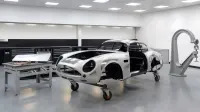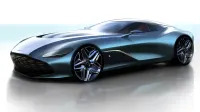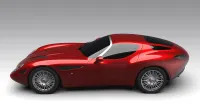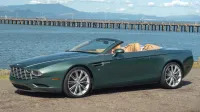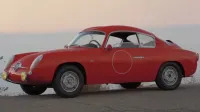

Click to view a gallery of the Lamborghini Zagato Raptor
If you thought the Lamborghini Reventon was as exclusive as Bolognese supercars get, feast your eyes on the Zagato Raptor. The one-off concept car unveiled at the 1996 Geneva show took on the insurmountable task of supplanting the Diablo (on which it's based) on the bedroom walls of enthusiastic children worldwide.
The concept car borrowed its mechanics from the Diablo VT, but while it retained the Lambo's 492-hp V12, in a gesture to insanity it did away with the traction control and ABS. The design, which Zagato appears to have echoed with the Spyker C12 concept, features the carrozzeria's signature double-bubble roof that tilts up with the doors not unlike the canopy on Pininfarina's Maserati Birdcage or Giugiaro's Quaranta concepts. The Raptor was developed in conjunction with Swiss sledding champion Alain Wicki (yes, he has his own Wikipedia entry), and while public reception was hot, the car was never put into production. All that remains is this one original show car, which is now going up for auction at Pebble Beach by the auctioneers at the Blackhawk Collection.
Check out the images in the gallery below. Thanks for the tip, Jonathon!
Say "Italian-styled Cadillac" and any car person will shoot back "Allante." It does appear, though, that Zagato executed coachwork on top of a fourth-generation Eldorado before Cadillac ever thought of shipping its wares to and from Pininfarina. This Eldo looks a lot like a Ferrari, and there's a reason for that, according to the seller. The bodywork on this car was reportedly designed by Luigi Chinetti, Ferrari racer and the first Ferrari agent in the United States. Chinetti went on to found the North American Racing Team, also an official Ferrari venture, and that might explain why this car has NART prominently displayed on its nose.
The NART badging is the only thing this custom Caddy shares with the Ferraris under Mr. Chinetti's umbrella, though. The success of his Prancing Horse franchise is likely why this prototype, which was displayed at the Turin and New York auto shows in 1971, never went anywhere. Currently, the car is in Brussels Belgium, and potential buyers are invited to make offers. If the provenance holds up, we doubt it'll be a small selling price. At least you'll get 1970's Italian style with the inexpensive upkeep of 1970's American running gear.
Click above for more high-res shots of the Zagato Bentley Continental GTZ
Since we're still in the midst of awards season, the trophy for least complicated reveal goes to Zagato, which made nary a fuss over its angularized and curvified Bentley Continental GTZ. Just a note, a bigger note and press photos, and now we present the live shots. It's a striking car, no doubt -- from some angles at the front we think it looks like it had a long night out with Salvador Dali and Georges Braque. Check out the hi-res photos for yourself, below.
We've posted a number of articles in recent months about coachbuilders like Pininfarina and Bertone finding themselves in financially troubled waters. The difficulties these and other independent manufacturers around Europe are suffering now appear to be part of a larger trend that's forcing these companies to either adapt to the changing market or face extinction.
While major manufacturers once subcontracted the production of niche vehicles – sports cars and convertibles especially – to smaller companies, the larger carmakers have been adapting their assembly lines towards small runs of diverse automobiles, leaving the indie coachbuilders with declining business. As a result, Pininfarina, for example, has been dipping further and further into the red, while Bertone was forced to sell its business on the verge of bankruptcy hearings.
Industry experts now advise that the coachbuilders will have to change their focus in order to survive and return to profitability. Although some have been receiving patronage from wealthy customers seeking original automotive creations like Zagato's Maserati GS and Pininfarina's Ferrari P4/5, that business is sporadic at best. Magna Steyr continues to be awarded contracts from carmakers like BMW, and Karmann is gearing up for an anticipated contact from Kia, but these and other coachbuilders will need to begin looking elsewhere for continued viability. Pininfarina and Bertone can return to their erstwhile core business of automotive design while shutting down or severely downsizing their manufacturing divisions, while emerging markets like China could provide potential contracts in the future. But while there may be a light at the end of the proverbial tunnel, European coachbuilders will need to streamline to reach it.
[Source: Automotive News (subscription required) via Winding Road]
The name Zagato might as well be Italian for "exclusive"; that's exactly what their designs are. Although the carrozzeria has been designing cars since 1919, their most recent designs have all been extremely limited editions. Creations like the Maserati GS Zagato and Ferrari 575 GTZ had just one example made of each. The Spyker C12 Zagato was planned for 24 copies, but those plans have since been shelved. The design house recently announced that the Diatto GT Ottovu would be produced in a limited run of 99, like the 2002 Aston Martin DB7 Zagato, which seems like mass-production by comparison. So it makes sense that when the Milanese design atelier turned their attention to creating a wristwatch, they would only make 25 examples.
The striking timepiece you see here is the result of a new long-term collaboration between Zagato and Swiss watchmakers Wyler Genève, forged out of the childhood friendship between the heads of both companies. Zagato designed the titanium case which houses the mechanical "manufacture" – i.e., built completely in-house – movement suspended in a carbon fiber and resin frame on shock absorbers. The dial features an F-E power reserve indicator like a fuel gauge on a car, and like Chopard's Mille Miglia and Pirelli's P.Zero watches, is strapped to the wrist with a rubber tire-tread strap.
You can bet the pricing is on a "if you have to ask" basis, but if you have the means and missed the 25 Zagato watches being offered, don't fret – let your bank manager do that for you. The same case design is being used on Wyler's new tourbillon, a complicated rotating form of watch movement that typically sells well into a likewise very automotive five-figure range.
Click on the image gallery below to see more. Complete press release after the jump.
Zagato is responsible for some of the most exclusive and interesting rebodying jobs ever to grace tarmac. Beauty being in the proverbial eye of the beholder, some have had greater affection for their designs than others, but they're certainly intriguing. Some recent examples have included the custom Ferrari 575 GTZ and Maserati GS, but the Milanese coachbuilder's work has branched far out of the Italian peninsula, including the unfortunately stillborn Spyker C12 Zagato, as well as a stable full of British cars for Rolls-Royce, Jaguar and, of course, Aston Martin (among others).
The carrozeria has announced plans to prepare a coachbuilt Bentley according to the latest reports. The news arrives on the heels of Bentley's announcement that it would increase its in-house customizing efforts, which at the time ruled out turning to outside coachbuilders. This still appears to be the case, as a spokesperson for the automaker told us that to his knowledge, Bentley has not been involved with the Zagato project. No further details are known at this time, we're looking forward to scoping out what Zagato has in store for the Flying B badge. If we had to guess, a Continental will be the subject of the transformation. Stay tuned.
It was simply a matter of time before the financial stresses ailing Spyker would filter their way down to product. The result is the unceremonious execution of the stillborn C12 LaTurbie and the Zagato edition. Killing off those two models enables Spyker to put more of its limited resources into two remaining models, the C8 and the upcoming Super Sport Utility Vehicle D12.
According to Spyker head Hans Hugenholtz, the C8 will remain as it's cheaper to produce and stands as the cornerstone of the ultra-niche automaker's turnaround efforts. That, and the introduction of the D12 SSUV, now delayed until the end of 2008, will hopefully return the firm to profitability.
The death of the C12 was a huge financial hit, as Spyker spent a considerable amount of cash and resources toying around with the VW-sourced 450 HP 6.0-liter W12 that now may find a home within the D12 SSUV.
The Concept Lawn at Pebble Beach always manages to host a few surprises. Last year we saw the Glickenhaus one-off P4/5, a Ferrari Enzo rebodied by Pininfarina as an homage to the legendary P3/4 racecars of the '60s. This year we saw the unveiling of the new Callaway Speedster and the official showing of the new Aston Martin DBS, but there were some other cool cars there as well -- cars that may be somewhat familiar from other shows but that many folks haven't seen in person. This year's visitors were treated to up-close glimpses of the new Maserati GranTurismo, Lincoln MKR, Chrysler Nassau, Lexus LF-A and IS-F, Mercedes-Benz Ocean Drive, Dodge Demon, Giugiaro Mustang, Bentley Brooklands, Jeep Trailhawk, Cadillac Cien and CTS-V.
But few save the first two drew as much attention as the Spyker Zagato. That's the limited edition run of 24 special closed coupes we first saw in Geneva. It's at once more contemporary than other Spykers and simultaneously more retro. Kind of made us think of the Flash Gordon show -- A retro look at the future. It taks some classic auto styling cues and adds a fair bit of SLR and Zonda in for good measure. It's quite a looker, and a mover too by the sound of it. A derivative of Spyker's flagship C12 model, the Zagato uses a version of VAG's 6.0L W12 putting out 500 hp, or 650 with the optional supercharger. Because of its light weight (3,086 lbs.), the C12 Zagato should be good for a 0-60 mph sprint of 3.8 seconds on its way to a top speed of 193 mph.
Gallery: Pebble Beach Week 2007: Spyker Zagato makes California appearance
Click on the image above to view the new Diatto GT Ottovu in high resolution
Hot on the heels of our Top 10 Coachbuilt Supercars comes the announcement from Zagato that the Italian carrozeria will be reviving the stoic Diatto marque with a small run of the Diatto GT Ottovu. First shown at the Geneva show as the Diatto Ottovu Zagato, the GT will step out of the concept box and into limited production of 99 examples.
Those coming new to the game might not be familiar with the Diatto name, but it has a loyal and, as it turns out, wealthy following who have motivated (and likely bankrolled) the brand's revival by commissioning the new GT from Zagato. Once a contemporary of Bugatti and Maserati, Diatto started out some 170 years back, producing horse-drawn carriages, then moving on to luxury train cars before becoming one of the first automakers in the world and finally vanishing from the industry in the inter-war period.
Reviving the classic Turinese carmaker, the Diatto GT Ottovu is based on a steel frame with an aluminum body with a front-mid engine layout driving the wheels behind the four-passenger cabin. Motivation comes courtesy of Ford's 4.6-liter V8, supercharged and tuned by Roush and Cosworth to produce 530 horsepower, although Zagato says up to 650 would be possible. As it is, the GT Ottovu is claimed to hit 60 in the threes.
As for the styling, the concept looked better in person than in the pictures, and Zagato clearly went for an elegantly understated design approach. That being said, it still falls short of taking many breaths away. Zagato called the bespoke leather interior "sober, smart and comfortable"...which may as well have applied to the overall design. If it tickles your fancy, though, it will be available through specialist dealers in the United States as well as Europe, but don't expect that kind of exclusivity to come cheap.
Sometimes the past deserves to remain in the past, but once in a while the automotive industry reaches into its history to resurrect something worthwhile whose demise was regrettable and whose return is welcome. The return of coachbuilding is one example of an industry trend we're glad is making a comeback.
Coachbuilding was popular decades ago among the extremely wealthy for whom the ordinary offerings of the automotive industry weren't anywhere near exclusive enough, so they had special bodywork fitted to regular cars to make them their own. Contemporary coachbuilt motors follow the same formula: an existing car fitted with new bodywork, and often customized mechanicals, for the most discerning and obscenely wealthy clients. Results have varied, but variety, as the saying goes, is the spice of life. Here we've chosen our ten favorite examples.