

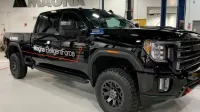
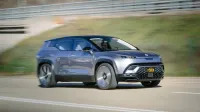

After nearly three years of rumors and speculation, the new jacked-up MINI SAV will finally make its debut, according to Autocar. The Brit pub is reporting that the MINI 'ute is bound for Paris, with an on-sale date sometime in 2010 and sporting a five-door design.
Questions still remain about what platform the new all-wheel-drive model will be based on, with sources suggesting it will either be based around the Clubman's architecture, making use of a new upper-body structure, or the current Cooper's chassis, using the front end and employing a new floorpan to accommodate the AWD system and new seating positions. Regardless of what's underpinning the SAV, MINI has to justify the R&D, so if the biggie-sized MINI proves successful, there's a possibility that a front-wheel-drive variant will be offered on the same chassis, oxymoronically dubbed the MINI "Maxi."
Production is expected to begin late next year at Magna's factory in Graz, which currently produces the X3. And with BMW shifting production of its entry-level SUV to the U.S. sometime next year, MINI will have the manufacturing capacity to bring its sales over the 340,000 mark.
Click for a hi-res gallery of Porsche production in Finland
Porsche has announced that production of its Boxster and Cayman models is to shift to component supplier Magna Steyr's facility in Austria beginning in 2012. Last year the contract with Finland's Valmet to assemble the two associated mid-engined models was extended through 2012, after which the terms will expire and Magna will take over.
Porsche CFO and deputy chairman Holger P. Harter stressed that the decision was not a vote against Valmet – which has to date built over 200,000 vehicles for Porsche – but rather the result of several elements that Magna brought to the table: firstly, Magna's production is scalable so that it will only manufacture what Porsche's own factory in Zuffenhausen (where the rear-engined 911 series is made) cannot handle. Secondly, Magna is able to assume some development responsibilities along with the final assembly. Thirdly, Magna's proposal was more financially attractive (read: cheaper) than Valmet's. And finally, Magna already supplies various components to Porsche – including convertible roofs and body panels – creating the opportunity for future synergies between Porsche and various Magna subsidiaries.
Click on the thumbnails below to view the Porsche Boxster and Cayman production facility at Valmet in Finland.
The Magna MILA Alpin concept car shown in Geneva has gotten the attention of both Mercedes and BMW. The button-cute 4-wheeler rode on a flexible platform, could utilize a variety of fuel sources, climb 45-degree angles, and get up to 120 mph. Those capabilities, and the ability to be easily rebodied and cost-effectively manufactured, have the two premium brands looking at ways to bolster their lineups and enviro-credentials.
Mercedes is known to be working on developing a 4-wheel-drive A-Class sedan. While the sandwich floors in the A-Class and B-Class cars were specifically created to allow flexible drivetrains, it is open to exploring options with BMW. Those other Bavarians in blue and white appear to be even more serious, having engaged Magna to discuss strategy and market demand. The MILA could provide a sound platform for BMW's electric car rumblings, as well as cost-effective, outsourced manufacturing.
Click above for more pics of the Magna Mila Alpin concept
Three years ago, Magna Steyr debut what it called the Mila concept car -- Magna Innovation Lightweight Auto. Conceived as a pure driver's car, it was an environmentally-conscious single-seater that ran on natural gas up to 120 mph. Last year around this team, Magna followed up the Mila CNG with the Mila Future, a further evolution of the concept that bore two seats, completely covered wheels and an impossibly complicated folding hard top. For the next evolution of the MILA, Magna apparently thought that no one was serving the mountain climbing concept car market and stepped up to the challenge. The Mila Alpin is a chunky little off-road number that can climb 45-degree angles, runs on CNG, has 3+1 seating and what looks to be a seriously small turning radius. We hope the Magna stand in Geneva has a model Matterhorn so we can try it out. For now, you can check out images of the Mila Alpin concept below.
We've posted a number of articles in recent months about coachbuilders like Pininfarina and Bertone finding themselves in financially troubled waters. The difficulties these and other independent manufacturers around Europe are suffering now appear to be part of a larger trend that's forcing these companies to either adapt to the changing market or face extinction.
While major manufacturers once subcontracted the production of niche vehicles – sports cars and convertibles especially – to smaller companies, the larger carmakers have been adapting their assembly lines towards small runs of diverse automobiles, leaving the indie coachbuilders with declining business. As a result, Pininfarina, for example, has been dipping further and further into the red, while Bertone was forced to sell its business on the verge of bankruptcy hearings.
Industry experts now advise that the coachbuilders will have to change their focus in order to survive and return to profitability. Although some have been receiving patronage from wealthy customers seeking original automotive creations like Zagato's Maserati GS and Pininfarina's Ferrari P4/5, that business is sporadic at best. Magna Steyr continues to be awarded contracts from carmakers like BMW, and Karmann is gearing up for an anticipated contact from Kia, but these and other coachbuilders will need to begin looking elsewhere for continued viability. Pininfarina and Bertone can return to their erstwhile core business of automotive design while shutting down or severely downsizing their manufacturing divisions, while emerging markets like China could provide potential contracts in the future. But while there may be a light at the end of the proverbial tunnel, European coachbuilders will need to streamline to reach it.
[Source: Automotive News (subscription required) via Winding Road]
Since it's inception a half century ago, Magna has grown into the fourth largest automotive parts supplier in the world with sales of almost $24 billion in 2006. The Canadian company has even gotten into complete vehicle assembly with its purchase of Steyr-Daimler-Puch a few years back. Of all the things Magna has done, the one thing it's never tried is negotiating a union contract. Magna plants up until now have now never been unionized. For the first time, the company has reached an agreement that would allow the Canadian Auto Workers union to try and organize the companies 61 Canadian plants. The company will stay neutral as the CAW conducts organization drives. It will be interesting to see if this new policy gets extended to Magna's US plants and the UAW, as well.
Magna is making news all over. The latest effort from the Canadian auto supplier is aimed at getting BMW to let it build a MINI SUV. The SUV will be called the "Colorado," and could be the next step in MINI's increasingly grand line. As it is, the MINI is so popular that BMW can't squeeze another car out of its MINI plant in Oxford, England, and it's still got the Clubman to deal with. Magna has excess capacity at its Steyr plant in Graz, Austria where the Chrysler 300 was built until Chrysler shifted more of its production to its Brampton, Ontario plant. The Austrian factory will also lose out on building the next generation BMW X3, whose production will shift to South Carolina, and both Chrysler and Mercedes are bringing more operations in-house. Magna Steyr built 26,400 Chryslers and 113,000 X3's last year, and is working replace those with 65,000 MINI Colorados, as well as 20,000 VW roadsters.
According to UK magazine Autocar, Magna is looking into the purchase of Land Rover and Volvo. Magna, you'll remember, was in the market for Chrysler, and was for a time the frontrunner -- until all of a sudden it wasn't and the company went to Cerberus. While everyone knows that Jag and Land Rover could be sold, it was only last week that Ford said Volvo would not. It's unclear from Autocar's report if they are really just talking about Magna's interest, or if Magna has really engaged Ford about buying both companies. Magna makes parts for the Land Rover, and could also be interested in Rover and Volvo factories. We find it unlikely, though, that Ford would even consider a deal like this, which would leave it stuck trying to sell Jaguar as a standalone company. Without the sweetener of Land Rover, finding a buyer for a decent price would be more than merely challenging.
Magna International, along with fellow Canadian company Onyx Corp., has a bid in for a stake in Chrysler, and now additional funds may be coming from Russia. Edmunds' Auto Observer is reporting that Russian billionaire Oleg Deripaska is ponying up $1.54 billion to expand Magna into Eastern Europe, where Deripaska controls Russian Automaker GAZ. Magna is already working with GAZ on several projects, including a new plant in Nizhny Novgorod.
The $1.54 billion could be used to help Magna put together the necessary funds to buy Chrysler, and it represents yet another reason many consider Magna to be a front-runner to own the automaker. The UAW prefers the Union-friendly supplier wins out over private equity groups like Cerberus and Blackstone, and Magna is also profitable, with record revenues in the first quarter of this year.
It seems like just yesterday when the words "Supplier" and "Bankruptcy" went hand in hand, and here we are half-way through 2007, and Magna International seems to be on the precipice of owning the automaker for which it supplies parts. Oh, how the tables have turned.
In spite of the non-discrete presence of Wolfgang Bernhard around Chrysler headquarters in Auburn Hills last week, a German paper seems to think that only Magna is really serious about taking over the company. Automobilwoche reports that Cerberus, of which Bernhard is part of the team, and the Blackstone Group apparently may be being brought in by DaimlerChrysler's investment bankers to provide the appearance of more interest than there really is. A go/no-go decision on a sale is likely to be made in the next few weeks.
From an operational standpoint, Magna is the bidder likely to be most interested and capable of succeeding in reviving Chrysler. They have long wanted to be more than just a supplier and they've been doing full vehicle assembly through their MagnaSteyr division, so they have the motivation. Blackstone has had some sucess in running large suppliers like American Axle and TRW so they may also be interested in more than just splitting up Chrysler and selling it off. Cerberus' intentions are less clear although the presence of Bernhard does lend credibility to their desire to rebuild the company. There is always the possibility that Daimler will decide to just hang in there keep the US based group.