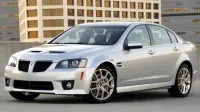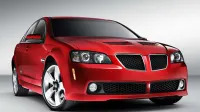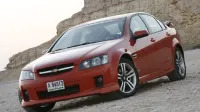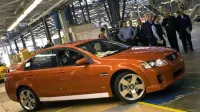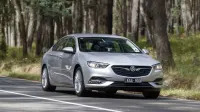
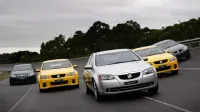
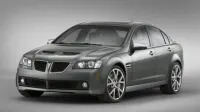
General Motors has been the perpetrator of several fortunate and unfortunate badge engineering jobs over the years, and the G8 -- based off the Holden Commodore -- is the most recent example. The Aussie sedan was partially developed with American sales in mind and because of that, it doesn't take much to give your spiffy new G8 a nose job inspired by the Land Down Under. Australian firm JHP Vehicle Enhancements will sell you an entire body kit to change your G8 into a Holden for a mere, um, $4,000 if you choose to go all out in an attempt to replicate the HSV model. That's a sizable chunk of change, but beauty is in the eye of the beholder. Since we're less concerned with appearances, we'd just put the extra scratch towards upgrading to the GXP.
Click above for a gallery of the turbocharged APS HSV Commodore.
APS is in the business of making power and that's exactly what they've done for the new Pontiac G8 GT and its Aussie-spec sibling, the Holden Commodore HSV. The tuner's Stealth Intercooled turbocharger setup uses two water-cooled turbos mounted deep into the engine bay, just ahead of the transmission, to ensure underhood temps are kept in check – road debris be damned. According to APS, the system is a straightforward, bolt-in affair, utilizing a right-sized, aluminum, air-to-air intercooler, seven pounds of boost and a pair of TIAL 38mm external wastegates to bleed off exhaust gases and optimize throttle response. While APS hasn't installed the system on a Pontiac G8 GT yet, they've strapped its own blown HSV (with a three-inch cat-back exhaust) onto the rollers of a Dyno Dynamics dyno and produced 557 hp and 583 lb.-ft. of torque while running 93-octane. Pricing hasn't been announced yet, but considering how impressed we were with the standard G8 GT, this setup has the potential to redefine the bang-for-the-buck quotient in the segment.
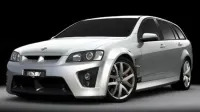
Like the sedan and ute before it, the Holden Commodore Sportwagon will also soon have a corresponding HSV performance variant. The HSV Tourer is essentially an HSV Clubsport R8 Wagon, as it features the muscle sedan's front clip and 425-horsepower (317kW) LS3 V8 powertrain. Look for it to arrive arrive in Australia this October and in the U.S. as a Pontiac, well, never. (Pontiac has no plans to bring over the Commodore Sportwagon, remember.)
HSV admits that the Tourer could take some sales away from the Clubsport R8 upon which it's based, but that the presence of the wagon in the now-complete HSV lineup should still help HSV's sales numbers overall. Drive.com.au notes that the Commodore Sportwagon was supposed to launch back in March, but has been delayed while Holden continues to work out kinks with the wagon bodystyle. We expect to get plenty more info on the HSV Tourer closer to its launch, but today, we're more bummed than ever that Pontiac isn't importing the Commodore Sportwagon. Imagine what the possibilities could have been... Pontiac G8 Safari GXP? Not bad. And unfortunately, not gonna happen.
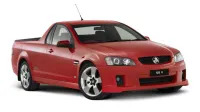
For those of you interested in picking up one of the new Pontiac G8 ST utes when they come to the US next year there's good news. In a recent round of ute/pickup crash testing in Australia, the Holden Commodore Ute beat all comers to score five stars. No competitor matched the lofty score. The Ford Ranger-based Mazda BT50 got three stars while the Indian Mahindra pickup only managed two. The Mahindra currently doesn't have airbags, which hurt its scores. Look for that to change before Mahindra launches its trucks and SUVs in the US a couple of years from now. For the time being, however, if you plan on driving into any barriers, you'll want to go for the El Camino wannabe.
UPDATE: Enough already! Yes my NyQuil hazed brain still isn't working quite right as I try to recover from this flu I've been battling all week. I did indeed mis-read the story. The Holden/Pontiac Ute only got 4 stars. On to other topics of discussion.
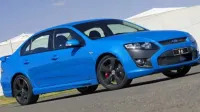
Holden and Ford have been fighting the battle of Commodore vs. Falcon for many years, and with the recent announcement of the new Falcon range, the war has heated up. Holden's very competent Holden line has been given quite a jolt in anticipation of the Falcon's release, with many offerings trumping Ford's recently introduced Falcon models.
The Commodore will now feature standard side curtain airbags across the model range, as opposed to only two of eight Falcon models having the safety tech standard. The Commodore's side air bags will also protect both first and second row passengers, as opposed to only the front row in the Falcon. Holden also held the price of the upcoming Commodore wagon to within $1,000 of the sedan's price, where before it was an extra $3,000, and air conditioning is now standard on all models. Pricing for the eight Falcon models has yet to be announced, so Ford still has a chance to retaliate.
It appears that the battle rages on for RWD superiority in the land of OZ, and if we're lucky Ford will bring the Falcon Stateside to battle the Pontiac G8 on our turf.
Since the G8 was unveiled at the Chicago Auto Show, there has been an air of optimism for the Pontiac brand. There's good reason for the uptick in serotonin, too, as the G8 is a real live RWD sedan from the General. It doesn't hurt that its 6.0L V8 can kick out 362 HP and hit 60 mph in 5.3 seconds. It may seem as though the G8 unveiling was a million years ago, but production has finally begun for the Holden Commodore-based sedan. The G8 and the Commodore will be built in the same Australian plant, with the facility running at full steam to a tune of 620 units per day. About half of that number will make its way outside of OZ, split between Chevrolet (Middle East), Vauxhall (UK), Daewoo (Korea), and Pontiac. That probably doesn't make room for more than 50,000 G8s a year here in the States, and in the unlikely event the sports sedan isn't a hit, GM can shift sales anywhere else in the world. The G8 will hit dealer showrooms sometime in the 1st quarter of 2008, and we're eagerly anticipating taking a spin in the most exciting Pontiac in a generation.
You'd think after looking at it that the Holden VE Sportwagon was one of those no-brainer vehicles that was a production lock from the moment it was a twinkle in some designer's eye. According to GoAuto, that wasn't exactly the case. The outgoing VZ wagon was a fleet darling, beloved for its exceptional cargo capacity. That added space came courtesy of the same LWB architecture used for the Caprice and Statesman sedans. In a departure from tradition (the wagons had been built on long-wheelbase platforms for decades), the VE proposal was based on the shorter underpinnings used for the Commodore sedan. With that comes reduced capacity and a total package that's less attractive to fleets. After ultimately seeing a clay model of the car presented in Sydney, Holden execs greenlit the project anyway.
And that's where we, the US and Canada, come in. One of the factors that pushed the VE wagon into production was its obvious export appeal. No agreements or contracts are in place, but according to GoAuto, Holden sees exports of 10,000 per year as being the goal, and North America the biggest target market outside of Australia and new Zealand. Meanwhile, Holden feels it can mitigate the expected downturn in fleet sales at home by leveraging the VE's great looks and sporty practicality to sell more profitable examples to consumers, especially ones looking to get out of SUVs. Assuming the stars line up and the car comes over to the US as hoped, it would be after the arrival of the Ute, which appears to be next in line according to the GoAuto piece. There's a lot more to the article, which is interesting, wide-ranging, and worth a read. As for the VE Wagon, well, this Autoblogger's all for it. It's a hell of a lot cooler than the '87 Pontiac Safari my parents had, and that I learned to drive in. Let's leave the wood stickers off this one, though, okay?
The relationship between Holden and the late Peter Brock goes back nearly forty years, and a good part of that time saw the Aussie racing legend compete behind the wheel of a Commodore sedan. During his illustrious career, Brock's leadership of the Holden Dealer Team (HDT) racing outfit also saw several modified high-performance roadgoing Commodores hit the market before the group was disbanded in the late '80s.
Now, the owner of one of the largest collection of Brock Commodores in Australia plans to revive the HDT nameplate in Brock's honor. Queensland mining contractor Peter Champion currently owns over 40 Brock Commodores and now wants to build the kind of car Peter Brock would have built today using the latest VE Commodore. Champion and Brock had been friends for over a decade and even talked about releasing a new model months before his untimely death in a car crash during a race last September.
The new cars will likely be based on the VE SS, the same car on which the upcoming Pontiac G8 is based. The cars won't have any mechanical modifications, although it will be offered if customers seek it, says Champion. Instead, the new HDT cars will receive bodykits and wheels designed to match the original racing Commodores from Brock's era.
Mike Levine at PickupTruck.com is speculating that there's a good chance the El Camino name will be revived in the near future. The prospects just seem too good considering that Holden, GM's Australian division, is set to soon export the Zeta rear-wheel-drive platform to the U.S. for use in the Chevy Camaro and Pontiac G8. More vehicles are likely, and the El Camino could be among them. Bob Lutz himself has reportedly talked up the business case for an El Camino comeback, and the timing could be right for an Australian Ute to finally make the long trip from Oz to American shores.
PickupTruck.com has a few renderings showing what the El Camino could look like, which isn't hard to guess considering that the new VE Commodore-based Utes are set to debut in Australia in about a month. From the A-pillars forward it would look much like the sedan on which it's based, but all body panels aft of that point will be unique to the Ute. The Australian version will have an engine lineup of V6 and V8 engines, and we suspect that concerns over fuel economy would also necessitate a V6 option for the U.S. market. That's fine, as the General's current crop of V6 engines are smooth and powerful. Of course, it wouldn't be a proper El Camino without the availability of a V8, and we know GM has a few of those lying around.
What do you think? Would there be any takers for a new El Camino in the U.S.? We think the answer is obvious, as this truck wouldn't be an SSR redux. Click on the read link to view three renderings of what a 2011 Chevy El Camino might look like and let us know your thoughts in the comments.
At the launch of the VE Commodore in July last year, Holden management were quick to point out that more than a billion Aussie dollars were sunk into developing GM's new global RWD architecture, and that thousands of miles of testing were conducted for the latest version of Australia's most popular car.
Holden is now on the back foot following the four-star crash test rating its VE scored in last week's Australasian New Car Assessment Program (ANCAP), the local equivalent of the Euro NCAP and America's NHTSA crash test ratings. The latest result means the all-new Commodore is no safer than the previous VY model released back in May 2003. Worse still, in some cases, such as the offset impact test, the new VE was rated less safe than the previous car.
Holden's official response is that the ANCAP doesn't represent real-world conditions, and that 80 cars were crash-tested during the VE's development in addition to more than 5,000 computer-simulated barrier tests. When questioned about the poor result by Australia's GoAuto, Holden chairman Denny Mooney could only respond that he didn't have the test data in front of him. Remember, this is the same platform that GM's RWD ambitions are riding on. It's the same basic structure that will spawn a host of new models including the Camaro and Impala, and the car is already coming to the US as the Pontiac G8, so there's a great deal riding on it.