
Filed under: Safety, Tech, Acura, Audi, BMW, Mitsubishi
Torque Vectoring: The future of AWD
The F-16 is inherently unstable and cannot fly without computerized nannies to keep it aloft. As AWD systems in cars get more complex and can do more things more quickly, one wonders if there will come a time when we'll be absolutely unable to drive without gizmos to make sure rubber stays on road. Torque vectoring is the next step in AWD, its contribution being that it can get power to any wheel nearly instantly without having to use the brakes or cut power.
Most current AWD control wheelspin by braking a spinning wheel or cutting the power from the engine. Torque vectoring is achieved by using redesigned differentials that can distribute power to the wheel or wheels that have traction. That means that wheels don't need to be stopped, and even better, you won't suffer from a sudden loss of power as you're negotiating an unexpected loss in traction. The systems in use now or being developed work on FWD, RWD, and AWD cars, and can get power to any wheel or combination of wheels. Ricardo's system can do so in a tenth of a second.
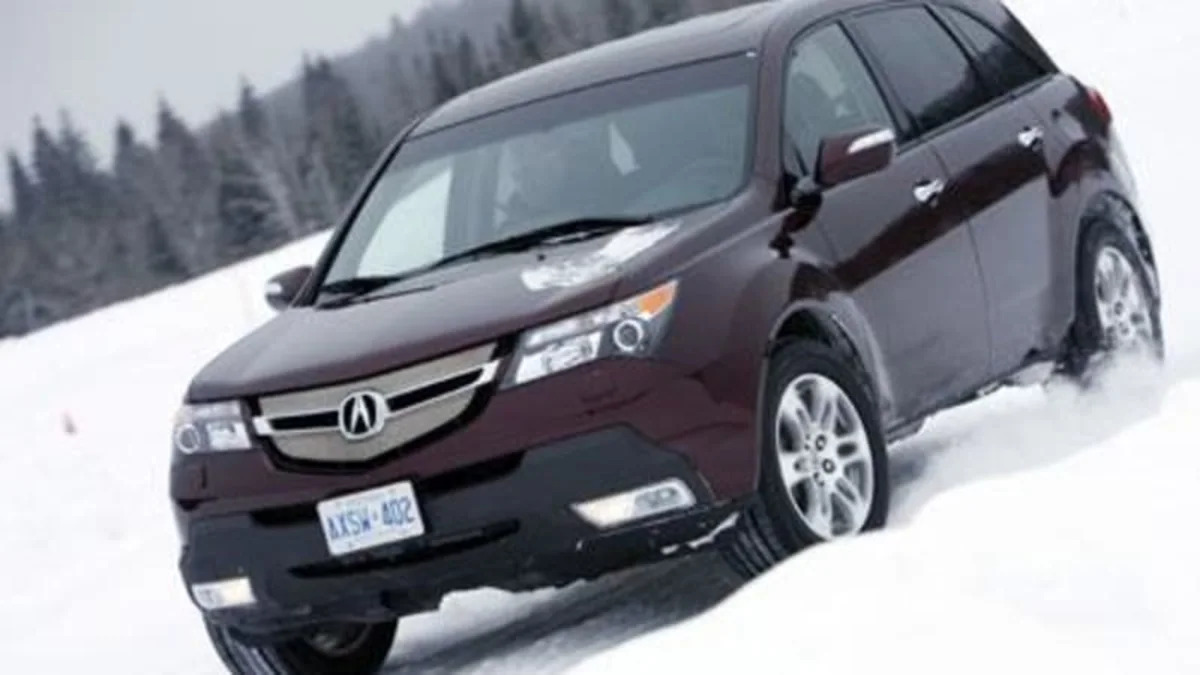
We drove Acuras with SH-AWD (Super Handling All Wheel Drive) earlier this year on an ice track in Montreal, and the difference is remarkable. Where other SUV's stopped in the middle of an icy corner either due to braking or power loss, the Acuras maintained their lines almost at speed. Mitsubishi has used the technology for almost a decade now on its Lancer Evolutions, and Audi and BMW will be joining the party later this year with new systems from Ricardo and ZF.
[Source: Popular Mechanics]

Reader Comments (Page 1 of 2)
John R 11:28AM (10/14/2007)
EVO AYC FTW!
Reply
the law 11:35AM (10/14/2007)
Saab already has this XWD.
Reply
MikeW 1:58PM (10/14/2007)
No it does not.
Saab XWD (cross wheel drive) is nothing but the latest Haldex coupled rear axle system (generation 4) plus an 'eLSD' which is just a computer controlling a lock up clutch pack on the rear differential. There isn't any shuffling, only adjustable yaw damping by locking/unlocking the rear differential. That is all.
There isn't any reason all the haldex implementations can't have this (other than maybe some contractual stipulation) The new Golf R36 comes to mind, or the Volvo S80 T6.
Gardiner Westbound 12:04PM (10/14/2007)
That's odd. A road tester who had the opposite experience with an Acura MDX wrote a very unflattering report about its abilities in snow.
http://www.theglobeandmail.com/servlet/story/RTGAM.20061206.wh-mdx07/BNStory/Business/
Reply
Ducky 1:50PM (10/14/2007)
Gardiner Westbound, I'm very familiar with your comments on the globe and I'm surprised to see you here. That being said, there were TWO articles on the globe; one from a freelance journalist and one from a regular columnist. It probably confused people that one praised the AWD system and one did not, although it appears that SH-AWD will help you through icy corners and such, it doesn't help you if you're trapped in like a meter of snow (no system will)
MikeW 2:41PM (10/14/2007)
It is probably a conflux of factors.
Honda used to sell the old MDX with the winter tire size 235/65 17, and the weight was about 100lbs lighter (and there was room for 255/60 17, which would have help out handling)
The current MDX has 255/55 18, and Honda has optional 275/45 19s. So the winter tire size should be 235/60 18.
Also Honda make you use the manumatic to get 2nd gear starts (did the author do that?), instead of the selector. And Honda has decided that the drivetrain LOCK button is now superfluous (yeah, thanks)
scenturion 12:18PM (10/14/2007)
wait, im confused. i thought the torsen system in audis already did this. its a purely mechanical system that shifts the torque to the wheels that arent spinning freely.
the traction control that brakes loose wheels is an entirely different, yet complimentary, system
Reply
Arthur 11:41PM (10/14/2007)
Audi does not do this. They have a clever mechanical setup that assures that all 4 wheels are being driven symmetrically. Subaru does this too, but with viscous type limited slip differentials. Pretty much everyone else, BMW including, uses something licensed from or based on the Haldex system, which is poohpoohed by AWD fanatics as not being "true" AWD, because of the forementioned loss of power that happens when the vehicle enters a slippery bit.
The drawback to the Audi/Subaru strategy is that it really *is* true 4x4 and that sort of thing eats up a *lot* of fuel.
James Sonne 12:28PM (10/14/2007)
I swear I read this same exact thing in a Road&Track Ampersand article not too long ago, but their website is too difficult to sort through. The F-16 "computer nannies" and all ... Could be wrong, though ... anyone else?
Reply
scenturion 12:33PM (10/14/2007)
wait, my mistake. the latest iteration of quattro uses a center torsen differential, and front and rear electronic differentials, which is where the braking of loose wheels come in.
Reply
szemy 12:34PM (10/14/2007)
Torsen differential do this whitout delay. They are mechanical parts not electrical, so they don't do any computation. Audi is the oldest using these, but there are sure others too.
Reply
Dustin 3:09PM (10/14/2007)
Audi's Torsen differential only varies drive torque between the front and rear axles. Acura's system varies torque between the front and rear as well as side to side on the rear wheels.
why not the LS2LS7? 1:13PM (10/14/2007)
Jeep Quadra-Drive (1999-2004) could vector power to or away from any wheel.
http://en.wikipedia.org/wiki/Quadra-Trac
Also, the Nissan Skyline GT-R V-Specs of the past did this too.
And to be honest, Acura's SH-AWD is a rather inflexible system, it has no center diff, so it can't really send torque any which way it wants.
In practice though, many systems like AH-AWD (and even less complex ones like the Haldex AWD in VW/Audi products) work very well on the road, being capable of everything that is asked of them in nearly all situations. And these systems save a lot of weight and thus save fuel and increase performance in situations where grip isn't at a premium.
To be honest, besting most SUV systems isn't difficult. They typically use a system of all open-diffs in high-grip conditions (which is fine), but in low-grip conditions they lock the center diff. This ensures that you always have some grip, because the front and rear axles will both get power. But in a turn, where all 4 wheels want to run at different speeds, the center lock will cause at least one wheel to slip. You can feel an SUV in 4-hi (lock) loosen up in turns on snow and ice.
Reply
MikeW 1:51PM (10/14/2007)
No only is there no center differential in the (synthetic handling 'awd'), there isn't a rear differential.
Honda tried this torque vectoring with the Prelude SH. Car and Driver was quicker around a race track without the system activated (pulled the fuse).
The bad thing about the old quadra-drive (nvg247 + f/r gerodisc differentials) was there wasn't a center differential. Jeep should have offered the gerodisc differentials (Vari-Lok in marketing speak) with the nvg242 transfer case. The nvg247 was an improvment over the nvg249, in that the responsiveness of the gerotor coupling was more direct (linear) than a viscous coupling. Also the later nvg249 transfer cases had the low range lock that the earlier models forgot (ooops!)
Sean Flanagan 3:07PM (10/14/2007)
So you're positing that there is no center diff in a drivetrain that sends power to 4 wheels, and the reply is that there's no rear diff? I think a little "Introduction to Drivetrains" is in order here... Every driven axle of every car needs a differential. If it's a 4WD or AWD system, it needs a center differential as well. Otherwise, at least one of the driven wheels will turning either too fast or too slow for its position along the curve. In the case of the SH-AWD system, the center diff and rear diff are contained in one unit in the place where a traditional rear diff would be located. This one housing manages the torque fore-aft and side-to-side on the rear axle. The torque vectoring discussed in this post describes the side-to-side management of the SH-AWD system, something that is beginning to crop up on other AWD systems.
Note that a purely mechanical system is unable to manage the torque in the same way, as the SH-AWD system can send 100% of the rear-biased torque to either rear wheel depending on conditions. A mechanical system would only be able to split the torque 50-50 along the axle (full lock) in slip conditions, so that 50% of the torque is still going to the slipping wheel. Torque vectoring allows 0% of the torque to go to the slipping wheel, and 100% to the wheel with traction, so there is no inefficiency getting the power to the ground.
why not the LS2LS7? 4:22PM (10/14/2007)
It's impossible to put a true center diff where Honda puts it. This is because a center diff has one power input and two power outputs, one going fore and one going aft. This is because the center diff is going to apportion the power, and so it needs to be able to adjust torque/power to both front and back.
Where the SH-AWD "center diff" is, is after the power has already been split front and rear. Thus, the mechanism in this location is unable to redirect power from the back to the front and thus it isn't a center diff at all.
SH-AWD is a full-time FWD system with PTO to the rears, much like the VW/Audi Haldex system or the Volvo system. By connecting the PTO, you drive the rear wheels, and by disconnecting it, it reverts to FWD.
These systems have a basic limitation, which is power cannot be removed from the front wheels. This means the fronts are always being pushed at least as much as the rears, and thus you cannot put torque just anywhere you want it.
In road situations though, the fronts are going as fast as the rears anyway or even faster (in turns). So by driving the rears the same speed as the fronts, you put some power to the rears, or in turns since the fronts aren't being driven as fast as they would naturally roll, the rears are doing more of the work than the front, and the car feels like it's being pushed like an RWD car.
SH-AWD one ups this slightly, by putting in a planetary gear set at the rear which can increase the speed the rear wheels are being driven at. This causes the same effect in a straight line as happens in a turn, that is the fronts aren't being driven as fast as they are rolling (due to the road) and the car takes on some RWD characteristics.
But, in reality, the power distribution options are limited and you could create situations in low-traction situations where the SH-AWD system cannot do what would be best for the situation.
SH-AWD also has a system that allows the power to be distributed left to right across the rear wheels, much like a limited slip diff can do (or a Torsen).
On road, you just don't encounter a lot of situations even a basic full-time FWD+part-time AWD can't handle anyway.
Sean - the AWD system used in the Aztek and the Buick Rendezvous has no rear diff. No, you can't get away with just a bevel gear either. But this system (and some like it) just either drive both wheels at the same speed, or don't drive them at all. It's a pretty good simplification given that you only are going to drive the rears in a low-traction situation anyway.
All this stuff is just monstrously complex, given that it rarely comes into play. And if you are in snow or in ice, your best best is to slow down anyway, because AWD doesn't make your brakes better. If you don't use it right, AWD can instead just turn into something that gets you into the ditch faster. I and many others have seen this in action a lot. After a big snow, SUVs are always the first to end up in the ditches.
pgh 2:12PM (10/14/2007)
The F-16 is not "inherently unstable". The F-16's claim to fame is that it is the first fighter to employ fly-by-wire which is computer-controlled electrical actuation of the flight-control systems. Fly-by-wire is a requirement of unstable designs, but having fly-by-wire does not mean that an aircraft is inherently unstable. Fly-by-wire provides many benefits such as weight savings, faster control response and reduced maintenance over conventional hydraulic control systems.
The first unstable design to fly successfully was the X-29 forward-swept-wing experimental aircraft. It came after the F-16 entered service.
Reply
Seminole 4:27PM (10/14/2007)
I think they meant the F-117 stealth fighter.
The F-16 Falcon is a traditional shaped fighter and has no problems, but the F-117 (and B2), due to all its angles and strange surfaces would be impossible to fly without the computers.
danms6 9:10AM (10/15/2007)
Correction. All modern fighter jets (including the F-16) are inherently aerodynamically unstable. The fly-by-wire computer systems are what provide stability while in cruise and during maneuvers.
the law 2:22PM (10/14/2007)
help me out here...
what are the main differences between this AH-AWD and say Saab's XWD?
AH-AWD is mechanical and XWD is Electrical; which will be better than cars go hybird or electric.
Which is better for winter conditions?
Reply