
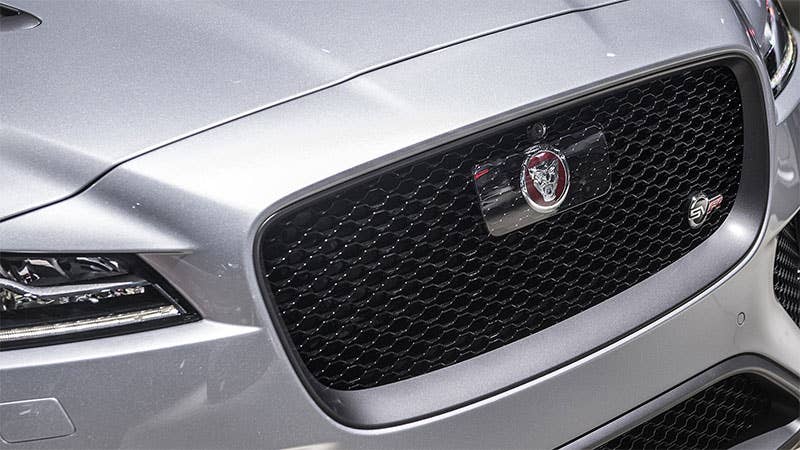
We’ve been talking about a
Jaguar J-Pace crossover for four years. In 2016, the large luxury SUV version of the
XJ sedan was expected to arrive this year and challenge the
Audi Q8,
BMW X7, and
Mercedes GLS. More recent information from
Autocar put the J-Pace’s length at roughly 4.9 meters (193 inches), putting the English offering in a bracket with the
Mercedes-Benz GLE and the
Porsche Cayenne. Dynamics will be the priority, with the J-Pace intended
to “beat the Porsche Cayenne at its own game.”
The
Jaguar will supposedly do this with a novel hybrid powertrain arrangement on the launch vehicle. The new Ingenium turbocharged inline-six, expected to be the “mainstream” engine, will turn the front wheels, the rear axle turned by an electric motor. That setup will provide more interior room thanks to the lack of a center tunnel, as well as finer control of torque to the rear wheels for better bad-weather and soft-roading character.
Autocar said electric and four-cylinder versions were possible although not confirmed. The magazine said traditional gasoline and diesel versions without the electric motor out back would likely come only in two-wheel drive. However, not only is the phrase “front-wheel drive Jaguar” a terrifically un-sexy string of words, but the
Modular Longitudinal Architecture (MLA) platform has supposedly been developed for rear-wheel- and all-wheel-drive cars. The Premium Transverse Architecture (PTA), an evolution of the aged D8 platform, supports the
Range Rover Evoque, but all JLR products are planned
to migrate to the MLA by 2025.
The MLA will come in high-rise, mid-height, and low-rise versions. Products like the coming
Range Rover and
Defender will utilize the high-rise version. The J-Pace will use the mid-height MLA, along with the rumored Road Rover. The Jaguar F-Pace and
Range Rover Velar take the low-rise PLA. These tiers would put a J-Pace roofline beneath the six-foot-two-inch-tall Range Rover and make for a sleeker appearance.
Autocar also says that the J-Pace will have more luggage capacity than the Range Rover, quite the trick since the Jaguar won’t be as tall and will be around six inches shorter.
If it arrives in 2021, the shape could define the next stage in Jaguar design; the next-generation F-Pace has been predicted for 2022, so it could fall into line established by the big brother. Predicted pricing will put it well above the I-Pace, somewhere in the £70,000 to £80,000 range (around $90,000-$105,000), leaving healthy room between the all-electric crossover below and the base Range Rover above.