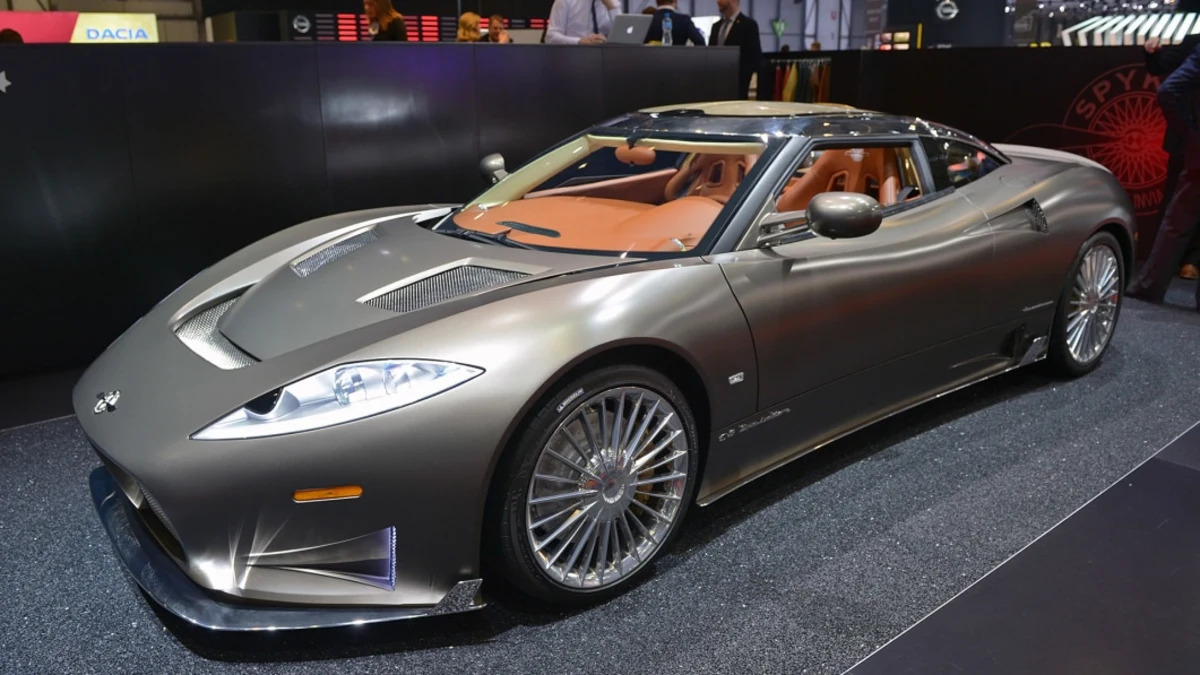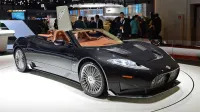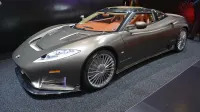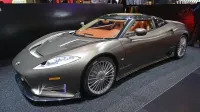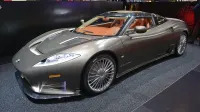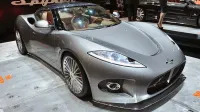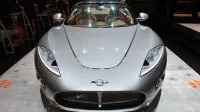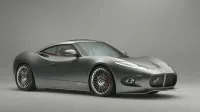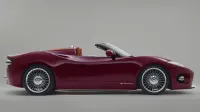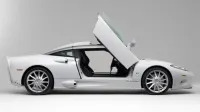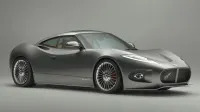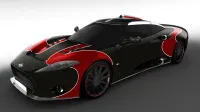
Click above for a high-res gallery of the Spyker C8 Aileron.
Lotus and Spyker have worked together on a variety of projects over the past four years, but today, they've announced a new partnership that will further solidify both automaker's technical and design prowess. As its name would imply, the "Parts and Platform Commonality Agreement" involves Lotus supplying both elements to Spyker, helping to build the Dutch supercar producer's new C8 Aileron and possible the D12 Peking-to-Paris SSUV. According to AutoCar, that could mean that future Spyker's could be based of the Lotus Esprit and that Lotus will increase its stake in the development of Spyker's cars.
Click above to view high-res gallery of the Spyker C8 Aileron
For such a small manufacturer of specialty vehicles, Spyker hemorrhaged a huge amount of money last year; 72.075 million euros ($113.07 million at current exchange rates), to be exact. Part of this loss was due to the sale of its Formula 1 operations, but their car-selling business managed to cost them a few million more. Money was so tight that the Dutch supercar company only managed to assemble 26 cars last year -- only two in the final quarter, despite the waiting list for their wares.
Good news is on the horizon, though, as Spyker has received a cash-infusion from Snoras Group, a Lithuanian bank (and now the largest shareholder in the company), and is again up-to-speed on automobile production. The long-wheelbase C8 Aileron, along with its new automatic transmission, is scheduled to go on sale in the third quarter of this year, while their D8 Peking-to-Paris will follow in 2009. Additionally, their racing team, Spyker Squadron, will continue its GT aspirations, though Formula 1 has obviously been abandoned. So, Spyker fans, look forward to a less-tumultuous year in 2008... we're pretty sure that it couldn't be any worse than the last.
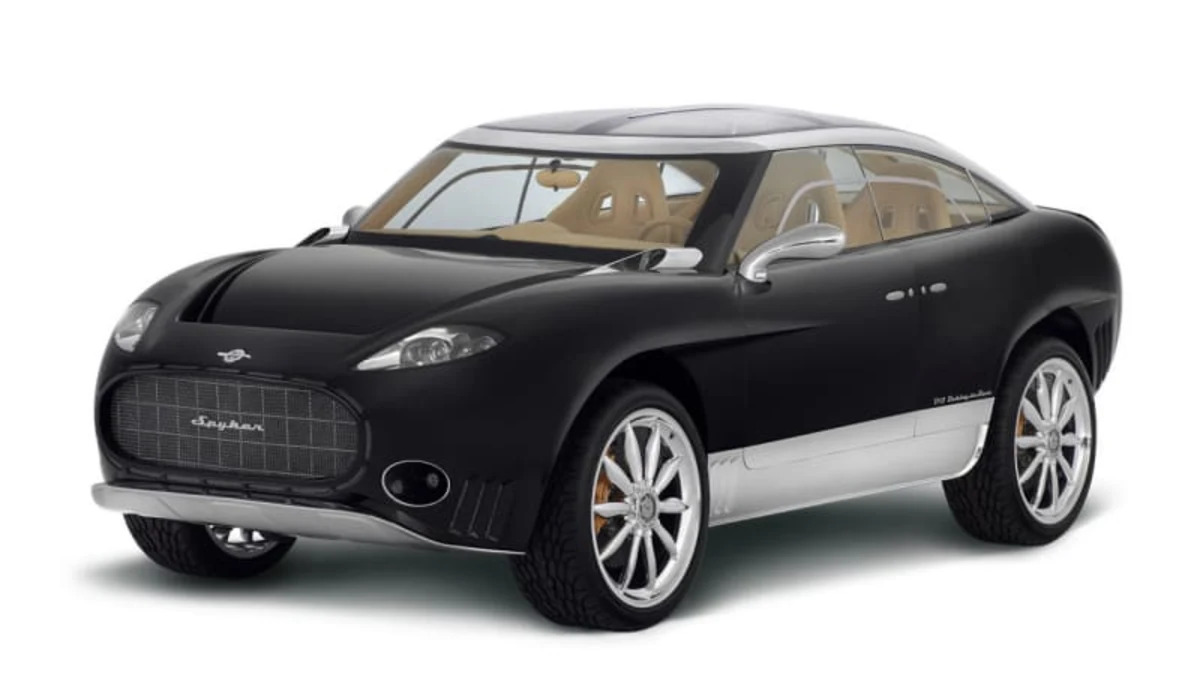
click above to view the pre-production D12 at the 2007 Geneva show
Like one of their exotics sitting impatiently on your driveway, Spyker isn't content sitting still, so the bean-counters will just have to keep up. Despite deep financial woes troubling the company, Spyker is forging ahead with new models. Following the announcement that the new long-wheelbase version of the C8 Laviolette would be hitting the show stand at Geneva, Spyker has reportedly confirmed that the radical D12 Peking-to-Paris SSUV, possibly with American muscle, will in fact begin production next year. This confirmation, however, has only been reported by one website that doesn't cite its source and claims the news comes from an investors conference at which Victor Muller, the President of Spyker's management board, made the announcement. Unfortunately, we could find no other evidence that Spyker itself has confirmed the D12 is headed into production.
The production of the exotic sport-ute would be part of Spyker's plan to expand into emerging markets in Eastern Europe where performance SUVs are valued most among the growing upper class. Meanwhile, because half of its sales are in the United States, Spyker is also forced to cave in to demand for an automatic transmission in the C8, which is also reportedly confirmed for the fall.
The current standard-wheelbase Spyker C8 Laviolette
Spyker may be down, but it's not out. The Dutch exotic automaker has fallen on some hard times, but that's not going to stop it from moving forward with at least some of its plans. The C12 Zagato has been postponed indefinitely, but at the upcoming Geneva auto show in March, Spyker is expected to unveil an improved version of its existing C8 Laviolette.
As wonderfully quirky as the current C8 is, owners complain of constricted space. In response Spyker has stretched the wheelbase, giving more space in the cabin while improving the vehicles proportions. The C8 Laviolette LWB will feature an elongated version of the current model's glass roofline. A long wheelbase Spyder version is expected to follow sometime thereafter, benefiting from a proper motorized convertible roof instead of the largely useless folding rag on the current short-wheelbase model. It's a small step forward for the ailing company, but a step forward nonetheless.
Follow the jump for a video rendering of the upcoming C8 Spyder LWB doin' the turntable thing.
Good news all you power-hungry Spyker fans. Rumors are flying that the newly revived Dutch company is re-thinking the powerplants in its new C12 Zagato and D12 SUV. Instead of using VW's 6.0-liter W12, Spyker may be looking to U.S. manufacturers for its engines.
Three reasons could be driving the company to go American. One is purely financial. With the Euro worth about $1.50 right now, U.S. engines would be much cheaper than German ones. The second reason is output. VW is expected to end production of their W12 soon, and Spyker doesn't want to get caught with nothing under their hoods. The third reason is, again, output. Spyker's CEO Victor Muller has said the Audi V8 his company had once planned for use in the D12 SUV just isn't powerful enough with "only" 400 hp.
So what engines would be appropriate for Spyker? "Beleggers Belangen" quotes Muller as saying, "Look at the block in the General Motors Corvette: thick 500 hp.And from the V10 Dodge Viper: over 600 hp."
Dear Santa: We've been really good this year, but if you bring us a Viper-powered, Dutch-designed supercar with 600 hp we can't make any promises for next year.
Never content to go quietly into the night, however, Spyker is on a campaign to raise funds. The latest endeavor has been to court European investors, but negotiations with Lichtenstein-based ACI recently fell through after an initial agreement was signed.
According to reports, Spyker is now in negotiations with Snoras Group, a Lithuanian bank, to fund and potentially acquire stake in the Dutch automaker. Spyker says it has a few other possibilities on tap, and hopefully one of them will come through to rescue the company and its beautifully quirky automobiles.
Some of Spyker's financial woes may be in the process of being resolved, with the news that several investment firms are currently in talks with the ailing Dutch supercar manufacturer. A group of private investors known as ACI Ltd. have already signed a letter of intent with Spyker, causing stock prices to increase by almost 60-percent. Although rumors are swirling that another firm might buy up a majority stake in the automaker, Hans Hugenholtz, the interim CEO of Spyker, said that ACI's stake "won't exceed 30-percent."
Spyker was looking like a bright young protégé for a while. It had some great ideas, a beautiful vision for the future and unstoppable ambition. Then it finished school and stepped out in the real world, ran out of money, had to cancel some of its more expensive plans, take some less glamorous jobs, sell off some of its assets, take a new direction, and hunker down to the realities of running a small operation with limited resources. Fortunately for the Dutch niche automaker, a group of students has seen eye-to-eye with its situation and have offered a helping hand in the form of this intriguing concept.
The C69 design study is (theoretically) equipped with two hybrid V6 engines (front and back) and bodywork straight out of Michael Bay's mind: one door scissors forward, the other rearward, and the front and rear shells tilt outwards. It's a slick little package, but we doubt Skyker would build it...at least not before paying off its student loans.
Check out the dramatic video after the jump for extra credits, and have your student ID number ready.
Following the sale of Spyker F1 (again), the new owners have announced the team's new name: Force India. Indian investor Vijay Mallya got together with former Spyker Cars CEO Michiel Mol to buy the team from the financially-troubled niche sportscar manufacturer, which it now seems had no business in F1 to begin with. Spyker itself had acquired the team from Midland, who in turn had purchased it from Jordan, changing the name and image with each new owner.
Mallya aims to use his new team to raise India's image abroad in an apparent confusion between Formula One and the A1GP World Cup of Motorsport, which is made up of national teams. The team's logo is anticipated to include the Indian flag, and will probably look like the one on Mallya's hat (at right).
After losing 13m euros in the first half on 2007 and making limited progress in this season's championship bout, Spyker has finally decided to offload its F1 team to a consortium of Indian investors. Orange India Holdings, headed by Vijay Mallya, chairman of the UB Group, purchased the company for 88m euro -- 14m euros more than Spyker initially paid for the team last year.
Rumor has it that with Mallya heading up the team, Narain Karthikeyan, an Indian test driver for Williams, may take the helm of the newly founded F1 team next season. Something that would really draw out the crowds if India hosts a race in 2009.