

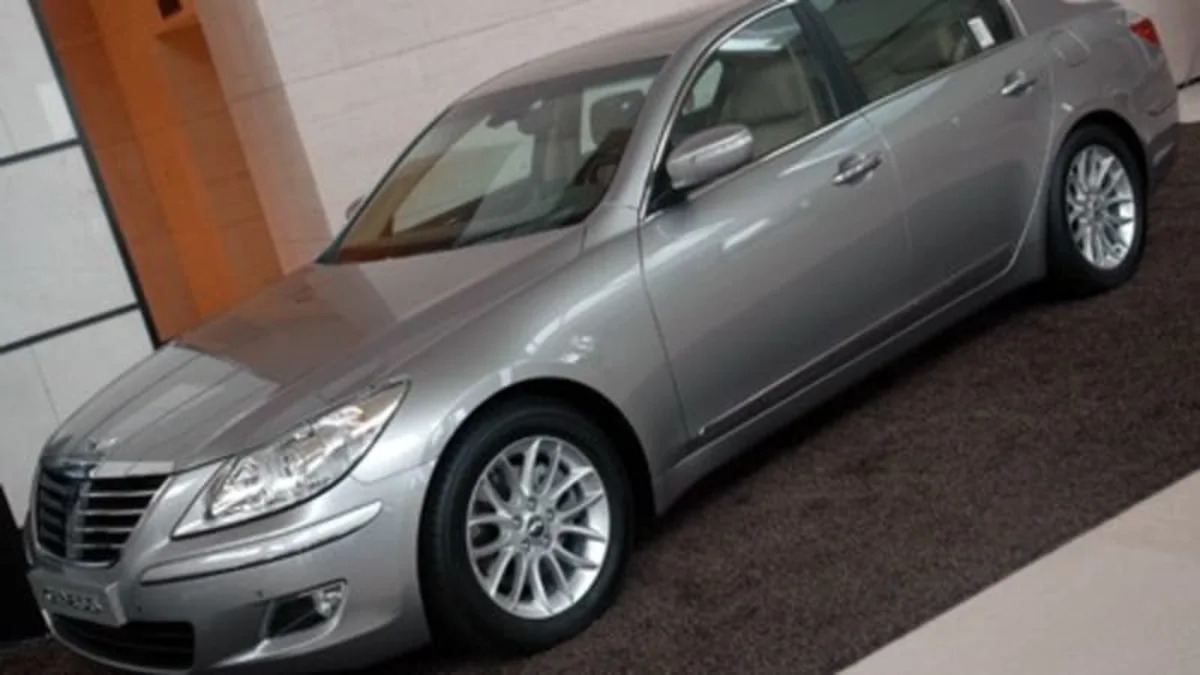
Click above for hi-res gallery of the Hyundai Genesis
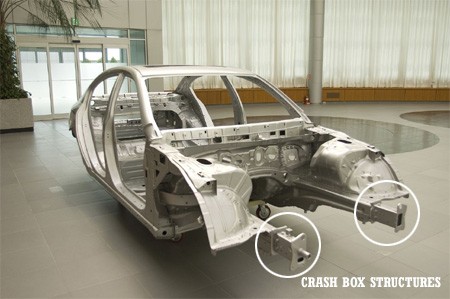
The story of what's underneath -- and inside -- the Hyundai Genesis is central to the story of the car and what Hyundai's trying to do with it. The body-in-white of the Genesis has a larger total body area than the Lexus LS460 and Mercedes S-Class. Yet ten years ago, if we had asked you which carmaker would create a rear-wheel-drive V8 sedan with a body structure that is larger, yet stiffer and lighter than the 5-Series or E-Class, would you have guessed it would be Hyundai?
Of course, you probably wouldn't have guessed that BMW would be selling all the MINIs it could make, or that Alfa Romeo would sell out a run of $200K supercars. The lesson: the games -- plural -- have changed for everyone. Follow the jump to find out how the Genesis is the spearhead of change for Hyundai and, if Hyundai gets its wish, the entire luxury segment. And be sure to check out the gallery of hi-res images below.
The story of what's underneath -- and inside -- the Hyundai Genesis is central to the story of the car and what Hyundai's trying to do with it. The body-in-white of the Genesis has a larger total body area than the Lexus LS460 and Mercedes S-Class. Yet ten years ago, if we had asked you which carmaker would create a rear-wheel-drive V8 sedan with a body structure that is larger, yet stiffer and lighter than the 5-Series or E-Class, would you have guessed it would be Hyundai?
Of course, you probably wouldn't have guessed that BMW would be selling all the MINIs it could make, or that Alfa Romeo would sell out a run of $200K supercars. The lesson: the games -- plural -- have changed for everyone. Follow the jump to find out how the Genesis is the spearhead of change for Hyundai and, if Hyundai gets its wish, the entire luxury segment. And be sure to check out the gallery of hi-res images below.
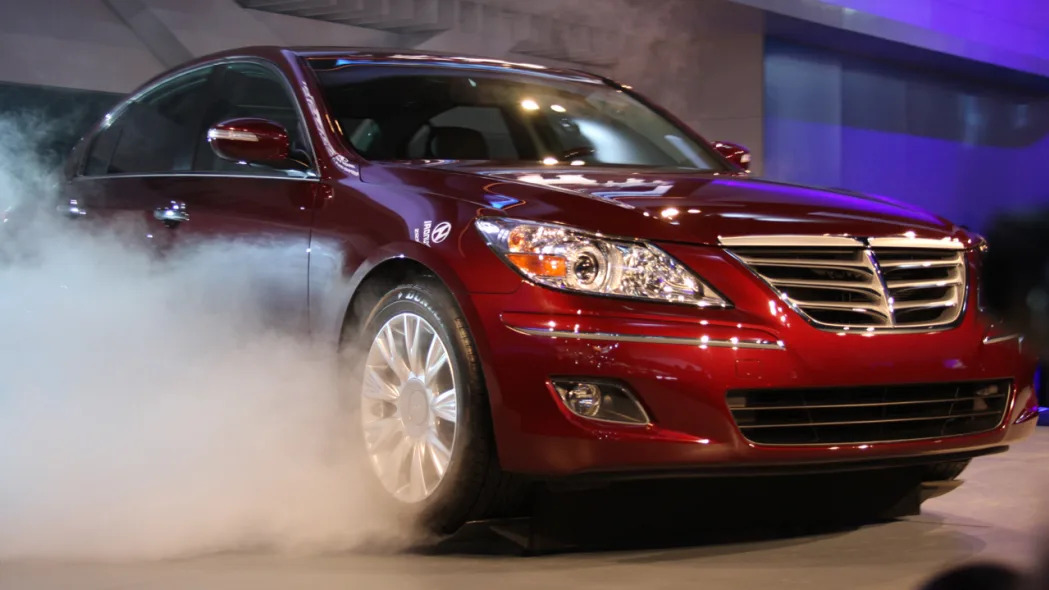
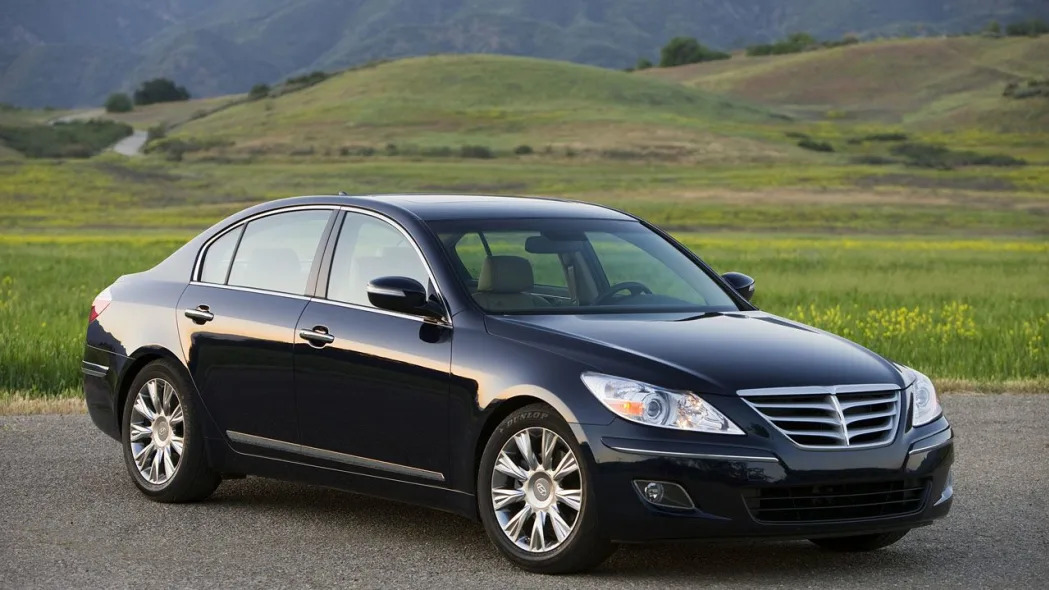
Before we dive inside, we'll start outside with the Genesis' design. We remember seeing the HCD-1 in 1992, and thinking, "Wow, a Hyundai..." The stream of HCDs that followed have had us thinking the same thing -- meanwhile, we saw almost none of their daring on dealer floors. We were showed slides of Genesis concepts during a presentation in Korea, and some were genuinely stunning. When we got the chance to speak briefly to the designer of the HCD-1, our question was why isn't the Genesis a little bit... bolder?
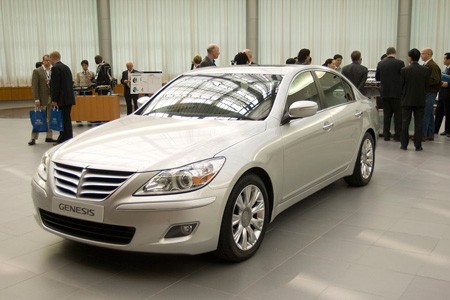
The various answers we got from him and several other designers were that, essentially, the Genesis should be considered a test of the Hyundai Luxury System. They wanted a mainstream design that wasn't extravagant and emphasized proportion, stability and dynamism. Success on all counts. It's a good looking car -- it's simply not memorable. We were, though, told that a more distinct design vocabulary will come. For now, they don't want to crash the party with something that will make people wonder, "Um, who invited that?"
 A discussion of design led naturally to the issue of badging. We really like the winged Genesis badges, and couldn't understand why Hyundai didn't call the thing a Genesis instead of a Hyundai. A few readers have asked the same question, with one commenter nailing it when he wrote, "This is one of the best arguments for a separate brand. I think Hyundai really dropped the ball on this one. A Genesis line (Coupe, Sedan, Veracruz SUV) would make a killing." Hyundai had considered that exact proposition.
There are a number of reasons why they didn't follow through. Hyundai hired an outside consultant to estimate the cost of launching a standalone brand, and the number they quoted was $250 million, with a break-even point 13 years hence. For a company focused on delivering a lot for a little, and not selling cars at a loss, that's a large number to spend in the unscientific arena of penetrating brand consciousness, which is what this would come down to. And we assume that is the necessary number only if the brand succeeds as intended; other standalone brands have spent much more than that to launch in the U.S. and, arguably, still haven't met their objectives.
Beyond hard cash is the softer, marketing-driven reason: Hyundai of America's marketing honcho said "We want to use the Genesis to sell 30,000 more Azeras." When looking for the kind of association that will lead to that kind of sales impact, not creating a separate brand makes sense. A Nissan GT-R can be expected to help shift more 350Zs -- certainly far more than the supposed Infiniti version of the GT-R would.
Hyundai wants you to think of the Genesis as a Hyundai, not a Genesis. Initially, in light of the branding, we didn't realize that -- the banners in Korea all read "Genesis by Hyundai," not "Hyundai Genesis." Once we understood the sales aspect, it made sense. The Genesis will be sold in a special area of a dealer's showroom, described at one point as a "well decorated corner." So it won't be quite like the Maybach, but looking in that direction. Dealers are installing touch-screen kiosks called iTubes that will mirror information onto laptops, and getting copious tours and training on the car.
They'll be rehearsing their lines to talk about some of the 20 new technologies that Hyundai created for the Genesis -- things about which the typical Hyundai buyer isn't used to hearing. They'll also be talking up the segment advantages a buyer would get from what is supposedly a non-premium car. Among Hyundai firsts and segment advantages are:
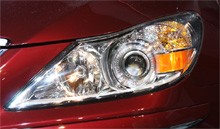
- HID headlights with auto-leveling depending on the load, and Active Front Lighting that swivels with the steering wheel.
- Navigation with a multimedia controller and MOST fiber optic wiring.
- Parking sensors in front and back.
- Rear back-up camera.
- Brake assist and electronic brake distribution.
- Cooled driver's seat.
- ZF 6-speed transmission in the V8.
- Sachs Amplitude Selective Damping (ASD) suspension.
- Acoustic laminated glass (windshield and front side windows).
- Auto windshield defogger with humidity sensor and rain-sensing wipers.
- Highest specific output (HP/liter) V8.
- Iridium double-tipped spark plugs good for the life of the engine.
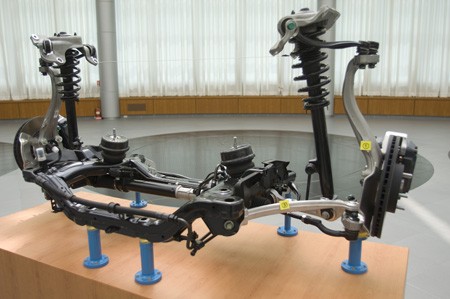
- 5-link suspension with aluminum knuckles, lateral arms, tension arms, and carriers front and rear.
- Electronic active head restraints.
- Proximity entry with electronic pushbutton start.
- Aluminum hood.
- Replaceable "crash box" structures to absorb low-speed impacts and reduce repair costs.
- Roof and side outer panels fused with a continuous laser weld, not spot welding.
- HD radio.
- 500-watt Lexicon LOGIC7 audio system with 17 speakers, a 12-channel digital amplifier, and available 40GB hard drive.
- Three-stage Smart Cruise Control available after a year.
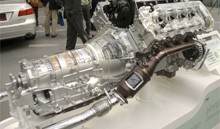
Speaking of that ZF 6-speed, sixth is geared to run laughably low RPMs -- on the test track, the V8 was doing 3,500 RPM at 130 mph.
Otherwise, on the tech front, Hyundai has teamed with Microsoft to work on future car entertainment systems. According to Hyundai, things like voice-controlled connectivity between mobile devices will be available in the U.S. from 2010. The Genesis also has a "cluster ionizer" -- but we didn't press that button for fear it would zap us back to the scene of our parents' courtship.
That's a lot of gadgetry for a Hyundai. Or, Hyundai would probably like you to think that used to be a lot of gadgetry for a Hyundai. Some readers have made much of the troubles Hyundai had with the Excel. Yet if things had really been that thoroughly awful, Hyundai wouldn't be here anymore. Forget about Yugo -- anyone remember Renault, Peugeot, and Fiat?
 During our time in Korea, we got a kick out of the story of Chung Mong-koo, Hyundai's chairman. He headed Hyundai Motors' after-sales service division for 20 years when the company was focused on volume more than quality. When he took over the company, he had long experience with the company's quality problems and knew just what needed to change in order to make better cars.
Are there going to be issues? It's certainly possible, as with any new car. But Hyundai was hitting the top three in J. D. Powers' Initial Quality Survey back in 2006, and you get that five years of bumper-to-bumper protection with 24-hour roadside assistance, and that 10-year / 100,000-mile warranty... and $33,000 for the V6, come on -- it's a great deal on paper and continues Hyundai's tradition of offering more car for less money. In this case, the Genesis is a lot more car.
Other tidbits from our time in K-town:
- The Hyundai Corporation comprises 42 companies, including rolling stock, parts, steel, construction, logistics, finance, R&D, and IT.
- The Hyundai-Kia Automotive Group (HKAG) is the world's #6 automaker.
- Hyundai made its first car, the Pony, in 1967. Before that it built Ford Cortina and Granada kits imported from Europe.
- Hyundai motors has 6 R&D centers. It also has a proving ground that it "cribbed" from another automaker by looking at Google maps.
- Hyundai's Ulsan, Korea factory is the world's biggest by volume, putting out 1.2 million units annually.
- Last year Hyundai sold 1.7 million cars in Korea, 911,000 internationally.
- Iran and Egypt are the largest importers of Hyundais (build kits).
- In 2009 Hyundai will sell an Elantra that runs on LPG in Korea.
- Hyundai plans on having a fuel cell vehicle in production by 2010.
- On creating the Genesis: Hyundai got the idea for it five years ago; designing the body took three years; it cost $500 million to develop and included 23 months of development work; reliability testing ran for 800,000 miles.
- The Tau engine took 100 engineers four years and $260 million to develop.
- Technologies such as direct injection and air suspension were nixed for cost/benefit reasons.
- The Genesis is ULEV II compliant.
- There is no plan for a diesel Genesis in the near future, nor will the Genesis be going to Europe. The car will go to North America, China, and Russia.
- Hyundai is developing paddle shifters, but don't expect them on the sedan any time soon.
- There is no 4-wheel-drive version planned.
- The guide lines on the reversing camera screen don't turn when you turn the steering wheel.
- All workers in the paint, body, assembly, and quality departments of the Genesis factory have at least 19 years of experience.
- HKAG has 7 new vehicles planned for the US by 2010.
- Now that Hyundai and Kia each have their own designers, Hyundai is planned to be modern and refined, Kia will be sport and dynamic.
- In spite of the economic climate, Hyundai plans on adding forty new dealers to its U.S. network.
Our travel and lodging for this media event was provided by the manufacturer.

Sign in to post
Please sign in to leave a comment.
Continue