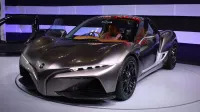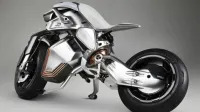
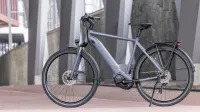
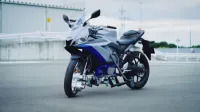
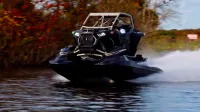

Click on the image to see more renderings of the Deus Ex Machina concept
If somebody asked us what an environmentally-friendly motorcycle of the future would look like, our best answer would be nowhere near as awesome as what Jake Loniak, a student at Art Center Pasadena, came up with. Perhaps that's why we are just bloggers who write about cool stuff instead of the actual designers. Called Deus Ex Machina, which means God Out of a Machine, the vehicle is a blend between a motorcycle and an exoskeleton.
Featuring seven artificial vertebrae, thirty-six pneumatic muscles and a head of its own, the Yamaha-branded concept looks like something out a child's worst nightmare. As speed increases, though, the two front wheels move outward, forcing the rider into a proper forward lean which resembles a current motorcycle stance more closely. In-wheel electric motors get their juice from a hybrid power pack made from Doped NanoPhosphate batteries and ultracapacitors. The designer believes that the machine could accelerate to sixty in three seconds and reach a top speed of seventy-five miles per hour. Sure, we're not likely to see anything like this in production in the near future, but it sure is cool to look at.
We always appreciate when folks can give it to us straight. Even if they've done something, um, regrettable, they can at least admit it, give us a no-bull explanation, and we can all get on with the show. Next up in the Please Relieve Me of My Mistake category is a gent in Seattle who got rid of his Ford Explorer for a Yamaha R6, only to realize that sportbikes weren't the must-have accessory he thought they were.
After buying it because it had shiny tires due to Armor All, laying it down in the parking lot at 5-mph, not having the desired effect on females, and putting just 3,000 miles on it, he has decided it's time for the R6 to go. It's possibly the only classified ad to include the word "douchecanoe", and the only R6 to allegedly come with side impact airbags, heated and cooled cupholders from a MINI Cooper, and a Wendy's Baconator coupon. Follow the link for your chance to purchase a piece of shattered dreams. The laughs you'll have while reading come free of charge.
Over the weekend, Dylan Weiss from Cry Havoc Productions, Inc. let us know that his latest motorcycle-specific documentary went live at Discovery's Turbo online site. We've spent some time watching the footage, and we think it's awesome. Focusing in on Honda, Yamaha, Kawasaki, Suzuki, BMW, Ducati, MV Agusta and Bimota, the crew took plenty of footage home with them and managed to ride some of the greatest modern sportbikes ever created along the way. Best of all, over four hours of video is available online for free at their mini-site, broken down into 50 segments.
The whole shebang was shot in High Definition, so we have some serious hopes that it will air on The Discovery Channel, be offered on DVD or both. It's extremely entertaining and we definitely recommend checking it out. Thanks for the tip, Dylan!
The Yamaha V-Max is pretty much a two-wheeled muscle car, and many people have had a hard time keeping them on two wheels. Solution: add another wheel? Sure, according to Tilting Motor Works. Starting with Legos before moving on to something more substantial, Bob Mighell designed a new front end for the Yamaha V-Max, one that is capable of leaning into corners but offering more grip for cornering and braking purposes. Removing the front forks and tightening eight bolts will transform your bike into a really big Piaggio MP3. Whether that is a good thing or not is up to you.
Speaking of the MP3, that and concepts such as the Yamaha Tesseract prove that people are thinking of making the single-track of the motorcycle into a dual or triple-track. If it allows people who'd like to ride the chance to do so, we're all for it.
South Florida has a motorcycle problem, and lawmakers are introducing legislation to show bikers that they'll go a long way to punish those who break the rules. Stunt riding (including wheelies), excessive speeding, and concealable license plates will get you a 10 year ban on your motorcycle license, mandatory jail time, and an impounded bike. If the punishment sounds like the medieval practice of cutting off the hand of a man for stealing, that's exactly how State Representative Carlos Lopez-Cantera wants it.
Lopez-Cantera witnessed firsthand a variety of incidents during which reckless behavior was on display, including bikers flying down the highway at 120 mph, high speed wheelies, and more. Police officers can't even run plates since bikers will often flip them up to avoid detection, and it's very difficult to catch a motorcycle on the open road with a squad car. We like motorcycles, even though our focus is on cars, and it's disappointing to see that things have apparently gotten so out of hand in South Florida that draconian enforcement policies are being seriously discussed.
A version of Toyota's iQ concept, originally shown in Frankfurt, is rumored to begin production sometime next year and according to a couple of sources cited by Automotive News, power will come courtesy of Yamaha. The two Japanese firms are currently collaborating on a new 1.0-liter engine based on one of Yamaha's motorcycle powerplants, although output and fuel economy numbers have yet to be disclosed.
Toyota is expected to produce around 100,000 units, with Europe receiving approximately 80,000 vehicles when sales begin in 2009. Although there's no word on U.S. distribution, the iQ-inspired micro-car may find its way into emerging markets in India and China where low-cost transportation is becoming a booming business.
We've seen quite a few videos on Autoblog of exotic sports cars tackling the ring, but motorcycles don't make much news here. MCN road-tester Michael Neeves braved the 'Ring back in April in a Yamaha R1 while his brother Ben followed close behind in a Porsche 911 GT3. In the wide-open, the R1 tears the lightning-fast GT3 a new one, but the Porsche consistently caught up in the twistier sections.
The 8:48 lap time pulled in by the Neeves brothers was pretty impressive considering the major traffic on the track and the two accidents that needed to be traversed. Hit the jump to check out the two-wheeled action.
Gordon Murray has had his hands in a number of impressive projects over the years. Be it Formula one or the McLaren F1, if Murray is involved, you know it's going to light, balanced and fast.
One of Murray's more intriguing projects was the Rocket, a lightweight, road-going tribute to the open-wheeled racers of yesteryear. Originally equipped with a 143 HP Yamaha superbike engine, the Rocket was able to reach 60 MPH in a mere four seconds, primarily due to its minimalist design.
That was in the 90s. Now, Chris Craft, 24 Hours of Le Mans veteran and avid car collector, and his son Luke have decided to introduce a modern version of the Rocket, powered by a 1150cc Yamaha mill that makes up to 170 HP. Said engine will be nestled within the nuevo-retro body to create an 877-pound terror that might justify it's $100k price tag.
Only 10 Rockets will be produced each year, but with the new found popularity of lightweight track toys, we expect most to be spoken for as soon as the Craft's set up shop.
Amidst a series of recent shake-ups in Ford's production, a new casualty has fallen prey to the "way forward." The Yamaha derived 4.8-liter V8, currently found in the Volvo XC90, sought a new home within the Lincoln MKS in 2008. That possibility has been squashed, mainly due to the low volume of vehicles that would suit the engine.
In doing so, Ford is putting all their power-producing eggs into one, 3.5-liter V6 engine. This stalwart of Ford's product line is currently available in everything from the Lincoln MKZ to the Ford 500, although the power output will be increased slightly for the MKS, due to it's competitors V8-advantage.
Although this lack of engine choice may prove to be a sticking point with consumers, the possibility of not offering a V8 may be in Ford's best interest if fuel economy concerns continue to mount.
Give Lincoln Brier credit for doing something out of the ordinary when he came upon the idea to convert his used Legends racecar into a single-seat street machine. The task was relatively simple, with the addition of turn signals, lights, a full exhaust system with muffler, and a horn pretty much being the extent of the modifications required to register the pint-sized '34 Ford replica as a homebuilt vehicle. The laws on this vary dramatically by state, so as they say, check with your local authorities before proceeding. To make life a bit more tolerable, Brier also added rear windows and a radio, and swapped out the rear gearing for something a bit taller. Even with the ratio swap, the top speed is a meager 90 MPH, but I'm sure that it's an entertaining experience topping out the miniature car. Oh, and there's no Reverse gear. Would that stop us from having more fun than should (or would) be legal with this thing? Hell no. We'd just choose our parking carefully.
For those not familiar with the Legend circle-track cars, they're pocket-sized tube-framed racers, draped with fiberglass bodies resembling a variety of American classics from the '30s, that are typically powered by Yamaha 1200cc air-cooled motorcycle engines. The majority of the parts are tightly controlled by the rules in an effort to create a level playing field and keep costs relatively low. More info is available from 600 Racing, Legendsforce, and Legends Cars.