Are you prepared for Wrath of the Lich King? WoW Insider has you covered!

Posts with tag iihs

Feds' new crash-test program to go into effect in 2010


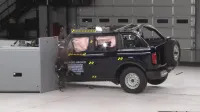
Click above to view video of the 2008 smart fortwo crash test

Each year, it seems as if more and more new models are able to ace both the IIHS' and the government's crash-test ratings. In fact, according to Transportation Secretary Mary Peters, 97-percent of all new cars available today earn the highest four or five-star ratings from NHTSA. These all-too-similar ratings makes it rather difficult for consumers to make a choice based solely on passenger safety, so the Fed's have decided to take another stab at the current rating system, which was introduced way back in 1979. Though still based on a five-star ranking, the revised 2010 ratings will include additional front-end tests and a new side-impact test meant to mimic the impact of a vehicle that collides with a tree or pole. Also new for the '10 model year is an overall rating meant to make comparisons easier between competing vehicles. More changes are possible for 2012, as NHTSA is still considering whether to make electronic nannies like stability control mandatory.

[Source: The Detroit News]

A gentler tap - IIHS suggests car bumper standards for light trucks

It's not a surprise that the Insurance Institute for Highway Safety (IIHS) would be backing a proposal that has the potential to lower the amount of damage vehicles sustain in crashes, and therefore lead to less costly repairs for insurers. What is surprising is the NHTSA's stubborn attitude about accepting outside suggestions. The proposal is simple enough; the IIHS recommends that trucks and cars use the same bumper standards for greater crash compatibility. Being cynical and following the money does lead one back to the fact that such a change would save the insurance industry a large sum, but so what? Saving the insurance industry money saves us poor saps a few nickels, too – or the rates continue to be just as expensive while the corporate robber barons pocket the increased profits.

NHTSA has heard this argument before, rejecting petitions for porting the car bumper standard to light trucks in both 1984 and 1991. The IIHS is hoping that this time around, the fact that it's an organization proposing the change, and their new research, will sway the regulatory body in a more favorable direction. The IIHS used the Ford Explorer and its more car-compatible bumpers to demonstrate in tests that both vehicles in a crash would sustain less damage without exacting any penalty in usefulness or capability. NHTSA is already on the case of vehicle compatibility in a broad sense, and will likely try to roll any bumper-centric work into that effort. It would seem like a no-brainer to have cars and light trucks with bumpers that match up, but it's taken the past century of automotive production and dependence to get the idea any kind of traction. With that kind of glacial pace, we should start petitioning now in anticipation of a super-tight oil supply and incoming waves of sub-A class vehicles. We sure wouldn't want to get mauled by an Explorer on our way to get milk and bread in our Nano in 2030. IIHS Press Release after the jump.

Continue reading A gentler tap - IIHS suggests car bumper standards for light trucks

Acura TSX named Top Safety Pick by IIHS


Click on the image above for pics of our uncrashed 2009 Acura TSX

The all-new 2009 Acura TSX was recently crashed into a barrier at 40 mph, and smacked with a side sled at 31 mph, by the Insurance Institute of Highway Safety (IIHS). While the last model (2005-2008 with side airbags) scored "good" in frontal, and "acceptable" in side impact testing, the 2009 model received the highest scores ("good") in both tests. When combined with the improved rear crash test results (seat and head restraint design), the new TSX earned the Institutes's "Top Safety Pick" rating.

While our caps are off to Acura, we think it is time to revise all crash test standards (IIHS and NHTSA). Each time the results are released, we can't help but think that the automakers have learned how to ace the tests over the years. Let's bump up the speed in the barrier and sled tests (maybe throw a random angle in there to make things challenging?), and focus more on dynamic safety. As always, this team prefers to avoid the accidents in the first place.

Gallery: Autoblog Garage: 2009 Acura TSX

[Source: IIHS]

University of Michigan to test crash-avoidance system


Lane departure sensors and adaptive cruise control have helped to prevent accidents and save lives, and new technology from the University of Michigan hopes to take the those ideas to the next level. U of M's Integrated Vehicle-Based Safety System warns drivers if they're about to hit another vehicle while changing lanes; if they're about to leave the road; and if they're going to rear-end another vehicle. The system improves on existing technology by integrating data from video, radio sensors and GPS to warn drivers of dangerous situations and give them the path of least possible harm.

The university secured over $32M in funding from state and local governments plus several corporations, which will pay for the testing of 16 passenger cars and 10 commercial trucks equipped with the system. IIHS predicts that tens of thousands of lives will be saved each year if lane departure and forward crash systems are improved, so here's to hoping the Wolverines have a smash hit on their hands. No pun intended.

[Source: Detroit News]

VIDEO: smart fortwo crash test leaks out of IIHS


The IIHS has put the 2008 smart fortwo through its frontal offset crash test, and the video is on YouTube even though the IIHS hasn't released its results yet. For everyone who points out the benefits of the smart's miniscule size, there are a number of others who say they wouldn't want to go up against a normal American car in a smart. Even the NHTSA had some concerns when it tested the fortwo's crashworthiness. Based on the video after the jump, however, it looks like the smart acquits itself quite well with no deformation of the A-pillar and not even a crack in the windshield. We'll have to wait for the IIHS to give its final, official word, however. Sure, we wouldn't want to be driving a smart fortwo in an accident... but that's only because we don't want to be in an accident. Follow the jump to watch the video for yourself.

[Source: YouTube]

Continue reading VIDEO: smart fortwo crash test leaks out of IIHS

IIHS warns Canada against merging bumper standards with U.S.

Transport Canada has been planning on implementing a change which would lower Canadian bumper safety standards from the current 8 km/h standard to 4 km/h. This halving of the standard would bring the Canadian testing in line with the regulations of both Europe and the U.S. Apparently, Transport Canada believes that vehicles would be cheaper to import while maintaining automobile safety. In fact, Canadian officials believe that the new standard could actually improve pedestrian safety. Or not, according to the IIHS, which has sent a letter to Transport Canada urging them to reconsider making the change. The IIHS response is pretty scathing, Using words and phrases like "unsubstantiated, incorrect assumptions, ill-informed and misleading," but the response could seemingly be summed up this way: Yo hosers, what were you thinking, eh? Thanks for the tip, Karen!

[Source: Auto North]

IIHS questions the effectiveness of five new safety features


The view above your left knee in the 2009 Infiniti FX.

In the last 24 hours, we've been accosted with more high-tech, in-car wizardry than we've ever asked for. And while you'll have to wait until next week to read our review of the new Infiniti FX, the Insurance Institute for Highway Safety has weighed in on the top five new safety technologies that may, or may not, have an effect on crash rates.

The IIHS studied how blind-spot detection systems, adaptive headlamps, lane-departure warning systems, forward-collision warning systems with automatic braking and emergency brake assist, work and how they may prevent collisions.

Of the 2.3 million frontal crashes that take place annually, 7,200 result in a fatality. The proliferation of systems that can detect an imminent frontal collision, sound a warning and if the drive doesn't react, preload all the safety systems and begin applying the brakes may prove useful. The same goes for lane departure warning systems, which notify the driver with a tone if they begin veering out of their lane. Others, like blind-spot detection systems won't have as much affect on road fatalities since they don't account for a substantial amount of fatal crashes, but they'll certainly make people more aware of their surroundings.

The IIHS also noted that adaptive headlamps, which turn in conjunction with the wheel to illuminate around a curve, might cause drivers to increase their speed, making a crash more probable. While we don't buy that last one, it highlights the point that's often left out of these studies: driver error is the number one cause of collisions. Fix that and all this added technology is superfluous.

[Source: IIHS via Detroit News]

IIHS midsize smack down: Side impact ratings better, rear crashes, not so much


The Insurance Institute for Highway Safety just wrapped up its latest battery of batterings and most of the tested contenders in the mid-size segment faired well. The Dodge Avenger and Chrysler Sebring, along with the Infiniti G35, Nissan Altima, Chevrolet Malibu, Saturn Aura, Mitsubishi Galant and Kia Optima all received a grade of "Good" for front and side impacts, with the exception of the Optima, which ranked "Acceptable" during the side impact evaluation. However, problems arose in the rear crash test, where the G35, Altima, Malibu, and Aura were all rated as "Marginal," while the Avenger/Sebring received an "Average" score and the Optima walked away with a gold star and a "Good" rating. The only vehicle that received a "Poor" rating on any of the tests was the Mitsubishi Galant, which didn't hold up as well during the rear-impact test.

All the details from the IIHS are available in the press release after the jump.

Continue reading IIHS midsize smack down: Side impact ratings better, rear crashes, not so much

Flipside: Is crash safety endangering accident victims?


Crash safety ratings are a big selling point – who's going to buy a car with just two stars? In pursuit of salable collision performance, automakers have turned to stronger metals and better construction, and consumers can reap the benefit by choosing from a panoply of highly rated vehicles. A problem arises, however, if that safety design is ever called upon to perform. Lots of vehicles now sport high strength steel in critical areas like roof pillars, and while it certainly helps protect occupants, it could hinder rescue crews. Tools that once made quick work of crashed vehicles are now having trouble shearing through modern cars. Not only that, modern cars have lots of airbags around the cabin, and there are also worries about cutting high-voltage electrical cabling in hybrid or electric vehicles. Rescuers need to know where all the potentially hazardous equipment lies within a vehicle so that they can safely retrieve human cargo without creating a further tragedy.

What was once a simple matter of cutting a roof off to get passengers out can now become a sawblade-eating saga that takes double or triple the time. Taking more time at an accident scene has repercussions that put recovery or even survival at risk by delaying treatment. Automakers are aware of this, and they're working with public safety entities to provide training and information. Schematics and build details of vehicles are being made available to first responders by the non-profit group COMCARE Emergency Response Alliance. The ability to research where and how a car should be taken apart in an emergency could buy injured people critical minutes, so Ford, for instance, is asking for a dialogue with rescue crews and the makers of their tools by offering a look at the construction of the 2009 F-150. Upgrades to rescue tools are also necessary, but the flip side of the harder rescue is that the death rate from passenger car accidents is historically low. So buy that five-star vehicle and try not to hit anything. Thanks for the tip, Juan!

[Source: Houston Chronicle]

IIHS studies effectiveness of roof strength: Surprise! It matters


There's been considerable debate between automakers, legislators and safety advocates over how roof strength correlates to deaths in rollover crashes. The majority of the focus has appropriately been heaped on SUVs, whose high center of gravity makes them more prone to rollovers, particularly when they leave the road.

The Insurance Institute for Highway Safety has just released a study that proves that more roof strength can reduce injuries by some 39 to 57 percent when compared to the weaker models it tested. The IIHS used the same roof strength test as the feds on a group of SUVs that currently meet the government's roof requirements. At the top of the heap was the 2000-2004 Nissan Xterra that was able to withstand almost 12,000 pounds of force, while the lowest ranked vehicle, the 1999-2004 Jeep Grand Cherokee, lost its head(room) after 6,500 pounds of force was applied to the roof.


[Source: IIHS]

Next Page


Autoblog Features


Featured Galleries

Mercedes-Benz SL65 AMG Black Series Wallpaper
IIHS side crash test -  small pickups
Ford Mustang AV8R
TechArt GT Street RS
In the Autoblog Garage: 2009 Nissan GT-R
RCA Eco-Friendly Concepts
Ego Bentley Laptop
Honda OSM Concept
Lotus Evora
2010 Chevrolet Camaro: Live Reveal
2010 Chevrolet Camaro
BMW M1 Procar Series Revival at Hockenheim


Find Your Next Car


Sponsored Links

Autoblog bloggers (30 days)

#BloggerPostsCmts
1Damon Lavrinc975
2Noah Joseph920
3Chris Shunk751
4Jeremy Korzeniewski709
5Dan Roth5515
6Alex Nunez5328
7Drew Phillips383
8Jonathon Ramsey370
9Sam Abuelsamid276
10Michael Harley268
11John Neff206
12Sebastian Blanco110
13Frank Filipponio81
14Chris Tutor80
15Merritt Johnson84
16John McElroy20
17Justin Gardiner20