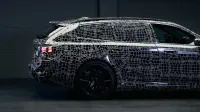
Up until now, the Fisker Karma hasn't really been much more than a pretty face to go along with a promise. That changes today, thanks to a spy photographer who was lucky enough to catch the upcoming plug-in hybrid sedan out testing in California. Lawsuits often seem to have a dampening effect on enthusiasm, so it's good to see the Karma out and about. We can clearly see that the body is the same shape as what we all saw at its introduction earlier this year in Detroit. What we don't know yet is what's powering those shapely curves down the road. The first inclination from Autocar is that a Volkswagen 1.4-liter four-banger will provide power to the lithium ion batteries via a generator, but we really can't be sure what's being tested. Still, given the amount of electric know-how that Quantum Technologies, the electric powertrain supplier to Fisker, already has, we wouldn't be too surprised if something close to final-spec components were being run through their paces.
With the mostly unloved Mercedes-Benz SLR McLaren set to get the official axe in 2009, the path is clear for the next McLaren-branded supercar to be unveiled. Expected to be built at its facility in Woking, England, McLaren has plans for the as-yet-unnamed vehicle to compete with Ferrari's incredible F430. Rumored to be powered by a 550-horsepower V8 engine featuring a basic design snagged from Mercedes and built by Mahle (that of the former Cosworth tuning fame), the power-to-weight ratio should handily outdo that of the Prancing Horse. Shortly after the new coupe codenamed P11 is unveiled, a convertible version is also expected.
True hardcore McLaren enthusiasts should mark 2012 as the year that McLaren returns to form with a proper replacement for its awe-inspiring F1 of a few years back. Powered by a lightweight version of the P11 architecture, this car codenamed the P12 is expected to be powered by a V10 engine with over 600 horsepower. The waiting list will likely start right... about... now.
Hyundai's on-again, off-again plans to bring a pickup to the U.S. market are... um, off again, and possibly for good this time. The news that neither Kia nor parent company Hyundai will offer a pickup should not come as much of a surprise, considering the sorry state of affairs in the U.S. truck market. Timing, as they say, is everything, though Honda's unibody Ridgeline pickup has actually weathered the storm well. A possible front-wheel-drive unibody truck competitor from Korea could have offered another fuel-saving choice for U.S. consumers who like the utility of a pickup but balk at the poor fuel mileage of the standard-fare full-frame rear-wheel-drive platform. Hyundai's not ready to take that bet, though, according to company CEO Kim Dong-Jin, who says, rather succinctly, "now is not the right time to produce a pickup truck." The Kia plant in West Point, Georgia will likely be used instead for the production of Hyundai passenger cars like the Sonata, which shares a platform with the Kia Optima that's already planned to be built at the plant.
General Motors has been hit so hard by the ongoing American Axle strikes that it's stopped production of the GMC Yukon, Denali, Sierra heavy-duty regular and extended cab, its commercial-duty pickup and variants of Chevrolet trucks and Tahoes. All the while, the General is still negotiating with the UAW over local contracts at some of its most important plants. To ease some of its supply problems, General Motors has reportedly offered as much as $200 million to American Axle for the funding of employee buyouts, early retirements and for the support of wage buy downs. The offer, however, is conditional on a quick resolution between American Axle and the UAW.
Spokesman Dan Flores says that GM hopes "the offer will help bridge the gap between American Axle and the UAW and that they will be able to reach a mutually satisfactory agreement in the near future." Both the UAW and American Axle sound supportive of the investment; Bill Alford Jr., vice president and incoming president at UAW Local 235 says, "We're happy that General Motors is finally coming to the table and realizing that they have a stake in American Axle's future." For GM's sake and that of the striking workers, we hope the feuding companies find an amicable solution soon, though it seems unfortunate that GM, which is not exactly posting record profits itself, should need to cough up funding to make it happen.
Though it's usually the adventure touring crowd that excels at turning their motorcycles into rolling technology test-beds, we've recently run across a Yamaha Vino scooter that has been fully farkled. Featuring an on-board computer based around a VIA mini ITX form factor motherboard that's cleverly been hidden under the stock Vino's seat, this rolling geek-mobile packs in WiFi, Bluetooth, USB, GPS, FM radio, a TV tuner and a front-mounted camera in its diminutive frame. With the full-spec computer, pretty much anything should be possible right from the road using this scooter. While this is certainly a cool project, we have a few questions regarding its durability. How long will the acrylic plate that makes the structure for the computer hold up? Perhaps most importantly, how long will the scooter's battery be able to power all this technology? In the name of science, of course, we graciously offer our services for a road trip on the machine to find the answer to these all-important questions. Thanks for the tip, jared!
The current economic environment in the United States is hurting all auto makers these days, even mighty Toyota, which was once considered immune to so-called market realities. Though its overall performance last year would be considered a stellar achievement for any other automaker, Toyota's 28% profit plunge in the fourth quarter of 2007 points to an expected 27% drop in annual profits in 2008. If Toyota's revised forecast proves accurate, 2008 would break a nine-year stretch of profit growth. In addition to the slowing U.S. market, Toyota also cites high material prices, the worldwide credit crunch and a strong yen as contributing factors in its mild downturn.
Toyota's expected profit drop is certainly newsworthy, but we just have to wonder how the money-losing American car companies will cope in the U.S. market with the same issues. While sales of cars are gaining strength, the SUV and truck markets are sinking with what could be Titanic-like implications for the truck-heavy lines from Ford, Chrysler and GM.
Click on the image above for high-res shots of this wacky scene
Running diesel vehicles on biofuels is a good thing, right? Not always, according to Greenpeace Argentina. It seems that the export of soybeans from Argentina is causing more pollution than was initially estimated. Also, too much of Argentina's native forests are being mowed down for the soybeans. These issues are in stark contrast with two of Greenpeace's stated charters: (1) catalyzing an energy revolution to address the number one threat facing our planet: climate change and (2) supporting sustainable agriculture by encouraging socially and ecologically responsible farming practices.
No Greenpeace protest would be complete without some sort of outlandish stunt, and this one follows suit. Because most of the Argentinian biodiesel goes to Germany, a Mercedes-Benz M-Class and a Porsche Cayenne were made to look like bulldozers by men and women wielding German flags. The two SUV's were surrounded by fake tree stumps. Once again, Greenpeace has done an admirable job of catching plenty of attention. Whether the group's wacky efforts have any effect, though, is another matter entirely.
Click on the image to see more high-res shots of this '78 SE Trans Am
Mid-to-late 70's Pontiac Trans Ams have really been picking up steam on the collector car market. While not nearly as powerful as their more muscular 1969-1974 forebears, the later TAs certainly have a unique and gaudy manly-quality about them, helped in no small part by their association with '70s icon Burt Reynolds and, of course, the Smokey and the Bandit movie franchise. The vehicle you see in this auction is a particularly nice example of the breed. As a 1978 Special Edition Y/82 Trans Am equipped with the desirable Pontiac 400 engine with 4-speed manual tranny, this is already a collectible vehicle. The original Hurst Hatches and AM/FM/8-track player and CB radio along with the rare rear-console add to this bird's rarity.
For real Burt Reynolds aficionados, though, this fire-breathing Poncho offers something truly special: his signature on the dash. Not only that, Burt drove the vehicle around while he was in Georgia helping to develop Year One's Bandit Edition replica car and it has been on television numerous times. With all it has going for it, don't expect this car to come cheap. In fact, it's already past $46 grand with days still to go in the auction.
Though Men's Vogue has already attempted to disprove the theory that only women can get away with driving one, it seems that smart has seen the need to dispel some rumors about the fortwo, their little urban runabout. Specifically, many people apparently question how large of a person the smart can easily handle, how safe a car this small could be, how much room there is for stuff and what features the fortwo is equipped with. In all honesty, the smart would probably work for a large percentage of the population of both the U.S. and the U.K., but certainly not for every situation likely to come up in everyday life. As a second car or strictly for commuting, we imagine that the smart would meet the needs of quite a few drivers who would never even consider a vehicle this small.
Just for fun, why not check out the truth about smart here. Even if you hate the car, you may enjoy seeing it mildly-mangled by a wrecking ball.
Recently, Ford Motor Company sponsored a contest with the goal of modernizing the iconic Model T, a car which revolutionized motorized transportation the world over. The winner of the competition, a 24-year-old junior at the College for Creative Studies in Detroit named Dong Trang, came up with an electric crossover of sorts. That's fitting, according to Peter Horbury, head of design for Ford in the Americas, because Henry Ford's original Model T sat high off the ground and had a modular design, capable of hauling people and their stuff at the same time.
What the modern-day designs don't share with their forebear is retro looks. Each of the modern T adaptations features fairly sleek styling and alternative power that goes along with our modern-day energy and emissions problems.
Trang's design is rather unique, featuring solar panels on the vehicle along with an energy-capturing suspension design that would help recharge the on-board batteries. Those batteries are also removable to provide power outside the vehicle. The seating arrangement is modular, allowing for up to four occupants or offering increased storage capacity. The rear hatch is also capable of folding away to offer a small pickup bed. Click past the break for some videos of Trang talking about his design.