
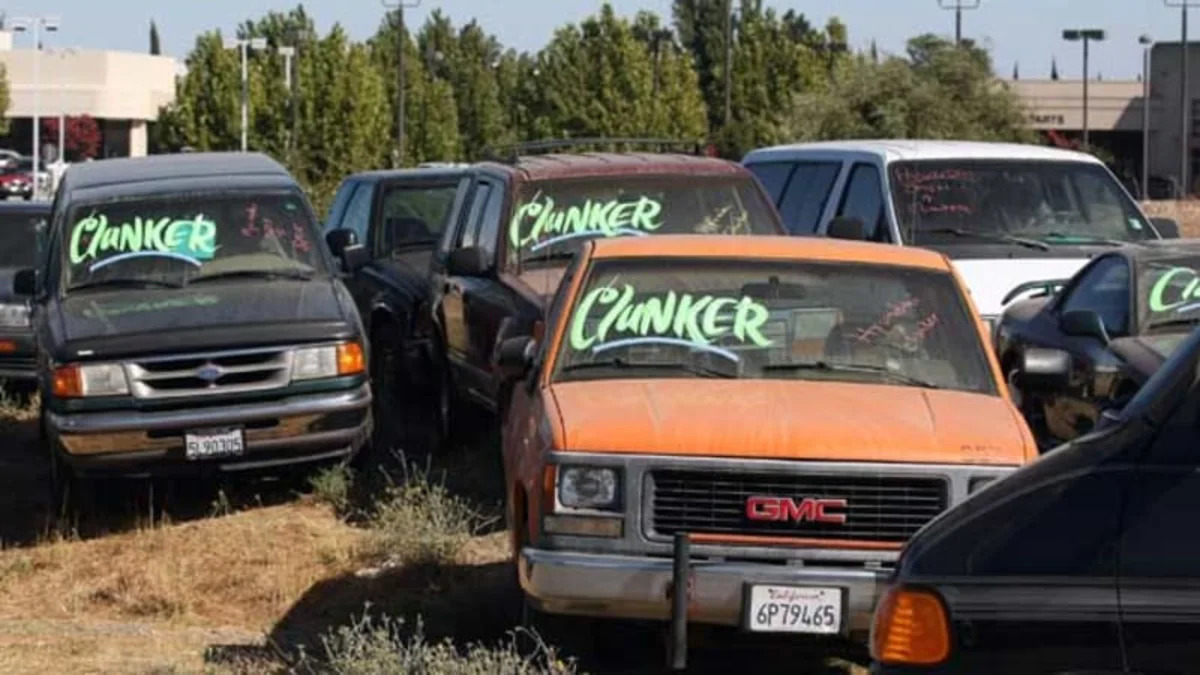
STUDY: Cash for Clunkers helped Japanese way more than Detroit 3

While there is no question that Obama's Cash-for-Clunkers program accelerated vehicle sales this summer, a new report by the University of Michigan's Transportation Research Institute shows the big winners were from Japan, not Detroit.
According to the study, nearly 85 percent of the trade-ins were from General Motors, Ford, and Chrysler, yet they only sold 39 percent of the new cars moved off the lots. On the other hand, 8 percent of the trade-ins came from Toyota, Honda, and Nissan, manufacturers who accounted for 41 percent of new car purchases.
While these numbers may be justified by the large quantity of inefficient domestic trucks and SUVs that were deemed clunkers, customer loyalty also seems to have taken a big shift. About 68 percent of owners who traded in Toyota, Honda, or Nissan vehicles replaced them with another from one of those Japanese brands, while only 43 percent of consumers who traded in Detroit steel purchased another General Motors, Ford, or Chrysler product. The program cost the U.S. taxpayers about $3 billion.
[Source: USA Today | Image: Justin Sullivan/Getty]



Get a WordPress.com Blog


Reader Comments (Page 1 of 4)
nirad 7:34PM (11/13/2009)
most of the "Japanese" vehicles sold were probably manufactured here in the US.
Reply
Red 7:47PM (11/13/2009)
I was about to make the same sentiment. I'm not entirely sure what point the author was attempting to make. Many people know this.
risk 7:42PM (11/13/2009)
but but, if it doesn't sound like they helped the enemy the newspapers cant get anything out of it!
fixitfixitstop 7:54PM (11/13/2009)
The profits still go to Japan and that benefits Japan more than the US.
Venom 7:54PM (11/13/2009)
Classic case of convenient reporting and manipulating a story.
Everybody does it I guess....
Eh 8:16PM (11/13/2009)
Who cares if money goes to Japan, selling cars is not a race. There is no sliding scale, Japan doing bad doesnt mean that America is doing good.
VictorRaikkonen 9:11PM (11/13/2009)
'The profits still go to Japan and that benefits Japan more than the US.' That's one way to look at it so long as you ignore the bit about those profits 'going to Japan' are keeping American's employed.
alex 10:23PM (11/13/2009)
Most of them made here? No. Honda makes most of the cars they sell in the us right here in the us. Toyota, Nissan, Mazda, Kia and Hyundai import most of their cars.
Yaroukh 4:05AM (11/14/2009)
@VictorRaikkonen: Because without them the demand for cars would plummet, right? So there would be no jobs for those employees, right?
Aprime 5:45AM (11/14/2009)
Fixitstop: the profits go to the owners of Toyota, which could be anyone here - nothing's stopping you from buying Toy stock.
Leclerc 9:39AM (11/14/2009)
@ Alex, check your facts. Toyota manufactures a majority of their vehicles stateside.
Sea Urchin 9:49AM (11/14/2009)
I am tired of this Taxes going to Japan argument. Corporations routinely avoid paying taxes, they also keep money in the country where they manufacture for improvements and R&D. What matters is where the product is manufactured, where people are hired. As long as car is made in USA like Civic and not is Mexico like Fusion, buying a Civic is much better for USA.
Zag 6:03AM (11/15/2009)
Ah but you forget, If the money is going to save Jap companies, and not going to the US car makers then the US car makers will shrink or close the doors for good.
Then all your cars belong to japan.
So while it might be great to have some people employed, I'd hazard to say that the US car makers probably have way more US employees than the Jap companies do.
PJ 1:40PM (11/14/2009)
"The profits still go to Japan..."
This argument is seductively simple, but as in most such cases, oversimplified to the point of fallacy.
The short version of the long story is that profits go to shareholders, regardless of a company's national origin. What's stopping U.S. citizens from buying shares in Toyota, Honda, etc. and encouraging them to invest in our country's economy? Nothing. Which is why it's exactly what's happening with these "transplant" automakers.
recharged95 2:19PM (11/14/2009)
Nice coment.
Problem is all the profits and high paying jobs (that immediately impact the economy, by spending new moeny, no paying debt).... are at their corporate HQs--Japan.
Not THAT Matt 3:53PM (11/14/2009)
I guess.
A lot of people in my part of the country (Green Bay, WI) are incredibly biased and think anything domestic is the devil.
The number one selling car brand in the state is still Chevrolet, though. But I guess the rednecks can't really use a Honda Civic to tow their supplies up to the cabin for deer hunting - way too much beer needs to be hauled for THAT purpose - so I guess that makes some sense.
God damned rednecks.
Chris 11:42AM (11/16/2009)
Hoorah! Glad we're keeping all those high-talent, white-collar, high-paying manufacturing jobs! Goodbye, engineering, research, and development! Who needs ya?!
turbo-quattro 7:37PM (11/13/2009)
that wasnt the purpose of C4C. it was to stimulate the economy, not necessarily the US auto industry.
Reply
tuna 8:14PM (11/13/2009)
Right. And people need to stop thinking about the economy in the same way they think about climate change. Weather systems and atmospheric trends are not localized by country or continent. What happens in one place can initiate change elsewhere. Same goes for flow of money, globally.
Besides, on a local level, C4C kept the folks at the dealers working. For small towns and cities with dealerships that are several generations old, that's a big deal.
Plus, C4C has already taken place. It's in the past. "Quit yer belly aching".
tanooki2003 8:55AM (11/14/2009)
Thank you @turbo-quattro & tuna.
You are both absolutely right.
People also need to seriously stop trying to make this into some ridiculous political issue.
Would you prefer that nothing was done and everything remained stagnant? I am guessing on the political attacking standpoint they would actually prefer that so they would have a reason to argue about something else. In other words we will never here the end of this and it will be made out as the biggest disasters in USA history, when in fact it's quite the opposite.