Review: 2009 Nissan Frontier continues to blaze the small truck trail

2009 Nissan Frontier – Click above for high-res image gallery
Small pickups occupy an odd and oft forgotten spot in the over-hyped, Biggie-Sized truck segment, but making a case for their existence remains easy. Not everyone needs a larger vehicle or has the space for a full-size truck, and small pickups offer the utility weekend warriors require without necessitating an organ exchange at the pump. Although not as diminutive as their forebears, today's more compact dimensions are easier to cope with behind the wheel, and in this economy, moving down a rung in the pickup hierarchy is sure to save you a few dollars in monthly payments and insurance premiums. But is it just about a small footprint and an easy to swallow sticker? Or is just best to bite the bullet and option up for what some consider to be a "real" pickup? We test the 2009 Nissan Frontier to see if this squat truck has more than just measurements on its size to woo punch-drunk pickup buyers away from the latest and greatest in the full-size segment.
Gallery: Review: 2009 Nissan Frontier
Photos Copyright ©2009 Dan Roth / Weblogs, Inc.
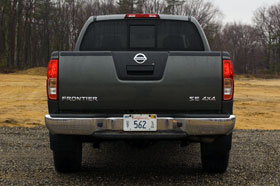
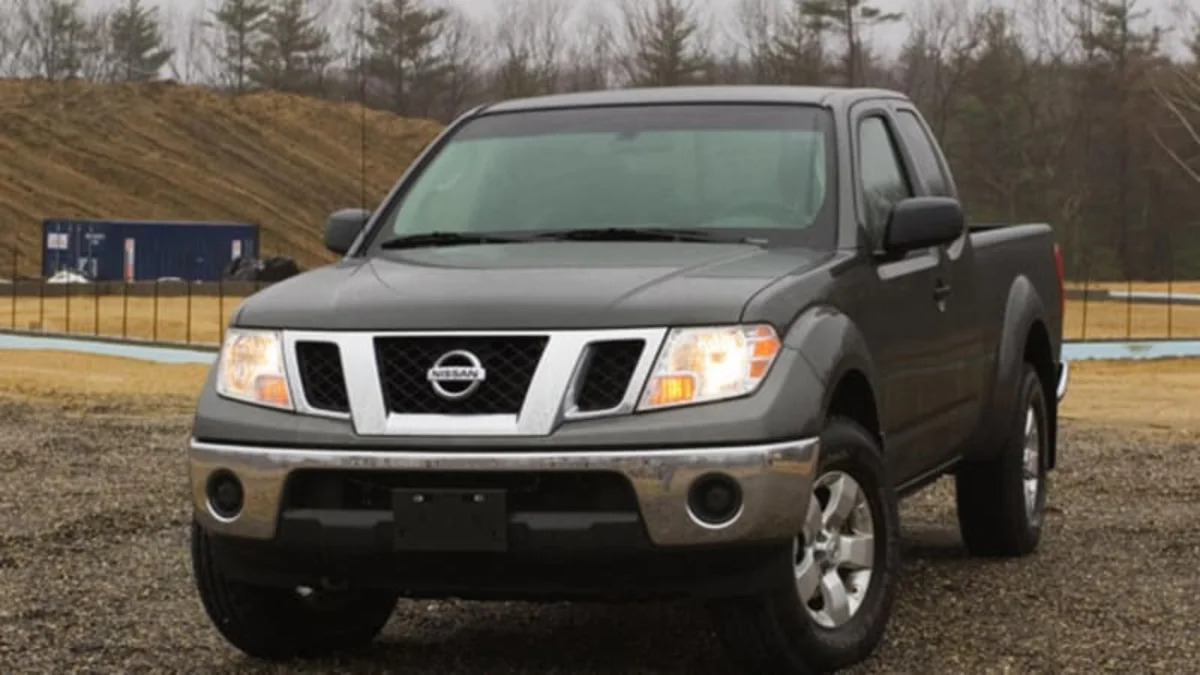
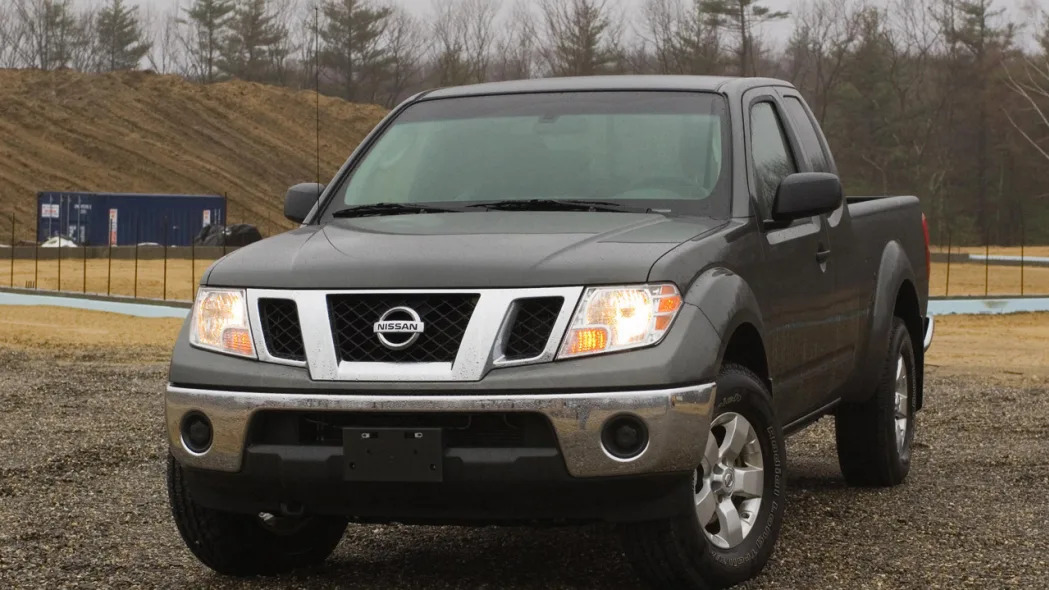
The Frontier is exactly what it feels like: a smaller version of the Titan. It drives with a solid and willing feel that's roughly akin to the Maxima of trucks. A 4.0-liter version of the company's ubiquitous VQ engine kicks this thing around with plenty of authority, and the real four-wheel drive rig underneath lends more billy goat ability than most buyers will ever put to use. 261 horsepower at 5,600 rpm and, more importantly, 281 pound-feet of torque at 4,000 rpm, are churned out with an authoritative voice while burning cleanly enough to earn LEV2/ULEV emissions ratings. There is a four-cylinder version of the Frontier for buyers seeking a bit better fuel economy, but our sampler was an SE-trim 4x4 with a five-speed automatic and V6.
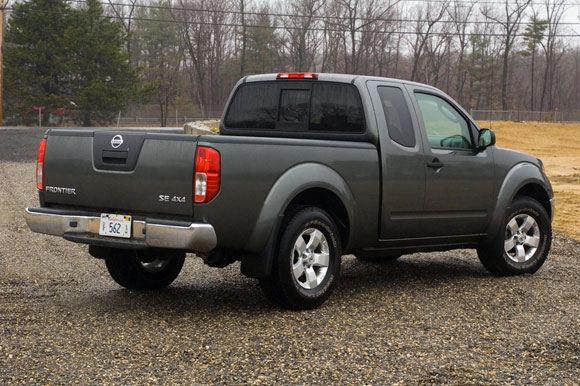
The Frontier comes in extended King Cab or true four-door Crew Cab configurations. There's enough space in the demi-door King Cab for the average buyer, with plenty of storage cubbies and a roomier feel than even a full-sizer from 15 years ago, but the jump seats are only suitable for occasional use. If truck-pooling is part of your usage brief, go right for the Crew Cab, which has the side benefit of more creature comforts than the King Cabs. The materials in our SE were good for the class, if not gobsmackingly fantastic. In the end, it's a truck, and while it can be dressed up with cushier trappings, it's still a working-class vehicle first and foremost.
It drives like a two-thirds scale version of the Titan.
While the Frontier is comfortable and easy-driving, it won't skip town in the middle of the night if challenged to a showdown – there's serious hardware here. Solid foundations are provided by the fully-boxed F-Alpha platform, the same frame that gives the full-size Titan its rigid, dare we say, sporty demeanor. Sharing the Titan's bones, it's no surprise the Frontier drives like a two-thirds scale version of its big brother, which is to say it's pleasing to gearheads who value direct steering and a communicative ride. 
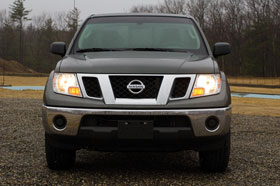
With a surprisingly sprightly 4,315 pound curb weight and a 58/42 weight distribution, the facts and figures sound more sporting than trucklike, and the Frontier is car-easy to drive. Fuel economy of 14 city mpg and 19 highway in the configuration we tried brings you back to full-frame, four-wheel drive reality. Four cylinder Frontiers can reach into the low 20s on the highway, though the economy is about what's expected given the specs.
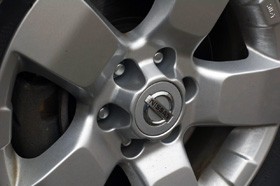
Disc brakes all around are something that's becoming more common on trucks, and our Frontier arrived packing 11.7-inch rotors in front and 11.3-inchers in back. In practice, braking performance falls short, likely due to limited traction from the BFG Long Trail tires. SE four-bys get standard 16-inch alloy wheels shod with 265/70 tires. While the ride is comfortable and quiet, and there's traction for wilderness excursions, hard stabs at the brake pedal cause the rear end to skate before the ABS kicks in. The danger with the Frontier's braking performance, at least in the guise we sampled, is that there's plenty of go power and the handling borders on sporty, so it's a surprise to step on the whoa pedal and be met with a wimpy showing. The steering, however, is direct and communicative, a surprise, and the firm chassis pleasing.
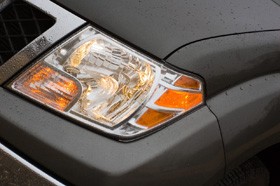
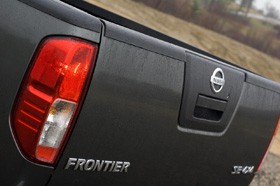
The other pedal is the fun one. Squeeze the skinny treadle and the DOHC six puts its shoulder into it with a growl, delivering a firm shove ahead. While Nissan has figured out how to squeeze a V8 into the Frontier's Pathfinder platform-mate, and the Chevrolet Colorado and Dodge Dakota offer eight-pack thrills in the mid-size arena, there's no need for any more engine in the Frontier. Even the tow-crazy will have little to complain about; 4WD V6 Frontiers can drag around 6,300 pounds, slotting neatly between the Colorado's 6,000-pound maximum and the Dakota's 7,200-pound peak.
Consumer Reports rates it a Recommended Pick and projects very good reliability.
Towing and mudslinging are ways to put this puppy-friendly vehicle to work, and the Frontier laps it up without complaint. Owner complaints are likely to be few and far between, too. Consumer Reports rates the Frontier as a recommended pick and projects very good reliability. Heading off-pavement, too, is another area where the Frontier is as happy as a black Lab in a mudpuddle. Our dirt ventures were child's play for the Frontier. Dialling up low-range four-wheel drive is as easy as twisting a rotary knob, and the truck was comfortable and controllable up and down some mild terrain. Approach and departure angles aren't Wrangler-steep, but when you're poking around with a borrowed vehicle without a winch, you tend not to take extreme chances.
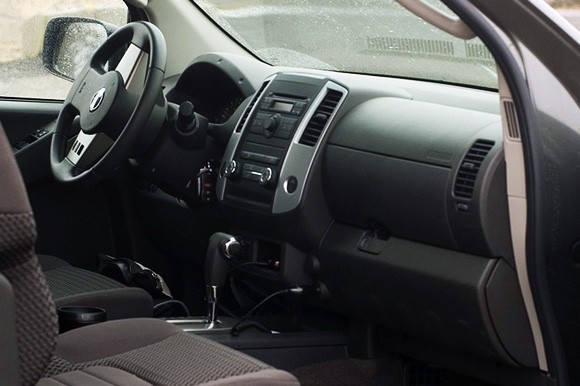
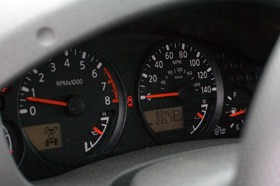
Nissan has carried out a naming shuffle for the hardcore offroad trim level. What used to be known as the NISMO package has been replaced by the PRO-4X for 2009. Bilstein shock absorbers, extra skid plates and a locking Dana 44 rear axle bolsters the mechanicals for stump-bumping. PRO-4X interiors are detailed with white-faced gauges, a trip computer and leather wrapping with red stitching on the steering wheel. Manual transmission equipped PRO-4X models also get a leather shift knob, and Crew Cabs with the package can also be luxed up with power-operated heated seats covered with the thematic leather. Outside, the rock-chewing Frontiers get obligatory stickering on the bedsides, along with color keyed grille, bumpers, mirrors and door handles. Foglamps, a sprayed bedliner and the Utili-Track cargo system are also part of the PRO-4X.
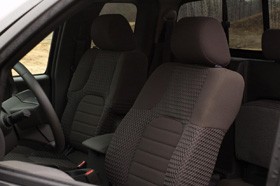
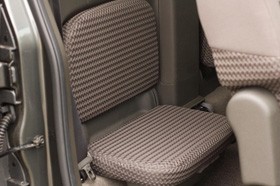
This kind of money will put you into an F-150, Silverado, Tundra or even Titan.
The trouble with mid-size trucks is that full-sizers can be had for much the same money, especially in these times of screaming deals on just about anything. Our well-equipped tester started at $24,110 and was equipped with the SE Value Truck Package for $1,330 that added the SE Power Package of keyless entry, power windows, locks, and mirrors, plus cruise control. Also in the SE VTP is a brake-based limited slip, 16-inch alloy wheels, bedliner and floor mats. Safety was tuned up with the $550 airbag package that fits seat-mounted side bags and roof-mounted side curtain bags into the Frontier, and Nissan also requested $745 for destination charges for a grand total of $26,735. That kind of money will easily put you into an F-150, Silverado, Tundra or even Titan. It would be a stretch, however, to get into one of those bigger pickups for the same price as our Frontier with an extended cab and four-wheel drive, let alone the other niceties included in the value package.Well-equipped and reasonably priced, with options for both luxury and rock-hopping, the Frontier covers a lot of bases. It's handsomely styled, even if it's not the freshest face on the block, and Nissan's entry-level truck identity has matured to the point where it's got a purposeful, bulldog stance that comes off as both rugged and dignified. The Frontier's well-behaved chassis handles driver inputs better than some cars we've sampled, and although our biggest gripes are centered on the Frontier's fuel economy, braking performance and bed size – likely sacrificed at the altar of human comfort – is a reasonable tradeoff for a daily driver.
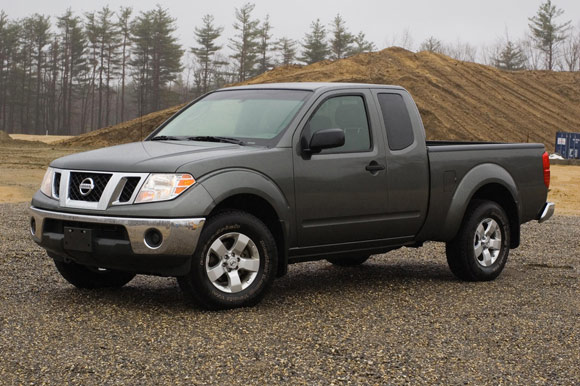
For those who appreciate performance, the Frontier may well be the only choice in pickups. Among a class that includes such varied choices as the Ridgeline, Ranger, a Chevrolet with a V8 similar to what you'll find in a Corvette, and the Dakota with its uber-punchy eight-cylinder mill, the Frontier scraps successfully as a well-rounded offering, continuing to prove that good things can come in small packages.
Gallery: Review: 2009 Nissan Frontier
Photos Copyright ©2009 Dan Roth / Weblogs, Inc.



Get a WordPress.com Blog


Reader Comments (Page 1 of 3)
BigMcLargeHuge 12:11PM (7/20/2009)
Gotta agree that the Tacoma/Frontier are as much truck as I'll ever need.
They are roughly the same size/capability as a mid-90's full-size. Which means today's full-sizes are just plain too big for my needs.
Plus you can get them with 6-speed manuals.
Reply
usingthelou 12:11PM (7/20/2009)
Love my truck.
Reply
GOT 8:49PM (7/20/2009)
And I love my 97 Nissan truck... with over 300k miles on it. Wish the current model was as small.
GOT 8:52PM (7/20/2009)
I mean 1993, I love my 1993 Nissan truck!
Mr.TiredOfEconomicDownturn 5:25AM (7/21/2009)
@ GOT: Yeah, so much love that you can't remember how old she is any more...
retsel 12:13PM (7/20/2009)
Now where is the all new 2010 Ranger with a 4 Cylinder Diesel giving me 39 MPG
Reply
RJ 4:26PM (7/20/2009)
In Europe, and the rest of the world... lol
Big Mola 12:17PM (7/20/2009)
Still too big and thirsty--I want my El Camino. Now! (If Bob wants to resurrect the G8 as a Caprice, the G8 Sport Truck can become the El Camino.)
Reply
geoff 12:20PM (7/20/2009)
I wouldn't call this a "small" truck. It's certainly smaller than the F-series, Ram, and Silverado, but this is NOT a small truck. Where is our modern-day Datsun pickup? What happened to the Toyota Hilux mini-truck? Where is the Suzuki SJ-413K pickup? We simply do not have small trucks in America anymore. This "small" Frontier is nearly as big as full-size trucks, which makes it way too big for many people's needs.
Not to mention that wimpy independent front suspension on the 4x4 model means it does not have the strength or durability for real off-road use.
Sorry, Nissan. Try again.
Reply
BigMcLargeHuge 12:44PM (7/20/2009)
What 1/4-1/2 ton pickup doesn't have an IFS these days?
Did you think they designed it with 38" boggers in mind?
I uprooted 4 medium-sized tree stumps with mine in 4-Lo, and pulled another vehicle out of a swamp on stock all-terrains.
I get 22mpg with the 6MT on the highway with a 500lb quad in the bed. There's plenty of torque so you can get decent mileage even with the crazy tall gearing.
Not sure what exactly you're needing it to do, but it is pretty much the ideal frame-based pickup and I wouldn't change a thing.
I would like to see some unibody-based pickups in the US though.
Sam 1:11PM (7/20/2009)
There are lower-sitting non-4WD versions of both the Nissan Frontier and the Toyota Tacoma that are exactly what you're looking for. That just didn't happen to be what the review was based on.
geoff 2:10PM (7/20/2009)
I don't want or need a "lower sitting" 2wd truck. I want a truly compact 4x4 with solid axles and a low range transfer case. Something along the lines of my 1985 Toyota Truck, before they ruined their truck line forever with weak, expensive independent front suspension and nearly-full-size bodies. The 2wd Frontier and Tacoma are just as big as the 4x4 versions - just because they're lower to the ground doesn't mean they can fit between trees and rocks any better than the taller 4wd versions. And all that extra body size leads to more weight, which requires more power, which further hurts fuel economy.
The closest Toyota has come to the "right truck" in years was the Tacoma Truck concept from SEMA 2008: http://news.pickuptrucks.com/2008/11/sema-2008-tacom.html I could deal with the oversize body if Toyota ever made this truck. I would seriously buy two of them and gladly pay a $5000 premium if Toyota offered this truck with differential locks in its front and rear solid axles.
BigMcLargeHuge 3:05PM (7/20/2009)
This truck is a tool, not a toy.
And Nissan/Toyota did a near perfect job making trucks for men that need to move people and things.
You don't want a truck, you want a toy.
So have fun in a Wrangler already.
geoff 4:23PM (7/20/2009)
I hope you don't mind if I use my solid-axle Toyota and Suzuki trucks to pull your broken IFS trucks off the trail and out of the way, so that the real men who drive real trucks - not these car-based-suspension faux-by-fours - can continue with our work and our play.
Seriously, what's wrong with wanting a vehicle with a heavier-duty suspension and drivetrain? Just because Toyota and Nissan do a "near perfect job of making trucks" doesn't mean that they have done a 100% perfect job. This Frontier is a great truck - but it could be a lot better. That IFS is its biggest shortcoming and is probably the single biggest "feature" that turns away truck buyers. If they offered it with a solid front axle, I would own one. If they also made it 10-15% smaller, I would own two. And if they also added a 4-cylinder turbodiesel, I would own three. Why do you think Ford and Dodge still refuse to downgrade their heavy duty trucks to independent front suspension?
With independent suspension and roomy seating for 5 or 6 people, Nissan and the others are not trying to make these trucks appeal to people who work or play with their trucks; they're catering to those who want a cushy ride and would in most cases be better off with a station wagon or minivan.
I'm not just blowing a lot of hot air. I've worked in the 4x4 industry for 15 years and have firsthand experience with a huge variety of trucks in work, play, and commuting environments. Here's an example - Suzuki Samurai steering tie rods are heavier duty than 1-ton Chevy/GMC tie rods. That's why 4-wheelers and ranchers love Suzukis, and why shops and mechanics love Chevrolets: $$$
BigMcLargeHuge 6:05PM (7/20/2009)
But you're not a man. You're a little boy that wants to play in his sandbox with his toys.
Why would they build something nobody but off-roading rednecks are going to buy? I know plenty of rednecks (relatives). They don't buy new, and they modify the hell out of their off-roaders. So the company has NOTHING to gain by building a to-spec off-roader. They'd lose a ton of money on every one they built.
There's no point in building a solid front axle truck when 1% of buyers give a sh*t about the crap you're talking about.
Trucks need to tow trailers loaded with boats. People judge them on their towing capacity because they take them to the lake, or campground, etc.
Everyone I know with a truck tows a heavy trailer with it. Trucks ARE tools for many, even if they aren't meant to be broken in a mud puddle.
They are fantastic for light snow and mild off-roading to get to a job site. I bought mine used off a contractor/house painter.
Yes, it would be very 'cool', but totally stupid for Nissan to build what you are suggesting.
They made the right choice. You and your cousins don't represent what America needs in a truck. You are blowing wind.
geoff 8:49PM (7/20/2009)
Okay, you've convinced me. You're absolutely right. I completely rescind my previous comments. In fact, John Cleese said it best:
"Alright, alright I apologize. I'm really, really sorry. I apologize unreservedly. I offer a complete and utter retraction. The imputation was totally without basis in fact and was in no way fair comment and was motivated purely by malice and I deeply regret any distress that my comments may have caused you or your family and I hereby undertake not to repeat any such slander at any time in the future."
As you said, Nissan clearly makes the best truck ever. The Frontier is 100% perfect for 100% of the people on Planet Earth. There never has been - nor ever will be - any reason whatsoever for a heavier-duty solid front axle under any 4x4. Independent Front Suspension is the Holy Grail.
Thank you for clearing that up, and for doing so without having to try to resort to childish stereotypes. I am in your debt for sharing your wealth of knowledge with me.
BigMcLargeHuge 10:03PM (7/20/2009)
So be as sarcastic as you want, you're still wrong.
Guess how many Baja racers, 2WD or 4WD use a solid front axle?
Take your time.... NONE!!!
Guess how many Lucas Off-Road Racing series trucks, 2WD or 4WD class. use a solid front axle?
Take your time... NONE!!!
Those trucks go over jumps and land uneven. Solid front axles cannot handle uneven surfaces as well at high speed.
Many teams are switching to Independent REAR as well. Better traction and LIGHTER too.
The US army HMMWV has an independent front AND REAR suspension for higher ground clearance and better control over bumpy terrain at high speed. Look it up.
You see, IFS/IRS is actually a benefit off road. At least that's how the pros see it.
I have redneck tendencies myself. And I know from experience that there is NO point to a solid front axle if you don't intend on using oversize tires. NONE. And the only people that use oversize tires are rednecks. Not sure how that's insulting.
Your prejudice towards solid axles is old-school and obsolete.
geoff 12:48AM (7/21/2009)
Every comment you make highlights your ignorance. No Baja racers use solid axles? Then explain to me all the Baja race teams who buy my company's products for their Dana 44 and Dana 60 front axles. I guess you'll also claim nobody still races Baja in Volkswagen Beetles?
The Lucas series are required to use independent suspension because that is a spec race - they have no choice in the matter.
But you're asserting that off-road racers who go over jumps or land unevenly don't want to use solid front axles? Then explain to me why in the toughest off-road race in the world, King of the Hammers, only ONE competitor this year attempted to compete with IFS?
Oh, maybe the Hammers is too hardcore to hold up to your argument. Okay, how about competition rockcrawling? Sure, Walker Evans gave independent suspension a serious try, but halfway through the season and a gazillion dollars later, he gave up on it and went back to solid axles so he could actually stand a chance against his competition. And guess what? Several years down the road, all the state-of-the-art rock buggies are still using solid axles.
No, solid axles aren't just about bigger tires - they're about strength and durability. Ask anyone who's actually had to work on these vehicles and they'll tell you how weak independent suspensions are. If vehicle manufacturers made their independent suspension components as strong as their solid axles, then I wouldn't have much of an argument, but I've yet to see a factory IFS that's as strong as a factory solid axle.
And don't go using the HUMMER H1 and AM General HMMWV as an example of a strong or durable independent suspension, because their failure rate both in military and civilian applications is shockingly high. These vehicles are very underbuilt for their size and weight, and ridiculously expensive to repair.
The trophy trucks you mention that use independent suspensions have VERY high-dollar, custom one-off components made from exotic materials. The suspension on one corner of those trophy trucks costs more than an entire Nissan Frontier. That's not exactly a cost-effective solution if you're trying to sell a strong, durable, mass-market 4x4 that suits many purposes. The reason these teams are willing to spend mega-bucks to build these IFS setups is because it is better-suited to high-speed conditions than a heavier solid axle.
I will concede the fact that IFS is better suited for the mall.
But for those of us who use our trucks in non-race conditions, and who just want a simple, strong, durable, and easily serviced vehicle, we're willing to pay a premium. The slightly degraded ride quality versus IFS is well worth the sacrifice to have a suspension that is so much better suited for truck duty.
And as for your comment about redneck tendencies, I can't say that I'm familiar with that end of the market, although I'm sure that even rednecks are smart enough to understand that solid axles are stronger, more durable, easier to service, more affordable, and have much more upgrade potential than independent suspension.
The market my company serves is the high-end of off-road recreation and several different forms of motorsports. These people settle for nothing but the best money can buy. They will spend $6000+ tearing the IFS out of their Toyota or Nissan or Chevy or Ford or Hummer or whatever other vehicle so that they can install a Dana 60 or a hybrid "609" and finally stop breaking ball joints or snapping tie rods or exploding unit bearings or tweaking centerlinks. There wouldn't be so many people performing expensive solid axle swaps if there wasn't a competitive advantage to it.
Here's the real kicker - it would be cheaper for Nissan to manufacture the Frontier if they sourced a front Dana 44 at the same time they were sourcing that truck's rear Dana 44. If they sold the truck for the exact same price as they do for the current IFS one, they'd be making more of a profit, AND be selling a stronger and more durable truck. But instead, people are willing to spend thousands of dollars tearing that weak front-end out of the truck to install a solid front axle. Imagine what a premium they'd be willing to pay if Nissan offered the truck with a solid axle! Profit, profit, profit!
It's really only the Americans who have become sissies about our trucks. For instance, look at the wonderful selection of solid-axle trucks from which South America and Australia get to choose! These countries are a truck owner's paradise, where not only solid axles but also turbodiesels and manual transmissions are still king! Sure, if all you're going to do is drop the kids off at soccer practice on your way to Costco, then independent front suspension is fine. But if you're going to drive across the outback or through the jungle, which suspension type are you going to entrust your life and pocketbook to? Weak independent suspension, or a nice big beefy solid axle?
Independent suspension is for cars. Solid axles are for trucks. End of story. Cars dressed up as pickup trucks are fine - the Frontier is amazingly similar to the El Camino - but they are not a good substitute for a proper TRUCK. If an El Camino suits your needs better, that's fine. But for a whole lot of people, a solid axle is not just a desire, but a necessity. Nissan could OWN this market if they offered a solid-axle truck. But instead, the Frontier is just another also-ran in an overcrowded market. It's a decent product, but it's by no means a standout in the segment.
BigMcLargeHuge 9:25AM (7/21/2009)
Rockcrawling and mudding which require oversize tires. Rednecks LOVE oversize tires. You want a truck that's strong enough for redneck activities. Don't kid yourself.
King of Hammers involves rock crawling and oversize tires. Do you even bother to read?
"The reason these teams are willing to spend mega-bucks to build these IFS setups is because it is better-suited to high-speed conditions than a heavier solid axle."
That's what I said. Do you even bother to read? You say I'm wrong on everything and then just repeat me. They don't do it because it's "the spec", they do it because solid axles would slow you down over that terrain.
That pretty much says it all - you just contradicted yourself. You make idiotic claims like "IFS is for shoppping malls" and then say that they are better for high speeds over a particular terrain.
Its not just the trophy trucks. Every class of 2WD and 4WD trucks in the Baja series, Lucoil, Protruck, use IFS so that they go faster. Some IRS as well.
"look at the wonderful selection of solid-axle trucks from which South America and Australia get to choose! These countries are a truck owner's paradise, where not only solid axles but also turbodiesels and manual transmissions are still king!"
The Toyota Hilux and Nissan Navarro are IFS in Australia too. Even with their turbodiesels (which we DO need in the US). But I already told you that the Tacoma/Frontier come with 6-speed manuals.
"Here's the real kicker - it would be cheaper for Nissan to manufacture the Frontier if they sourced a front Dana 44 at the same time they were sourcing that truck's rear Dana 44. If they sold the truck for the exact same price as they do for the current IFS one, they'd be making more of a profit, AND be selling a stronger and more durable truck. But instead, people are willing to spend thousands of dollars tearing that weak front-end out of the truck to install a solid front axle. Imagine what a premium they'd be willing to pay if Nissan offered the truck with a solid axle! Profit, profit, profit!"
Nope. Like I said, it would be cool, but it would be loss, loss, loss.
Having a completely adequate IFS system means they can consolidate parts on their entire range (2wd and 4wd). You're focusing too much on the axle. Integrating to the rest of the vehicle would take (as you confirmed) megabucks. They'd essentially have 2 trucks in 1 platform. Horrible business decision.
You say Nissan would 'corner the market', but there really isn't a market. If there were, Wrangler sales would be huge. But they aren't, they are a niche market.
Not ONCE have you mentioned needing a pickup bed or a towing capacity. So again, you don't need a truck. Solid front axles are for toys. Keep doing the conversions or buy a Jeep and STFU because you sound like a lunatic.
BigMcLargeHuge 9:52AM (7/21/2009)
I don't disagree that trucks with big tires that can negotiate 'obstacles' are 'cool.'
I like them, and their solid axles, and their big tires. That is as far as I meant by 'redneck tendencies.' As in, I think your redneck ways are kinda cool.
But its also utterly useless for most people who aren't going to install oversize tires and crawl rocks.
You operate in a niche where people need to come to you to do specific things. So you assume that it's like that outside of your own little world, and that's just not true.
That is apparent in your pipe dream idea of a 'utopian' Australia where all the trucks are solid-axle. Actually you could not be more wrong. Australians are the makers of the small car-based pickups called 'utes'.
Their bestsellers include the Ford Falcon ute and the Holden Commodore ute. Not to mention the diesel Hilux (IFS) and Nissan Navarra (IFS). The Suzuki ute is also IFS.
They travel poorly paved ROADs in the Outback. And IFS lets them travel down the outback paths at a higher speed.
Aside from your little recreational rockcrawling niche, solid axles aren't really seen as useful in most parts of the world. Go figure.