

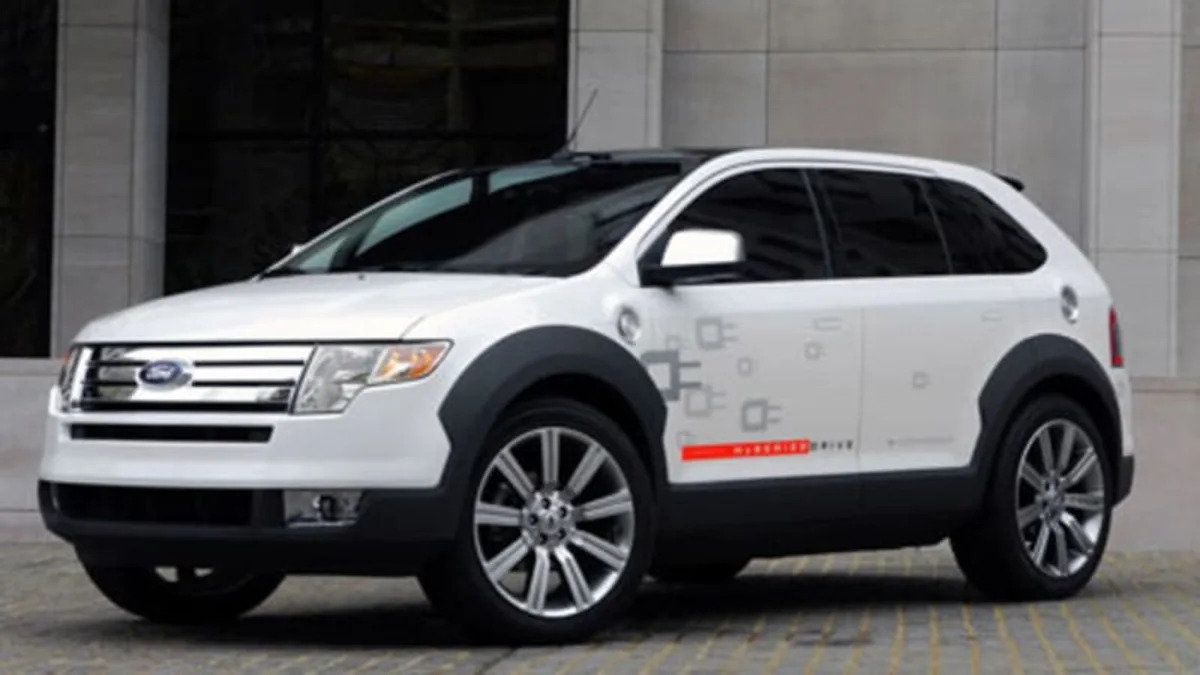
Click the image above for a full gallery.
When Ford unveiled their Airstream concept in Detroit, any attention to its revolutionary drivetrain was lost due to its funky styling and the debut of GM's own plug-in effort, the Volt.
Knowing that pie-in-the-sky concepts will only do so much for the development of Ford's alternative fuel line-up, the boys of the Blue Oval decided to throw the powertrain from the Airstream concept into their newest crossover, the Edge.
The Washington D.C. Auto Show (of all places) served as the stage for Ford to unveil the Edge equipped with the HySeries Drive powertrain. The system utilizes a lithium ion battery pack that initially receives power from a standard wall outlet, and once that initial charge is drained (in about 25 miles) a fuel cell system begins sending power to the batteries. Those batteries are hooked up to an electric motor, which propels the Edge up to a maximum speed of 85 MPH. Once the fuel cell begins making power, it can provide an additional range of 200 miles and, in some applications, up to 400 miles.
AutoblogGreen is hot on the case and will be bringing more technical analysis and a full driving impression in the future.
In the meantime, be sure to check out the gallery of the Ford Edge with HySeries Drive by click the image above (we dig on the two-tone paint scheme) and read Ford's press release after the jump.
[Source: Ford]
When Ford unveiled their Airstream concept in Detroit, any attention to its revolutionary drivetrain was lost due to its funky styling and the debut of GM's own plug-in effort, the Volt.
Knowing that pie-in-the-sky concepts will only do so much for the development of Ford's alternative fuel line-up, the boys of the Blue Oval decided to throw the powertrain from the Airstream concept into their newest crossover, the Edge.
The Washington D.C. Auto Show (of all places) served as the stage for Ford to unveil the Edge equipped with the HySeries Drive powertrain. The system utilizes a lithium ion battery pack that initially receives power from a standard wall outlet, and once that initial charge is drained (in about 25 miles) a fuel cell system begins sending power to the batteries. Those batteries are hooked up to an electric motor, which propels the Edge up to a maximum speed of 85 MPH. Once the fuel cell begins making power, it can provide an additional range of 200 miles and, in some applications, up to 400 miles.
AutoblogGreen is hot on the case and will be bringing more technical analysis and a full driving impression in the future.
In the meantime, be sure to check out the gallery of the Ford Edge with HySeries Drive by click the image above (we dig on the two-tone paint scheme) and read Ford's press release after the jump.
[Source: Ford]
PRESS RELEASE
FORD UNVEILS WORLD'S FIRST DRIVABLE FUEL CELL HYBRID ELECTRIC VEHICLE WITH PLUG-IN CAPABILITY
* The Ford Edge with HySeries Drive™ is the world's first drivable fuel cell hybrid electric vehicle with plug-in capability.
* Ford's flexible powertrain architecture enables the use of new fuel and propulsion technologies as they develop without redesigning the vehicle and its control systems.
* The HySeries Drive technology is able to operate using a fuel cell, small gasoline or diesel engine connected to an electric generator to make electricity.
WASHINGTON, D.C., Jan. 23, 2007 – Ford Motor Company [NYSE: F] today unveiled the world's first drivable fuel cell hybrid electric plug-in that combines an onboard hydrogen fuel cell generator with lithium-ion batteries to deliver more than 41 mpg with zero emissions. The vehicle is built on a flexible powertrain architecture that will enable Ford to use new fuel and propulsion technologies as they develop without redesigning the vehicle.
"This vehicle offers Ford the ultimate in flexibility in researching advanced propulsion technology," said Gerhard Schmidt, vice president of research and advanced engineering for Ford Motor Company. "We could take the fuel cell power system out and replace it with a down-sized diesel, gasoline engine or any other powertrain connected to a small electric generator to make electricity like the fuel cell does now."
The new HySeries Drive™ powertrain featured in a Ford Edge uses a real-world version of the powerplant envisioned in the Ford Airstream concept unveiled earlier this month at the 2007 North American International Auto Show in Detroit. The HySeries Drive powertrain delivers a combined city/highway gasoline equivalent fuel economy rating of 41 mpg. For those who drive less than 50 miles each day, the average jumps to more than 80 mpg.
"We wanted to take what was in a 'gee whiz' vehicle like the Airstream and connect it with something people are driving on the road today, something that wasn't just a futuristic concept vehicle," Schmidt said.
The plug-in hybrid is powered by a 336-volt lithium-ion battery pack at all times. The vehicle drives the first 25 miles each day on stored electricity alone, after which the fuel cell begins operating to keep the battery pack charged. This provides another 200 miles of range for a total of 225 miles with zero emissions. Individual experiences will vary widely and can stretch out the time between fill-ups to more than 400 miles: drivers with modest daily needs would need to refuel only rarely, drivers who travel less than 50 miles each day will see fuel economy well over 80 mpg, while those with long daily commutes will see somewhat lower numbers as the fuel cell must run a larger fraction of the time.
The Ford Edge with HySeries Drive can travel at speeds of up to 85 mph. An on-board charger (110/220 VAC) can refresh the battery pack when a standard home outlet is available, making the concept a true plug-in hybrid.
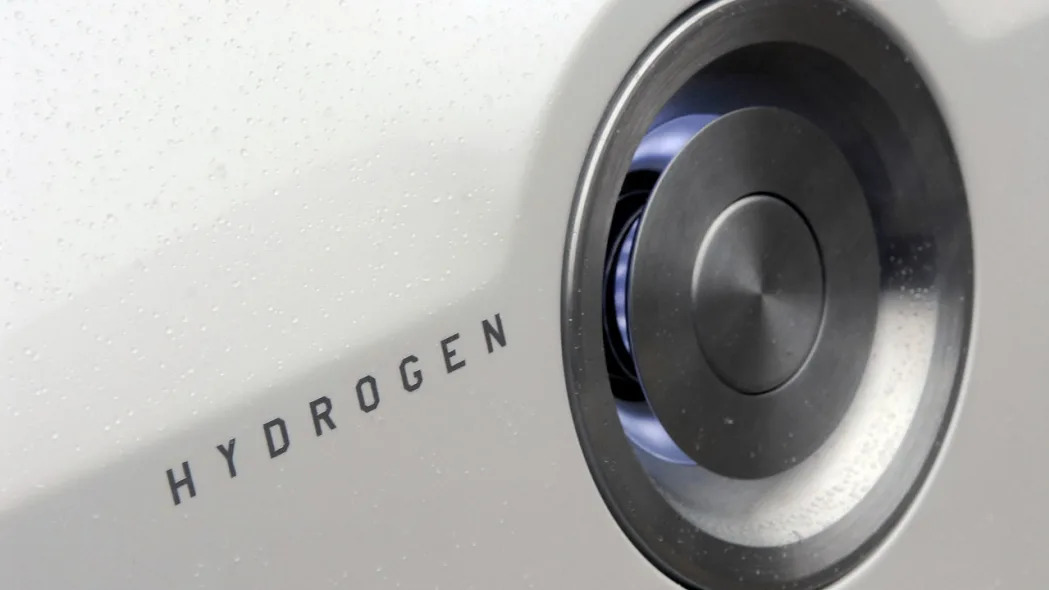
When the battery pack is depleted to approximately 40 percent, the hydrogen fuel cell – supplied by Ford partner Ballard – automatically turns on and begins generating electricity to recharge the batteries. Like a conventional automobile, the Ford Edge with HySeries Drive will go until it runs out of fuel – in this case via a 350-bar hydrogen tank that supplies 4.5 kg of useable hydrogen.
The HySeries Drive name is derived from the powertrain's structure: a hydrogen fuel-cell-powered series hybrid drivetrain. This highly innovative approach reduces the size, weight, cost and complexity of a conventional fuel cell system by more than 50 percent. It also promises to more than double the lifetime of the fuel cell stack.
This flexible powertrain architecture enables the use of new fuel and propulsion technologies as they develop and become available without the need to redesign the vehicle and its control systems.
Certainly, many significant technical hurdles need to be overcome before a vehicle such as the Edge with HySeries Drive can become a reality. Fuel cell vehicles remain expensive, costing millions of dollars each. And the single biggest hurdle to plug-ins remains the cost of lithium-ion batteries. Much work also needs to be done to make fuel cells more durable and to create a hydrogen infrastructure.
Hydrogen Part of a Broader Effort At Ford
Research into hydrogen, including the Ford Edge with HySeries Drive, is part of Ford's overall effort to address the challenges of climate change and energy independence. Ford is moving ahead with a range of technology solutions simultaneously, including vehicles such as the Ford Escape Hybrid and Mercury Mariner Hybrid, hydrogen fuel cells, hydrogen internal combustion engines, ethanol, clean diesel and refinements to gasoline fueled engines and advanced transmissions. Some of the technology, such as that seen in Ford's lineup of hybrid vehicles, represents near-term approaches. Other technology, including hydrogen fell cells, must be viewed as a long-term option.
Ford began working on hydrogen technology in the early 1990s. Ford's first hydrogen fuel cell vehicle, released in 2001, was based on a lightweight aluminum sedan body, which also was used in the development of the company's first hydrogen-powered internal combustion engine.
The company currently has a fleet of 30 hydrogen-powered Focus fuel cell vehicles on the road as part of a worldwide, seven-city program to conduct real-world testing of fuel cell technology. The fleet has accumulated more than 300,000 miles since its inception. With this fleet on the road, a great deal of information that can be integrated into future fuel cell vehicle propulsion systems is being generated in different local environmental conditions.
Having the fleet outside the confines of Ford Motor Company also has allowed the team to gain valuable feedback on servicing vehicles in the field. As a hydrogen infrastructure is developed and implemented for the fleet at each location, lessons learned are being generated to ensure that the customer and hydrogen fueling interface is seamless and customer friendly.

Sign in to post
Please sign in to leave a comment.
Continue