
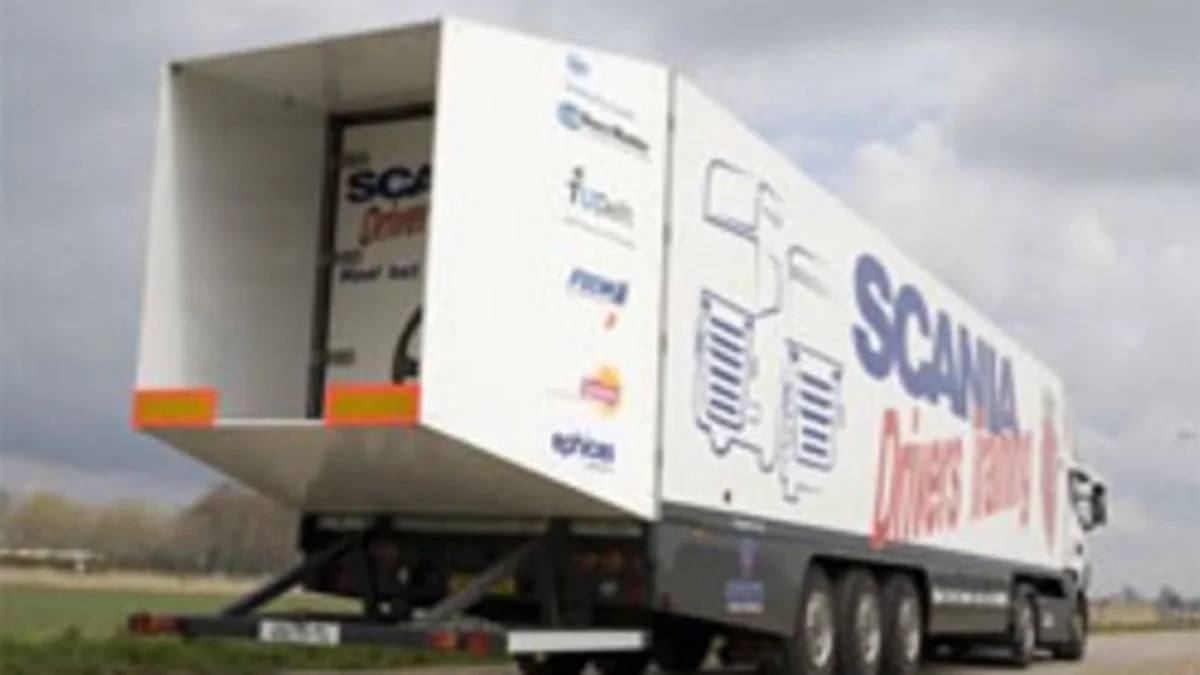
Why a boat-tail semi isn't as silly as it might sound
Sure, a six-foot protrusion sticking off the rear end of any vehicle is kinda funny looking. Unless we're talking about a Porsche 917/30 or a Plymouth Superbird. Those cars have some very fine rear extensions. Okay, fine – a six-foot protrusion looks a little bit weird when growing out of a semi-truck's rear. Happy?But a boat-tailed tractor trailer might be just what we need. Why? Because when fitted with such a piece of aerodynamic kit, total fuel-consumption reportedly drops by 7.5%. The tests in question were conducted by the Dutch PART (Platform for Aerodynamic Road Transport) public-private partnership platform on public roads. One truck without any aero-aid was driven around for a year, as was another truck with the boat-tail.
Not only did the boat-tailed machine get a 7.5% fuel economy bump, but at the same time, emissions were slashed by about the same margin. Even though these numbers are indeed promising, PART wants to figure out a way to reduce semi truck fuel consumption and emissions by 20%.
[Source: Science Daily]



Get a WordPress.com Blog


Reader Comments (Page 1 of 3)
feeboo 8:39AM (11/13/2009)
2 different trucks? These guys clearly aren't scientists then.
Reply
Swede 8:43AM (11/13/2009)
Where did you get that from?
"An articulated lorry was driven for a period of one year with a boat tail (of varying length) and one year without a boat tail. "
Aprime 8:51AM (11/13/2009)
This isn't a survey, for one.
For two, "One truck without any aero-aid was driven around for a year, as was another truck with the boat-tail."
One would think the lenght of the test alone and the fact that both trucks are the same would give scientific worthiness to the test. Of course there is no info available in regards to human error right now (if only two truckers partook in the test, if they swapped trucks, drove on the same roads during the same weather conditions or something similar), but you're calling out the test as invalid over the wrong elements. The addition of the ending is (keeping what I said in mind) guaranteed to provide near equal or superior benefits over time regardless of the tractor that's pulling it.
Aprime 8:55AM (11/13/2009)
Addendum: Swede apparently read the Science Daily text in its entirety, I only briefly scanned it. So basically it's already clear that the truck hasn't gone through the same elements - however we do not know if it had more than one pilot to add further validity to the test. Regardless, anyone with a minimum of knowledge of aerodynamics these days can attest to this concept's validity, it's basically a repetition of the teardrop design for cars applied to the semi - it reduces drag.
Jeffrey Smith 9:45AM (11/13/2009)
We have done these sort of test at Argonne National Lab's. They is a company in the US that makes a inflatable housing that goes on the back of the semi that we did simulation work with and verified with wind tunnel experiments.
“Commercial CFD Code Validation for Heavy-Vehicle External Aerodynamics Simulation,” W. D. Pointer, T. Sofu, D. P. Weber, in The Aerodynamics of Heavy Vehicles: Trucks, Buses, and Trains, pp473-483, R. McCallen, F. Browand, J. Ross editors, Springer (2004).
Swede 8:40AM (11/13/2009)
Longer and more fuel efficient trucks are the future. The 30-meters project here in Sweden is also showing increased fuel economy and reduced emissions. Applied on a large scale it also means less congestion.
Reply
notYou 10:08AM (11/13/2009)
"Longer and more fuel efficient trucks are the future. "
While trying to avoid the extrapolation-into-irrelevance trap, but doesn't that idea eventually just result in ...
trains?
Swede 11:39AM (11/13/2009)
One could say that. Trains are very underutilized so there will be a massive push to shift cargo from road transport to rail transport, but we will still need road transport at some stage in the process even in the future.
mk15 8:46AM (11/13/2009)
If it's available commercially, the next question is if it's legal and is it worth it. The length of most trailers are near or at the legal limit for length. I could see this on European-style trailers in the US though. Length limits for trailers in Europe are shorter than in North America. So equipping a boat-tail on a Euro-legal trailer in North America would not put the trailer over the legally allowed trailer length... But in Euro-style in Europe or typical-US-style trailers in North America, unless you shorten the trailer, is it worth it? Companies will have to give up cargo capacity to save 7.5% in fuel.
Another headache I just realized that the trailer door can be docked right at the dock.... the tail is in the way... how many facilities are going to deal with accommodating these kind of things? How would they load/unload? I would assume it would require the removal of the boat-tail and the "bumper" add-on. That wastes time and lowers efficiency, many trucks get to a facility load/unload and are gone almost as fast as they got there.
I don't see this being widely adopted. Getting extra efficiency is awesome, but I doubt people would want to put up with the annoyances.
Reply
Tohe 8:50AM (11/13/2009)
Rules are meant to be broken, laws are meant to be challenged.
fixitfixitstop 8:56AM (11/13/2009)
The tail appears to fold out of the way.
Swede 9:03AM (11/13/2009)
European combinations are limited to between 18,75 to 25,25 meters depending on where you find yourself within the EEC.
Obviously you cannot load or unload with the tail in place, according to the resarch material the tail retracts into the body. The researchers have also tested inflatable versions, they retract within 30 seconds.
James Sonne 9:55AM (11/13/2009)
You know, I would put money on diffusers lining the back edge of the trailer being somewhat effective and less likely to cause problems. They could be purchased as a "spike" strip and affixed to the rear in any number of ways (magnetic probably the number one), so the driver could move them to each trailer they haul.
Anyone know of any research on trailers with diffusers?
the4thheat 6:17AM (11/14/2009)
Maybe they can integrate the shape into the actual trailers somehow, but make it movable for loading/unloading. That way you don't have extra length not holding cargo (although I guess the very end you'd have to load a few less boxes)
Tohe 8:47AM (11/13/2009)
That is pretty cool. I'm sure it also helps reduce their wind tail. Sometimes, thinking outside the box is all it takes.
Reply
mk15 9:11AM (11/13/2009)
I am not saying it won't work, but I'm saying there's a lot of obstacles. If these things came to my warehouse I can see the tail being able to fold back, like doors, but the bottom part has to be removed, I can see the bumper tucking underneath through some mechanism so it can dock. But with reduced capacity, what took 5 trailers will take 6 or even 7 trailers... the 7.5% savings is partially mitigated.
So this is not something I can see used universally, but I can see it's value in situations where it can work.
The government could relax the limits on trailer length, then these trailers will have a harder time making turns at some intersections, to outright not being able to turn at certain places anymore because of the extra length. There are a lot of considerations to be made.
I'm all for fuel savings. I think the side skirts on the trailer seen in the picture is the first thing everyone should adopt.
Jared 1:22AM (11/14/2009)
Simple fluid dynamics tell you that this works physically.
As for economically, the peices could be made by the same cheap material the trailer is made from. And when its time to dock, the walls around the unloading area would push this twards the body of the trailer. Then all that would be needed is a simple one way actuator that could push one of the panels (interlocking with the others) back out when the truck leaves the loading/unloading bay.
ack154 8:51AM (11/13/2009)
I wonder how it affects the draft or aerodynamics of the cars behind them.
I think we need NASCAR to fire up their Draft Track and fill us in...
Reply
Visnick 9:01AM (11/13/2009)
I wonder how many cars will get taken out when that tail swings around at intersections?
Reply
Swede 9:04AM (11/13/2009)
Only people that run red lights or can't drive.