

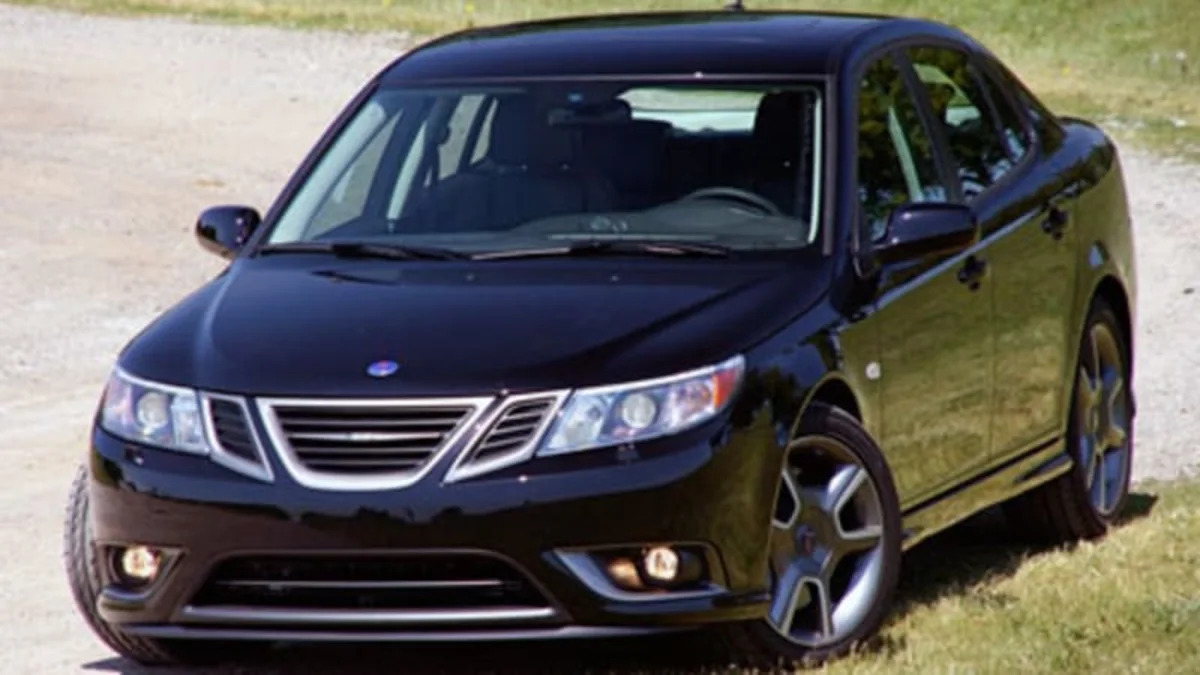
2008 Saab Turbo X – Click above for high-res image gallery
Turbocharging has been as much a part of Saab's DNA for the last three decades as jets. Saab didn't invent turbocharging, but the Swedish brand has probably embraced it more completely than other carmaker. With 2008 marking the 30th birthday of the first production Saab 99 Turbo, the gang in Trollhattan decided to celebrate with their meanest and fastest iteration yet. As we close out the 2008 model year, our Swedish friends are now starting to deliver the direct descendant of that first turbo, the 9-3 Turbo X.
Saab Turbos have come a long way over those three decades. The original 99 Turbo extracted 143 horsepower from its 2.0L four-cylinder engine to twist the front wheels. Most Saabs today are still powered by turbo four-cylinder engines driving those same front wheels. The Turbo X, however, adds two more cylinders and two more drive wheels. It also has nearly double the power and torque of that first effort. Fellow Autoblogger Dan Roth spent the day thrashing the Turbo X at a media preview a couple of weeks ago. We've now had the chance to spend a full week with Saab's newest baby in everyday use.
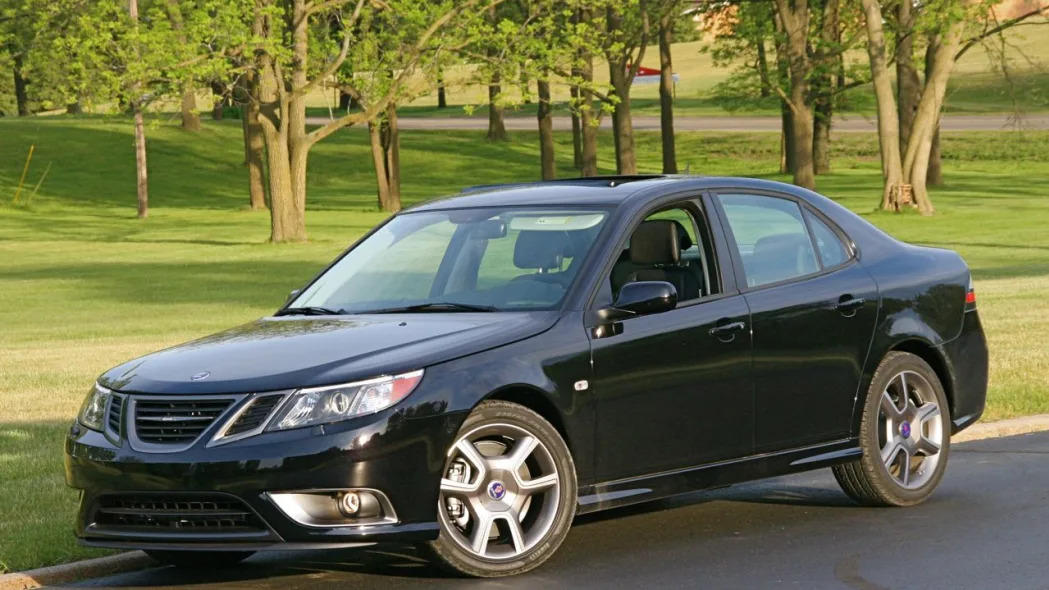
Photos Copyright ©2008 Sam Abuelsamid / Weblogs, Inc.
When press vehicles get shuffled off from one journalist to the next, occasionally things get bent or broken. Transmissions get destroyed, cars slide off on-ramps, and sometimes engines need repair. That means that the cars that we're scheduled to drive sometimes have to be canceled. Such was the case last week when the Audi TT we were expecting failed to arrive, leaving us trying to find a replacement for an upcoming weekend road trip. Fortunately, the GM press fleet manager called up less than 24 hours later to let me know the Turbo X had just arrived in the fleet. Barely 24 hours after that call I was signing for the keys to the sinister looking black Saab.
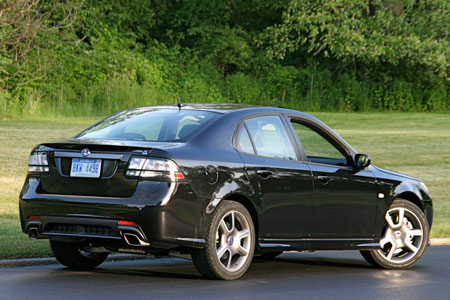
The Turbo X is the newest derivative of Saab's mainstream 9-3 lineup. The 9-3 is built on the same global Epsilon platform used for most of GM's mid-sized models. In addition to the 9-3, Epsilon is used for the Chevy Malibu, Saturn Aura, Opel Vectra and others. Although the next generation Epsilon II debuts this summer with the Opel Insignia, The Epsilon I used for the Turbo-X is still a fine architecture.

For 2008 the 9-3 got a major visual refresh, primarily in the front. The new face draws a lot from recent Saab concepts like the Aero X. The three port grille now looks much more aggressive and has more visual distinction than the previous edition.
Anyone familiar with Saabs of yore will feel instantly at home in the Turbo X. Like almost all Saabs, the key goes in the center console aft of the shift lever. By my fourth day with the Turbo X, I was almost consistently remembering not to reach behind the steering wheel. Unfortunately, the car that GM sent over was saddled with the six-speed automatic rather than the three-pedal shift-for-yourself gearbox. Saab does provide manual shift switches on the steering wheel, however, so you don't have to use the gear shift.

The air vents at the outboard of the dash and top of the center stack feature a little joystick in the middle that allow you guide the air where you want it to go. The temperature of the air coming out of those vents can be individually managed and automatically regulated for each of the front seats via the knobs lower down on the stack. Unlike many other current the GM products, the On-Star buttons are located just above the climate control knobs instead of on the rear view mirror. Front and center in the top of the stack is the same standard issue double-Din radio used on most other mainstream GM models like the Malibu and Aura.
At a starting price of nearly $42K you might think a head unit with a nav system should be a standard offering, but as is so often the case, that's a $2,145 extra. Regardless of its feature set, the standard radio sounds decent and is straightforward to use. As in all other applications of this unit, it also has the standard 1/8" plug on the front allowing you toplug in your iPod or other audio player (for the four of you out there using some other brand).


Aside from the odd-ball location of the key, the only other quibble we had with the interior layout was the location of the release for the steering wheel adjustment. The wheel is adjustable for both reach and rake. Unfortunately, the release is so far down the column, that after making an adjustment and trying the re-lock it, the steering wheel usually ends up moving again.
One button unique to Saabs is the Night Panel switch. Pressing the button at night switches off all the dash lighting except for the speedometer and even switches off the tachometer. Another thoughtful feature of the interior is the ribbed rubber inserts in the bottom of the storage cubbies in the center console. Cell phones and iPods placed in these compartments no longer slide around when cornering.

One element that certainly can't be faulted on the 9-3 is the seats. They were extremely comfortable over a three and a half hour drive from Ann Arbor to Yellow Springs, OH. Up to three combinations of seat and mirror positions could be stored in memory, which was handy as the test unit had an odd quirk that was likely a software bug. Every time I got out of the car and closed the door, the driver side mirror dipped down to look at the ground. Being able to just press the memory button restored it back to it's previous position. Once correctly positioned though, the Saab seats do a great job of keeping the driver correctly oriented during hard cornering allowing full mental effort to focused on positioning the car instead of the posterior.
Mechanically, the main thing that distinguishes the Turbo X from its lesser 9-3 siblings is the higher output 2.8L turbocharged V6. Compared to the Aero, the X picks up an extra 25 hp and 32 lb-ft of torque (now at 280hp and 295lb-ft). This engine is a smaller displacement variant of the 3.6L high feature V6 used in a range of GM products worldwide and, as always, it's smooth running and in this form has plenty of torque in the meat of the rpm range.

Unfortunately, if you're cruising along with the revs at around 2 grand, a quick stab at the throttle incites a momentary pause as the turbo spins up to generate some boost. Once that happens though, the Turbo X just leaps forward and takes no prisoners. The single turbo layout and lack of direct injection are probably to blame for the lag here. Getting more power typically requires a bigger turbo to generate more boost, and the resulting increase in inertia usually brings with it lag.
Hopefully next time around GM will see fit to use two smaller turbos that spin up faster and still generate the same or more combined boost. Migrating the direct injection system from the bigger 3.6L in the Cadillac CTS would also help as the engine could then run higher compression without risking knock. That would further fatten the bottom of the torque curve and improve overall responsiveness.

That responsiveness wasn't helped by the automatic transmission, at least in its default mode. The programming obviously was optimized to get the utmost out of the EPA driving cycle and wanted to keep the engine revs down. When pulling out to pass it wasn't particularly inclined to downshift and launches were less than thrilling.
Conveniently, Saab actually builds in a very simple solution to this behavior. Next to the radio is a button labeled with an 'S' and a little gear shift icon. A quick press of the button switches the transmission shift logic to Sport Mode and makes it behave the way a performance-oriented driver would row a manual box. Shifts are sharper and happen NOW. The other thing it does is downshift during decceleration inducing some engine braking. The result is that on corners the transmission is now in something closer to the optimum gear for accelerating out the other side. If someone could just figure out which bit to flip in the powertrain control so that sport mode was the default when starting the car, it would be much more in keeping with the character of the car.

Easily the most annoying aspect of the Turbo-X is the exhaust note. It's not annoying all the time, just in the range from about 2,000- 2,400 RPM. Like far too many "sporty" cars today, the exhaust has a droning sound in that range. Above and below that range the tone is fine, but in that region it has a constant low frequency sound that is just plain awful. It's not like a rumble or roar that implies power, but more like the coffee can mufflers you find on so many tuner cars.
This might not be a problem were it not for the fact that 70 MPH in 6th gear equates to about 2,100 RPM. That means that cruising at the legal speed limit on most American highways subjects occupants of the car to this sound. I did find a work around, though. Popping the shifter into manual mode and downshifting to 5th brings the speed up to 2,500 RPM and the sound magically disappears along with some extra gas.


While I didn't have the opportunity to really thrash the Turbo X on a track or push it too hard on the road, the cross-wheel-drive system demonstrated its worth every time the car accelerated. Even with all that power, the Turbo X never exhibited even the slightest hint of torque steer. Like Acura's Super Handling-All Wheel Drive and BMW's xDrive, the Haldex system vectors torque to the wheels not only with the most grip, but also to help the car go in the direction that the driver is requesting. Signals from the stability control system are fed to the drive control, which helps reduce the need for braking the wheels and also cutting engine torque.


Accelerating through corners or on-ramps, the Turbo X always felt neutral and went directly where it was pointed. For a sporting car like this, the Turbo X has a good ride for everyday commuting without pounding the occupants. During my driving, the car averaged 22 mpg, which probably would have been 1-2 mpg more if I had left the transmission in 6th on the highway. Saab claims a 16.2-gallon fuel tank, but before I filled the tank the gauge was reading empty and the cluster showed a distance to empty of 10 miles. However, the tank would only take 13.7 gallons. Since I wasn't inclined to drive the car until it died, I'm not sure if the gauge was just being really conservative or there is an error somewhere.
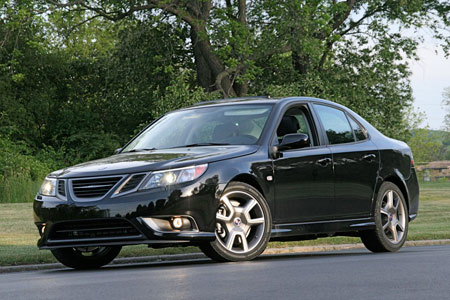
Overall, the Saab Turbo X is a fun car to drive and, aside from the exhaust note, is a great long distance cruiser. The only option missing from this car was the nav system, while the automatic transmission, Touring and Cold Weather packages bring the bottom line to $45,305 including destination charges. You can get the Turbo X in Jet Black Metallic, Jet Black Metallic, Jet Black Metallic, or Jet Black Metallic. Is it worth $45K? Only the buyer can decide, but for Saab-o-philes or anyone looking for a fun sport sedan, it's certainly an eminently viable option.
Photos Copyright ©2008 Sam Abuelsamid / Weblogs, Inc.

Sign in to post
Please sign in to leave a comment.
Continue