click above for a new high-res gallery of the 2009 Cadillac CTS-V
This week the Cadillac communications crew invited a group of media out to General Motors' Milford Proving Ground for a special preview of the new second-generation Cadillac CTS-V. We first saw the CTS-V last January at the Detroit Auto Show and more information has been dribbling in the intervening time period. A few weeks back, GM's resident speed demon engineer John Heinricy took a production spec CTS-V to an all-time lap record of 7:59.32 for a production sedan at the Nürburgring, and this week Cadillac revealed the official SAE certified power numbers for the super-Caddie at 556 horsepower and 551 pound-feet of torque.
When we got to Milford our handlers took us out to a tent by the Lutz-ring test track where we found three CTS-Vs and various displays of the hardware contained within. Heinricy was on hand as well to tell the tale of the "fast lap" last month. For those who may not have been paying sufficient attention over the past 6 months, the CTS-V is GM's answer to all those German uber-sedans like the Mercedes E63 AMG, Audi RS4 and RS6 and, of course, the one that started the madness, the BMW M5. Read on after the jump to learn more about what makes this Caddie so special and what it was like to go for a ride.
BONUS: Four videos after the jump, including burn-out runs from both inside and outside the new 2009 Cadillac CTS-V.
When I was in Kindergarten, I rode Bus 11. It was an oil-burning 32-passenger GMC that was ready for retirement by 1982. It was driven by Sarge. I'm not sure why she was called Sarge, but her demeanor definitely lived up to the moniker. Frequent exhortations to"SIT DOWN AND SHUT UP" kept us all in line. Nobody ever laughed when she ground the 2-3 upshift. Think you'd enjoy ruling passengers with an iron fist? You could go get the endorsement on your license and then hit the job market, or if that takes too much effort, just buy Bus Driver, the video game.
Hey, at least it's still a driving game, but it's the staid, responsible version of gaming. Rather than speed around a track or create mayhem, your mission is to follow routes in your school bus, city bus or tour bus while picking up and dropping off fares. What fun, the replays must be enthralling. It could be worse, though – it's still a wheeled conveyance you're controlling rather than some Wiimote-powered silliness. We do wish that Meridian4, the game's publisher, had included the DeLorean bus that never got off the ground.
Check out this music video for Lacquer's Behind. Maybe some of you will scoff at it being featured here on Autoblog, but it speaks to motorists, adventurers and travelers who like voyages on America's highways and byways. It starts with an old convertible parked at the Pacific Ocean, and turns into a journey across our continent. Coast to coast the driver covers the whole of the USA in under four minutes with the use of some snappy time-lapse photography, as directed by filmmaking brothers Michel (Be Kind Rewind, Eternal Sunshine of the Spotless Mind) and Olivier Gondry. Beautiful scenery and gorgeous skylines abound, as well as some good music. Thanks for the tip Mark!
In an effort to thwart habitual speeding, Transport Canada has developed a new system that can make exceeding posted limits difficult or impossible. The device utilizes GPS and a speed limit map coupled with technology that caps a vehicle's top speed based on the legal speed of the road being traveled. Once the vehicle arrives at the predetermined speed limit, the device makes it very difficult to go any faster. For now, Canada is looking to slap this stingy speed governor on the vehicles of perpetual speeders and reckless drivers, but the technology could one day be used for all drivers. Lovely.
Luckily for drivers here in the States, a strict speed limit governor is just un-American, and legislators know it would be very unpopular politically suicidal to implement. Still, we're sure there'd still be some people willing to embrace technology like this. Heck, a lot of parents of 16 to 18 year-olds probably wouldn't mind purchasing this device to keep their teenagers in check.
Click above to see how "teen-friendly" the smart fortwo is.
We all know what teenagers do in the back seats of cars, don't we? Since the smart fortwo only comes with two seats, it's something that any parent will never have to worry about. And Dave Schembri, SmartUSA president, wanted to put everyone's fears to rest when he said, "After all, what better car to have for your teenager than one without a backseat."
But Schembri was actually talking about the far more dangerous backseat activity for teens: distracting the drivers in the front seats. (I don't know what else you might have been thinking). Since more than one accident has been caused by a rowdy -- or just plain distracting -- group of kids on the rear bench, it's another thing fortwo drivers won't have to worry about on the commute.
In light of the "backwards-travelling wave" that researchers recently discovered as a cause of congestion, another study has pinpointed a possible major contributor. The University of Utah's Traffic Lab uncovered that drivers paying more attention to yapping on their phone – hands free or not – add to the suffering of us all. Talking while driving leads to drivers who take considerably longer to change lanes when following slow-moving vehicles, drive slower overall, and take longer to arrive at their destination.
Any benefits from slower speeds and more deliberate movements are mitigated by the distraction of a conversation. Thinking along the lines of chaos theory, even the small slowdowns created by poky drivers can grow into exponentially larger traffic problems quickly. Then, when we're all stuck in the stop and go, we call someone else and bitch about how bad the traffic is. Sounds like what they've really discovered in Utah is the fuel for a perpetual motion machine. Car stops, jaw continually flaps.
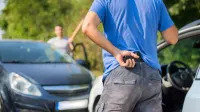
So, this guy in Australia is all offended because he was mocked in a manner promoted by an anti-hoonage advertising campaign. He was so offended, in fact, that he hurled a water bottle at a woman's car and promptly got himself charged with malicious damage. Since nothing can ever be anyone's fault, the Sydney man is blaming his behavior on the Roads and Traffic Authority's anti-speeding campaign in Australia that diminishes any macho cachet surrounding risky traffic moves by showing wagging pinky fingers, implying the behavior is compensation for, well, you know.
Simon Jardak received an AUS$400 fine, but contends that the wiggling pinky gesture his victim made was akin to sexual assault, and enraged him far more than her flashing her headlights and using other common rude gestures. Whatever, dude. Are you that insecure? If you're having a gestural fight with another driver while rolling down the highway, you deserve whatever rudeness you get. What amounts to a schoolyard taunt certainly doesn't deserve having things hurled at your car. Perhaps Mr. Jardak needs to cool his temper a bit – we can certainly imagine that anyone reckless enough to engage in an argument on the road and throw things at other cars might not be the most responsible driver.
Here's a news flash: traffic is a huge waste of time for commuters mired in rush hour gridlock. A recent study by the Texas Travel Institute unearthed some startling statistics concerning traffic, and everybody, including state and local governments, is paying huge.
On average, drivers spend 38 hours per year in traffic, which translates into 2.9 billion gallons of wasted fuel. If you live in L.A., 72 hours per year are thrown out the window as a result of congestion. Due to the strain that 2.9 billion additional gallons of gasoline puts on the volatile refinery market and all the lost revenue caused by the delays, about $78 billion goes down the drain each year.
The study puts much of the blame on an infrastructure that hasn't grown much over 50 years, even as the amount of drivers on the road has exploded. Commuters are also putting more distance between themselves and their typical destination. It'd be a welcome sight for our government to spend as much energy increasing the bandwidth of our roads as it does imposing challenging fuel economy standards on automakers. The economy could use the extra jobs created by the needed construction work, and our environment could use a break from all the carbon coming from drivers with their foot on their brake.
Michael Wiley lost his arms and most of his left leg in an electrical accident when he was 13. He didn't let the lack of limbs stop him from getting his driver's license or driving. His toes handle starting, his knee is on shifting duty, and his stumps do the steering. He turns on the lights with his teeth. He also didn't let it stop him from the kind of spirited piloting that includes leading police on high speed car chases, having his license suspended numerous times, and racking up enough felonious driving charges to spend three years in jail. He's even kicked a state trooper.
His latest trick: speeding off in an Explorer, leading police on a high speed chase -- and eluding them. Finally caught and taken to court, he was sentenced to five years in jail for felony driving and drug charges. Now Wiley says his driving days are over: "I'm beat. The white flag is up." For a man with one limb, it's a pretty incredible record.
For drivers between the ages of 16 and 24, the price of insurance can seem more than a little unfair. While $125 per month could insure a luxury vehicle for someone in their 30s, a 16 year-old couldn't get such a rate for a Pinto. There's a very simple reason for this disparity; young motorists are by far the most dangerous drivers on the road. A study by the Rand Corporations shows that while 13-percent of all drivers are between the ages of 16 and 24, 43-percent of all accidents come from that age group. It's a good thing everybody seems to be on the phone while driving, it may not hurt as much when you don't see that pimped out Neon coming.
While young drivers are an accident waiting to happen, those over the age of 65 are much safer than their unearned reputation may suggest. Senior citizens make up 15-percent of all drivers, but only cause 7-percent of the total accidents. Maybe it's because people are a little more careful when they see a Crown Victoria on the road, but that AARP discount appears to be well-deserved anyway. Next time you're on the freeway and you see a Buick Roadmaster in the right lane, get behind it, it's probably one of the safest places on the road.