
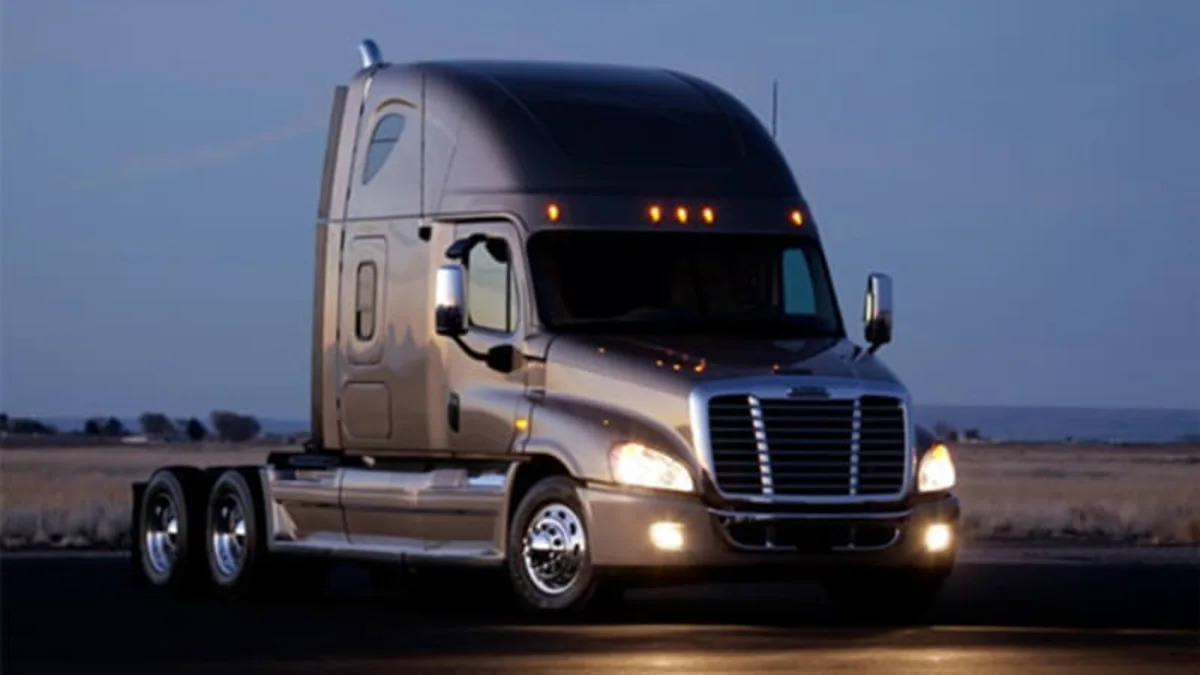
Freightliner debuts RunSmart Predictive Cruise Control

The next step in cruise control comes courtesy of Freightliner semis and GPS data company NAVTEQ. Freightliner broadened communication between the cruise control and map data: the GPS transmits information on the road ahead up to a mile, and then the cruise control computes the best speed at which to cover the distance with the greatest fuel efficiency.
It's called RunSmart Predictive Cruise, and it employs slope data from the NAVTEQ system that has been collected on 200,000 miles of the most used truck routes. While RunSmart is looking for peak efficiency, it won't sacrifice speed; the system remains within 6% of the set speed. It's an available option on Freightliner's Detroit Diesel DD15-equipped Cascadia model with the 72-inch raised roof.
[Source: Daimler]



Reader Comments (Page 1 of 1)
Hike15 1:39PM (3/22/2009)
im surprised mercedes doesnt have this in their crazy cruise control which basically follows the car in front of it
Reply
Zach 1:58PM (3/22/2009)
They'd just need to partner with someone that has the slope data. This has always been the downside of cruise controls, they'll be stupid enough to spend gas to get you up a hill, but then ride the brake back down.
sonic the plumber 1:45PM (3/22/2009)
Autoblog, you're going to have an angry mob of truckers after you for revealing this secret of the trade. You shouldn't have challenged that trucker to eating a massive steak or you'd not be in this mess now. ;)
Reply
Andrew L 1:48PM (3/22/2009)
haha great episode!
JL 4:35PM (3/22/2009)
ahahahah, yep
so now we finally discovered the Navitron Autodrive System parental company:
NAVTEQ
Edmond Dantes 4:24PM (3/22/2009)
Does it help with the 16 gears?
Reply
twonius 6:36AM (3/23/2009)
This is a pretty standard model predictive controller, so yes it could provide some advice to the driver on which gear to select or if it had an automanual it could select it itself.
Edmond Dantes 10:44PM (3/24/2009)
I have a ton of respect for any driver who can manage that many gears all the time.
twonius 6:40AM (3/23/2009)
Anyone notice that in the release there's no predicted average fuel savings?
Reply
keep the change 12:39PM (3/23/2009)
If this is about saving fuel, there is no need to predict anything. The cruise control needs to be governed, not by the speed of the wheels, but by the fuel flow - to within 6% of the current set speed. Simple. On the way up a hill, the speed is sacrificed to maintain fuel flow, on the way down the hill, the flow is cut to maintain speed. Call it flow control.
Reply
twonius 6:56PM (3/23/2009)
assuming you maintain air fuel ratio, then you're talking about maintaining a fixed air flow.. which you achieve by maintaining the same throttle position (or setting an upper bound on the cruise controller). As for going down hill, a conventional cruise controller would probably go almost to idle if the vehicle was going faster than its set point.
Good thought process but it's a little more complex problem than that.
warning: engineering description of Model Predictive Control follows:
what this system probably does is model what the fuel flow will be based on maintaining its speed (within bounds) over the next mile. The total fuel consumption is then added up. It may also look at the maximum change in throttle input in order to avoid making an sudden moves. Adding these together forms whats called a cost function. From there an optimization is performed trying to minimize the total cost cost function over the next mile (prediction horizon), so it will plan its throttle inputs for the next let's say 100m (this is called the control horizon).
Since it can't predict what the wind will be or whether the driver will have to brake etc. It re calculates this optimum throttle input sequence at every time step (around a second, or perhaps less), and then takes the first throttle input from that sequence, measures its speed and re calculates at the next time step.(receding horizon)
lets say you're nearing the top of the hill at your desired speed, the system will know since you're about to start going down hill that you can coast over the crest without going below your lower bound and then begin coasting down the hill.
If you coupled this with a start-stop feature you could conceivably shut down the engine on long downhill grades.
If enough data became available it might even be able to time stop lights, or avoid scheduled train crossings.
keep the change 7:18PM (3/23/2009)
Well it should be as simple as I suggested. I had a car with a fuel flow meter, an HHR. I monitored it religiously. When going up a hill, the fuel flow increased to maintain speed. If I would have disconnected the cruise control, and kept my foot on the gas pedal with the same pressure as before climbing, I could have maintained the same fuel flow as when I was on level ground. In fact, I did it as an experiment.The cruise control could have been programmed to do that just as maintain speed. Instead it needed to be done manually.