

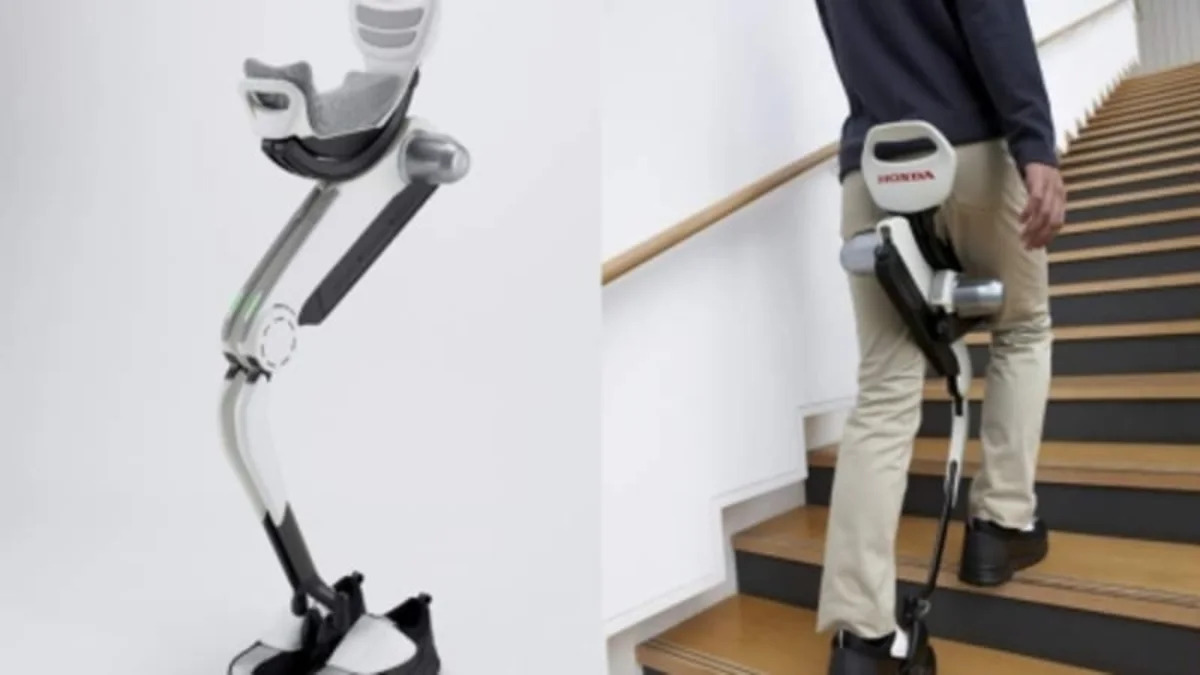
Click above for more shots of the Honda Walking Assist Device
Those who have difficulty walking may not be bound to a Segway for like thanks to Honda. The Japanese automaker is developing a new technology called the experimental walking assist device. These accessory legs have been designed as a means to offer a helping, um... leg to those who have difficult supporting themselves in day-to-day life but are capable of walking without assistance. Ongoing research for Honda's humanoid Asimo project spurred the robotic leg development, which began in earnest way back in 1999. Honda is now testing the legs at one of its Japanese factories in Sayama, Saitama.
To use the legs, the wearer slips on the special (and extremely stylish) shoes and adjusts the seat so that it supports their weight. Two motors move the frame and seat position while lithium-ion batteries keep the system powered for about two hours on a full charge. Are we the only ones who think Honda's new toy looks like the lower half of a Star Wars droid? OK, just checking.
[Source: Honda]
PRESS RELEASE:
Honda Unveils Experimental Walking Assist Device With Bodyweight Support System
Honda Motor Co., Ltd. today unveiled its second experimental walking assist device that helps support bodyweight to reduce the load on an individual's legs while walking, going up and down stairs, and in a semi-crouching position. The device is designed for people who are capable of walking and maneuvering on their own, but who can benefit from additional leg and body support while performing tasks. Honda will now begin testing the device in real-world conditions to evaluate its effectiveness.
The new walking assist device with the bodyweight support system reduces the load on leg muscles and joints (in the hip, knees, and ankles) by supporting a portion of the person's bodyweight. The device has a simple structure consisting of seat, frame, and shoes, and the individual can put it on by simply wearing shoes and lifting the seat into position. Moreover, a mechanism that directs the assisting force toward the user's center of gravity and the ability to control the assist force in concert with the movement of the legs - both unique Honda innovations - make it possible for the device to provide natural assistance in various postures and motions.
Honda began research on a walking assist device in 1999 with the goal to provide more people with the joy of mobility. The first walking assist device, announced in April 2008, has a stride management system and was designed for people with weakened leg muscles, due to reasons such as aging. The research and development of Honda's advanced humanoid robot, ASIMO, including the study of human walking, provided Honda with the knowledge necessary to develop the walking assist device. This research has been conducted by the Fundamental Technology Research Center of Honda R&D Co., Ltd. in Wako, Saitama. To evaluate the effectiveness of the experimental model of the walking assist device with bodyweight support system, Honda will test the walking assist device at its Saitama Factory (in Sayama, Saitama) starting this month.
Key Features:
* Convenient sitting-type device
o The individual simply needs to wear shoes and raise the seat into place.
o The user can benefit from the assist without belts fastening the device to their body.
o The structure to position the device between the individual's legs minimizes the required footprint, therefore making it easier for them to maneuver.
* Method to assist bodyweight support
o The device will support a portion of the person's bodyweight by lifting the seat as the frame between the shoe and seat bends and extends, just like knees, with the force from the motor. As a result, the load on leg muscles and joints (in the hip, knees, and ankles) is reduced.
o Honda developed a unique mechanism where the seat and frame follow the movement of the body and legs. The assisting force will be directed toward the individual's center of gravity, just as with human legs, which enables the device to provide assistance in various movements and postures including walking, going up and down stairs, and in a semi-crouching position.
* Natural control of the assisting force
o Natural walking is achieved by changing the amount of assisting force applied to the right and left legs through the control of two motors based on the information obtained though sensors imbedded in the shoes of the device.
o The effectiveness of the device was increased in those motions and postures which put increased load on knees, such as going up and down stairs and in a semi-crouching position. This was achieved by adjusting the assisting force in accordance with the bending and stretching motion of the knees.
Key specifications of experimental walking assist device with bodyweight support system:
Weight: 6.5kg (including shoes and batteries)
Drive system: Motor X 2
Battery pack: Lithium ion battery
Operating time per charge: 2 hours (including walking and in a semi-crouching posture, etc.)
Suitable height of the user: Within plus or minus 5cm of the set height (Example: set height for Medium size is 170cm)

Sign in to post
Please sign in to leave a comment.
Continue