
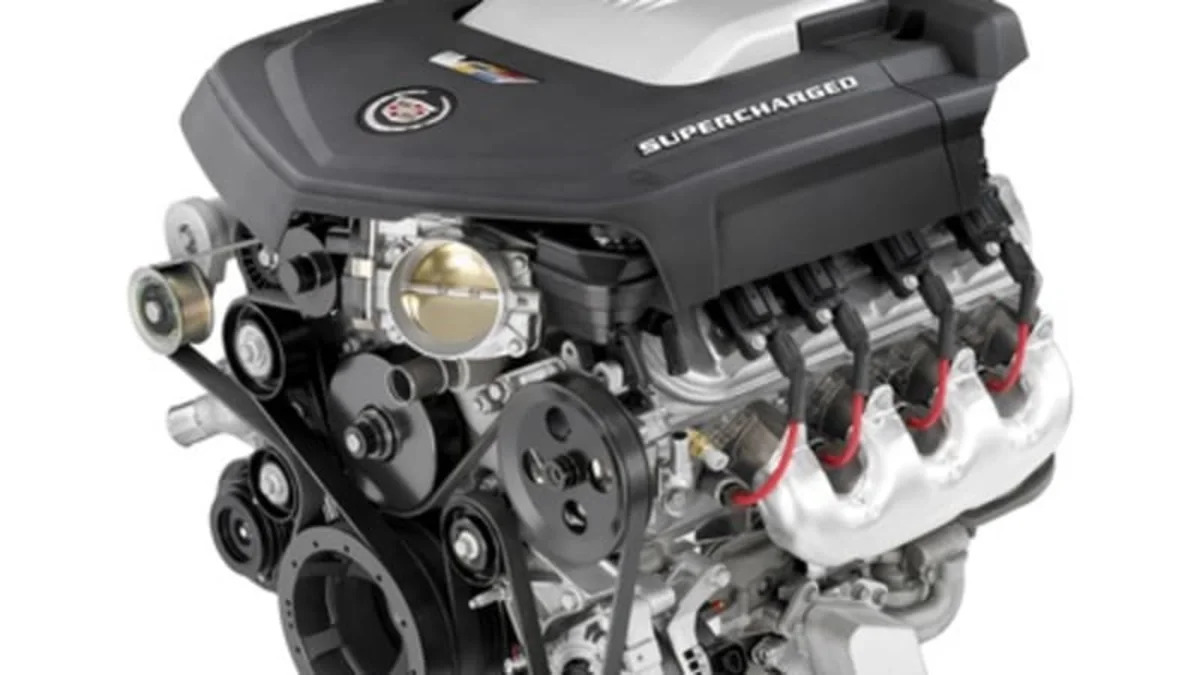
High gas prices mean more superchargers. We're okay with that

Click above for more shots of the GM LSA V8 and its Eaton supercharger
The ongoing debate between the supercharger camp and the turbo boys isn't likely to die along with large, fuel-thirsty performance engines. In fact, Eaton believes that the market for both power-boosters will continue to grow at an extremely fast pace along with the rising price of gas. Because manufacturers are looking to downsize their engines, power-adders like the supercharger are becoming increasingly necessary in order to deliver the kind of performance new car buyers have come to expect along with the low fuel consumption that is becoming increasingly necessary.
Unlike the high RPM power generally associated with heavily-boost turbocharged engines, superchargers produce added power at all engine speeds. The downside is that engine power is used to drive the compressor, which reduces the available power gains somewhat. In order to make up some of that lost power, Eaton is developing variable-speed superchargers, which will allow for good power from idle through redline with a reduced strain on the engine. For our part, we fully support the use of both turbochargers and superchargers on any and all new cars. Solely in the name of fuel economy, of course.
Gallery: Detroit 2008: GM LSA V-8
[Source: Automotive News - sub. req'd]



Reader Comments (Page 1 of 4)
s13hybrid 3:09PM (7/28/2008)
Exciting new times. This fuel problem is really making things change for the better in my opinion. To bad I am a poor student that wont be able to purchase these new cool cars, let alone save any money because of gas prices. I can't wait to graduate!
Reply
MachinaDC5 3:25PM (7/28/2008)
I'm with ya, buddy.
azzo45 5:11PM (7/28/2008)
I might get killed by engineering gurus... but how the hell is SC more fuel efficent than a turbo???
I had a 2004 Mini Cooper S, obviously a small SC'd 1.6L motor & I wouldn't call it a "great" on gas (considering the car's weight & overall size, etc).
I'm all for keeping performance but I have never owned a SC or TC car that I'd call a mileage champ.
MikeW 5:50PM (7/28/2008)
The Neon engine sucked.
Single camshaft, no VVT (by definition), no VCT, Hell only two ignition coils.
The turbo, VVT (intake), direct injection engine is way better.
azzo45 6:18PM (7/28/2008)
MikwW: The Mini engine was NOT the neon motor... the neon motors were the 2.0, 2.4L turbo (SRT-4) & a 1.8L for the BUX (european) Neons.
The 1.6L was a Chrysler BMW joint venture. The Chrysler PT used the non SC version... Mini's SC engine had things they did NOT share with DCX.
Crackberry Addict 6:25PM (7/28/2008)
I guess thats what i have to look forward to. Im about to start college in 4 weeks! Bitter-Sweet
MikeW 7:21PM (7/28/2008)
Yes I know it wasn't an actual neon engine. {I should have put Neon* type engine)
timing belt, reverse firing (two spark plugs), iron block, more chrysler than bmw.
jgp 8:38PM (7/28/2008)
The 1.6L Tritec was just a small-block version of the Neon engine. Same engine, but with less space between the bore centers and thus a smaller block.
The engineering was entirely performed by Chrysler; BMW just provided funding.
azzo45 10:45PM (7/28/2008)
jgp: BMW did more than fund it & trust Chrysler to produce the motor. I had a friend who worked for Tritech, lived in Oxford, England & worked/ consulted with mostly BMW staff on the SC part of the engine especially.
Chrysler's SOHC & especially the DOHC was not a well designed/ engineered small motor... reflecting poorly on the neon's overall quality ratings/ consumer confidence.
I doubt BMW would just put blind faith & a production budget behind the Chrysler team. Sorry!
Rocketboy 6:22AM (7/29/2008)
Well, a variant on the NA engine WAS used in the EU Neons. But regarding gas mileage with the SC version of the MINI engine, it wasn't built with gas specifically in mind. Also, keep in mind that this article is more about adding a supercharger vs. more cylinders. Which can be a very good thing.
P.V. 3:09PM (7/28/2008)
Can someone please explain to me the difference between a supercharger and a turbocharger? I am in the dark on this one.
Reply
Jeremy Korzeniewski 3:13PM (7/28/2008)
P.V. -
Both use compressors to force more outside air into the combustion chambers, increasing power. A turbo uses spent exhaust gases to spin the turbine, a supercharger uses a direct connection to the engine's crank to spin the compressor.
Hope that helps.
JK
s13hybrid 3:13PM (7/28/2008)
Supercharger = Belt driven
Turbo = exhaust driven
Jeremy Korzeniewski 3:15PM (7/28/2008)
forgot to add, a turbo will ALWAYS make more peak power, as it does not draw power from the engine to spin. However, when a turbo is set up for max power, it generally falls flat down low.
A supercharger will never make as much peak power, but makes an improvement across the entire rpm range.
Let the debate rage on...
JK
KeatMP 3:20PM (7/28/2008)
I'll take a wack at explaining.
The only thing superchargers and Tubochargers have in common is that they both force more air into the engine, making more power.
The supercharger does this by using belt driven screws that twist in a way that forces air in-between them and into the engine. The donwside of a supercharger is that it takes some power away from the engine directly because is it belt driven. The upside of this design is that you have added power at any RPM.
A turbocharger makes power from the exaust and is made up of two turbines, one from the exaust, one from the intake. The exaust spins one turbine, causing the the directly attached intake turbine to spin, forcing more air into the engine. The dowside of this design is that there is a "lag" of power, as the turbocharger needs to "spool up" to start making power at the higher RPM range. The advantage if the turbo is the increased efficiency as the turbo does not take power directly away from the engine to make more power.
Hope this helps.
Corey W. 3:34PM (7/28/2008)
This is just some basics from the net, but in speaking with people who are actually experienced in this stuff have told me, anyone who tells you one is better than the other, without application specifics, usually don't know what they're talking about.
Let's start with the similarities. Both turbochargers and superchargers are called forced induction systems. They compress the air flowing into the engine. The advantage of compressing the air is that it lets the engine stuff more air into a cylinder. More air means that more fuel can be stuffed in, too, so you get more power from each explosion in each cylinder. A turbo/supercharged engine produces more power overall than the same engine without the charging.
The typical boost provided by either a turbocharger or a supercharger is 6 to 8 pounds per square inch (psi). Since normal atmospheric pressure is 14.7 psi at sea level, you can see that you are getting about 50-percent more air into the engine. Therefore, you would expect to get 50-percent more power. It's not perfectly efficient, though, so you might get a 30-percent to 40-percent improvement instead.
The key difference between a turbocharger and a supercharger is its power supply. Something has to supply the power to run the air compressor. In a supercharger, there is a belt that connects directly to the engine. It gets its power the same way that the water pump or alternator does. A turbocharger, on the other hand, gets its power from the exhaust stream. The exhaust runs through a turbine, which in turn spins the compressor.
There are tradeoffs in both systems. In theory, a turbocharger is more efficient because it is using the "wasted" energy in the exhaust stream for its power source. On the other hand, a turbocharger causes some amount of back pressure in the exhaust system and tends to provide less boost until the engine is running at higher RPMs.
A supercharger is mounted to the engine and is driven by a pulley that is inline with the crank (or accessory) belt. Air is drawn into the supercharger and compressed by either an impeller (centrifugal-style supercharger), twin rotating screws (screw-type supercharger), or counter-rotating rotors (roots-type supercharger). The air is then discharged into the engine's intake. Faster crank speed (more engine rpm) spins the supercharger faster and allows the supercharger to produce more boost (normally 6 to 9 psi for a street vehicle). Typical peak operating speeds for a supercharger are around 15,000 rpm (screw-type and roots style superchargers) and 40,000 rpm (centrifugal-style superchargers).
A turbocharger operates in much the same way as a centrifugal (internal impeller) supercharger, except it is not driven by pulleys and belts attached to the engine's crank. A turbo is instead driven by exhaust gasses that have been expelled by the engine and are travelling through the exhaust manifold. The exhaust gas flows through one half of the turbocharger's turbine, which drives the impeller that compresses the air. Typical operating speeds of a turbocharger are between 75,000 and 150,000 rpm.
Cost:
The cost of supercharger and a turbocharger systems for the same engine are approximately the same, so cost is generally not a factor.
Lag:
This is perhaps the biggest advantage that the supercharger enjoys over the tubo. Because a turbocharger is driven by exhaust gasses, the turbocharger's turbine must first spool up before it even begins to turn the compressor's impeller. This results in lag time which is the time needed for the turbine to reach its full throttle from an intermediate rotational speed state. During this lag time, the turbocharger is creating little to no boost, which means little to no power gains during this time. Smaller turbos spool up quicker, which eliminates some of this lag. Turbochargers thus utilize a wastegate, which allows the use of a smaller turbocharger to reduce lag while preventing it from spinning too quickly at high engine speeds. The wastegate is a valve that allows the exhaust to bypass the turbine blades. The wastegate senses boost pressure, and if it gets too high, it could be an indicator that the turbine is spinning too quickly, so the wastegate bypasses some of the exhaust around the turbine blades, allowing the blades to slow down..
A Supercharger, on the other hand, is connected directly to the crank, so there is no "lag". Superchargers are able to produce boost at a very low rpm, especially screw-type and roots type blowers.
Efficiency:
This is the turbo's biggest advantage. The turbocharger is generally more economical to operate as it as it is driven primarily by potential energy in the exhaust gasses that would otherwise be lost out the exhaust, whereas a supercharger draws power from the crank, which can be used to turn the wheels. The turbocharger's impeller is also powered only under boost conditions, so there is less parasitic drag while the impeller is not spinning. The turbocharger, however, is not free of inefficiency as it does create additional exhaust backpressure and exhaust flow interruption.
Heat:
Because the turbocharger is mounted to the exhaust manifold (which is very hot), turbocharger boost is subject to additional heating via the turbo's hot casing. Because hot air expands (the opposite goal of a turbo or supercharger), an intercooler becomes necessary on almost all turbocharged applications to cool the air charge before it is released into the engine. This increases the complexity of the installation. A centrifugal supercharger on the other hand creates a cooler air discharge, so an intercooler is often not necessary at boost levels below 10psi. That said, some superchargers (especially roots-type superchargers) create hotter discharge temperatures, which also make an intecooler necessary even on fairly low-boost applications.
Surge:
Because a turbocharger first spools up before the boost is delivered to the engine, there is a surge of power that is delivered immediately when the wastegate opens (around 3000 rpm). This surge can be damaging to the engine and drivetrain, and can make the vehicle difficult to drive or lose traction.
Back Pressure:
Because the supercharger eliminates the need to deal with the exhaust gas interruption created by inserting a turbocharger turbine into the exhaust flow, the supercharger creates no additional exhaust backpressure. The amount of power that is lost by a turbo's turbine reduces it's overall efficiency.
Noise:
The turbocharger is generally quiter than the supercharger. Because the turbo's turbine is in the exhaust, the turbo can substantially reduce exhaust noise, making the engine run quieter. Some centrifugal superchargers are known to be noisy and whistley which, annoys some people
Maximum Power Output:
Turbos are known for their unique ability to spin to incredibly high rpms and make outrages peak boost figures (25psi+). While operating a turbocharger at very high levels of boost requires major modifications to the rest of the engine, the turbo is capable of producing more peak power than superchargers.
Mino 3:43PM (7/28/2008)
Corey, You also left out that compressing the air itself creates heat, as to why some people opt to install an after-cooler on their superchargers.
why not the LS2LS7? 4:27PM (7/28/2008)
Turbochargers don't always make more peak power. They easily can though. The reason for this is simply that turbos are very non-linear (unlike positive displacement belt-drive superchargers), and so it's tough to make a turbo that works well at both low and high speeds. Basically, a turbo is more peaky.
Let me add one big thing to Corey W's otherwise very comprehensive coverage, that is packaging. Since a turbo is driven by exhaust gases and acts upon intake gases, that means a turbo has to be connected to both the exhaust and intake manifolds. And since these are on the opposite sides of the engine (or each bank, as the case may be), a turbo has a lot more plumbing, which adds weight, reduces efficiency and adds lag. A supercharger only needs to be on the intake side and have access to a belt. Because of this, a centrifugal belt-driven supercharger is about the easiest way to add supercharging (both turbochargers and belt-driven superchargers are technically superchargers) to a car. As such this setup, which has little other merit, actually ended up on a lot of Acura Integras and Honda Civics in the boom years of import tuning.
Mino:
Actually, compressing the air both adds heat and concentrates the heat that was there into a smaller space. So an intercooler is often used to get rid of some of this heat by exchanging heat with the ambient air.
This is another place where belt-driven superchargers are making advances. Turbochargers already have so much plumbing (see packaging above) that they virtually always use air-to-air intercoolers. Air to air intercoolers are large, heavy and require a lot of feed outside air to work. They also increase the volume of the intake ducts too and again add more lag (although by increasing charge density, an intercooler can actually fight lag).
Superchargers are being more commonly used with air-water-air (commonly called air-water) intercoolers. These are much smaller since a volume of water conducts so much more heat than air. They are a bit heavier and take a little energy to drive the water pump. But the packaging is far superior, and it requires less feed air, which is great since any air that goes through the car (instead of around the car) creates a significant drag.
havoc 4:40PM (7/28/2008)
@ why not:
which were commonly added to integras and civics? centrifugal blowers? (never knew anyone with one).
I ran an m45 on my b18b, along with many internal mods and stand alone. my dynos never indicated tons of power, but the little eaton that could, offered me a flat tq curve from around 2k to 7k. this was with overdrving the blower, and running the highspeed poly wheels. i understand that overboost.com had some re-worked m62s that were putting out amazing numbers on the b18c's, but the cost was $$$. Most of the people i knew that went boost on their B-series just went turbo because of so many kits available, and the higher output numbers (dyno queens?)
Mino 4:44PM (7/28/2008)
yea LS, he didn't signify that both have heat issues. I know that they both create more heat, There's also heat due to the friction between the air and the walls of the tubes they are going through but I wasn't delving that deeply into the matter,
In laymans terms that compressing the air creates heat, and that's why many utilize heat exchangers (intercoolers) too dissipate the heat before it reaches the engine. Are you happy I was more technical now LS2/LS7?