
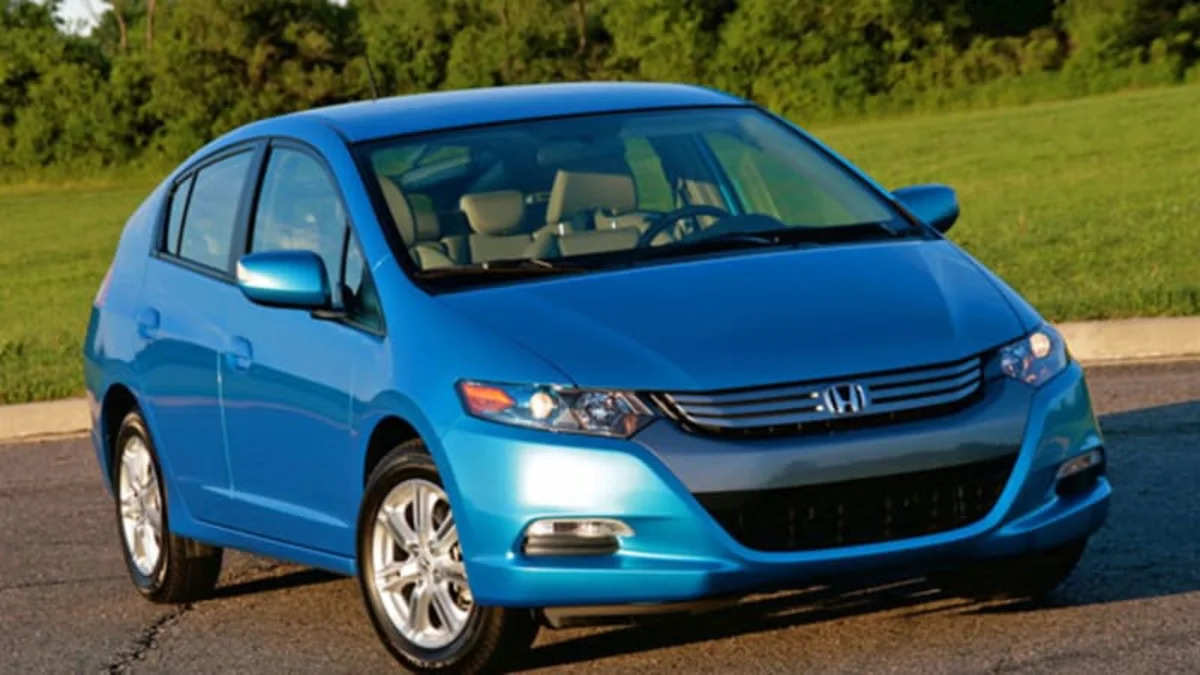
Review: 2010 Honda Insight EX, familiarity breeds discontent
2010 Honda Insight EX - Click above for high-res image gallery
First impressions can be problematic, even more so when reviewing a vehicle. When the media gets its first shot at a new offering, the automaker typically invites journalists to a location of its choosing to drive under conditions that show the car in its best light. Such was the case with the 2010 Honda Insight. After our First Drive, we came away with the impression that Honda's hot new hybrid was an engaging alternative to the Toyota Prius, but we quickly came to realize the Insight's limitations and flaws after a week behind the wheel on our home turf.
Get our real-world impressions after the jump.
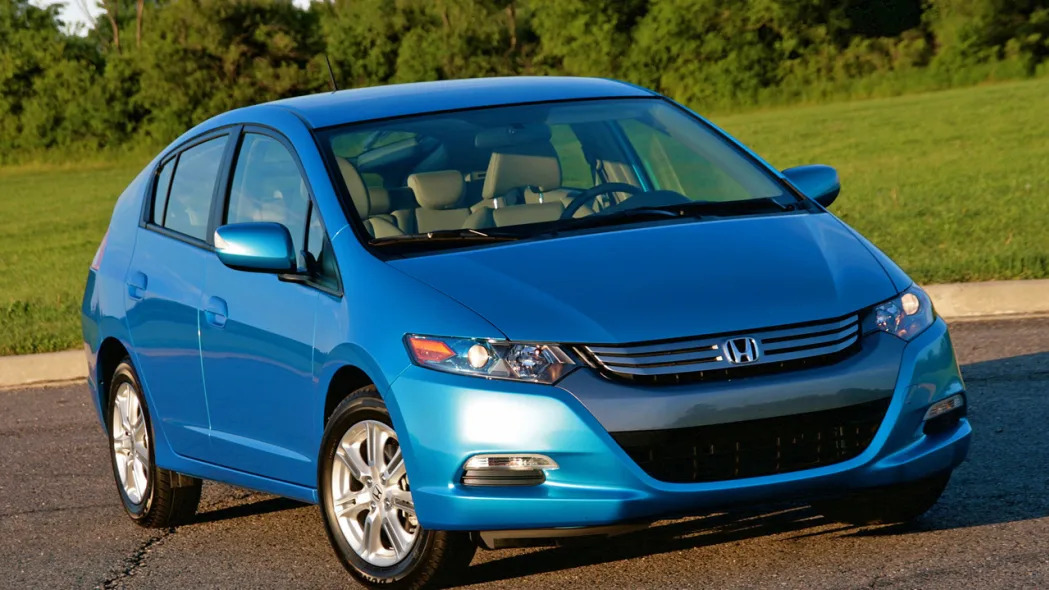
Gallery: Review: 2010 Honda Insight EX
Photos Copyright ©2009 Sam Abuelsamid / Weblogs, Inc.
When Honda revealed its all-new dedicated hybrid model, it was careful to emphasize that the Insight wasn't meant to be a direct competitor to the Prius. (If you buy that, we've got a bridge you might be interested in...) Without a doubt, Honda saw the success that Toyota enjoyed with the Prius as an instantly recognizable alternative powertrain vehicle, so with the same engineering and aesthetic goals in mind, Honda's designers followed a similar aerodynamic path. While that drew a fair amount of criticism from the Peanut Gallery (the Insight's a Prius clone!), in reality, both hybrids simply adhere to the time-honored task of "form following function."
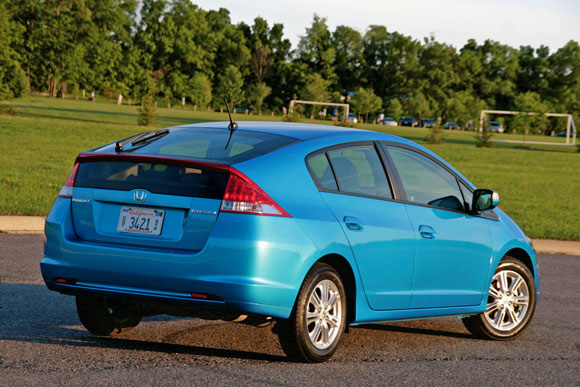
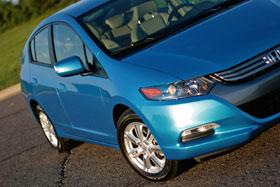
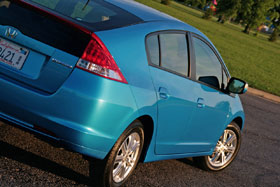
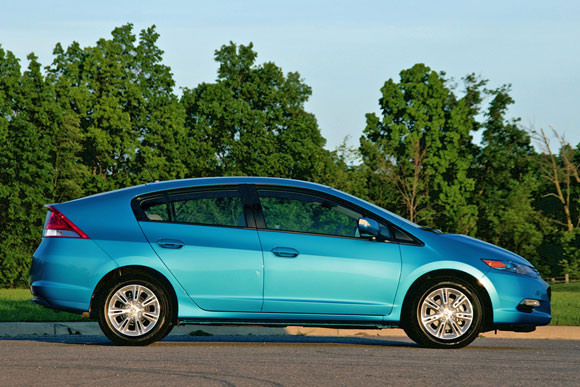
In spite of a very similar shape, the styling of the Insight has its own unique touches that connect it to the rest of the Honda lineup, particularly the hydrogen-powered FCX Clarity. Most bystanders like the look, although there was some debate about the chosen wheel size. The 15-inch hoops look positively puny in the wheel arches, but while larger rolling stock would give the Insight a more athletic appearance, they would add weight, decrease fuel economy and degrade ride quality.
Unlike the Toyota Prius, which carries a mid-size classification, the Insight is much smaller, sharing many of its underpinnings with the Fit. Since Honda doesn't want to put the Insight side-by-side with the Prius (we'll humor them), maybe it's best to draw a comparison between the hybrid and Honda's other sub-compact runabout. Not quite. Compared to the Fit, the emphasis on optimal aerodynamics has taken a big bite out of passenger room, with the peak of the Insight's roof sitting four inches lower than the Fit's and then sloping downward into the hatch.

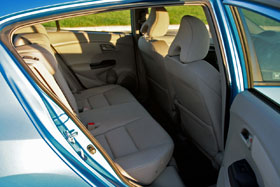
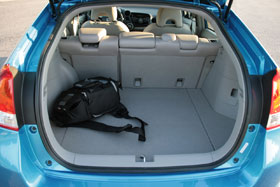
The rear door openings cut down sharply and make ingress and egress a pain (in one case, literally) for anyone over six-foot tall, and once fitted into the rear confines, head room is limited, with only a fraction of an inch separating one of our lanky passenger's craniums from the roof. However, we were able to fit three passengers in the back, and while the shoulder fit was snug, there was a reasonable amount of leg room. And although the Insight loses a lot of vertical space, it's still packing plenty of cargo room, with 15.9 cubic feet under the hatch – enough to easily handle eight, 40-pound bags of top-soil from our local big box store.
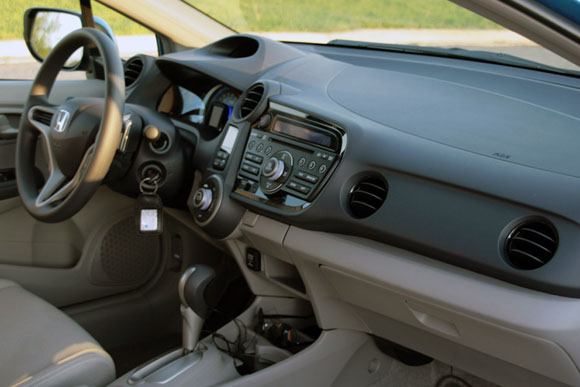
Up front, the Insight's interior is a mix of Civic and Fit, with an assortment of futuristic shapes and hard plastics normally found in Honda's entry-level models. Lending even more familial cohesion is the split-level instrument cluster with tachometer, power and fuel gauges mounted inside the multi-information display (MID) in the lower section and a separate pod mounted above the steering wheel to house the digital speedometer and color-changing eco-friendly display. While the MID provides a number of driver-coaching aids to maximize fuel efficiency, most will rely on the speedometer background that displays green when driving gently and blue when you give it the boot.
We were impressed with the Insight's ride during our initial drive in Arizona, where the roads were perfectly manicured and mercilessly devoid of northern Michigan's imperfections. Body roll was well-controlled, and the Insight delivered decent steering feel and reasonable grip. Back home, it was a different story, where freeze-thaw cycles conspire with 80+ ton trucks to create the state's hellaciously poor excuse for modern roadways.
Compared to the 2010 Toyota Prius, which needs more damping compliance over small road imperfections, the Insight's spring rates are too tight and the damping is too loose. The result is a ride that ends up feeling bouncy yet not floaty. Although those in southern states might not notice, citizens in the snow belt are sure to take issue with the Insight's ride.
Which brings us back to the Fit comparison.
Those looking for an affordable Honda have three main choices: the Civic, Fit and Insight. What you should choose depends on your full spectrum of needs and wants. For those who rarely have to traverse bumpy roads, that takes one element out of the equation. If you regularly need to carry four people and two of them are over six feet tall, the Fit is the clear winner. The same is true if you are looking to maximize utility in a small package.
Those purely interested in maximizing fuel efficiency or minimizing greenhouse gas emissions should go for the Insight. Over a week of driving around town and on freeways, we scored an impressive 43 mpg with the Insight compared to the 47 mpg we managed to squeeze out of the 2010 Toyota Prius. However, no matter how much you want to save fuel or protect the environment, for many of us, dollars and cents play a big part of the equation. Here's where things get a bit dicey. The Prius we drove came to over $30,000. Including delivery charge. This Insight comes to $22,010. That's a big difference, though you can get a Prius priced a lot closer to the Insight by choosing lower levels of equipment.
The Insight's real internecine competitor, however, is the Fit. At just $17,820 out the door, a Fit Sport has a significant pricing advantage over its electrically assisted kin. The Fit Sport we reviewed last fall achieved 33 mpg, which nears a point where the diminishing returns of increased mileage kick in. If gas were $4/gallon, driving the Fit Sport some 12,000 miles per year would cost $1,452 versus $1,116 for the Insight. The difference of $336 per year in fuel cost would take over 12 years to cover the premium paid for the Insight. This won't matter to people who are more interested in reducing their carbon footprint than saving some greenbacks, but for the rest of us, the Insight's extra cost may not be manageable, especially in this economy.
From what we've said so far, you might get the impression that we've taken Jeremy Clarkson's recent review of the Insight to heart, or that we stand shoulder-to-shoulder with Consumer Reports in our assessment of the Insight. Nothing could be further from the truth. We've just gotten a somewhat clearer picture of the Insight's faults and foibles after sampling it in the real world.
Gallery: Review: 2010 Honda Insight EX
Photos Copyright ©2009 Sam Abuelsamid / Weblogs, Inc.
| 2010 Honda Insight EX | ||||
| Performance | Brakes/Tires/Wheels | |||
| Engine | 1.3-liter inline four (w/ elec. motor) | Front Brakes | 10.3-inch ventilated discs (ABS) | |
| Configuration/Valvetrain | SOHC, 2 valves per cylinder, I-VTEC | Rear Brakes | 7.9-inch drum | |
| Max Horsepower @ RPM | 98 hp @ 5.,800 RPM | Wheels (front) | 15-inches | |
| Max Torque @ RPM | 123 lb-ft @ 1,000 to 1,500 RPM | Wheels (rear) | 15-inches | |
| Drive Type | Front-wheel drive | Tires (front) | 175/65 R15 | |
| Transmission | CVT w/ paddle shifters | Tires (rear) | 175/65 R15 | |
| Fuel Injection | Multi-port | |||
| Compression Ratio | 10.8:1 | Exterior Dimensions | ||
| Recommended Fuel | 87 octane | Length | 172.3 inches | |
| Fuel Capacity | 10.6 gallons | Width | 66.7 inches | |
| EPA Fuel Economy (city/hwy) | 40 / 43 mpg | Height | 56.2 inches | |
| 0-60 mph time (MFR est.) | Not Available | Wheelbase | 100.4 inches | |
| Top Speed | Not Available | Curb Weight | 2,727 pounds | |
| Suspension/Steering | Interior Dimensions | |||
| Front | MacPherson, with anti-roll bar | Maximum Seating | 5 | |
| Rear | Torsion Beam | Luggage Capacity (seats up) | 15.9 cu-ft | |
| Steering | Electric Power Assist Rack-and-Pinion | Head Room (Front/Rear) | 38.4 / 35.9 inches | |
| Turns Lock-to-Lock | 3.29 | Shoulder Room (Front/Rear) | 52.7 / 50.4 inches | |
| Turning Circle (feet) | 36.1 | Leg Room (Front/Rear) | 42.3 / 33.5 inches | |



Get a WordPress.com Blog


Reader Comments (Page 1 of 5)
Luis 12:02PM (7/02/2009)
Wow!
Reply
Luis 12:06PM (7/02/2009)
The Prius continues to be in a class of it's own, with more power, more room, more tech-goodies and a ride more suited to "real world" roads. And the Prius is not comparable to sub-compact cars, try as people might to compare to the Yaris and even the Corolla.
zamafir 12:14PM (7/02/2009)
Luis, honda would prefer you not compare the insight to the prius, because they're both hybrids and for $500 more you get a hell of a lot more car with the prius.
why not the LS2LS7? 12:17PM (7/02/2009)
Right on, Z. But frankly, given how poor the reviews on the Insight have been so far, if I were Toyota, I might kill the stripper model Prius slated to compete with this vehicle. It probably won't be needed as it appears the Insight isn't a serious competitor to the Prius (verbage courtesy Honda itself!).
Luis 1:53PM (7/02/2009)
Toyota just needs to concentrate on developing their superior technology. They've been in the game for more than a decade and their system is much better at delivering results than Honda's mild hybrid systems. I bet if they had just given the Insight the same engine as the Fit it would perform almost as well. Aerodynamics and weight play such a key role in efficiency, that a mild solution isn't really worth the effort.
Patrick 1:10PM (7/02/2009)
Why would you make a 1 word comment and then reply to your own post? I think you're just trying to get the 1st post in the comments section.
zamafir 1:43PM (7/02/2009)
" bet if they had just given the Insight the same engine as the Fit it would perform almost as well. Aerodynamics and weight play such a key role in efficiency, that a mild solution isn't really worth the effort."
Have you driven the car? The engine isn't the issue, the unrefined transition between engine and mild-hybrid drive is the problem. Honda went the cheap route, undercut the prius by barely anything, and shot themselves in the foot in the process. It’s symptomatic of their entire lineup, base models with drum brakes? Esp only standard on the most expensive trim civic? As competition continues to increase below from Kia and Hyundai, Across from Toyota and to some extent VW, and above against the gloriously uncompetitive acura brand, Honda's going to need to really recess nickel and diming their customers for cars which aren’t any cheaper and lack what many now include as standard.
Luis 2:08PM (7/02/2009)
Patrick, +1. That's what I wanted! HA!
Charger06RT 12:00AM (7/03/2009)
Doh!
Not THAT Matt 10:54AM (7/05/2009)
Hybrid arguments (for or against them) aside, this car is quite... irrelevant given the Prius' price drop. Better mileage + better interior + similar price = why would you pick up an Insight?
Oh, and that's from a guy who openly hates the Prius and every human being who owns or drives one.
Dondonel 12:07PM (7/02/2009)
Insight is further proof that mild hybrids are not worth the money.
Reply
tuxchown 12:51PM (7/02/2009)
Even Honda didn't think it was worth the money as they stole the tail lamps from an Impala.
Sam Abuelsamid 1:03PM (7/02/2009)
The problem is not mild hybrid technology. The difference in operating cost between the 43 mpg I got with the Insight and the 47 mpg I got a few weeks ago with the Prius only amounts to $72/year ($3/gallon and 12,000 miles). The mileage was perfectly adequate, the problem is you give up to many other things going from Fit to Insight to justify the difference.
tuxchown 2:00PM (7/02/2009)
Sam - You hit the nail on the head. Many people are not willing to give up the driving experience, whatever that may be, for a few dollars per year. The last few cars my dad owned mid sized SUVs. He was retired and didn't drive much so MPG was of little importance to him. He did not want to have to sit down into a little car because of his knees. I am sure he could have went with a hybrid SUV but that comes with much added expense. Not worth it when you only drive a few thousand miles per year. Some people like power and performance. You won't get that in a hybrid without giving up something even if that something is added cost for minimal MPG increase. Still others like big car luxury and road isolation. Again, if you want a hybrid that does that, you're going to pay and for what? A few MPG? Hybrids are far from a perfect solution. Certainly it is a choice and for some it may be worth it, but it is not a mainstream solution, at least at this point in time.
Dan 12:34AM (7/03/2009)
Sam nailed it.
This doesn't show that mild hybrid isn't worth the money while a full hybrid is. It shows that a subcompact personal commuter (eg, one that's parked 160 hours a week) wasn't using enough gas to matter in the first place.
Accepting that level of compromise - both the thousands in up front cost and the miserable driving experience - to save 6 bucks a week with hybrid A against 10 bucks a week with hybrid B is missing the forest for the trees.
XGM 1:34PM (7/03/2009)
Wait we needed proof ?
downtoearth 6:57PM (7/03/2009)
tuxchown:
> You won't get that in a hybrid without giving up something
> even if that something is added cost for minimal MPG increase.
You talk about the Insight vs Fit and extend conclusions from this particular case onto the entire hybrid cars line. Small wonder you come up with nonsense.
What exactly are you trading in with a Camry hybrid vs the ordinary 4 cylinder one? The hybrid is faster and much more fuel efficient.
Same with the Fusion hybrid. Same with the new Prius vs ordinary Corolla. Same with the Lexus RX 450h vs 350, Highlander vs Highlander hybrid.
> Still others like big car luxury and road isolation. Again, if you
> want a hybrid that does that, you're going to pay and for what?
> A few MPG?
Fuel is still far too cheap to really appreciate hybrids. Do you remember what happened with hybrid demand when it was 4$+ per gallon?
> Hybrids are far from a perfect solution. Certainly it is
> a choice and for some it may be worth it, but it is not
> a mainstream solution, at least at this point in time.
Hybrids are already very much a mainstream solution.
In Europe, the new 2010 Prius is cheaper than comparable diesel cars (which are almost always more pricey than gasoline equivalents). And yet diesels sells massively there, while being more expensive to buy and run than the hybrid. Diesels gained their popularity due to fuel prices and hybrids, offering better performance, economy and total costs, will simply replace them.
1337 4:32PM (7/05/2009)
Mild hybrids are somewhat feasible for those who do a ton of city driving. The electric motor does most of the heavy lifting for stop-and-go traffic, bringing the car from 0 to 25 mph repeatedly.
That said, most of my driving is done on long highway trips. The aerodynamics on the Insight are great on the highway, but the hybrid system contributes almost nothing to efficiency at those speeds.
I'd like to see a non-hybrid Insight with the Fit powertrain. Price it at $1000 above a Fit, and I'm sold. I'd enjoy great highway fuel economy without paying for an electric motor that doesn't do much for my economy.
Enigmatic 12:11PM (7/02/2009)
I find it ludicrous that Honda manages to say that they don't intend this to be a direct competitor to the Prius. It is doesn't matter what they say, the consumer decides what a competitor is. And if people cross-shop a Prius with an Insight (which most people looking for a hybrid will do), then they are competitors.
Reply
artandcolour 12:16PM (7/02/2009)
i've said it once and i'll say it a hundred times: no one buys a dedicated hybrid model like this to save money. they are bought to save barrels of oil. they are bought by people that care more about the environment than their wallets. whether or not they are correct in their assumption, is another story altogether, but it's just not about money. another reason is they want people to KNOW they're saving barrels of oil for the world, not their pocketbook. that's why the Prius has done so well, and why, i suspect, this test notwithstanding, the Insight will do well too. they look different, they're seen as hybrids even by people that don't know a Civic from a Corolla. the Insight will go to people that don't care about the latest 'luxuries,' it will go to current Honda owners that love their light weight and econoclass trappings. the Prius could be sold for $40,000 and they would still sell as many as they do now because those owners appreciate the space age interior, the leather, the xenons etc. loaded Priuses are the norm.
Hybrid cars like this one are a visual statement for their eco-minded buyers, and they don't buy them to save money. the argument of the intial cost vs long-term ownership never enters the equation.
Reply