
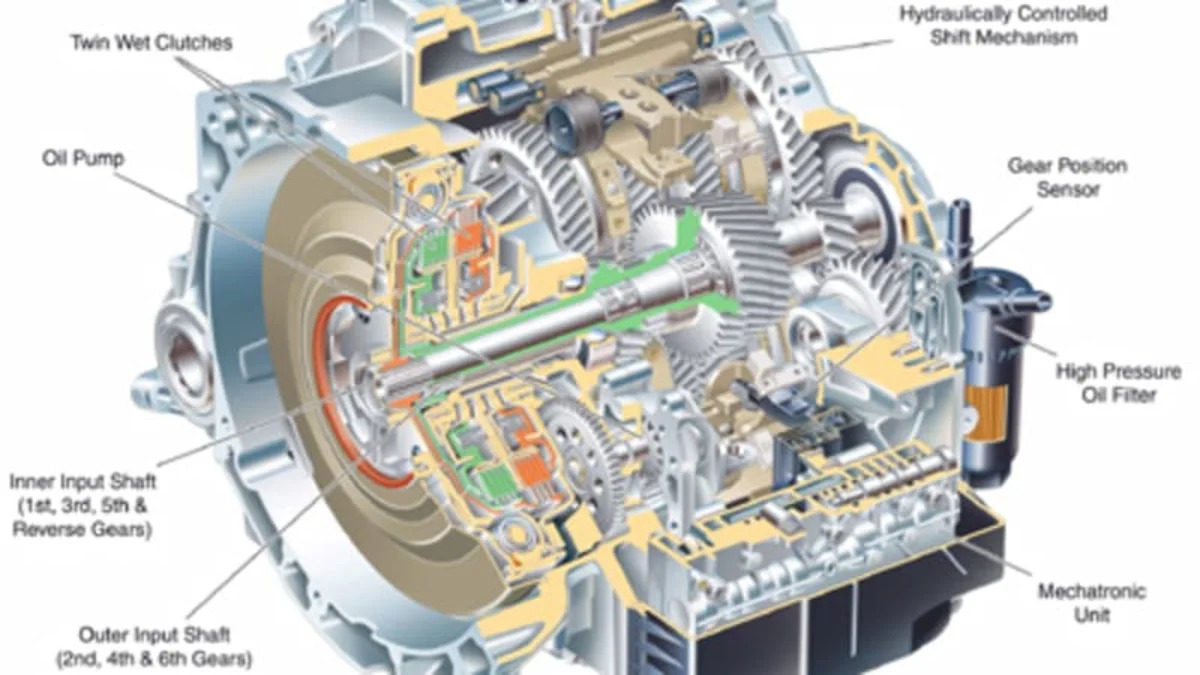
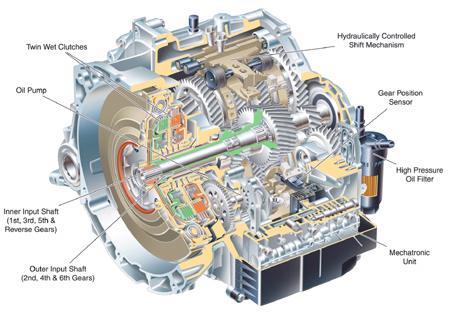
Volvo's answer to DSG goes by the name Powershift

Volvo is joining the ranks of other automakers by beginning to offer a dual-clutch gearbox to the masses. The new transmission, developed in cooperation with Getrag, features six-forward gears and reverse, and opts for a wet-clutch system like the first generation VW/Audi setup. Aside from the obvious performance advantages gained by quick shifts, Volvo estimates that fuel consumption will be reduced by around eight-percent.
The new setup can handle over 330 lb.-ft. of torque, something that has proved to be an issue with similar setups because of the small surface area of both clutches. When Volvo's Powershift transmission debuts, it will initially be equipped on the C30, S40 and V50 fitted with the 2.0-liter turbo diesel. There was no mention of what models in the U.S. could benefit from the new 'box or when it might be available here in the States.
Volvo's full press release is posted after the jump.
PRESS RELEASE
INTRODUCING VOLVO POWERSHIFT – SMOOTH, POWERFUL AND FUEL EFFICIENT
* Automatic sequential six-speed transmission
* Twin wet clutches for fast and smooth changes
* Over 47 mpg and less than 160 g/km CO2
* Optimised for powerful diesel engines
The new Volvo automatic Powershift transmission will be available to order from late February on the 136PS two-litre turbodiesel versions of the Volvo C30, S40 and V50 with a recommended retail price of £1,250. This new Powershift six-speed unit features twin wet clutches to provide the gear changing comfort of a fully-automatic transmission with the performance of a manual gearbox.
Operating as two parallel manual gearboxes, Powershift has twin wet clutches that work independently of one another. One clutch controls the odd gears (1, 3, 5 and reverse) while the other handles the even ratios (2, 4 and 6). The two clutches operate alternately with one engaging while the other disengages, like a slip clutch. This means that at the same time as the engine gets full power and maximum thrust in first gear, second gear is placed ready to be engaged. And when second gear has been engaged, third gear is readied, and so on. This gives a continuous flow of power without any disruption in power delivery or any torque loss. This results in extremely fast and smooth gear changes whilst maintaining acceleration allowing 0-60mph to be reached in nine seconds in the Volvo C30, 9.1 seconds in the S40 and 9.2 seconds in the V50 and boasts a top speed of 127mph in all three models.
Apart from gear changing comfort and high performance, Powershift also contributes to delivering improved fuel efficiency. The Powershift Automatic offers an impressive combined fuel consumption of 47.1mpg and a CO2 figure of 159g/km in both the Volvo S40 and V50; while it brings the Volvo C30 47.9mpg on a combined cycle and a CO2 figure of 156g/km.
"Lower fuel consumption allied to increased comfort and higher performance sounds like an impossible equation. But with Powershift we have shown this is perfectly possible," says Magnus Jonsson, Senior Vice President, Research & Development, Volvo Cars.
Automatic or sequential gearchanging without any loss in torque
Powershift gives the driver an automatic transmission that permits sequential gearchanges, just like with Volvo's Geartronic transmission. The difference is that with Powershift even manual gearchanges take place without any time or power losses. Also, unlike a conventional automatic transmission, Powershift does not need a torque converter, planetary gears or multiple wet clutches, there is also none of the added torque losses that these features bring.
Optimal choice for powerful diesel engines
Thanks to the use of twin wet clutches, the Powershift transmission can handle high torque levels and in principle has no limitations on choice of ratio. This makes it an ideal partner for today's powerful diesel engines. The version of Powershift that Volvo is now launching is dimensioned to handle torque levels up to 450 Nm. In the versions of the Volvo C30, S40 and V50 in which it is fitted, Powershift is mated to the 2-litre four-cylinder turbodiesel which delivers a power output of 136 PS and 320 Nm of torque.



Reader Comments (Page 1 of 2)
seoultrain 2:38PM (1/11/2008)
hmm... volvo owned by ford.... who also owns mazda... 330lb-ft torque rating... mazdaspeed3/6 with DSG? DO IT.
Reply
Lad 3:46PM (1/11/2008)
I agree duel-clutch trannies are good for performance and race cars...not really needed elsewhere. Lots of mechanical devices, including nanies, and thus the friction wear are unnecessary for EVs. On a BEV if you place the motor at the rear, you can delete the ICE, clutch, transmission, drive shaft and differential. When batteries advance and become lighter and when we start building light chassis, we won't need all this mechanical complexity.
zamafir 2:40PM (1/11/2008)
So this isn't the same as the Borg-Warner units supplied to VW? Volvo's building these themselves?
Reply
CH 3:53PM (1/11/2008)
It uses the same basic technology licensed from Borg-Warner as the VW units. However, the Volvo units are built by Getrag under the Ford-Getrag joint venture consumated about 2 years ago.
zamafir 4:19PM (1/11/2008)
@CH, AWESOME! That's the kind of reply that makes me happy, thanks for the 411!
JBoll 2:52PM (1/11/2008)
Wow Wonder how long those clutchplates will last with some real power applied, hopefully pretty well because it dosen't look to service friendly.
Reply
jim 4:35PM (1/11/2008)
Given the likely cost of repair, you'll want to think long and hard before buying a car with this tranny used.
Jimbo 10:07PM (1/11/2008)
The wet clutch and Powershift name sounds somewhat like the sort of "powershift" transmissions used in farm tractors for years. My Dad's got an '89 Case with a 16-speed, wet clutch, you can shift from any gear to any gear under a full load. After near 20 years...some sort of nitrogen(???) system used to speed up gear changes has stopped working, that's been all the transmission trouble.
jim 2:49PM (1/11/2008)
Fearless prediction: Due to the new gas mileage standards dual-clutch gearboxes will replace traditional automatics as well as traditional stir-it-yourself manuals.
It there place will be a computer controlled DSG with a switch for normal, wet/snow and towing shift patterns and with out paddles or other forms of manual activation.
Reply
Dustin 3:00PM (1/11/2008)
What's the deal with the 47.9mpg? That isn't U.S.-standard, is it?
Reply
CH 3:35PM (1/11/2008)
That's 47.9 miles/imperial gallon combined on the Euro test cycle, which is 39.9 miles/US gallon. The EPA number would be lower than 39.9 mpg because of test cycle differences.
416Hammy 3:35PM (1/11/2008)
I wonder if it has a "Power Torque Steer" mode?
Reply
Corey W. 3:40PM (1/11/2008)
I wonder how far over the 330lb rating can it handle.
Reply
Alex 7:07PM (1/11/2008)
probably fails in a spectacular manner at 335lb's
Jack P 7:47PM (1/11/2008)
CH: I don't know that any licensing fees apply. DSG is actually pretty old technology. Ford had a "proof of concept" car running over 20 years ago !
JBoll: Clutch durability is helped a lot by them being "wet" clutches. Obviously at some point over the rated torque they will slip and the wear rate will go through the roof. Once clutches start to slip (when they are not supposed to) they just get worse.
Reply
CH 9:29PM (1/11/2008)
Ward's Automotive article, Feb 2006:
http://www.bwauto.com/about/in_the_news/files/2006-02-01-Wards.pdf
Quote:
"... and last summer, the Getrag Ford Transmissions GmbH joint venture invested E300 million ($364 million) in a new plant in Slovakia that will begin making dual-clutch transmissions under a Borg-Warner license."
The plant opened last November and is the source of Volvo's Powershift transmissions.
zamafir 7:09PM (1/11/2008)
So who knows if this was to be produced at the now stalled plant in kokomo?
Reply
tr 11:03PM (1/11/2008)
that plant was being built by chrysler and getrag, not ford or volvo.
http://www.autoblog.com/2008/01/11/chrysler-halts-construction-of-dual-clutch-transmission-plant/
rgseidl 9:20AM (1/12/2008)
@ JBoll, JackP,
wet clutches transmit torque via laminar shear forces in the thin oil films between the multiple plates. Ergo, torque can only be transmitted if there is a small speed difference between input and output. The power of torque transmitted times speed difference is lost as heat to the oil. In addition, a wet clutch DCT has a circulation pump that adds weight and further reduces efficiency. Even so, vehicle fuel economy is very close to that of a manual because the gear shifts are so fast and smooth the drivetrain controller can optimize gear selection for fuel economy. Besides, relative to a conventional AT with planetary gears, the gear ratios can be better tuned to the engine and vehicle.
There is no mechanical contact between the clutch plates at all unless they are warped by overheating due to overtorqueing.
Reply
Guenther 5:20PM (1/13/2008)
Doesn't Ford's 5spd Truck transmission carry the name "Powershift"?
Reply