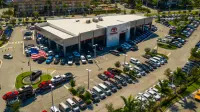


In March of this year, Honda sent a letter to certain members of its dealer network letting them know they needed to make changes to their stores. With so many Hondas leaving showroom floors, dealers are doing all right on the sales side, but some aren't performing to Honda's standards on the maintenance side, with waits of up to three weeks to get your Honda serviced.
And maintenance wasn't the only issue Honda chose to address with particular outlets. The changes Honda asked dealers to make include increasing or improving a building's site size, showroom area, service department area, and number of parking spaces, among other things. They are the kinds of changes certain to make customers happy.
Dealers, though, are none too pleased. One dealer said Honda's asking him to invest more than $2 million, and his market doesn't support that. Another dealer, also facing a $2-million-plus bill for requested changes, said the increased debt load would decrease the value of his business should he sell. Honda, of course, doesn't think it is asking too much. Dealers feel that Honda is threatening not to renew their franchise agreements if the changes aren't made, but Honda says it doesn't really have that power. Nevertheless, dealers have been told they have until May 31 to lay out their improvement plans, and until January 2010 to break ground.
If you're in the market for a Focus sedan, the question is, exactly what kind of Focus will you buy? According to Ford's option sheets, there are 100,000 different combinations you can create. Eighty percent of Focus sedan sales, however, are comprises of just 4,000 of those combos. This glut of choice has increasingly become an issue that translates into lost money, unhappy customers and overwhelmed dealers for the Big Three, and now they're going to trim the options tree.
Ford's new marketing chief Jim Farley has said, "Coming from Toyota, I can tell you that the opportunity is there to reduce the complexity of our line-up." Toyota cars are not known for an obscene wealth of choice, although Nissan has found itself with too many choices on the Maxima and Altima, and has cut them down recently. Meanwhile, the domestics are working to figure out how to rationalize the choices they offer -- and the money they spend on them -- with the need to give people want they want.
Ford is doing it by shrinking the number of "buildable combinations of the 2008 Focus by 99 percent." Chrysler has reduced its own complexity by a claimed 93-percent over the last two years by jettisoning options. And GM's global platform strategy aims to severely curtail the expense of developing and building a car. Said marketer John Tulloch, the manufacturers can win this fight "if the savings are used to improve remaining models and reduce sticker prices." We can only hope.
In Dallas, a businessman has spent half a million dollars to install nine pumps that dispense E85, E10, and biodiesel. The catch: the businessman is a HUMMER dealer, and the pumps are next to his dealership. The station is called Classic Clean Fuels, and it is intended to make a statement for next year's H2 and H2 SUT, which will be the first production models to be Flex-fuel capable.
You won't need to drive a HUMMER to get E85 at the station. The pumps are open to the public, a first for a dealer-owned gas station. By 2010, GM has said all HUMMERs will be biofuel-capable. GM plans to market 15 Flexfuel models next year, but only one percent of the country's service stations sell E85. GM is using that as an opportunity to open the public's (and dealers') minds to putting alternative fuel stations in alternative places.
Said GM's Larry Burns, "Down the road we may even want to consider hydrogen dispensers at dealerships."
Among the many ills plaguing automakers, and General Motors in particular, is an excessive amount of dealers selling their wares through competing outlets. GM has decided to rectify the matter by combining its top three "luxury" marques – Cadillac, HUMMER and Saab – into megastores that aim to provide consumers with a variety of choice without watering down each brand's distinct niche.
The plan involves consolidating the 1,400 Cadillac dealerships with the 238 Saab and 170 HUMMER outlets to form a one-stop shop for all things at the high-end of the General's spectrum. There have already been a few cases where GM has helped larger dealers buyout Mom and Pop operations that weren't willing to expand or were looking to get out of the retail game entirely. While the move has the potential to make it easier for consumers to get everything they want under one roof, the amount of capital GM might need to enable larger to dealerships to consume their smaller competitors could prove to be pricey. Plus, it's going to take a top-notch interior designer to combine the Quonset hut theme of HUMMER with the Kenny G stylings of Saab into a cohesive environment.
UPDATE: 3-24-08 -- This was left on the original M3 forum thread by Ken, the nearly-defrauded winner of the eBay auction: "Sorry its taken so long to post a update. The site is very slow (understandably). This morning, BMW of Lincoln has agreed to sell me the car at a price of 60K, with certain conditions. I'll be going over the conditions with the dealership tommorow, and I hope to have everything finalized by tommorow afternoon." You can read the rest of his comment here. It's pretty cool what the Internet can do...
Apparently all is not kosher in corn country. BMW of Lincoln, Nebraska posted an auction on eBay for a brand new M3 Sedan for $60,000. Perhaps they were hoping for the kind of eBay madness that would push the price to six figures (something other dealers are doing right on the show floor). If that's what they were after, well, they didn't get it. The car was won by a gentleman in California for the listed price: $60,000.
The problem is that the dealer doesn't want to give him the car. Not long after the auction ended, the winning bidder got a call from BMW of Nebraska telling him the auction was "a mistake," and that he couldn't have the car. In spite of the fact that the dealership changed the Buy It Now price twice -- and so was paying attention to the auction -- and eBay rules that make it clear that if someone wins the auction then you must complete the transaction, the buyer is still trying to get someone to give him the car he won at the winning bid price. Follow the link for the full story, and to you, Dooma350, good luck. Thanks for the tip, Ken!
On March 1, 2008, Second Life will host the grand opening of the Automobile Dealer Relations Center (ARDC) called AutoLand. While that sounds like the kind of place where you'll have to run for your life from a cyborg Yul Brenner, it will actually be home to a multi-brand showroom in the virtual life sim that was created by customer relationship management software maker iMagic. What's more, you'll be able to chat with up to 50 dealers nationwide about pricing, availability and service issues.
We have to admit that we find the idea of a virtual car showroom kind of funky (disclaimer: this blogger has never been in or on or at Second Life before today). After all, Second Life's graphics aren't cutting edge, so at best you'll only be able to look at chunky representations of the car you're interested in buying. As for chatting with dealers, virtual sales don't affect the brick-and-mortar bottom line much, and if the chatroom becomes a forum to gripe about service issues, we can see things getting testy pretty quickly. If nothing else, it's a neat experiment, and we'll see what happens. And when you get tired of kicking digital tires, you can head on over to Peugeot island and see what the hubbub is about: that company leads all 11 automotive brands in Second Life with more than 9 million accounts.
In 2007 Hyundai had a US sales target of 555,000. That number was set by HQ in Korea, and when it was clear they weren't going to make it, they revised it downward to just over 500,000. By the time the bell rung, even that number proved a little beyond Hyundai's reach: they sold 467,009 cars last year. That still represented a 2.5-percent gain over 2006 sales.
Hyundai's goal this year is a 20-percent increase in global sales. For the US, though, the goal is 500,000 units, which is the goal set by the folks in the US, not Korea, and even though nearly everyone has predicted a sales downturn, that goal is "regardless of what the industry is doing." To achieve those sales, the automaker has revamped numerous aspects of their dealer incentive operation. Hyundai dealership profit was down five-percent last year, and only two-thirds of dealers benefited from company incentives. This year, the dealer incentive has been streamlined and set up so that 99-percent of dealers are expected to receive some sort of incentive. Dealers will also be receiving more Accents and Elantras to prevent the shortages experienced last year.
Hyundai is also bringing back its dealer ad associations and is going to distribute more largesse to help dealers advertise everything happening for the growing brand. Hyundai has a refreshed Sonata and the new Genesis coming in the spring, and the Genesis coupe and Elantra Touring coming later this year, and it wants to make sure everyone hears the word. It's quite conceivable that Hyundai can increase its sales this year in spite of the market, and making its dealers happy will be a good way to help the cause. Dealers are, of course, happy about the changes, but also want to make sure Hyundai doesn't forget its bread and butter cars and customers in the Genesis hoopla.
Yesterday we wrote about GM's intent to shrink its 14,118-strong dealer network, with one idea to combine Pontiac, Buick, and GMC dealers into larger, more modern flagship outlets. Turns out that was only part of the plan: according to Automotive News, "General Motors is preparing to make public a plan to encourage the creation of superstores in major metro areas that would carry every GM brand."
These superstores, which would be called GM Collections, are being evaluated for major metropolitan markets where the real estate itself is more valuable than the dealer franchise. For dealers interested in such an outlet, GM's idea is to move service and parts centers off-site to make room for all of the brands. Some dealers think that's a turn-off for consumers, others report good results. In LA, this has been standard practice for a while, with some service departments 25 minutes away from their dealerships. We don't find anything wrong with it, either -- after all, once you've bought the car, how often do you need to go back to the showroom?
The superstores plan is another part of the consolidation plan. In addition to combining Pontiac, Buick, and GMC, the General is also thinking about merging Cadillac, Hummer, and Saab dealerships, which would leave only Chevrolet and Saturn as standalone entities.
UPDATE: Mark LaNeve sent an email to GM dealers this morning saying that the article in "Automotive News concerning a major push to put all of GM brands under one roof is out of context and a mischaracterization." There are no plans to make an announcement about new metro superstores at the NADA conference next month in San Francisco. However, Automotive News still maintains that GM will allow certain stores to carry all of GM's eight brands. We've included the full text of LaNeve's email after the jump (thanks Rob!) and you can check out Automotive News' updated article here (sub. req.).
[Source: Automotive News - Sub Req.]
At the end of World War II, GM "put a dealership in every little hamlet" to keep up with the postwar boom. Sixty years later, in 2005, long after that boom had ended and every domestic maker was losing market share, GM had 15,094 dealerships. By 2007 GM had reduced that to 14,118 dealers. But if GM plans to compete financially with its overseas competition, it will need to shrink that number a great deal further.
Chevrolet has 4,000 dealerships. Toyota, to sell the same amount of cars, has just 1,244 dealers. Put another way, the typical Toyota dealer moves 1,766 cars per year. The typical Chevrolet dealer moves 554. And the other domestics fare about the same: the usual Ford dealership rolls 556 vehicles off the lot every year, while a Dodge dealer does 374 per year.
GM is looking at consolidating Pontiac, Buick, and GMC shops into one. However, state franchise laws don't make closing dealerships easy, and it's hard to tell a profitable dealer that he needs to close for the good of the parent company. Dale Willey, head of the National Automobile Dealers Association, said "Dealers make the decision to get into the business, and the manufacturers accepted the dealers getting into the business. It ought to be the dealers' decision to get out of the business." While GM CEO Rick Wagoner realizes that the "payoff is significant" for reducing the number of outlets, he must know that the price will be significant as well.
"Do you need the Polo?" That's going to be Volkswagen chief Martin Winterkorn's query to US dealers when he meets with them this week. The answer could determine whether or not we see a sub-Golf sized VeeDub here in the United States. Rising fuel prices have made small cars big again, and VW's taking a hard look at capitalizing on that. The inrush of Volkswagen's competitors to smaller models also makes the segment hard to ignore. BMW's got the hotly anticipated 1-series, Daimler's trend-tastic Smart has been foisted upon us, Saturn's slick Astra is nearly here, and Ford's threatening to give us the Fiesta in a couple of years, too. If we were a VW dealer, our answer to Winterkorn would be a resounding "YES!"