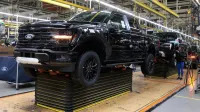
General Motors has been hit so hard by the ongoing American Axle strikes that it's stopped production of the GMC Yukon, Denali, Sierra heavy-duty regular and extended cab, its commercial-duty pickup and variants of Chevrolet trucks and Tahoes. All the while, the General is still negotiating with the UAW over local contracts at some of its most important plants. To ease some of its supply problems, General Motors has reportedly offered as much as $200 million to American Axle for the funding of employee buyouts, early retirements and for the support of wage buy downs. The offer, however, is conditional on a quick resolution between American Axle and the UAW.
Spokesman Dan Flores says that GM hopes "the offer will help bridge the gap between American Axle and the UAW and that they will be able to reach a mutually satisfactory agreement in the near future." Both the UAW and American Axle sound supportive of the investment; Bill Alford Jr., vice president and incoming president at UAW Local 235 says, "We're happy that General Motors is finally coming to the table and realizing that they have a stake in American Axle's future." For GM's sake and that of the striking workers, we hope the feuding companies find an amicable solution soon, though it seems unfortunate that GM, which is not exactly posting record profits itself, should need to cough up funding to make it happen.
Volkswagen has already announced its intentions to build a factory in the U.S., narrowing down the possible sites to Alabama, Michigan and Tennessee. Now, in advance of a shareholder meeting in Germany, Audi CEO Rupert Stadler is reportedly saying that Audi is considering a U.S. plant, as well. The move on both automakers' parts is an attempt to capitalize on the weak U.S. dollar, the stronger euro and the fact that material costs are on the rise and a U.S. plant could mitigate some of those expenses. Additionally, both VW and Audi have made it clear that in order to achieve their lofty sales goals – one million units a year by 2018 for V-Dub and Audi's campaign to become the numero uno luxury carmaker – ramping up production capacity in the U.S. where many of those sales will be made is instrumental to their mutual success.
General Motors has informed its dealers that production of some of its 2008 full-size trucks and SUVs has been halted due to the ongoing American Axle strike. The affected vehicles include the GMC Yukon, Denali, Sierra heavy-duty regular and extended cab, its commercial-duty pickup and variants of Chevrolet trucks and Tahoes. According to the General, a basic lack of parts is the reason for the stoppage and dealer orders for the week of May 8th and May 15th have been cancelled. While a lack of production is bad news for any automaker, we can't help but think that it couldn't have come at a better time for the General as SUV and truck sales are down overall.
The sale of Jaguar and Land Rover to Tata means that the two British marques will have to look elsewhere for the parts normally supplied by Ford. Following the news that Daimler could be a supplier to both automakers comes word from Dr. Z himself that a deal is a distinct possibility.
Daimler holds a seven-percent stake in Tata Motors, which could make an easy case for Mercedes to supply Jag and L.R. with the necessary components to wean them off of Ford. Dieter Zetsche told Auto Motor und Sport that, "If Ratan Tata approaches us regarding the supply of components, we would be open to talks." AMG-powered XF, anyone?
[Source: Auto Motor und Sport via Automotive News – Sub. Req.]
Local UAW contract negotiations aren't going well for General Motors, and today they took a turn for the worst as union members at the automaker's Fairfax assembly plant in Kansas walked off the job at 10AM EST. The bulk of GM's hot-selling Chevy Malibu are produced at the Fairfax plant, with a lesser number of the four-door sedan being built at the automaker's Orion plant in suburban Detroit. Last month GM sold 17,050 Malibus, a 39.5% increase in volume over April 2007. The local union in Fairfax had given GM a number of ultimatums, extending them since the first was established for April 22nd. We're not exactly sure what issue is at the heart of these contract negotiations, but The Detroit News reports that at least one bone of contention is the plant requesting seniority to snag transfer jobs, while the other issues remain undisclosed.
General Motors has been able to weather a 10-week strike by union members against American Axle, one of its main suppliers, as only production of large trucks and SUVs have been affected. Another strike at its Lansing Delta Township plant where the large Lambda CUVs are built has also only served to reduce inventories of vehicles that are seeing a slow down in sales. While the General can withstand a reduction of inventory for vehicles that currently aren't selling as well as they were before because of high gas prices and a slump in the housing market, the Malibu is gaining popularity with consumers month over month. The Fairfax and Orion plants were already producing at capacity to keep up with demand, so today's strike will assuredly hurt the automaker where it matters most: the bottom line. We'd expect GM to act quickly to end the strike, as money is being lost by the hour while Malibus aren't being built.
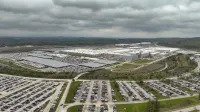
Autotechnogeoglyphics. If you didn't have to read that term at least a couple of times, slowly, to decipher it, you're probably some sort of freak. But that's the name of a display of aerial photographs taken of automotive test facilities across the United States. The show will be on at the Walker Art Center in Minneapolis, Minnesota, until August 17 before it moves to the Carnegie Museum of Art from October 4 through January 18.
Among those proving grounds being displayed in the show are GM's facility in Milford, Michigan, and Caterpillar's equipment test mountain. The images were taken by the Center for Land Use Interpretation, which previously displayed photos of parking lots under the heading "Pavement Paradise: American Parking Space".
If you told us a year ago that Fiat was going to sign a deal with the government of Serbia, we'd have laughed. But that was before the country announced that it was accepting tenders for investment in the state-owned automaker Zastava, makers of the famous Yugo (aka Skala 55). The process started back in December when the Serbian government made the announcement, sparking interest from various automakers. But even as recent as last week, the Fiat stance was that it was still considering the proposition. Well, it appears the Italian auto giant has done thinking, and has signed a memorandum of understanding with Serbia to establish a joint venture that involves Fiat investing a staggering 700 million euros (!) into Zastava's manufacturing facilities in exchange for a majority stake in the company, known in full as Zavodi Crvena Zastava. The Serbian government, meanwhile, will contribute some 200 million euros through tax incentives and similar measures.
Fiat has revealed that it will use the Zastava plant to produce the upcoming Topolino microcar. The vehicle will be based on the same platform as the 500 and Panda, but even smaller and positioned below either model, and share the same name as the concept car that previewed the new 500 and originally used on the 1936 runabout pictured above. According to reports, the new Topolino will be a compact two-seater measuring just 3150mm (124 inches) in length, slightly longer than the Smart ForTwo at 2692mm (106 inches). A four-seater version is expected to follow, in addition to an upscale version for the Lancia division.
If you've ever smashed up a car in an accident, you've probably had the unpleasant experience of dealing with insurance agents who assess what can be saved and what has to be written off. In most cases, insurance companies might find ways to save as much as they can. But the insurers of the Cougar Acewant to make sure every last nut and bolt of some $100 million worth of new Mazdas are completely scrapped.
The Cougar Ace, as you'll recall, was a ship full of Mazda automobiles that nearly capsized in the Pacific Ocean two years ago. Although the cars were securely strapped down, Mazda deemed it impossible to determine the extent of the potential damage caused to each of the vehicles on board, so rather than risk the cars making their way onto the market – like many Katrina-damaged vehicles from New Orleans three years ago – the company and its insurers decided each car had to be scrapped. The process of destroying 4703 vehicles, however, proved to be quite a challenge. Airbags had to be triggered, wheels sliced and tires purposely punctured. For the airbag process alone, it would have taken half an hour for each car, so Mazda developed a device to inflate them all at once on each car, saving countless hours of work. The result is a seemingly counter-intuitive disassembly line turns the nearly 5000 new cars into metal shards. Follow the jump to read more about the process.
Under proposed new fuel economy rules set by the National Highway Traffic Safety Administration (NHTSA), automakers with powerful short-wheelbase models are going to feel some pain. The agency is considering a plan to create two sliding scales of efficiency for cars and trucks of different sizes. Automakers will be assigned fuel economy standards based on the "footprint" (short wheelbase = small footprint) of their vehicles, and the number of vehicles they sell. Companies like Porsche, BMW, and Mercedes-Benz, independent luxury brands with high-performance models, will be hit the hardest. Interestingly enough, Toyota, Chrysler, and General Motors, big players with diverse model lineups, won't feel as much pressure.
Conforming to the tough new proposed rules may be very expensive. As a result, some industry executives expect some automakers, such as Porsche, just to pay the fines--it's less costly than changing a model lineup. Regulators are under the gun to adopt a policy by April 1, 2009. In the meantime, the NHTSA will be taking public comments over the next two months. Time to send 'em a letter...
Click above for high-res gallery of our time with the Bugatti Veyron
We already know that Bugatti's second vehicle in the modern era will be a targa-top version of the Veyron 16.4, but AutoExpress has revealed that production of the open-air exotica will be limited to just 80 units compared to the coupe's comparatively ample run of 300 cars. The cost of letting the sun shine through your Veyron's dome will also be more prohibitive, with a price tag creeping up on £900,000 compared to the £840,000 cost of the coupe. As with most open-air cars, the Veyron's chassis will be made beefier to cope with the loss of rigidity caused by a big hole in its roof. As such, the new car will weigh more than than the record-setting original. Top speed will therefore be relatively limited, if one can call a 217-mph top speed limited. Then again, as we learned while driving the car ourselves, every car is limited compared to the original Veyron.