
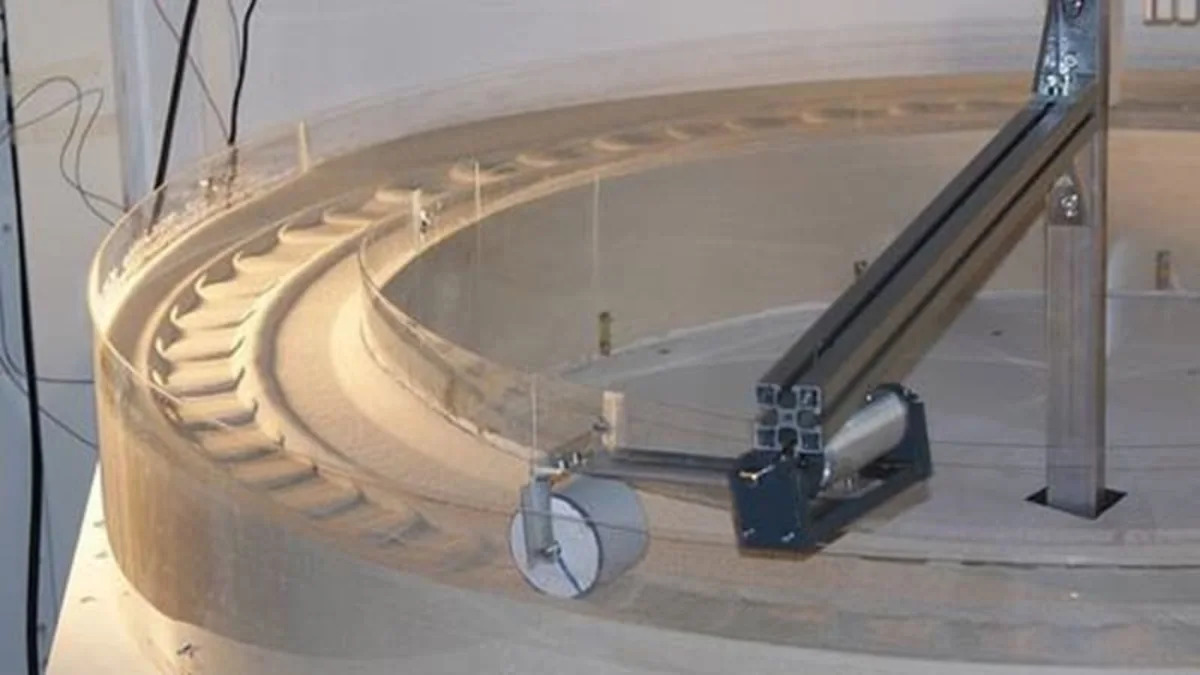
Why does a road ripple like a washboard? Here comes the science...

The good news is that the men in white coats have figured out why washboard roads develop on sand, gravel or any other loosely-surfaced roads. Above a certain speed, any linear force interacting with the surface causes the force to skip over the surface like a rock skipping over the water. The ripples are caused by the force alternately being "thrown off the surface" and then touching down again.
The issue isn't about oscillating car wheels, nor wheels at all for that matter. The scientists performed their experiments with a flat, inclined un-suspended plow blade; when it got above a certain speed the plow blade created ripples just like a wheel does.
The bad news is that it will be long time before the phenomenon can be stopped: "Just about any time a malleable surface is acted upon by a sideways force, you will get ripples." Since it doesn't look like ripples are going away, scientists could turn their attention to suspension systems that will "eliminate the bumpy ride." Hat tip to Michael S
[Source: Science Daily]



Reader Comments (Page 1 of 1)
Aloysius Vampa 6:05PM (7/09/2009)
This is fascinating research.
Reply
GOT 11:34PM (7/12/2009)
"The bad news is that it will be long time before the phenomenon can be stopped:"
They are fixing it. I've seen new concrete roads laid (eastern NE) with these small odd devices placed at certain intervals that are designed to counter the frequency of the energy from the tire contact. And those things work and keep the roads perfectly smooth.
MeiSooHaityu 6:07PM (7/09/2009)
That is very common with ATV and Dirtbike trails as well. Any frequently ridden trail does the exact same thing.
Reply
TigerMil 6:18PM (7/09/2009)
Old news. I knew/read this 15 years ago.
This is another reason people buy SUVs with more suspension travel...but the extra weight/wheels exacerbates the problem on city streets that have also taken to 'sealing' their concrete surfaces with a 3-4" asphalt coating every 5-6 years rather than do it right with concrete.
On the worst intersections the only solution is to rip up the concrete/asphalt overcoating and replace with solid concrete, generally for the average length of the rush-hour backup at the light.
Reply
UberSil 1:02AM (7/10/2009)
Your city uses concrete under it's roads? Are you sure their not nuts? Concrete is expensive and causes a much lower frictional force. Which doesn't help when you're trying to go around curves. If you're out on the highway it's fine because curves are angled due to the higher speeds.
But I've never heard of a city putting asphalt on concrete, none the less concrete on concrete for a road. And I studied as a Civil engineer.
That One Person 12:18AM (7/10/2009)
Thank you!!!!!
There is one intersection on my way to work that they keep repairing (a small square) because of the trucks turning and ripping up the asphalt. Duh! USE FREAKING CONCRETE!
Or some side streets in the city I live in that have maybe a half inch to an inch of asphalt over concrete. Who the hell thought of that!? And they wonder why our streets are going to hell.
Iridium 1:35PM (7/10/2009)
UberSil,
You must not live in the USA. Nearly every city paves over concrete with asphalt. Often times they only use 2" of asphalt which then cracks, splits, potholes up, and ripples.
In fact Rt 8 south of Cleveland, OH had about 10 miles of concrete highway which was just paved over with 2" of asphalt. By next spring the road surface will resemble the surface of the moon.
See in the USA roads are paved to fall apart as soon as possible. That way the government needs to keep paying crews to fix the roads. Different companies bid for the contracts and bribe city officials. Sometimes coming over to do construction work at the city officials house. Then the company pledges to donate to the official's political campaign and that all of his crew and family will vote for him in the next election as long as he gets the contract to fix the highway in two years when it starts to fall apart.
It is really sad when a back country road in Japan is better than a modern superhighway in the USA.
jhjacobson43 8:00PM (7/09/2009)
"The scientists performed their experiments with a flat, inclined un-suspended plow blade; when it got above a certain speed the plow blade created ripples just like a wheel does."
What speed is worse (best?) for creating washboards? Any rule of thumb? Vehicle weight, suspension travel, surface, etc probably all contribute.
Only asking because it's 6 miles of gravel just to get to the paved highway from my place. There are lots of washboard areas. Most folks, myself included, drive the 6 miles in 4x4 on the assumption four wheels pulling are more of a preventative against washboarding than pushing with the rear wheels only, particularly when going up hills. Don't know if it works, just saying...
Anyone have ideas on speed or how to minimize?
Reply
DasBoese 3:45AM (7/10/2009)
That's exactly what they're trying to find out. Patience, man, patience.
Contest Loser # 8,562,626 7:38AM (7/10/2009)
Thats why there is such a thing as pre-stressed precast reinforced concrete panels that are used on Interstate Highway off-ramps, in order to eliminate ripples from trucks decelerating. Mechanics of materials, people. Did these scientists ever go to engineering school???? Hmmmmmmmm
Reply
The Other Bob 8:51AM (7/10/2009)
"Did these scientists ever go to engineering school???? "
They are probably the same scientists that insist that GM can build a 40 mpg minivan for an additional $400 in equipment, when no car maker in the world does it.
lammermuir 10:29AM (7/12/2009)
Bravo scientists for figuring that one out. But surely more important, isn't it time, in the interests of road safety, that such brains turned their attention to inventing road markings that will be clearly visible at night when it's raining, even on streets with lighting ?
Yeah, "cat's eyes" have been around since WWII but they are too expensive for universal use.
We put a man on the moon but we haven't solved this one yet ?????
Reply