
Ford to offer 300 million shares of common stock

Right now, cash is king in the automotive world, and Ford Motor Company is looking to raise some serious greenbacks with 300 million shares of common stock. The money will be used to fund automotive operations, with a portion of the payments Ford is required to make to the Voluntary Employee Beneficiary Association (VEBA) retiree health care fund with the UAW.
At the close of trading on Monday, Ford stock was worth $6.08 per share, and the stock sale should net somewhere close to $1.8 billion, depending on future share fluctuations. That's low by historic standards, but nearly five times what it was worth in November, when the size and scope of the recession and automotive slump was being realized. Since that time, Ford has emerged as the one Detroit automaker that didn't need government funding. The Blue Oval has also increased market share in six of the past seven months, something the Dearborn, MI-based automaker hasn't done in years. The common share sale will be handled jointly by Citi, Goldman, Sachs & Co., J.P. Morgan and Morgan Stanley. Hit the jump to pour over Ford's press release.
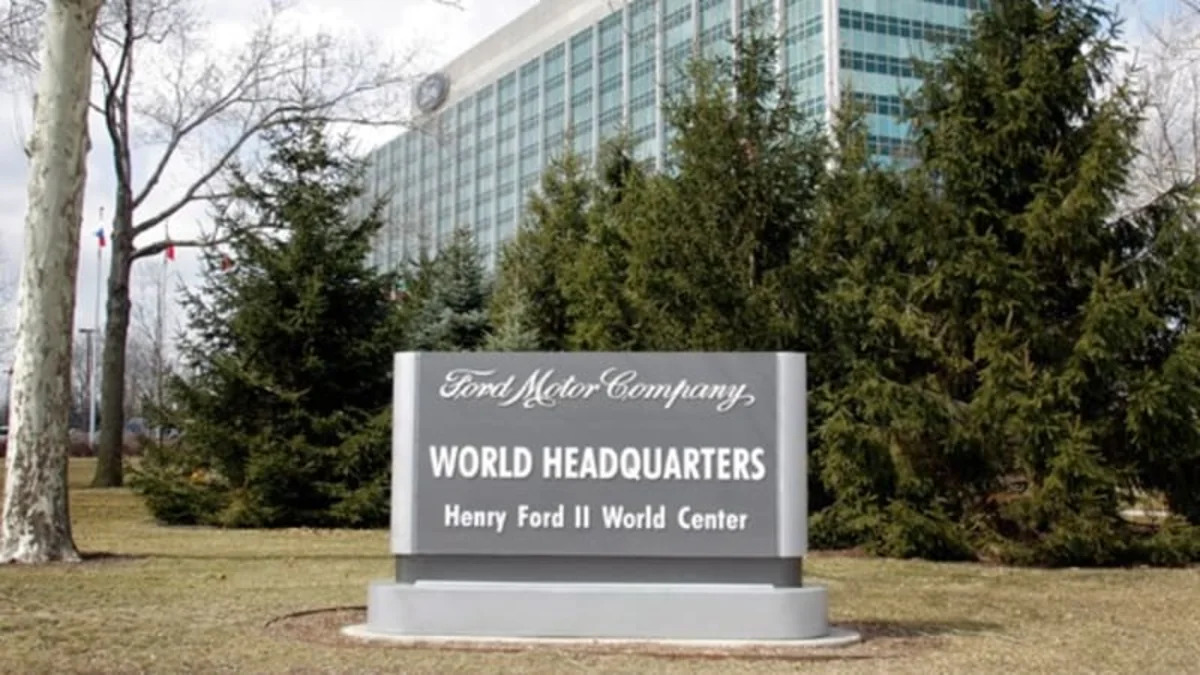
[Source: Ford | Image Source: Bill Pugliano/Getty]
PRESS RELEASE:
FORD MOTOR COMPANY ANNOUNCES PUBLIC OFFERING OF 300 MILLION SHARES OF COMMON STOCK
DEARBORN, Mich., May 11, 2009 – Ford Motor Company (NYSE: F) announced today a registered public offering of 300 million shares of its common stock at a par value of $0.01 per share. Ford said it also expects to grant to the underwriters a 30-day option to purchase up to 45 million shares of common stock.
Net proceeds to Ford from the offering are expected to be used for general corporate purposes, including to fund with cash, instead of stock, a portion of the payments the company is required to make to the Voluntary Employee Beneficiary Association (VEBA) retiree health care trust with the United Auto Workers.
"We continue to make strong progress on our transformation plan – gaining retail market share with great new products, improving quality, reducing costs and positioning Ford for a return to profitability," said Ford President and CEO Alan Mulally. "Today's equity offering is another example of the fast, decisive action we are taking as we build momentum on our plan, including further progress on improving our balance sheet."
Citi, Goldman, Sachs & Co., J.P. Morgan and Morgan Stanley are acting as joint book-running managers of the offering.
Ford has filed a registration statement – including a prospectus – with the SEC for the offering to which this communication relates. Before investing, investors should read the prospectus in that registration statement and other documents Ford has filed with the SEC for more complete information about Ford and this offering.
Investors may obtain these documents for free by visiting EDGAR on the SEC Web site at www.sec.gov. Alternatively, the issuer, any underwriter or any dealer participating in the offering will arrange to send the prospectus and the prospectus supplement upon request by calling Citi at (800) 831-9146; Goldman, Sachs & Co. at (212) 902-1171 or (866) 471-2526; J.P. Morgan Securities Inc. at (718) 242-8002; or Morgan Stanley & Co. Incorporated at (866) 718-1649.



Reader Comments (Page 1 of 2)
Gary Lowe 8:16AM (5/12/2009)
Is there any group of companies less credible then: Citi, Goldman, Sachs & Co., J.P. Morgan and Morgan Stanley. What will they be selling next? Wooden Nickels?
Reply
Sea Urchin 8:35AM (5/12/2009)
The KEY here is what class of stock is it.
Class A is the stock you buy on NYSE, available to anyone with money. These investors will lose value because their shares will be diluted, (their ownership will become smaller because now more people own part of Fords potential profits)
I don't see Ford family selling the Class B stock, which is not publicly traded, Class B is a special class that allows Ford family to control Ford Motor, those are the voting shares. How come they did not dilute their own ownership? They rip the benefits at the expense of people who own Class A. Mullaly needs to tell Billy the Lip to stop putting his family ( Cousin Ed, Uncle Gus, and others) ahead of investors who put their hard earned money into the company.
Reply
In2uition 8:40AM (5/12/2009)
Family first....
notYou 8:53AM (5/12/2009)
Sea Urchin: Class A is the stock you buy on NYSE, available to anyone with money. These investors will lose value because their shares will be diluted, (their ownership will become smaller because now more people own part of Fords potential profits)
You're mixing metaphors and it's not a zero sum game - while the issuing of more A stock expands the pool, the _dollar_value_ of existing stocks are in no way diluted. The value of the additional 300 million (~1.8bn?) comes out of the pockets of the people who purchase them, not at the the expense of the existing owners.
As far as a single class A owner's representation becoming smaller; sure. But does that matter since , like you said, the company is really controlled by the B share owners?
Bloke 8:57AM (5/12/2009)
The publicly traded shares won't necessarily be worth less with a new issue, since market value is determined by the company's performance and factors affecting the state of the market generally. However, in the event of a voted dividend, the amount of dividend per share would be smaller since distributable profit is being carved up over more shareholdings. Given the losses Ford has racked up in recent years, I dare say many Ford shareholders would be grateful to receive any dividend.
Sea Urchin 9:02AM (5/12/2009)
@ NOT YOU
Look Lets say company has 50 shares outstanding and made $100, each shareholder gets $2 a year. Now new shareholders come in, yes they do pay for their own shares but now there are 70 shares outstanding and the company still makes $100, now 70 people will share that $100 rather than 50. The original shareholders had their ownership (ownership of profit, not company) deluded.
This directly affects the price of the stock because as i said more people now have the right to the potential profit the company makes. As an example you still have you 100 share it's just that as a % that 100 shares is smaller.
notYou 9:24AM (5/12/2009)
Sea Urchin: "Look Lets say company has 50 shares outstanding and made $100, each shareholder gets $2 a year...."
Ford stock doesn't pay dividends, hence my point: existing Class A investors are _not_ going to lose actual dollar value nor diminished returns [re: dividends] as a result of new issuance. Sorry, but it is that simple. Please stop with the FUD.
Judy Zik 10:51AM (5/12/2009)
Yes the Ford's actually still have control of their family company. WTF is wrong with that? I am sure some of the other famous corporate families wish they had the foresight to keep some control over their name and the company they started. They don't seem to bother meddling in the day to day operations anyway. Anyone buying Ford stock knows this going in so what is the big deal.
This is once again a smart move and proof that Mullaly is worth his paycheque. At a time when Ford stock is climbing fast and getting tons of positive press a new offering will likely have little effect on their share price while giving them the cash.
why not the LS2LS7? 11:17AM (5/12/2009)
notYou:
Issuing more shares dilutes the current stock period. It doesn't matter whether the stock issues a dividend or not. There are simply now more owners to the company and so each owner owns less. So the amount of earnings per share is smaller. This changes the price to earnings ratio (per share) and thus changes the market price (per share).
GM and Chrysler are looking at similar problem with their VEBA buyouts.
notYou 11:57AM (5/12/2009)
WhyNot: "Issuing more shares dilutes the current stock period. ... This changes the price to earnings ratio (per share) and thus changes the market price (per share).
Lets all take a deep breath and say this together:
EPS and PE are _not_ stock value, they are tools. If they were the value, we wouldn't need stock markets to set pricing - everyone would just do the EPS/PE math, arrive at X and that would be it.
For example, if Ford issues a bazillion new shares, the EPS/PE drops through the floor but the collective market says "yeah, their EPS and PE sucks, but they're gonna take off with teh new capital!" and the price of the share remains the same, then your explanation doesn't hold water.
Which is why an Issuance in and of itself has nothing to do with existing shares value. While it will change EPS and PE, you have no way of predicting how or how much that will affect share value.
If your point was that it would dillute the number of shares in the market as a percentage of the pool, ok [shrug]. But the original point was the change of existing share's s value and there is no direct correlation.
why not the LS2LS7? 12:06PM (5/12/2009)
notYou:
Your argument that P/E isn't what determines the stock value is severely blunted by the fact that no one can say what determines stock value. Each person selects the amount they will be willing to pay. You cannot say it isn't P/E, especially because for a lot of people it is P/E.
Your example you give does not address the issue. If Ford doubles the shares, but people think the company is going up so the shares rise from half value to full value, it doesn't mean the doubling of the shares didn't do anything. Because if they hadn't doubled the shares, the value would have gone from full value to double value. So the stock is still halved due to the dilution.
Another problem with your argument is stock splits. When a stock splits 2:1, the share price halves. Why? Because of the dilution. Yes, it may go up later, but you cannot say it wouldn't be even higher if it had not split.
Finally, look at the share price today. Ford announces an approximately 10% dilution and the shares went down 10% at open.
Now go ahead and list a bunch of technicalities you can squeeze through to not be wrong in what you said. But it doesn't matter except so that you can declare victory. The rest of us know what this means. It means each share owns less of the company and therefore is worth less, so the market value drops.
Sea Urchin 9:04AM (5/12/2009)
@ Block
But isn't the effect on EPS per share the same?
Reply
Saluki 9:49AM (5/12/2009)
You can't issue new common stock without diluting existing shareholders.
The future earnings will be divided among more shares which lowers earnings per share. Unless the stock sells at a higher earnings multiple the addition of new shares reduces the value of existing shares.
This isn't a debatable topic, it's like arguing whether the earth is round.
Sea Urchin 10:06AM (5/12/2009)
So who is in the right me or Not You?
notYou 10:31AM (5/12/2009)
"You can't issue new common stock without diluting existing shareholders."
Again, you are both are mixing terminologies to suit your point - Sea Urchin originally said "investors will lose value because their shares will be diluted" now you're saying it's "diluting existing shareholder" (whatever that means).
EPS is a tool used to evaluate stock value; it doesn't set or change it. So regardless of EPS implications (which could go _up_ as a result of the additional capital, which is why this conversation is a ridiculous one) the _value_ of the existing shares is unaffected, even if EPS may (or may not!) be.
Saluki: "This isn't a debatable topic, it's like arguing whether the earth is round.""
Correct, see my point above.
Sea Urchin: "So who is in the right me or Not You?"
Take your pick.
BoxerFanatic 10:37AM (5/12/2009)
me or notYou, nice conundrum.
There may not be real cashflow difference right away for existing holders, and the new shares may sell at current prices.
But the market, unless it is completely abolished, will adjust for it over time, and the stock price for the larger pool of stocks will be adjusted to reflect company performance.
It probably won't be a pure percentage dilution, just by counting the number of shares. If Ford does well, it won't dilute as much, as people will share equity in a stronger company. If Ford tanks under union/competition pressure, or suffers due to supplier or government/competition pressure issues, the dilution will be more severe, as more people share in a weaker company over time.
But it will dilute, it is the laws of mathematics. You can't divide one thing by two different numbers, and get the same result.
HotRodzNKustoms 10:08AM (5/12/2009)
I like how you guys are talking stocks like you guys have your series 7. I don't come here to let everyone how much I do know about stocks, bonds, and commodities but I do come here to play armchair auto-exec and pretend I know how to run any multi-billion dollar automaker like a genius. Hahaha
I am just impressed that Ford remembered that there are conventional ways of raising money.
Reply
Saluki 10:47AM (5/12/2009)
I do have my series 7. Of course getting the series 7 requires that you know about as much corporate finance as the average McDonalds fry cook.
CFA charter is where it's at!
Tagg 10:49AM (5/12/2009)
True that. I guess Ford would be better off just having the government print off some of those billion dollar bills with Obama's face on the front. It just shows that no matter what Ford does there will always be a group ready to dump on it. Same for other automakers as well.
harlanx6 10:12AM (5/12/2009)
This is troubling. Issuing more stock always dilutes the value of the existing shares. They have to do this because of the 6 $billion indebtedness to VEBA. Again, with a very strong line of products, the UAW is dragging the company under similar the the late great GM and Chrysler. There will be no winners here. The UAW is going to end up with the stock, and then they can steal from themselves until the value is gone.
Reply