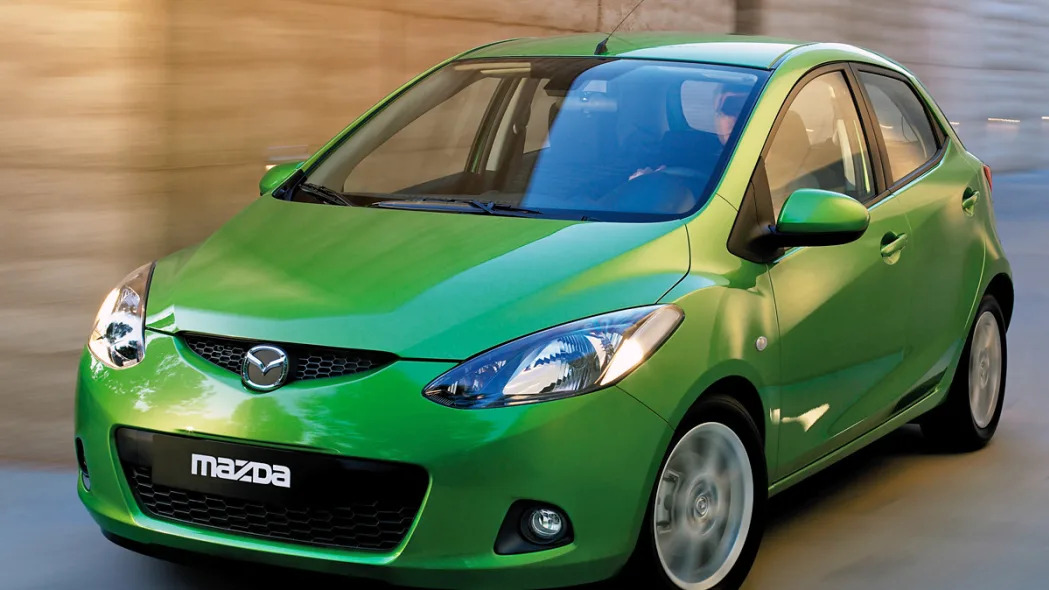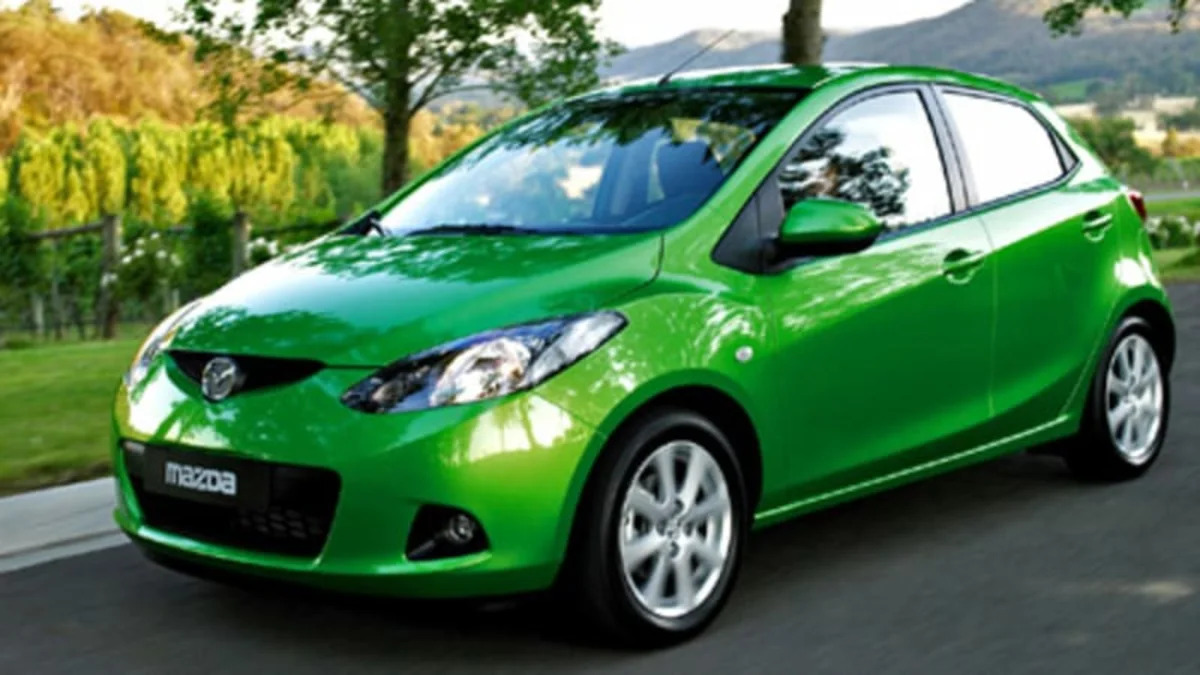
Mazda develops new NA 1.3L Miller-cycle engine for Mazda2/Demio

In order to qualify its new Mazda2/Demio for Japan's Green Tax exemptions, Mazda has developed a trick new 1.3L Miller-cycle powerplant that's naturally-aspirated, of all things. Normally a supercharger is required in a Miller-cycle engine, which makes Mazda's new mill particularly intriguing. It will be combined with Mazda's first CVT, and thanks to a 222 lb. diet, the new Demio is expected to return 54 mpg. In the press release after the jump, Mazda makes a big deal about how efficient its new Miller engine is, but fails to mention how much power it makes. That's not surprising, since it's generally accepted that, compared to our traditional Otto-cycle engines, a Miller trades off power for increased efficiency (that's what the supercharger's usually for). With this new engine, however, Mazda further cements its reputation as an automaker with a penchant for alternative forms of internal combustion.
[Source: Mazda]
Gallery: 2007 Mazda2
PRESS RELEASE
Mazda Develops New Naturally-Aspirated MZR 1.3L Miller-cycle Engine
The new MZR 1.3L engine powers the all-new Mazda Demio to achieve a fuel economy of 23.0 km/L and qualify for Japan's Green Tax exemptions
HIROSHIMA, Japan-Mazda Motor Corporation has developed a new, naturally aspirated MZR 1.3L Miller-cycle engine, which will power the all-new Demio (known as the all-new Mazda2 in overseas markets) when it goes on sale in Japan in July 2007. In combination with Mazda's first continuously variable transmission (CVT), the engine will assist the new Demio to achieve a 10-15 mode fuel economy of 23.0 km/L, an improvement of approximately 20 percent over the 19.2 km/L rating of the current model.
Newly developed from the current MZR 1.3L DOHC aluminum engine, the naturally-aspirated MZR 1.3L Miller-cycle engine employs delayed closing of the intake valves in order to reduce pumping losses and improve thermal efficiency through a higher expansion ratio. Intake valve timing is optimized by the Sequential Valve Timing System to provide improved fuel efficiency over the current MZR 1.3L engine when cruising and accelerating. In conjunction with the CVT, which transfers torque at low speeds without power loss and eliminates gear-shift shock, the setup achieves excellent fuel efficiency as well as a smooth and exhilarating ride.
In addition to this new, highly efficient powertrain, the all-new Demio has been made approximately 100 kg lighter than its predecessor through weight reduction techniques, which have resulted in nimble handling and significantly improved fuel economy.
The Demio model with the naturally aspirated MZR 1.3L Miller-cycle engine combined with the CVT transmission achieves a fuel economy that is rated as 20 percent or better than the level specified by Japan's 2010 fuel economy standards. Exhaust emissions are also at least 75 percent lower than 2005 standards, which conforms to Japan's Super Ultra-Low Emissions Vehicle (SU-LEV) standard and qualifies the Demio for Green Tax exemptions.
Through its Sustainable Zoom-Zoom plan that was announced in March 2007, Mazda declared its intention to pursue the harmony felt between driving pleasure and environmental and safety features, and its quest for an advanced Zoom-Zoom world. This includes the ongoing desire to create captivating design, to provide our customers with continual driving pleasure and to develop improved safety and environmental technologies.



![Bugatti Bird-gate Followup: Driver identity revealed <b>[*UPDATE:</b> Now with actual crash video!]](http://www.blogcdn.com/www.autoblog.com/media/2009/11/bugatti-veyron-swim-1258147199_143x85.jpg)


Get a WordPress.com Blog


Reader Comments (Page 1 of 2)
rem83 11:15AM (5/31/2007)
Um, correct me if I'm wrong here, but the Miller cycle engine uses forced induction (not necessarily a supercharger) to help with the compression. The intake valve remains open during part of the compression stroke, and therefore the compressor (be it turbo or super) accomplishes the first part of the intake charge compression. If you do not use a forced induction system, this is called an Atkinson cycle, like the Prius uses. So isn't this car really just using an Atkinson cycle?
Reply
Aetius 11:20AM (5/31/2007)
"It will be combined with Mazda's first CVT"
Uh-oh...
Reply
Rick Lyon 11:34AM (5/31/2007)
AMERICA! AMERICA! AMERICA! AMERICA! BRING THIS CAR TO AMERICA!
screw ford.
Reply
Peter 12:06PM (5/31/2007)
Probably about 50HP and 0-60 in 20 seconds making it a non starter in North America.
A Miller cycle (1940s) without supercharging is Atkinson cycle (1882) which predates Miller.
Referring to this as Miller without the supercharger is somewhat nonsensical, since Millers changes was the addition of the supercharger.
Prius uses Atkinson cycle.
Reply
bison 1:34PM (5/31/2007)
Toyota gets about 62 horsepower per liter out of their Atkinson-Cycle 2.4 in the Camry Hybrid. If Mazda can match this, they will come in at about 80.
Julius 12:10PM (5/31/2007)
I'd agree with calling this an Atkinson cycle engine.
Rick, what's with the "screw Ford?" This car is the basis for the Ford of Europe B-car which is also coming to America. What, did you forget that Ford owns a majority stake in Mazda?
Reply
Rick Lyon 1:39PM (5/31/2007)
Because Ford will not keep this body, it will look like a baby Focus. I dislike Ford's body panels, lights, an overall styling. The interior is OK, but then you also realize that Mazda provides owners with a rental and Ford does not, while the car is being serviced. Ford might own a portion of Mazda, but that in no way reflects on Ford's design or costumer relations. I don't want the Ford Fiesta or whatever, I want the car exactly above, the Mazda2.
Castle 12:21PM (5/31/2007)
As Peter has said, this is likely similar system to what the Prius currently uses (as well as the Ford Hybrid Escape).
However, while this method reduces pumping loss and increases efficiency their is a sacrifice in hp, which is why its usually mated to a electric motor or SC, but it probably matches the nature of this subcompact.
Reply
Tom Miller 12:26PM (5/31/2007)
If it has performance comparable to the Fit/Jazz, I'd sure take a serious look at this car.
Reply
naggs 12:49PM (5/31/2007)
the performance will be nowhere near Fit levels. Not with a atkinson 1.3. this thing is going to be like 60 hp at most
Reply
Peter 12:46PM (5/31/2007)
With about half the HP of fit/Jazz how could it possibly manage comparably performance? It certainly won't weigh half as much.
The standard 1.3l is about 65 HP, the Atkinson cycle probably knocks that down to 50 HP. Ok for a hybrid engine, but pitiful standalone.
Performance will be comparable to the Smart and nowhere near Fit/Yaris. At least in North American trim where they have over 100HP.
Reply
Travis Rassat 1:33PM (5/31/2007)
I'm no engineer, but after reading through the Wikipedia links provided with the article, it seems to be an interesting solution and I think they might be able to surprise us. Reading on the Atkinson Cycle page, it lists the Ford Escape Hybrid, Prius and Camry Hybrid Atkinson Cycle engines and their compression ratios, which are all very high. To me that would make sense - raise the theoretical TDC to BDC compression ratio to compensate for the Miller Cycle's reduced actual compression ratio. Perhaps by combining a higher compression ratio with variable valve timing, maybe they could get decent performance out of this?
It seems Mazda has a pretty good idea on how to make this work - this article was a link from the Wikipedia page:
http://www.mazda.com.au/articleZone5.aspx?articleZoneID=3817
I think this is pretty fascinating - I definitely learned a lot!
Reply
Guenther 1:42PM (5/31/2007)
I wonder if efficiency of a Miller Cycle using a turbo would return better fuel economy than a mechanical supercharger. I expect we'll see a Ford B-car before too awful long. A cheap, efficient powertrain will be key.
Reply
wwest 4:14PM (10/15/2007)
Turbocharging an Atkinson cycle engine to convert it to Miller is not possible. Not enough energy remaining in exhaust gasses/manifold to drive the turbo.
Peter 2:13PM (5/31/2007)
Toyota gets 76 HP out of the 1.5L in the Prius. I think that is in line with expectations. That would yield 65 hp.
Which is probably high, given that the standard 1.3 this is based off is 65hp and this one will sacrifice HP for economy.
My guess is 50-55 HP.
Reply
Gary Blomquist 4:28PM (5/31/2007)
I also second the comment....."Bring it here!!!" to the U.S.A..
Don 5:02PM (5/31/2007)
50 hp? This thing might as well be the 1.0-litre Metro if that's the case.
Reply
Peter 5:05PM (5/31/2007)
Bring it to North America sure, but they can keep the 55 HP engine and give me the 1.5l it was shown with before.
40mpg and 100hp is fine by me. 55HP will present more danger than I would want to face while merging.
Reply
That One Person 5:35PM (5/31/2007)
Rick...I dont know about your local Ford dealers but ours provide rentals and great service. The local Mazda dealers are ok...probably the best out of all the local import dealers (except the Ferrari dealer...they were extremely nice). Everyone I know who owns or has owned a Ford and has taken them in for service (which rarely happened), they were treated very nicely. I dont mind your opinion...you have a right. But not EVERY Ford dealer is run buy morons. Now, the local Honda/Toyota dealer...talk about a joke.
Anyways, cool cars. I would like to see how it performs before making a final judgement.
Reply
J 5:41PM (5/31/2007)
Hopefully its flex fuel. E-100 would be nice.
Reply