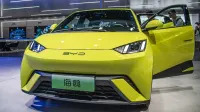
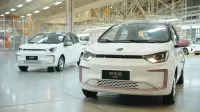
Fiat's Panda is the best selling minicar in Europe, and has been for four years. When China's Great Wall Motor -- Chrysler's Chinese partner -- decided to make a minicar called the GWPeri, it borrowed from the best. That is, if by "borrowed" you mean created a car that differs only from the Panda in it's headlamps and bumper details.
Fiat didn't just do a double-take when it saw the GWPeri, it sued Great Wall Motor both in Italy and in China to prevent the car from being sold in Europe and China. A court in Turin recently decided that "the [GWPeri] does not look like a different car but is a Panda with a different front end." Furthermore, if a Peri ever shows up in Europe, GW will have to pay Fiat €15,000, with every GWPeri after that incurring a €50,000 fee.
Great Wall has already said it is going to contest the European verdict. The Chinese ruling hasn't come down yet, where the GWPeri went on sale earlier this year. Thanks for the tip!
While domestic sales continue to slide, the auto market in China is thriving. Both General Motors and Ford have reported double-digit sales growth for the first-half of 2008 in the world's most populace country, with GM moving 590,126 Buick, Chevrolet, and Cadillac vehicles for a total sales increase of 12.7 percent, while Ford sold 172,411 units for 21 percent jump in growth. With China recognized as the second-largest vehicle market outside the United States, and with their economy forecasted to grow by at least nine percent this year, automakers in Europe, Japan, and the U.S. are investing heavily to expand sales and production in the Chinese market. It is worth noting that vehicle sales in China have been nearly immune to the increase in global oil prices as governmental controls keep diesel and gasoline prices among the world's lowest.
Following up on our report last month about Volvo possibly going to the Chinese, state media is now reporting that Chery Automobile, one of the largest independent and fastest growing Chinese auto manufacturers, has its eyes on the Swedish automaker. Although officials at Chery rule out the possibility of buying Volvo, other sources have stated that the Chinese automaker has already negotiated funding for a possible acquisition. If so, that funding will be significant-insiders put Volvo's value at 30 billion yuan (about $4.4 billion dollars). This isn't the first time that Ford has been rumored to be cashing-out on Volvo... however, it was just two months ago that Ford officials reiterated that Volvo was not for sale. We wouldn't bet our yuan on it.
Most automakers are struggling with horrible US market conditions right now, but unlike competitors such as Toyota and Ford, Chrysler doesn't have sales in other areas of the world to fall back on. The Pentastar is looking to improve its fortunes overseas while also benefiting from low labor costs by partnering with the Great Wall Motor Company. The young Chinese automaker doesn't specialize in the small vehicles Chrysler needs here in the States, however, as the company's primary focus is on trucks and SUVs. The goal of the union is to share distribution channels, technology, and components, which should save both companies money in R&D and improve economies of scale. The deal is unrelated to a separate pact with Chery to produce a small, Dodge-branded car for sale in North America.
With sales down in the states by 28% in June, Chrysler appears to be in the most trouble of the Detroit automakers in the near term. Branching out to other markets to drive down costs and add sales could be the automaker's best hope for survival in the future.
From Xinhua via our friends at China Car Times comes the above photo, showing Chinese counter-terrorism forces going through drills as they prepare to crush any dissent terror threat that might arise during next month's Olympic Games. The black ninja suits, fritz helmets, body armor, and submachine pistols all fit the profile of a specialized group like this. But... Segways?
UPDATE: Turns out, Engadget is having a caption contest. (Thanks, seoultrain.)
An eternally unanswerable question seems to be whether or not Ford is actively shopping around Volvo for a buyer. Just this week we reported that Chinese automaker SAIC and some Russian investors had expressed interest in purchasing the Swedish carmaker from Ford, but today we learn from a source within SAIC that the company is doing nothing of the sort. The unidentified source said that, as far as he/she knew, the two companies were not in contact about a possible purchase at all. Volvo's staying quiet and licking its wounds after announcing 2,000 layoffs this week, while Ford is singing the same old song with a catchy chorus that insists Volvo is not for sale. Well, the rumor that some Russians are interested in Volvo hasn't been refuted yet, so until someone named Boris says otherwise, let's considerable Volvo on the market despite Ford's protest.
According to Olivier Francois, Chief Executive Officer of Lancia, Richard Gere was chosen for a recent ad for the Lancia Delta because he "is not merely a fine actor; not merely one of the most famous men in the world. He is a man with a great difference: the ability to combine talent, fame and style with great character. I'm talking about his commitment to peace." That affinity for peace stretches especially towards the people of Tibet, a people who's autonomy from China Gere supports.
This commercial, which you can watch after the break, features Gere driving a new Lancia Delta from Hollywood to Tibet in just 30 seconds and aired in Italy. After reports of the commercial appeared in Chinese newspapers, China was apparently none too happy about it. Fiat has decided to apologize, with a company spokesman saying, "Fiat Group extends its apologies to the Government of the People's Republic of China and to the Chinese people."
Our opinion? Gere's alright in Pretty Woman, but not much else after that. Apologies are usually pretty lame, but we'd appreciate one for Gere's horrible singing in Chicago as long as they are being handed out so freely. And how 'bout one for that Lancia's front end?
American automotive companies have been doing rather well for themselves these last few years in China. Still, the majority of manufacturing those vehicles is done in China using locally sourced parts. For this reason, the Chinese government has been facing pressure to ink more deals with American companies for the export of goods there, which is apparently now beginning to take place. Ford, for instance, has announced that it will be sending 30,000 complete vehicles (no word on which ones) to China along with other various auto parts. General Motors has also signed on with about $1 billion in vehicles and parts for export to China. Chrysler too will get in on the trading, though its deals will likely be smaller than either Ford's or General Motors'. All in all, the automotive sector will make up about $2 billion of the recently announced deals, which total more than $8.3 billion in exports. And we're pretty sure they're all lead-free.
What's built in the States, stays in the States. At least that is how it used to be with one of the world's largest automaker. (The one exception is the Toyota Avalon sedan -- exported to the Middle East last year.)
Toyota has now announced that it will ramp up U.S. vehicle production in Indiana and begin exporting vehicles to other booming markets around the world. The first to leave our shores will be the Toyota Sequoia, as it heads to buyers in the Middle East later this year. The Toyota Sienna minivan will follow, as it will be shipped to China and other markets as early as 2010. This news should be welcomed by workers and suppliers at the automaker's plants as Toyota recently slowed production at several facilities. This new trend of shifting production towards exporting vehicles may help keep them running at capacity, and keep everyone on their jobs.
After years of talk, Chery is finally entering the North American market later this year, but the small car will be badged as a Dodge, and it'll be sold exclusively in Mexico. The decidedly un-Hornet-looking A1, which was designed by Bertone of Italy, will be rebadged as a Dodge and virtually unchanged from its Chery twin. While Chrysler execs are adamant that the A1 isn't coming to the US, the Pentastar is still working with Chery on a small car to be sold north of the border. Don't hold your breath waiting for an ultra-cheap Chery in the US, though. Chrysler co-pilot Tom LaSorda says Chery has "three or more years" before the Chinese automaker can meet US safety and emissions standards.