

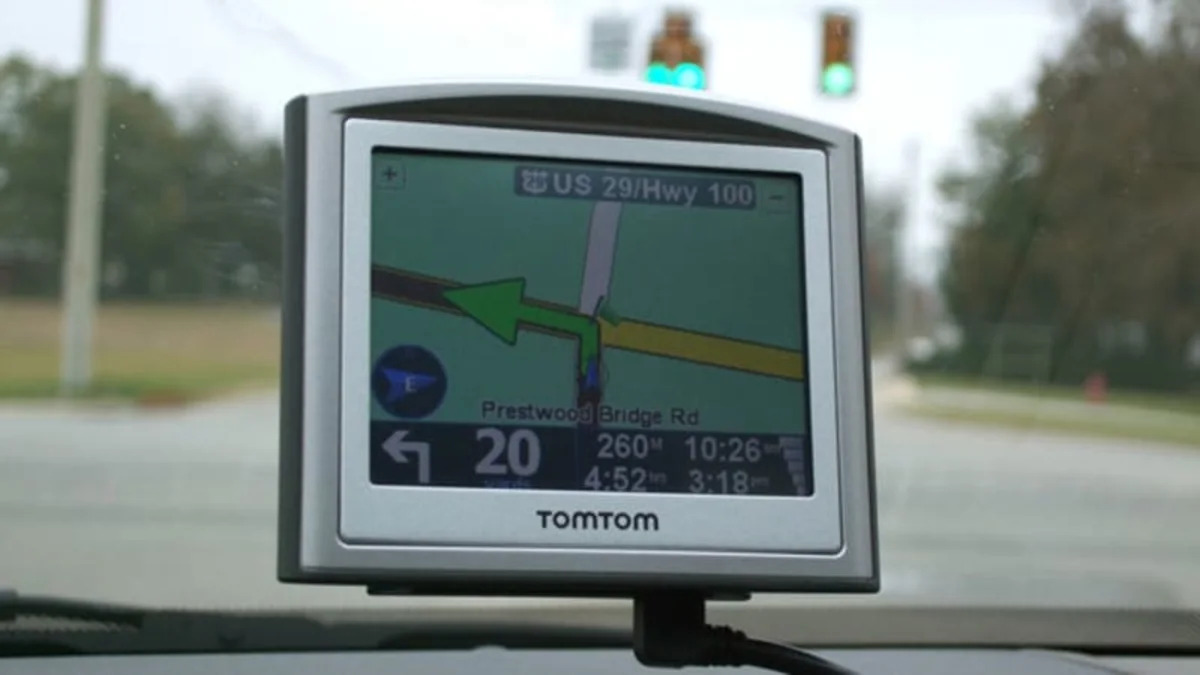
In Los Angeles, the 101/405 interchange is so congested that in 2002 it was determined that 27,144 hours per year were wasted trying to get from one freeway to the other. That's over 1,100 days. Per year. Not only does that number sound wildly low, but we guarantee it's gotten worse in the last seven years. Much worse. But according to a new study, GPS-systems with real-time traffic info can save American drivers four days a year of being mired in lousy traffic.
Now, we're taking this particular study with a grain of salt because it was sponsored by nav-system data-provider NAVTEQ. Still, even if it's only half true, we'll take our two days back. Here's what they did: The study looked at three types of drivers in a metro area (in this case the German cities of Düsseldorf and Münich), drivers with no navigation, drivers with static navigation and drivers with real-time traffic enabled navigation.
Not surprisingly, the third group of drivers spend 18 percent less time on their trips than the other two sets. Multiply those results out over a year and you save four days. Not only that, but it would lower the average driver's CO2 output by 21 percent. Of course, we're not sure how this would effect time spent stuck on interchanges like the aforementioned 101/405 where there's always traffic – no matter what – and there's really no other way to go. Full press release after the jump.
[Source: NAVTEQ | Photo by Scott Beale / Laughing Squid]
PRESS RELEASE
NAVTEQ Study Shows Traffic-Enabled Navigation Can Save Drivers 4 Days per Year
Results Build Upon Fuel and Carbon Emission Savings Previously Reported
CHICAGO, Aug. 27 /PRNewswire/ -- NAVTEQ, the leading global provider of digital map, traffic and location data for in-vehicle, portable, wireless and enterprise solutions, has revealed further insights from a proprietary research study designed to assess the consumer impact of everyday use of navigation devices. These findings focus specifically on the impact that the addition of real-time traffic has on the driver experience, and point to the use of traffic information as a primary influencer in time savings for the average driver.
The results are from a three pronged study conducted in two metropolitan areas of Germany - Dusseldorf and Munich -- which evaluated drivers without a navigation system, drivers with a navigation system, and drivers with a navigation system that included real-time traffic. Previous studies in this field focused more on "getting lost" scenarios versus the benefits to drivers of navigation system use during the course of their normal driving habits.
The study revealed that the drivers using traffic enabled navigation devices experienced dramatic time savings, spending 18% less time driving on an average trip versus drivers without navigation. If applied over the course of a year, a driver who does not currently use a navigation device would save themselves 4 days of driving each year if they had a traffic-enabled navigation system. Additionally, the findings show that drivers with real-time traffic experience reductions in distance traveled as well as increase fuel efficiency which would lead to a decrease in CO2 emissions per driver of .79 metric tons, or 21% less than a driver without a navigation system.
These results not only point to the positive impact on German drivers, they can be projected to other countries as well, for example*:
-- UK drivers with traffic enabled navigation would save 2.5 days per
year and drop their CO2 emissions by 20%
-- US drivers with traffic enabled navigation would save 4 days per year
and lower their CO2 emissions by 21%
* Study results have been applied to country specific data (e.g. market size; average annual miles driven) in reporting these figures
The participants, who had not previously owned a navigation device, had their vehicles outfitted with a logging device which was used to track the route they drove and their driving speed. The study results reflect more than 2,100 individual trips, more than 20,000 kilometers and almost 500 hours on the road.
The study was conducted by NuStats, a social science research firm that over the past 25 years has established itself as a leader in population surveys and qualitative research pertaining to transportation in general, and personal mobility and transit use in particular.
"This study continues to support the positive role that navigation plays in improving the consumer driving experience," says John MacLeod, executive vice president, NAVTEQ Connected Services. "In addition, the study supports the tangible benefits of navigation on fuel savings and environmental impact."
About NAVTEQ
NAVTEQ is the leading global provider of digital map, traffic and location data that enables navigation and location-based platforms around the world. NAVTEQ supplies comprehensive digital map information to power automotive navigation systems, portable and wireless devices, Internet-based mapping applications and government and business solutions. The Chicago-based company was founded in 1985 and has approximately 4,400 employees located in 192 offices and in 43 countries.
Now, we're taking this particular study with a grain of salt because it was sponsored by nav-system data-provider NAVTEQ. Still, even if it's only half true, we'll take our two days back. Here's what they did: The study looked at three types of drivers in a metro area (in this case the German cities of Düsseldorf and Münich), drivers with no navigation, drivers with static navigation and drivers with real-time traffic enabled navigation.
Not surprisingly, the third group of drivers spend 18 percent less time on their trips than the other two sets. Multiply those results out over a year and you save four days. Not only that, but it would lower the average driver's CO2 output by 21 percent. Of course, we're not sure how this would effect time spent stuck on interchanges like the aforementioned 101/405 where there's always traffic – no matter what – and there's really no other way to go. Full press release after the jump.
[Source: NAVTEQ | Photo by Scott Beale / Laughing Squid]
PRESS RELEASE
NAVTEQ Study Shows Traffic-Enabled Navigation Can Save Drivers 4 Days per Year
Results Build Upon Fuel and Carbon Emission Savings Previously Reported
CHICAGO, Aug. 27 /PRNewswire/ -- NAVTEQ, the leading global provider of digital map, traffic and location data for in-vehicle, portable, wireless and enterprise solutions, has revealed further insights from a proprietary research study designed to assess the consumer impact of everyday use of navigation devices. These findings focus specifically on the impact that the addition of real-time traffic has on the driver experience, and point to the use of traffic information as a primary influencer in time savings for the average driver.
The results are from a three pronged study conducted in two metropolitan areas of Germany - Dusseldorf and Munich -- which evaluated drivers without a navigation system, drivers with a navigation system, and drivers with a navigation system that included real-time traffic. Previous studies in this field focused more on "getting lost" scenarios versus the benefits to drivers of navigation system use during the course of their normal driving habits.
The study revealed that the drivers using traffic enabled navigation devices experienced dramatic time savings, spending 18% less time driving on an average trip versus drivers without navigation. If applied over the course of a year, a driver who does not currently use a navigation device would save themselves 4 days of driving each year if they had a traffic-enabled navigation system. Additionally, the findings show that drivers with real-time traffic experience reductions in distance traveled as well as increase fuel efficiency which would lead to a decrease in CO2 emissions per driver of .79 metric tons, or 21% less than a driver without a navigation system.
These results not only point to the positive impact on German drivers, they can be projected to other countries as well, for example*:
-- UK drivers with traffic enabled navigation would save 2.5 days per
year and drop their CO2 emissions by 20%
-- US drivers with traffic enabled navigation would save 4 days per year
and lower their CO2 emissions by 21%
* Study results have been applied to country specific data (e.g. market size; average annual miles driven) in reporting these figures
The participants, who had not previously owned a navigation device, had their vehicles outfitted with a logging device which was used to track the route they drove and their driving speed. The study results reflect more than 2,100 individual trips, more than 20,000 kilometers and almost 500 hours on the road.
The study was conducted by NuStats, a social science research firm that over the past 25 years has established itself as a leader in population surveys and qualitative research pertaining to transportation in general, and personal mobility and transit use in particular.
"This study continues to support the positive role that navigation plays in improving the consumer driving experience," says John MacLeod, executive vice president, NAVTEQ Connected Services. "In addition, the study supports the tangible benefits of navigation on fuel savings and environmental impact."
About NAVTEQ
NAVTEQ is the leading global provider of digital map, traffic and location data that enables navigation and location-based platforms around the world. NAVTEQ supplies comprehensive digital map information to power automotive navigation systems, portable and wireless devices, Internet-based mapping applications and government and business solutions. The Chicago-based company was founded in 1985 and has approximately 4,400 employees located in 192 offices and in 43 countries.

Sign in to post
Please sign in to leave a comment.
Continue