


2009 Toyota RAV4 Sport - Click above for high-res image gallery
The small crossover segment, where the neo-sorta-trucks live, is one of the hottest battlegrounds for consumer dollars. Small skirmishes go on in the border regions; confused vehicles don't know whether to be mud-slingers with brash attitudes or optioned-up urban sophisticates. Toyota's RAV4 certainly brings sophistication, and though it can venture off road a bit, it's not a jumbled, mixed-up mess. The RAV's classification-straddling lets it serve the whims of a broad array of potential buyers.
Wanting to cover all the bases, the RAV4 can be had in a variety of configurations, from a basic front-driver with four-cylinder power up to a leather-lined, four-wheel-drive Limited with a silly-powerful V6. A Sport version seeds right in between the base and Limited, carrying a satisfying level of equipment. There's an allure to the big horsepower delivered by the six – especially when it costs as little on EPA ratings as the RAV's 3.5-liter – but these days, "adequate" is riding a wave of newfound popularity as Americans struggle to pinch more pennies. In keeping with that spirit, when it came time to test a RAV4, we decided to try life with a four-cylinder 4WD Sport.
_1280.jpg)
Photos Copyright ©2009 Dan Roth / Weblogs, Inc.
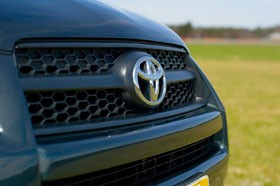
All grown up in its third generation, the RAV4 has swelled significantly since the model launched back in the 1990s. The Highlander's newfound gigantism left room for the RAV to expand beyond its Corolla roots. The CUV's styling has shed its old stubbiness and is now far from the weird of the original. There's a strong face, a slight hint of gaping maw suggested by the trapezoidal grille, but the overall design is generally restrained and safe. Nowhere do you find a hint of cladding or overly fussy detailing, making this not-so-small small CUV a cleanly-styled contender.
_1280_opt.jpg)
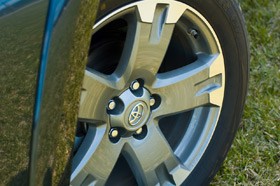
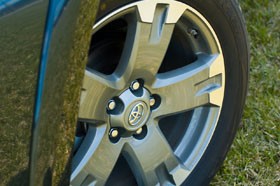
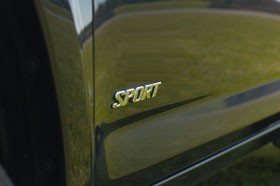
The Sport trim level gets body colored fender flare appliques, as well as painted door handles, fog lamps, and sharp looking 18-inch alloy wheels. Sport badges taped to the doors are backed up by sharpened suspension reflexes; check out those blue painted struts. The Sport manages to differentiate itself from a base RAV4 the same way a Z06 looks more special than the standard Chevrolet Corvette. No version looks bad, but there's a little extra zoot to the step-up model, differences that are most noticeable when parked side by side. Unlike the Corvette, though, absolutely nobody is going to gawk at your RAV4, not even with that tumor of a spare tire on the back door.
_1280_opt.jpg)
_1280_opt.jpg)
_1280_opt.jpg)
The Sport has its own interior scheme called Dark Charcoal, which teams with the deeply tinted rear glass to lend a dour atmosphere to the interior. Lighter interior colors, like in other versions of the RAV, feel friendlier. New ground is not broken with the RAV4 inside or out, but Toyota has taken a file and rasped off any rough edges, so the execution is all but flawless. Even without the niceties of leather and oodles of tech, the RAV4's cabin sets the standard for its class. Others come close to Toyota's combination of good materials and attentive ergonomics, but the RAV4 manages to be a smidge better. Surfaces that look luxuriant are surprisingly hard to the touch, just like everyone else, and there are other spots where the plastics can easily collect scuffs. Tolerances are tighter than you'll find elsewhere, though, and the easy nature of all the controls gives the RAV4 an edge.
_opt.jpg)
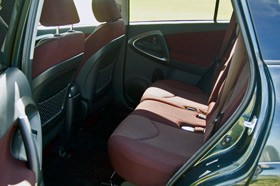
HVAC controls are three foolproof knobs. No fiddly rockers or digital displays here, just elegant, functional simplicity. There's no hunting around for anything in the RAV, with the exception of the miniscule fuel door release on the floor. The seats are the same story. Nothing exceptional, maybe not even the best, but when taken together with the rest of the vehicle, the whole still adds up to a sum that wins the day. Ferrying people? The second row slides and adjusts for rake, too. There's plenty of legroom for those passengers who didn't draw a long enough straw to sit up front. Child seat fitment, however, can be a little tricky if you're using the LATCH system. The top tether secures to a loop way down low on the seatback, a location that's very difficult to reach as it's blocked by the cargo organizer directly behind the seat.
_opt.jpg)
If the RAV will be dragging your amazing collection of JEM paraphernalia from the 1980s, your entire stock should fit behind the rear seats. With the spare tire on the back door, lots of space is freed up. Remove the normal cargo area floor panel and you'll also find a deep well. There's even a cargo organizer at the base of the second row seatbacks. If more space is needed, folding the seats is accomplished by pulling a lever on either side of the cargo area. For really big merchandisers, the V6 RAVs can be ordered with a trailer-prep package.
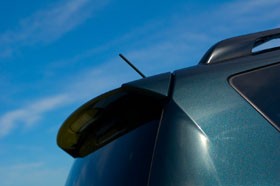
The rear door, hinged at one side, is less practical and studied than we've come to expect from a star student like Toyota. Tight parking situations can sometimes make swinging the door a challenge, and the weight of an 18-inch wheel and tire bolted to the other side doesn't help matters. Surely, a full size spare is welcome when you blow a tire, but if you're parked on a hill, it can be beastly to yank open the cargo hold, and if gravity gives an assist, you could inadvertently be whisked into next week. Besides, externally mounted spares don't always allow the bumper to do the...well, bumping, so a routine slow-speed back-up oopsie can end up costing many thousands in sheetmetal and broken glass. We think the RAV4 would be better with a top-hinged hatch, but at least Toyota paid attention to the fact that people will actually want to load things into the vehicle. There's a deep cut into the rear bumper that makes liftover height reasonable, and the door has a welcome "hold-open" feature.
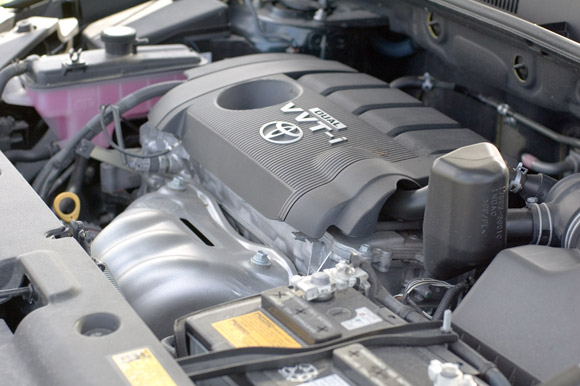
2009 marks the arrival of Toyota's 2AR four-cylinder in the RAV4's engine room. The AR series engine is used in the Camry, Highlander and Venza, though the larger 2.7-liter 1AZ is in the larger vehicles, leaving the 2.5-liter 2AR for the RAV and Camry. The new engine features an aluminum block with cast-in iron liners, dual balance shafts, variable valve timing on both intake and exhaust camshafts, and employs a low friction design. Other techniques like tumble control valves and newly designed fuel injectors are also employed to ensure clean, efficient running. The result of the impressive spec sheet is a 2.5-liter engine that delivers 179 horsepower and 172 lb-ft of torque while returning miles-per-gallon in the mid-20s. Even with a four-speed automatic transmission crying out for updating, the powertrain returned 25 mpg in our driving. Unfortunately for Toyota, that's not nearly efficient enough to beat newcomers like the redesigned 2010 Chevy Equinox, which is expected to achieve 32 mpg on the highway compared to this Toyota's best effort of 28 mpg.
The RAV4's transmission is a demerit, making performance feel soft when merging or passing. Once the tachometer needle swings past 4,000 rpm, the pleasantly powerful engine puts its shoulder into it and moves things along smartly. The four-cylinder RAV is not down on gumption, but it would be more pleasing and lively with either a modern automatic with more ratios, or a manual.
_opt.jpg)
The sport-tuned suspension of our Sport model was well behaved, but it felt slightly stiff-kneed, something that non-enthusiasts might find objectionable. Tightly snubbed body control is good, but there's more bobbing and head toss than we'd have liked. That said, if we had to pick, we'd take stiff over floaty. The electrically-assisted power steering surprisingly manages to avoid being shot up with Novocain, too. Thus, cruising down the road is relaxed in the RAV4 Sport. Overall, there's a Lexus-like sheen about its demeanor, and the attention to detail and care that's been taken with its design let it get away with some demerits. The RAV4 goes down the road in a calm, relaxed and muted fashion, and opting out of the V6 doesn't put you in an underpowered penalty box. Pricing in the mid-$20,000 range is competitive, and when compared with other small SUVs on the market, the RAV feels like a bargain that offers a level of sophistication that's head and shoulders above most.
Photos Copyright ©2009 Dan Roth / Weblogs, Inc.

Sign in to post
Please sign in to leave a comment.
Continue