

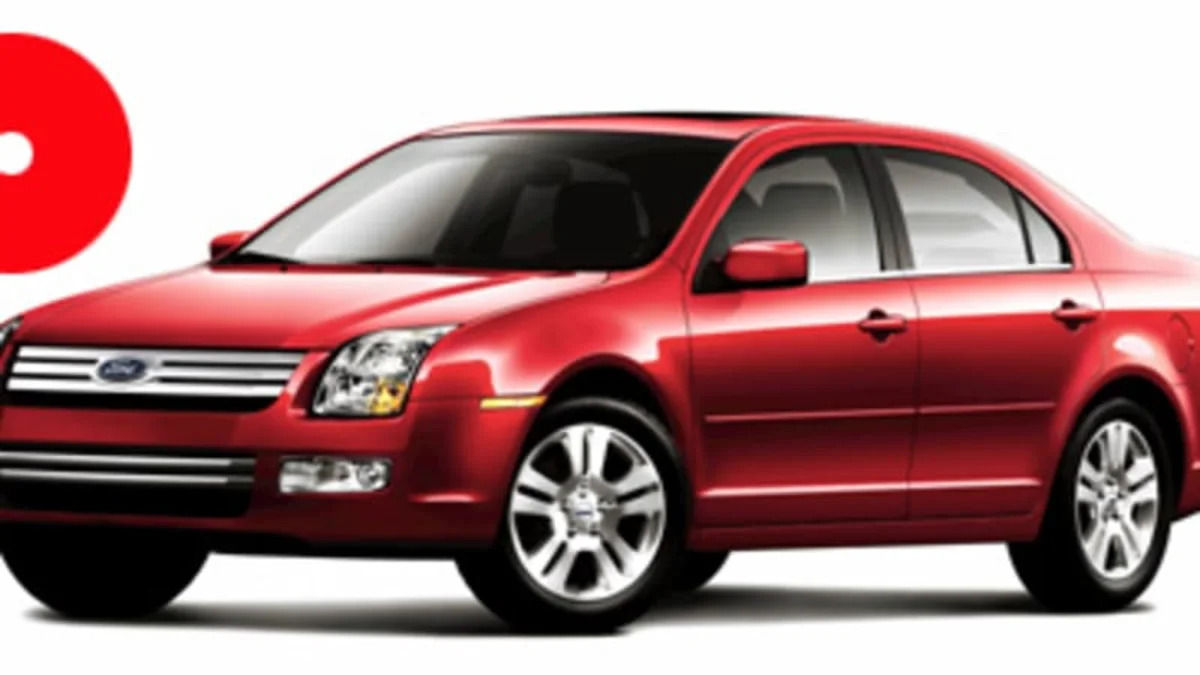
We've given Ford credit in the past for its super smooth roll out of the Fusion midsize sedan and its counterparts, the Mercury Milan and Lincoln Zephyr/MKZ. To date the three sedans haven't had a single recall for anything minor or major, not an easy feat when you're launching all-new models as Ford found out the hard way with the recall-plagued Focus launch back in 2000. Still, our kudos mean little in the grand scheme of things. However, when Consumer Reports calls out your success in its predicted reliability ratings, potential customers take notice.
In its newly released 2006 Annual Car Reliability Survey, Consumer Reports discovered that the Fusion and Milan actually scored higher in predicted reliability than the Honda Accord V6 and Toyota Camry V6. The Zephyr also did will in the upscale cars category, scoring slightly behind the Lexus ES350. Other domestic models did well too, including the Buick Lucerne and Cadillac DTS, both of which were above average in predicted reliability.
Despite these pockets of success, the domestics still only managed to account for six of the 47 vehicles that achieved the highest predicted reliability scores and got a little red circle with a white dot next to their names. The Japanese, meanwhile, accounted for 39 (21 from Toyota/Lexus and 11 from Honda/Acura). The Fusion/Milan/Zephyr, Chevrolet Tahoe, GMC Yukon and Pontiac Vibe were the six American vehicles that scored highest. The remaining two vehicles were a split between Europe and Korea with one going to the MINI Cooper and the other to the Hyundai Azera.
Mercedes-Benz wound up the worst brand in reliability with eight models, including the new S-Class, rated as least reliable. Nissan, which has lately scored very pourly in these reliability rankings, still contributed the only five Japanese vehicles to be rated least reliable, though CR says its vehicles are showing about half as many problems as they did last year.
Check out CR's full press release after the jump with more details from this year's survey.
[Source: Consumer Reports]
PRESS RELEASE:
CONSUMER REPORTS NEW CAR PREVIEW: RELIABILITY OF SOME NEW
DOMESTIC MODELS CHALLENGES JAPANESE FRONTRUNNERS
Ford Fusion on par with Honda Accord & Toyota Camry;
Family and small cars predicted to be most reliable overall
YONKERS, NY – Consumer Reports' latest Annual Car Reliability Survey shows some domestic models have become as reliable as their Japanese competitors, and that as a group, family and small cars have the best predicted reliability. However Asian models continue to be the most reliable overall.
Three of Ford Motor Company's newest models scored among the top players, with the Ford Fusion and Mercury Milan sedans scoring slightly better than the Honda Accord V6 and Toyota Camry V6. The Lincoln Zephyr also did well, scoring second in predicted reliability to the Lexus ES350, the leader in the upscale cars category. In addition, the Buick Lucerne and Cadillac DTS-both first-year models-scored above average in the large cars category, with the Lucerne scoring higher than the Toyota Avalon. However, the new Dodge Charger scored below
average and the Dodge Magnum dropped to below average in predicted reliability.
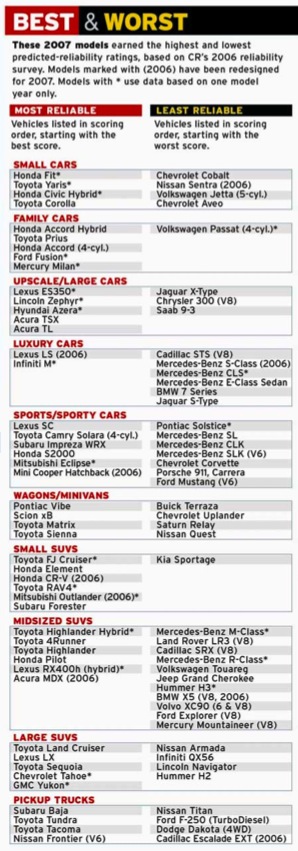
Overall, 39 of the 47 vehicles with the highest predicted reliability scores are Japanese. Just six are domestic models-the Fusion/Milan/Zephyr trio, the Chevrolet Tahoe and GMC Yukon large sport-utility vehicles (SUV), and the Pontiac Vibe wagon. Europe and South Korea each have one model rated most reliable, with the 2006 design Mini Cooper hatchback and the new Hyundai Azera respectively.
Consumer Reports' New Car Preview 2007, on sale now everywhere magazines are sold, includes reviews and information on 264 models and a first look at CR's latest reliability findings. The 2006 Annual Car Reliability Survey, the largest of its kind, gathered information on about 1.3 million vehicles from subscribers to Consumer Reports and www.ConsumerReports.org-30 percent more than last year. The survey was conducted in the spring of 2006 and covered model years 1997 to 2006. These results underpin the most comprehensive reliability data available in the United States.
Consumer Reports' expert team of survey researchers and statisticians used the survey data to predict reliability of new, 2007 model-year vehicles. To calculate predicted-reliability ratings on currently-available models, CR averages the overall reliability scores for the most recent three years, provided that the vehicle remained substantially unchanged in that period and also didn't change for 2007. If a vehicle was new or redesigned in the past couple of years, one or two years' data may be used, if that's all that's available.
New Car Preview ($6.99 U.S./$7.99 Canada) is part of the respected Consumer Reports Cars series of special automotive publications. More detailed results and analysis of the Annual Car Reliability Survey will be presented in Consumer Reports Annual Auto Issue next April.
Among the vehicles predicted to be least reliable by Consumer Reports, a total of eight Mercedes-Benz vehicles made the list, the most for any one brand. These are the S-Class (2006), CLS, E-Class Sedan, SL, CLK, SLK (V6), M-Class, and R-Class. The redesigned M-Class SUV and new R-Class crossover wee especially disappointing, with between 129 percent and 202 percent more problems than the average vehicle.
As a group, family and small cars had the best predicted reliability in the survey. In the small car category, the most reliable vehicles are the new Honda Fit and Toyota Yaris, the Honda Civic Hybrid, and the Toyota Corolla. The Chevrolet Cobalt, with 37 percent more problems than the average, scored the lowest among small cars, followed by the Nissan Sentra (2006), the Volkswagen Jetta (5-cyl.) and the Chevrolet Aveo.
The new Hyundai Azera tops the large-sedan category, with excellent predicted reliability. The V6 model of the Volkswagen Passat, which was redesigned for 2006, rated above average, while four-cylinder version of the Passat is below average. The BMW 3 Series has average predicted reliability. The least reliable upscale/large cars are the Jaguar X-Type, Chrysler 300 (V8) and Saab 9-3, in that order. The new Dodge Charger also has subpar reliability.
"CR's reliability survey suggests that domestic manufacturers are making progress in their push to make more reliable vehicles-though they still have some work to do. We also see continued improvements in vehicles from Korean manufacturers," said David Champion, senior director of Consumer Reports' Auto Test Center in Connecticut.
Among the other findings in New Car Preview 2007:
• Of the 47 Japanese cars that earned Consumer Reports' Most Reliable rating, 21 (45%) are from Toyota and its Lexus division. Honda and its Acura division had 11 (23%) models on the list. European and Korean manufacturers-Mini and Hyundai respectively-each had one (2% each). Six domestic models made the list, three (6.5%) from Ford and three (6.5%) from GM. (See the complete
list below.)
• Of the 45 cars that are on Consumer Reports' Least Reliable list, five (11%) are Japanese, all from Nissan and its Infiniti division, specifically the Nissan Titan, Nissan Armada, Infiniti QX56, Nissan Sentra and Nissan Quest. All but the Sentra are built in Nissan's Canton, Miss. plant. A total of 20 (44%) are domestic, with 12 (27%) from GM, five (11%) from Ford and three (7%) from the Chrysler Group. European models from Mercedes-Benz, Jaguar, Porsche, BMW, Volvo, Saab and Land Rover fill 19 (42%) spots.
• Though they still make up a minority of most reliable vehicles, CR's data shows that domestic models are improving. For example, the number of domestic vehicles on this year's Most Reliable list is up from two to six. The number of Least Reliable domestic models fell to 17, from 21. Twelve models are newly recommended, up from 10.
• Nissan's reliability has improved somewhat. While the predicted reliability of the Nissan Armada and Infiniti QX56 are still about 135 percent worse than the average vehicle, they had half as many problems as they did in last year's survey. The Quest minivan, though still much worse than average this year, had fewer problems than minivans from General Motors.
Like last year, the most reliable SUVs still come from Japanese automakers, though American SUVs got a boost from GM's redesigned Chevrolet Tahoe and GMC Yukon twins. The two scored above average and are now recommended. Among small SUVs, the new Toyota FJ Cruiser scored the best, followed by the Honda Element and the four-cylinder version of the redesigned Toyota RAV4. The Hyundai Tucson, which scored poor last year, improved to above average. Premium SUVs such as the Porsche Cayenne, Volkswagen Touareg, Range Rover Sport and Land Rover LR3 all had below average reliability. The six-cylinder BMW X5 prior to its redesign is the only exception, and had average predicted reliability. The reliability of the Nissan Armada and Infiniti QX56 continued to be much worse than average.
Hybrids, too, continued to have impressive reliability, though the Ford Escape Hybrid dropped from above average to average.
This year, Consumer Reports tested a number of sports cars, including the Porsche 911 Carrera S, which was top-rated by CR for its performance-but is among the least reliable sports cars along with several Mercedes, the Chevrolet Corvette, and the Ford Mustang V6. The redesigned 2006 Mazda Miata is only average, while Pontiac's new Solstice roadster is far below average.
As for minivans, the Toyota Sienna continues to be the only minivan with above-average predicted reliability. The Honda Odyssey and the redesigned Kia Sedona are both average as is the Mazda5. Chrysler minivans remain below average. The Nissan Quest, Chevrolet Uplander, Saturn Relay, and Buick Terraza are all much below average.
With pickups, the Toyota Tundra V6 and the Subaru Baja are the only pickups with much-better-than-average reliability. The Toyota Tacoma and Nissan Frontier rate better than average. Honda's Ridgeline has only average reliability in its first full year on the road. The Cadillac Escalade EXT (prior to its 2007 redesign), turbodiesel versions of the Ford F-250, and the Nissan Titan were far below average in reliability.
Conducted by Consumer Reports' National Research Center, the Annual Car Reliability Survey is used in determining which makes and models are recommended by the organization. Consumer Reports recommends only models that have performed well in tests conducted at its Auto Test Center in Connecticut and that have shown average or better reliability in its annual survey. In addition, vehicles must perform well in government or insurance-industry crash and rollover tests in order to be recommended. Occasionally, Consumer Reports may recommend a new or redesigned model that's too new to have compiled a reliability record if it scores well in CR's tests and if previous generations or the manufacturer had consistently outstanding reliability.

Sign in to post
Please sign in to leave a comment.
Continue