

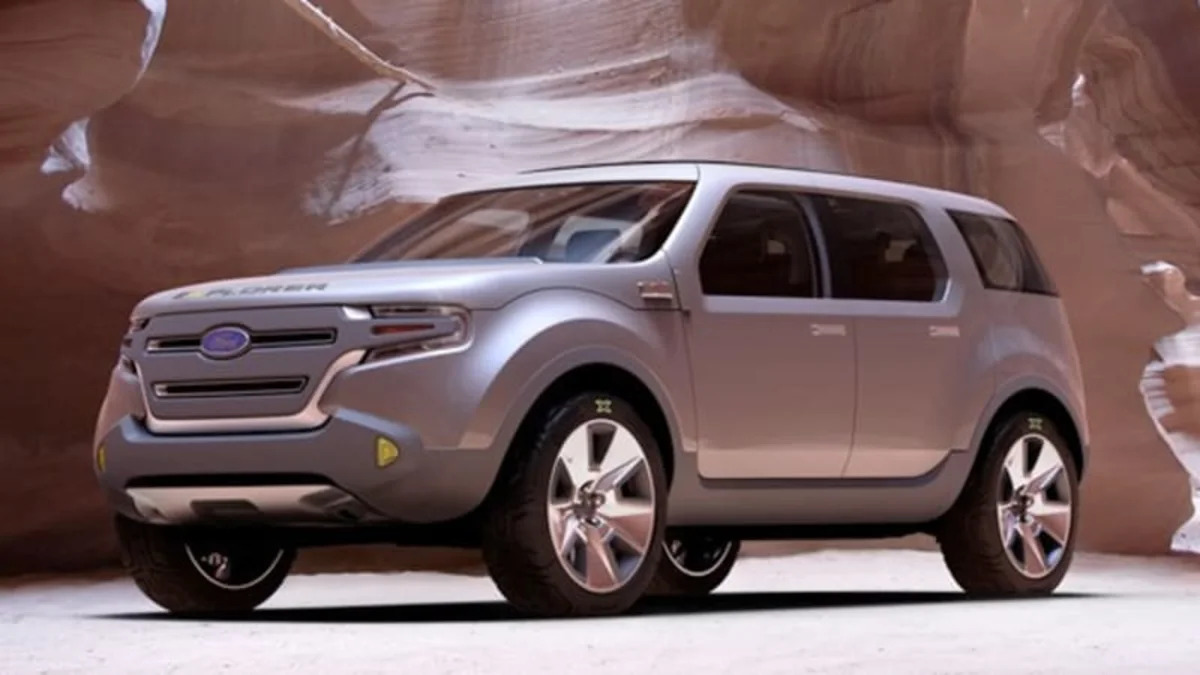
Ford Explorer America Concept - Click above for a high-res image gallery
As reported earlier, Ford used its 2010 model year preview in Dearborn, Michigan to announce the next stage of the company's EcoBoost strategy for North America. The new 2.0-liter EcoBoost four-cylinder will arrive in 2010, and along with the new engine, Ford will also debut its Powershift six-speed dual clutch gearbox next year.
The Powershift uses a dry clutch system Ford claims is more efficient than the wet clutch systems used on some existing DCTs (see: VW DSG). Samardzich said the Powershift will yield a seven- to nine-percent efficiency improvement over current automatics. So far, Ford officials have remained mum on which applications will see the new engine or gearbox first, although there are several likely possibilities. Make the jump for more.
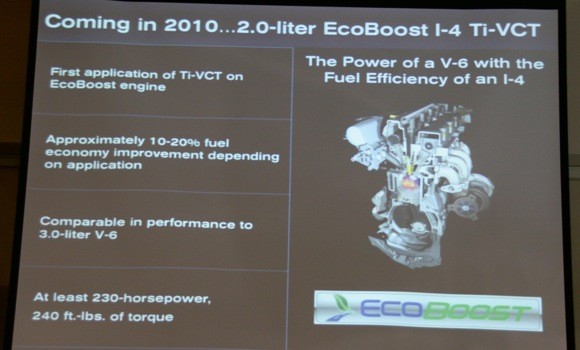
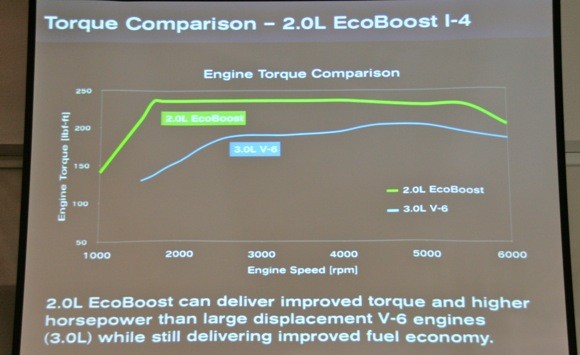
Brett Hinds, Manager of advanced powertrain engineering, wouldn't say whether the PowerShift would be paired with the new EcoBoost or even which vehicles it would appear in. However, Samardzich's charts compared it to the current 3.0-liter V6. According to Hinds, the four will be rated at about 230 hp and 240 lb-ft of torque. By comparison, the current V6 is rated at 240 hp but only 223 lb-ft of torque with a peak at 4,300 rpm. The EcoBoost reaches its torque peak below 2,000 rpm and stays there until about 5,500 rpm.
Like the current V6 EcoBoost, the new engine uses direct fuel injection and turbocharging to achieve its impressive output. A first for the new engine is twin independent variable cam timing. Both the intake and exhaust cams are adjustable independent of each other.
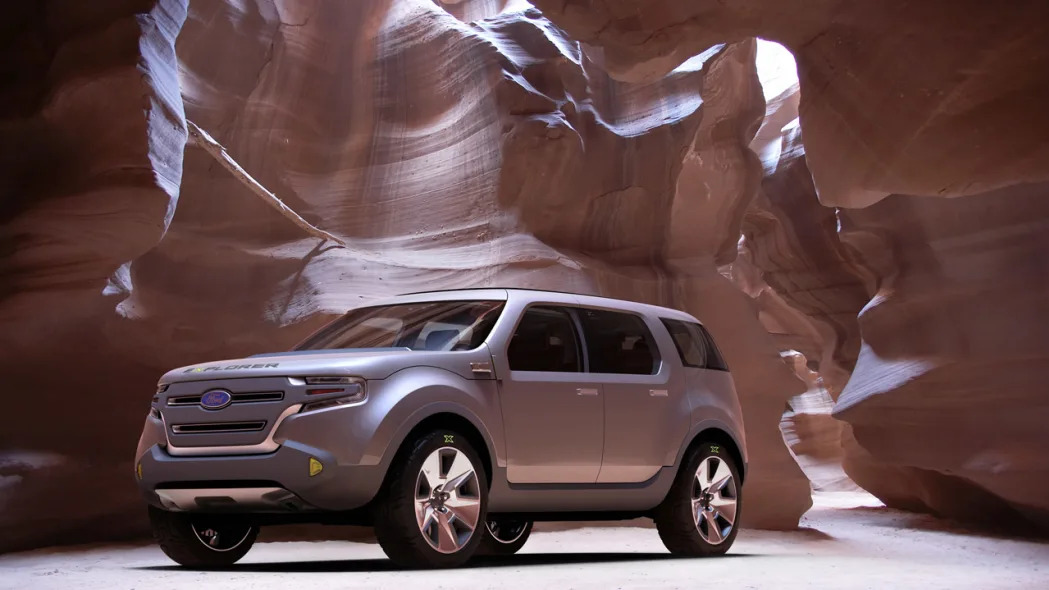
The V6 is currently used only in the Fusion/Milan and the Escape/Mariner, so those would seem to be the obvious applications for the new engine. However, when Ford showed its Explorer America Concept last year it was also listed as using either a 2.0-liter or 3.5-liter EcoBoost engine. The new uni-body Explorer will debut in 2010, so this would seem a suitable application. Another possibility is the Mustang where the turbo four could make a suitable replacement for the current 4.0-liter V6, a powerplant well past its expiration date.
There's also talk of a base engine application for the F-150, but the pickup's curb weight may be an issue. Also unknown is whether the new engine will immediately replace the V6 or supplement it as a premium option.
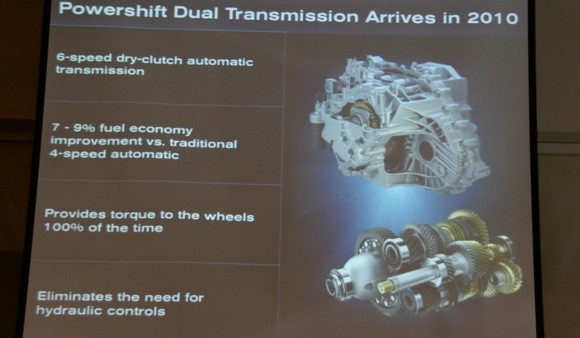
The new gearbox is currently used in several European Ford and Volvo models, mostly based on the C1 Focus platform. The U.S. Fiesta preview page has hinted at a dual clutch gearbox, so the best guess for the transmission would be fitted to the Fiesta and the new Focus coming later in 2010.
PRESS RELEASE
GIANT LEAPS, SMALL STEPS FURTHER FORD'S GLOBAL STRATEGY
- EcoBoost™ technology combines turbocharging and direct gasoline injection to improve fuel efficiency and lower CO2 emissions; the first 3.5-liter EcoBoost V-6 engines are debuting on 2010 Lincoln MKS, Lincoln MKT, Ford Taurus SHO and Ford Flex this summer
- Conventional powertrains continue to benefit from refinements such as Advanced Deceleration Fuel Shut-Off and Cam Torque Actuated (CTA) Intake Variable Cam Timing (iVCT)
- Ford's hybrid vehicle lineup expanding to include the Ford Fusion and Mercury Milan; all feature smaller, more powerful battery pack, enhanced electronic throttle control and electric air-conditioning compressor to reduce engine load
The EcoBoost Revolution
EcoBoost technology combines turbocharging and direct gasoline injection and is a key part of Ford's overall strategy to improve fuel efficiency and lower CO2 emissions company wide. The engines achieve better fuel economy and lower CO2 emissions compared with larger-displacement naturally aspirated engines without sacrificing power. Ford recently began series production of its 3.5-liter EcoBoost V-6, the first gasoline direct-injection twin-turbocharged engine produced in North America. With the fuel economy of a V-6, the 3.5-liter EcoBoost engine delivers 365 horsepower in the Ford Taurus SHO and 355 horsepower in the Ford Flex, Lincoln MKT and MKS, and a responsive 350 ft.-lb. of torque across a broad rpm range.
The 3.5-liter engine is the first in a wave of EcoBoost engines coming from Ford as part of a strategy to bring affordable fuel efficiency to millions. By 2013 more than 90 percent of Ford's North American lineup will be available with EcoBoost technology.
Hybrid Powertrain Advances
Bolstering its reputation as a world leader in hybrid technology, Ford introduced the new Fusion Hybrid and Mercury Milan Hybrid for the 2010 model year, doubling its hybrid offerings and delivering the best full economy of any midsize sedan. Along with Fusion Hybrid and Milan Hybrid, the Ford Escape Hybrid and Mercury Mariner Hybrid SUVs use many of the improvements engineered as a result of the hybrid car program.
All 2010 Ford Motor Company hybrids benefit from:
- 2.5-liter I-4 engine (155 horsepower/136 ft.-lb. of torque) running the proven Atkinson cycle mated to an electronically controlled continuously variable transmission or e-CVT.
- Intake Variable Cam Timing (iVCT), which allows the vehicle to more seamlessly transition from gas to electric mode and vice versa. The spark and cam timing are varied according to the engine load to optimize efficiency and emissions.
Fusion Hybrid and Milan Hybrid also feature:
- Enhanced electronic throttle control that reduces airflow on shutdowns, reducing fueling needs on restarts.
- A new smaller, lighter nickel-metal hydride battery has been optimized to produce 20 percent more power. Improved chemistry allows the battery to be run at a higher temperature and it is cooled using cabin air.
- An added variable voltage converter boosts the voltage to the traction battery to operate the motor and generator more efficiently.
- Smarter climate control system monitors cabin temperature and only runs the gas engine as needed to heat the cabin; it also includes an electric air-conditioning compressor to further minimize engine use.
- The regenerative brake system captures the energy normally lost through friction in braking and stores it. Nearly 94 percent energy recovery is achieved by first delivering full regenerative braking followed by friction brakes during city driving.
Constant Improvement to Conventional Engines
Naturally aspirated non-hybrid powertrains continue to motivate the vast majority of Ford, Lincoln and Mercury vehicles, and it's within this domain that engineers have faced their biggest challenges. But thanks to constant, incremental improvements, mileage increases – some significant – have been achieved on many Ford vehicle lines for 2010.
Some of the innovations include:
- Advanced Deceleration Fuel Shut-Off saves gas during normal slowdowns by temporarily interrupting fuel flow while maintaining optimal engine performance. When the driver releases the accelerator pedal to slow down, the system temporarily turns off the fuel. The flow of fuel seamlessly resumes when the vehicle reaches a set low speed or when the driver accelerates again. Operation is automatic and requires no unusual actions from the driver.
- Electronic Throttle Control optimizes engine performance and fuel efficiency by eliminating a direct connection from the accelerator pedal to the throttle. Instead, an electronic actuator monitors the accelerator pedal, relaying driver input to the electronic throttle control system.
- Intake Variable Cam Timing (iVCT) varies spark and cam timing according to the engine load to optimize efficiency and emissions. This year the Ford 3.0-liter Duratec® V-6 engine also debuts the industry's first application of cam torque actuated (CTA) variable cam timing (VCT) technology, allowing for a smaller-displacement oil pump, improved fuel economy and increased performance.
- Electric Power Assist Steering (EPAS) reduces the load on the engine since a belt-driven power steering pump is no longer required; reduced engine load leads to lower fuel consumption.
- Flex Fuel capability allows engines to run on gasoline, E85 ethanol or any combination of the two. It is found on more Ford vehicles than ever before, giving drivers more options at the pump.
Transmissions Key to Improving Fuel Economy
Significant gains in transmission operating efficiency are delivering tangible mileage improvements. Already working with a state-of-the-art 6F six-speed automatic transmission featuring a wide 6.04:1 gear ratio to deliver good fuel economy and performance, Ford engineers re-examined every aspect of the unit to reduce parasitic losses.
Efficiency improvements for 2010 include:
- Reduced fluid level for lighter weight and faster warm-up.
- Higher transmission operating temperatures result in reduced fluid viscosity; the fluid then requires less energy to move throughout the transmission.
- Mechanical and electronic calibration improvements adjust shift points and lockup characteristics.
The 2010 Ford Fusion and Mercury Milan I-4 also come standard with a six-speed manual transmission instead of the previous five-speed manual. The additional gear on the I-4 provides better drivability and performance as well as fuel savings.
The first gear features a deeper ratio, which provides smoother acceleration. At the top end a higher overdrive gear ratio allows the engine to turn more slowly at highway speeds, aiding fuel economy, wear, and noise, vibration and harshness (NVH) characteristics.
Quest for Cleaner Emissions
One tangential benefit of Ford's drive toward better fuel efficiency is reduced exhaust emissions; simply put, there's less exhaust when less fuel is burned. Ford engineers continuously are improving active and passive emission control equipment to reduce the amount of CO2 and other pollutants.
Some of the latest advancements include:
- Ford's popular non-EcoBoost 3.5-liter V-6 uses a 10.3:1 compression ratio and close-coupled catalysts to help it meet stringent ultra-low-emission vehicle (ULEV) II regulations.
- Hybrid models use a wide-band lambda (oxygen) sensor to analyze the mixture and adjust the air-fuel ratio accordingly to minimize emissions.

Sign in to post
Please sign in to leave a comment.
Continue