
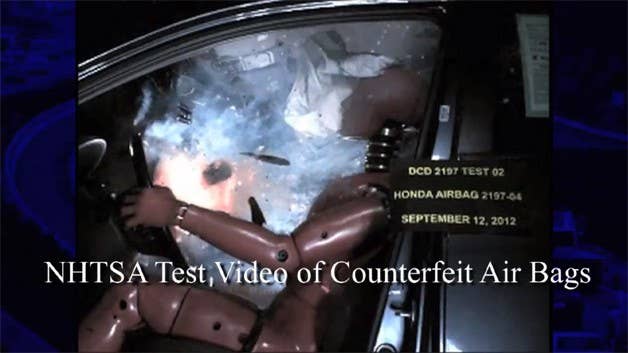
The National Highway Transportation Safety Administration is warning vehicle owners of the dangers of counterfeit airbags. During NHTSA testing, the agency discovered fake components that could fail in a spectacular manner, either by not deploying during an accident or by launching hot shrapnel into the driver’s face and hands. Currently, the government agency says it is unaware of how large the counterfeit airbag problem could be.
The components are not being installed in new vehicles. Rather, the fake airbags are being used as replacement parts in vehicles that have been involved in an accident.
Even worse, the replacement parts may look identical to original equipment pieces, right down to the labeling. So, how do you know if your vehicle has a counterfeit airbag? NHTSA says any car or truck that has been in an accident and had its airbag replaced within the past three years by any shop not part of a dealership is at risk. Additionally, shops that have purchased airbags online may also have inadvertently installed the faulty hardware.
NHTSA recommends that owners who believe their car or truck may have been repaired using the fake airbags contact a call center operated by their vehicle’s manufacturer and arrange to have the airbag inspected. Customers can expect to pay for the inspection themselves. Take a look at the full press release below, including a list of every potentially affected vehicle, as well as a video comparing the function of normal and counterfeit airbags.
Show full PR text
afety Advisory: NHTSA Alerting Consumers to Dangers of Counterfeit Air Bags
NHTSA 42-12
Wednesday, October 10, 2012
Traffic safety agency urges vehicle owners and repair professionals to use only certified, original equipment replacement parts
WASHINGTON – The U.S. Department of Transportation’s National Highway Traffic Safety Administration (NHTSA) has issued a consumer safety advisory to alert vehicle owners and repair professionals to the dangers of counterfeit air bags. NHTSA has become aware of a problem involving the sale of counterfeit air bags for use as replacement parts in vehicles that have been involved in a crash. While these air bags look nearly identical to certified, original equipment parts-including bearing the insignia and branding of major automakers – NHTSA testing showed consistent malfunctioning ranging from non-deployment of the air bag to the expulsion of metal shrapnel during deployment. NHTSA is not aware of any deaths or injuries connected to counterfeit air bags.
While the full scope and scale of the problem of counterfeit air bags is uncertain from currently available data, NHTSA has identified certain vehicle makes and models for which these air bags may be available and believes this issue affects less than 0.1 percent of the U.S. vehicle fleet. Only vehicles which have had an air bag replaced within the past three years by a repair shop that is not part of a new car dealership may be at risk.
Consumers whose vehicles have been in a crash and had their air bags replaced by a repair shop that is not part of a new car dealership within the past three years or who have purchased a replacement air bag online should contact the call center that has been established by their auto manufacturer to have their vehicle inspected at their own expense and their air bag replaced if necessary. The full list of call centers and additional information are available at www.SaferCar.gov.
“Anytime equipment that is critical to protecting drivers and passengers fails to operate properly, it is a serious safety concern,” said Transportation Secretary Ray LaHood. “We want consumers to be immediately aware of this problem and to review our safety information to see if their vehicle could be in need of inspection.”
“We expect all motor vehicle equipment to meet federal safety standards – and air bags in particular play a central role in keeping drivers and passengers safe in the event of a crash,” said NHTSA Administrator David Strickland. “That’s why it’s critical that vehicle owners work with their automotive dealers and repair professionals to ensure they use the appropriate, original equipment parts in the event they need to replace their air bag.”
NHTSA has been working with a number of government agencies – including U.S. Immigration and Customs Enforcement, U.S. Customs and Border Protection and the U.S. Department of Justice-to better understand the issue of counterfeit air bags and how to prevent them from being purchased and installed in vehicles.
“Organized criminals are selling dangerous counterfeit and substandard airbags to consumers and suppliers with little to no regard to hazardous health and safety consequences,” said ICE Director John Morton. “We will continue to aggressively investigate criminal supply chains with our law enforcement and private industry partners and bring these criminals to justice.”
NHTSA is currently gathering information from automakers about their systems for verifying the authenticity of replacement parts and is working with the industry to make the driving public aware of the potential safety risk posed by counterfeit air bags. Moving forward, the agency will continue to monitor consumer complaints, police accident reports, and other sources for additional information.
CONSUMERS THAT SHOULD NOT BE AT RISK:
Consumers who purchased their vehicle new and have not had their air bags replaced
Consumers who have full knowledge of the entire history of their used vehicle (including knowing whether the vehicle had been in a crash in the last three years and being certain that the air bag was replaced at a new car dealership)
CONSUMERS THAT MAY BE AT RISK AND SHOULD CONTACT THE CALL CENTER ESTABLISHED BY THEIR AUTO MANUFACTURER:
Consumers who have had air bags replaced within the past three years at a repair shop that is not part of a new car dealership
Consumers who have purchased a used car that may have sustained an air bag deployment before their purchase
Consumers who own a car with a title branded salvage, rebuilt, or reconstructed
Consumers who have purchased replacement air bags from eBay or other non-certified sources-especially if they were purchased at unusually low prices (i.e. less than $400)
VEHICLES FOR WHICH COUNTERFEIT AIR BAGS MAY BE AVAILABLE:
As of today, NHTSA is aware of counterfeit air bags available for the following vehicle makes and models:
2009-2011
TSX
2006-2009
A3, A4, A6, A8, Q5, Q7
2007-2011
X5, E70, E60, E61
2008-2010
5-series, 528i, 535i
2004-2007
5-Series, 525i, 530, 535, E60, E61
2007-2011
E90, E91
Not listed
E92, E93
2007-2011
X5, E70
2004-2007
525i, 530, 535
2011-2012
X3
2010-2011
Lacrosse
2011-2012
Cruze
2006-2010
Aveo
2011-2012
Volt
2012
Camaro
2012
Focus
2005-2009
Mustang
2003-2012
Accord
2006-2011
Civic
2002-2011
CRV
2007-2011
Fit
2009-2011
Pilot
2009-2011
Insight
2009-2011
Crosstour
2011
Odyssey
2007-2011
Elantra
Not listed
Not listed
Sonata
2007-2011
G35, EX35
2010-2011
Soul/Forte
2004-2009
Spectra
2012
Range Rover Evoque
2006-2011
IS250, IS350, IS-F
2003-2008
GX470
2007-2009
RX350
Not listed
ES350
2004
Mazda 3
2010-2012
Mazda 3
Mercedes
2009-2011
C, GLK
2010-2011
E350, E550
2007-2008
S550
2006-2009
ML
2009-2010
GL, ML
Not listed
Outlander
1992-2002
Quest
2010-2011
Quest
2009-2011
Cube
2007-2011
Versa
2009-2010
Murano
Not listed
Altima
2008-2009
Forester
2008-2009
Imprezza
2008-2009
Outback
2010-2011
Legacy
2007-2010
SX4
2002-2006
Camry
2012
Camry
2009-2011
Corolla, Matrix
2007-2011
Yaris
2004-2011
Highlander
2004-2011
Sienna
2004-2011
Tacoma
2010-2012
Prius
2003-2006
Tundra
2007-2011
Tundra
2003-2006
Sequoia
2003-2010
2004-2007
Highlander
2008-2010
Highlander
2004-2009
4Runner
2007-2009
Solara
2005-2011
RAV4
2006-2010
Jetta
Not listed
XC60, XC70
Not listed
V70, S60, S80