
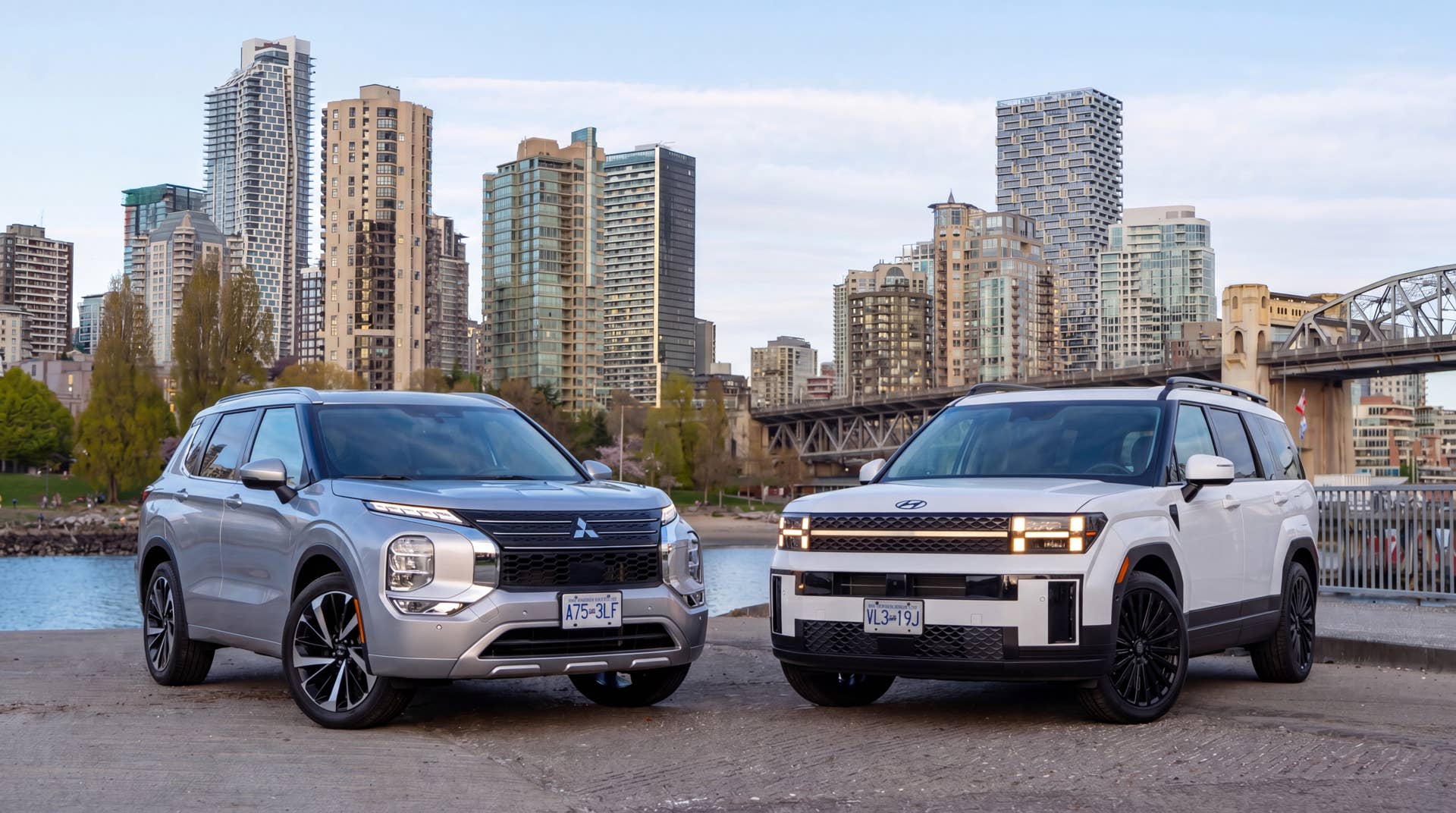
Automakers often like to play tricks with the phrase “three-row SUV.” It makes a vehicle sound so ready for the noble administrative burden of family life. Say it aloud, and you can practically hear the distant thud of hockey bags, the rustle of Costco receipts, the clumsy folding of a stroller, the argument over who has to sit in the back, and the panic of realizing the school concert starts in less than five minutes. But not all three-row SUVs are built for the same kind of family life. Some are full-time family haulers, while others are compact crossovers with a useful little emergency bench tucked into the back, in case little Susie wants to bring a friend along one day.
That second categorization is what brings the 2026 Mitsubishi Outlander and 2026 Hyundai Santa Fe together in the semi-niche, compact three-row SUV segment. Both offer three rows, both are aimed at families that need more flexibility than a normal two-row SUV can provide, and both have distinctive designs, available all-wheel drive, useful technology, and a relative sense of occasion. But is one better than the other? Does one appeal to a certain type of buyer, whereas the other aims toward a different crowd? That’s what we’re here to find out.

Cole Attisha
What’s Actually Different Between The Mitsubishi Outlander and the Hyundai Santa Fe?
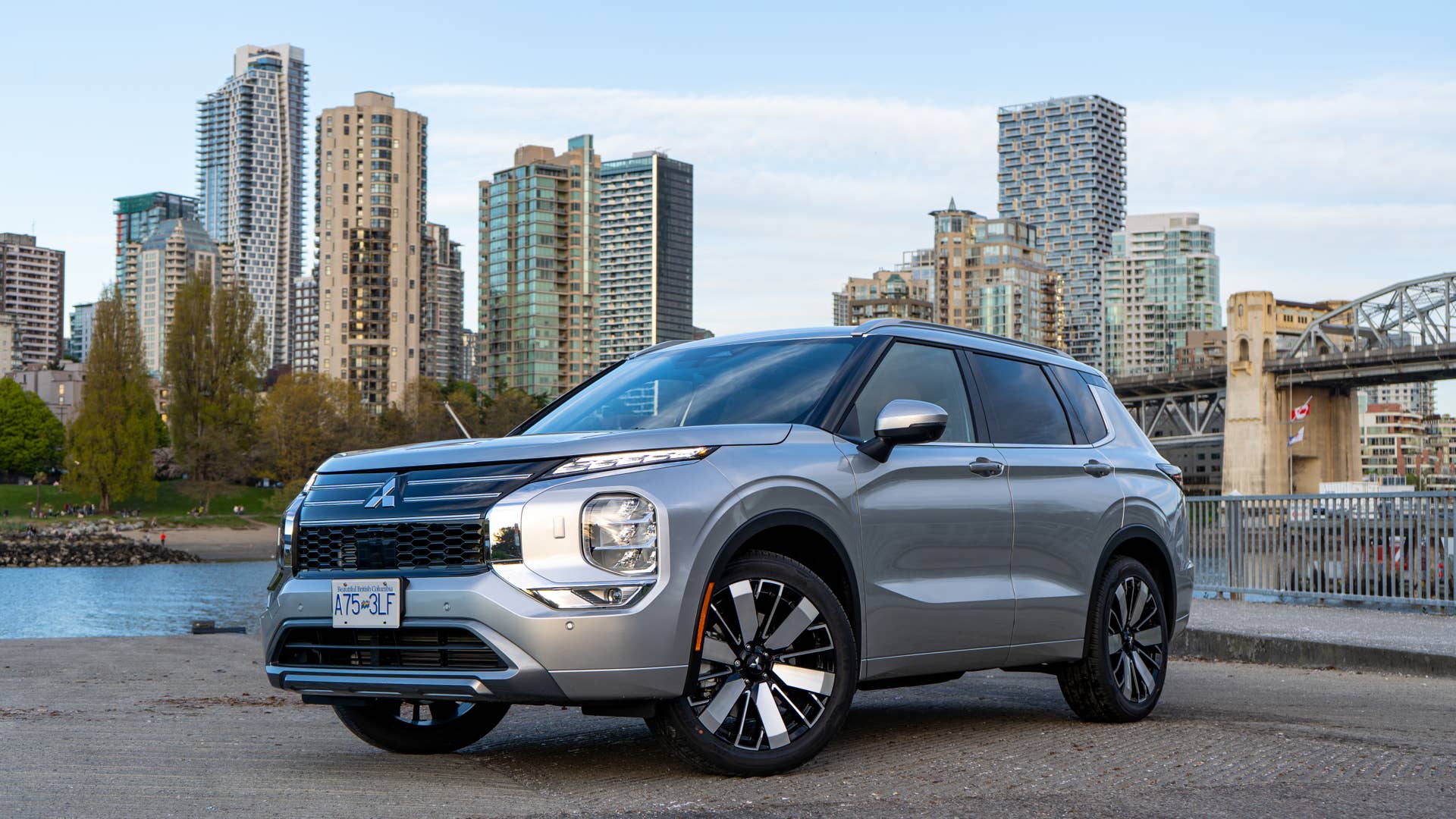
The Outlander and Santa Fe may both be three-row SUVs, but they are not the same size, nor do they feel built around the same philosophy entirely. The Mitsubishi is the smaller, more city-friendly machine—it’s as if a small MPV like the Mazda5 grew up and realized people actually find sliding doors a bit wimpy. The 2026 Outlander is 185.8 inches long, 74.7 inches wide, and rides on a 106.5-inch wheelbase, with cargo volume measured at 64 cubic feet behind the front row, 31 cubic feet behind the second row, and 11 cubic feet behind the third row. It uses a turbocharged 1.5-litre four-cylinder engine, paired with a 48V mild-hybrid system, rated at a combined output of 174 horsepower and 206 lb-ft of torque. It uses a continuously variable automatic transmission to deliver that power to either the front wheels or all four wheels through Mitsubishi’s S-AWC all-wheel-drive system. The base 2026 Mitsubishi Outlander starts at just $29,995 in the U.S. before fees and taxes.
Cole Attisha
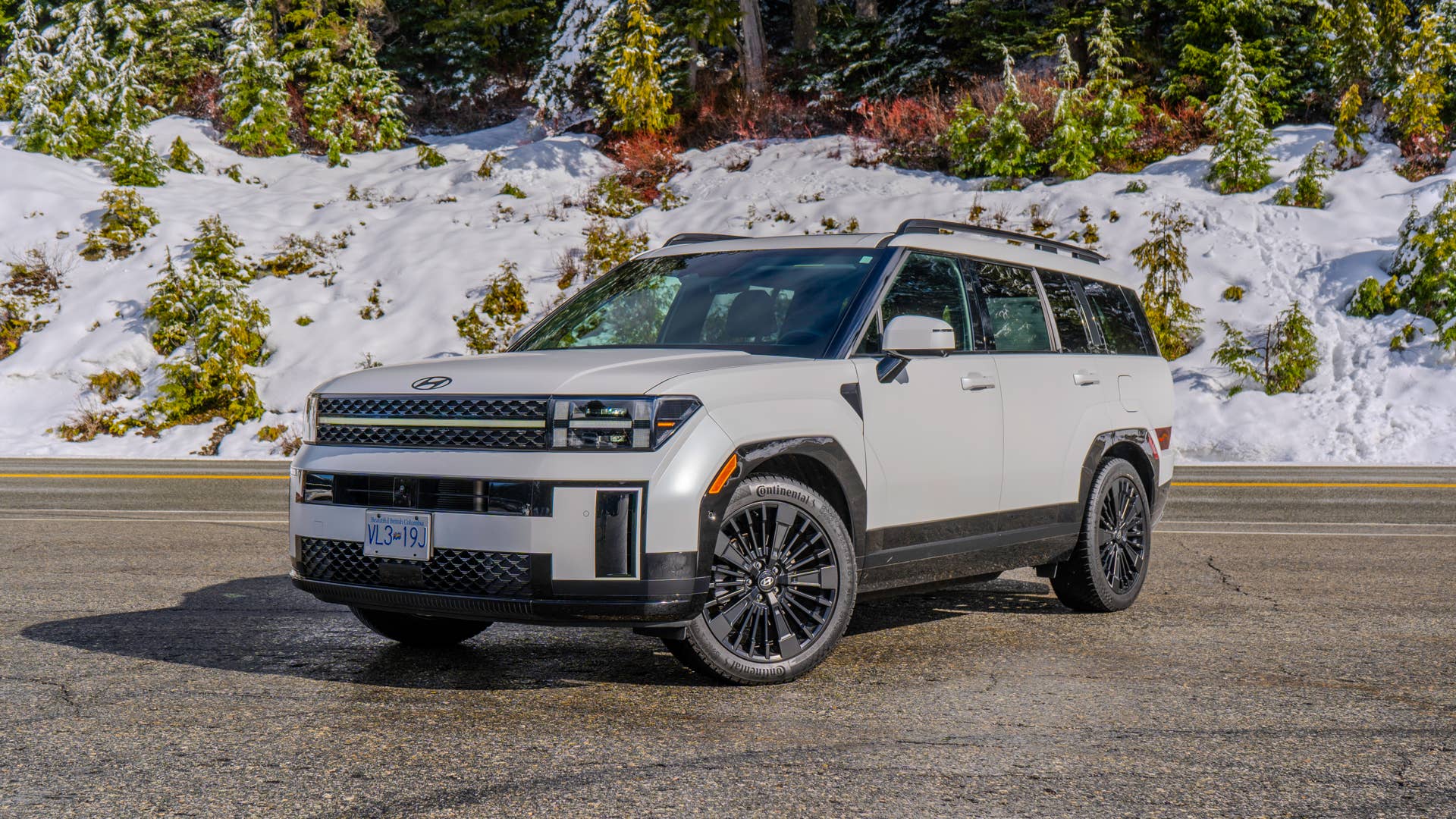
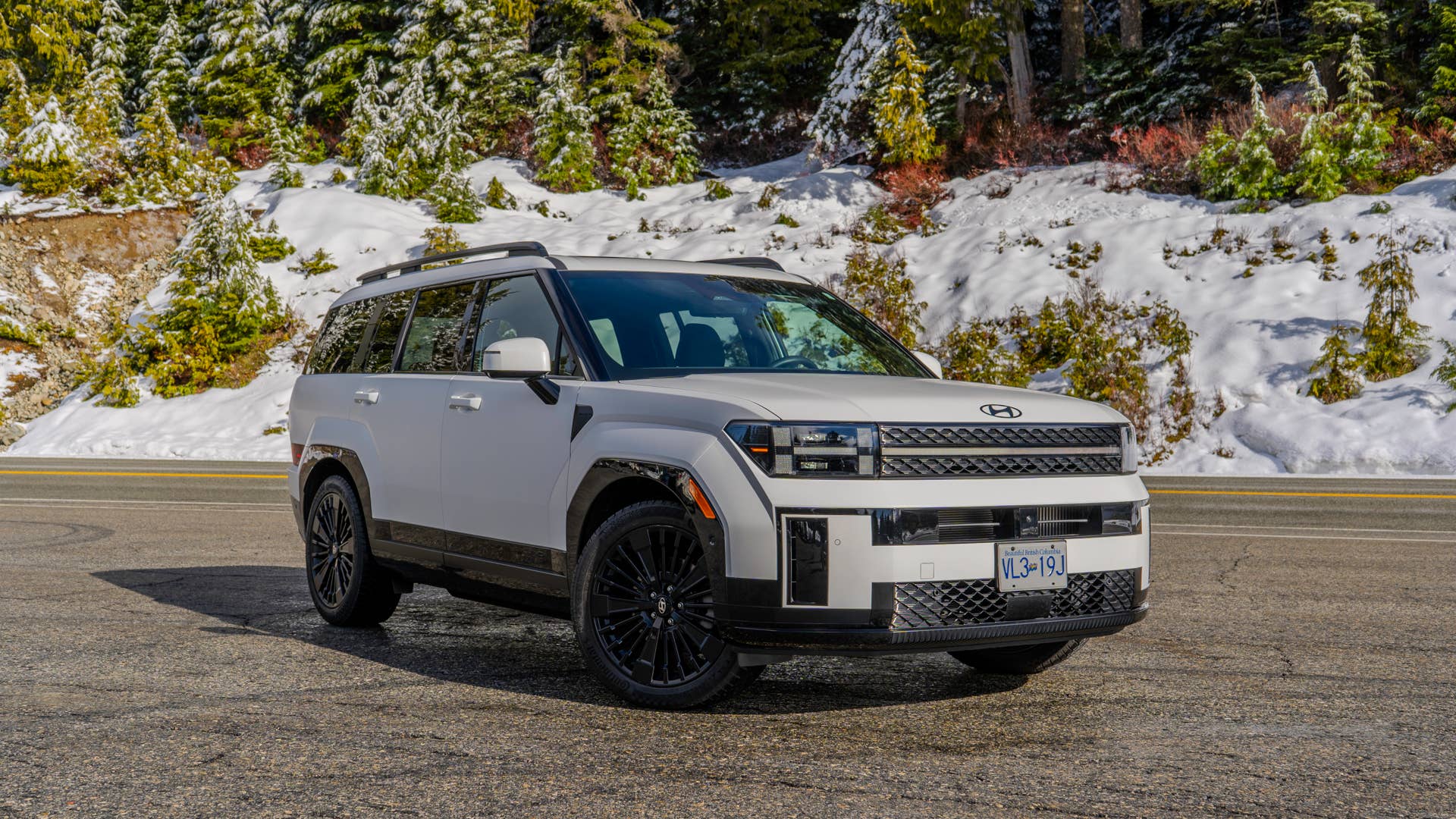
The Hyundai is the larger, more substantial family vehicle. The 2026 Santa Fe measures 190.2 inches long, 74.8 inches wide, and rides on a much longer 110.8-inch wheelbase. It offers 14.6 cubic feet of cargo space behind the third row, 40.5 cubic feet behind the second row, and nearly 80 cubic feet behind the front row. The gas-only Santa Fe uses a 2.5-litre turbocharged four-cylinder rated at 277 horsepower and 311 lb-ft of torque, while the Santa Fe Hybrid pairs a 1.6-litre turbocharged four-cylinder with electric assistance for a combined 231 horsepower and 271 lb-ft of torque. For 2026, gas Santa Fe models also switch from the previous dual-clutch transmission to an eight-speed torque-converter automatic, while hybrid models retain a six-speed automatic.
So, ultimately, the Outlander is more of a compact SUV with bonus seating, whereas the Santa Fe is a slightly larger family SUV that still happens to be usefully smaller than the really big stuff, like the Hyundai Palisade or the Toyota Grand Highlander. One aims to give you a third row without forcing you into something huge, and the other is trying to give you a more convincing family vehicle without pushing all the way into full-size territory.
Need New Tires? Save Up To 30% at Tire Rack
Find the perfect tires for your exact vehicle and driving style. Click here to shop all top-tier brands, including Michelin, Bridgestone, and more, directly at Tire Rack.

Cole Attisha
Powertrain And Driving Dynamics: The Santa Fe Hybrid Finds The Sweet Spot
The Outlander’s 1.5-litre turbocharged mild-hybrid system isn’t terrible—in fact, around town, it is perfectly usable. The 206 lb-ft of torque gives it a bit more low-end flexibility than one might expect, and in normal commuting, it gets the job done without too much drama. It also suits the Outlander’s personality as a calm, practical, easygoing SUV. The problem is that the powertrain never feels particularly happy when asked to work harder. The CVT gives acceleration that familiar elastic quality: the revs rise with coarseness, the sound hangs around longer than you want, and then the actual forward motion eventually catches up to the request. It is not offensively bad, but it is not satisfying either. It makes the Outlander feel like a lovely cabin being tugged along by an economy-minded compromise.
The Santa Fe Hybrid is certainly no performance vehicle, but it is much nicer to drive. Its hybrid system fills in the low-speed gaps more naturally, and the transmission behaves with far more polish than Mitsubishi’s CVT. Hyundai’s hybrid setup simply feels more cohesive in everyday use. It moves away from stops with more confidence, settles into traffic more smoothly, and communicates better with its driver. This is why the Santa Fe HEV is such an important choice in this comparison—it sits between the regular 1.5T Outlander and the Outlander PHEV in a way that makes more sense for many buyers. You get meaningful electrification, stronger refinement, better efficiency, and better real-world drivability without necessarily jumping into plug-in pricing or the daily ritual of charging.
The gas-only Santa Fe also deserves mention because it remains part of the comparison for shoppers who are not specifically looking at hybrids. For 2026, Hyundai replaced the gas Santa Fe’s previous dual-clutch automatic with an eight-speed torque-converter automatic, while the Santa Fe Hybrid continues with its own six-speed automatic setup. Both gearboxes are far more pleasant to operate than the Outlander’s CVT. It is still tall and boxy, though, and it will not trick anyone into thinking they are driving a sports sedan, but it feels more composed than the Mitsubishi. The steering is light but predictable, the suspension manages body motion more convincingly, and the whole thing feels more stable at speed. The Outlander might be easier to place in tight city spaces, but the Santa Fe is better to drive almost everywhere else.
Cole Attisha/Autoblog
Fuel Economy: Hybrid Hyundai Beats The Mitsubishi, Gas Hyundai Does Not
Without jumping to the plug-in Outlander, the Santa Fe Hybrid is the clear efficiency winner out of the bunch. The 2026 Santa Fe Hybrid is rated for 37 mpg city, 36 mpg highway, and 36 mpg combined with front-wheel drive, or 35 mpg city, 34 mpg highway, and 34 mpg combined with all-wheel drive. The Outlander is respectable, but not in the same league as the Santa Fe Hybrid. The Mitsubishi is rated for 26 mpg city, 31 mpg highway, and 28 mpg combined with front-wheel drive, or 26 mpg city, 30 mph highway, and 27 mpg combined with all-wheel drive. Against the gas-only Santa Fe, however, the Mitsubishi has a stronger efficiency argument. The 2026 Santa Fe’s gas mileage is rated at 24 mpg combined in base FWD form, or 23 mpg combined with all-wheel drive, and even lower in XRT AWD guise. So clearly, the Santa Fe Hybrid is more efficient than the Outlander, but the Outlander is more efficient than the gas Santa Fe.
Cole Attisha
Interior Design And Quality: The Outlander’s Best Argument
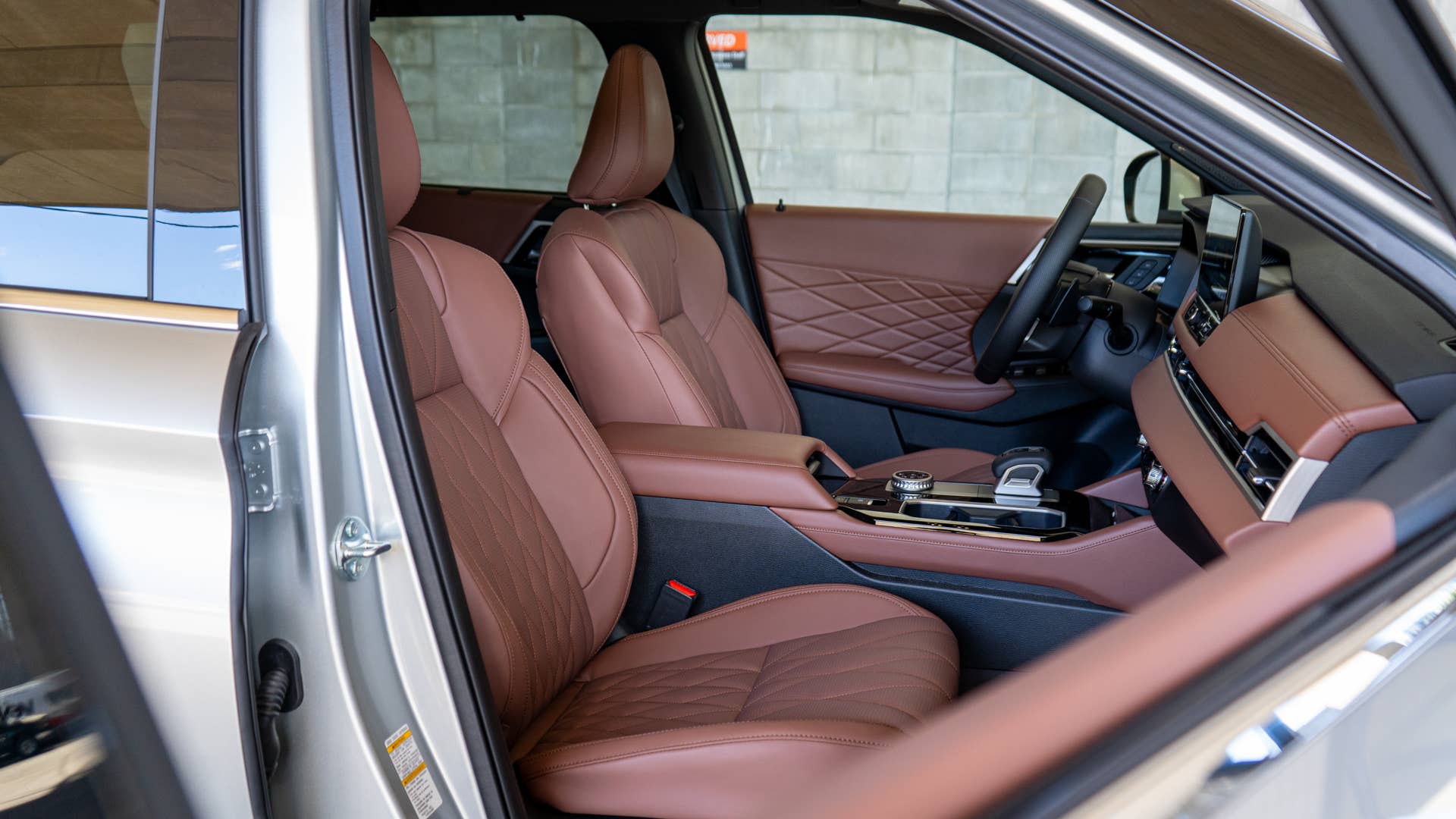
The Santa Fe undeniably possesses the more useful cabin for families—it’s simply more spacious. It has more room, more storage, better third-row packaging, and a more modern technology layout. But the Outlander I drove genuinely felt more expensive and atmospheric, and by a larger margin than I had expected. Especially when equipped with the 12-speaker Dynamic Sound Yamaha Ultimate system, semi-aniline leather-appointed Brick Brown seats, the Outlander is designed to impress, whereas the Santa Fe feels a bit more sanitized, like a dentist’s office.
With that equipment, the Outlander’s cabin felt genuinely deluxe. The brown seats gave it a genuine sense of warmth. The stitching and trim made the cabin feel carefully considered and emphasized the surprisingly high assembly quality. The driving position was comfortable, the materials were convincing where they needed to be, and the overall ambience felt closer to near-luxury than I would have expected from Mitsubishi. Then there was the unique Yamaha system, which was excellent. Clear, full, rich, and more emotionally engaging than the Bose system in the Santa Fe. Audio systems can be easy to overstate, but when their job is to drown out the incessant screaming of a bratty minor-league soccer team, they matter a great deal.

Hyundai
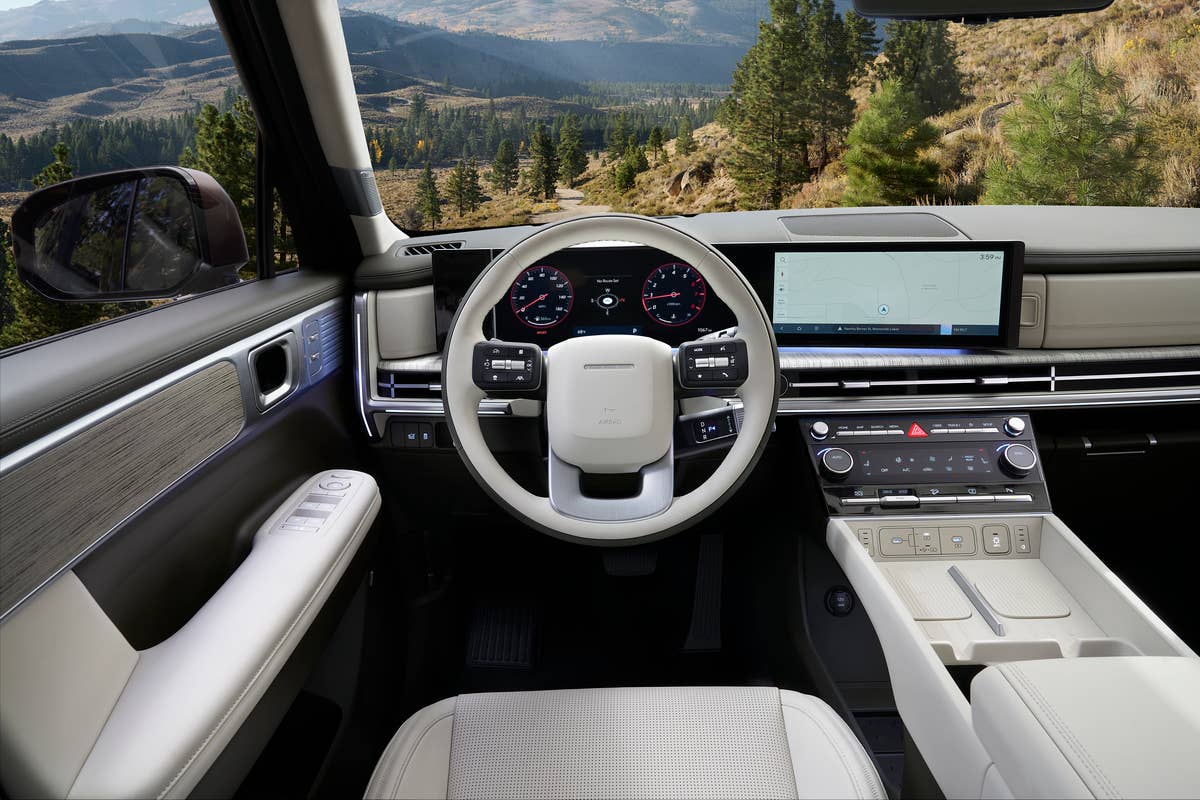
The Santa Fe Calligraphy’s cabin is still rather exceptional. It is open, airy, and intelligently organized. It may feel like a dentist’s office, but at least it’s a modern, high-tech one. The available captain’s chairs, useful storage areas, dual-opening center console, and broad digital display all contribute to a vehicle that feels designed around real family use. The Hyundai feels a bit more practical than indulgent, whereas the Outlander feels more indulgent than practical. If I were buying with my head and a full family calendar, I would want the Santa Fe’s space, but if I were sitting in the driver’s seat and judging by atmosphere alone, I would take the Outlander.

Cole Attisha
Technology And Usability: Hyundai Has The Better Interface, Mitsubishi Has The Easier Footprint
The Outlander’s technology doesn’t try to reinvent the wheel, which is often a blessing in the modern world. Wireless phone integration, a clear central screen, a useful camera system, and straightforward controls make it easy to live with. The smaller footprint also helps enormously in the real world, staying largely out of your way until you absolutely need it. It is easier to park, easier to maneuver, and less stressful in tight urban environments, thanks in part to a crisp 360-degree parking camera, though it’s mostly due to its shorter wheelbase. That’s critical in dense urban cities like Vancouver, where underground parking lots often seem to have been designed around the dimensions of a 1993 Honda Civic and zoned with the optimism of a city planner who rides a bicycle to work every day, even when it rains.
Hyundai
The Santa Fe counters with a more thoughtful and advanced technological experience. Its 12.3-inch touchscreen is crisp and logically arranged, and Hyundai deserves credit for preserving enough physical controls to keep the cabin easy to operate while driving. Hyundai’s driver-assistance technology also feels more polished. The available blind-spot camera displays, surround-view system, adaptive cruise control, and lane-keeping assistance all add to the sense that the Santa Fe’s tech suite aims to make family driving easier rather than more complicated. Ultimately, the Hyundai wins the tech fest.

Cole Attisha
Space, Seating, And Cargo: Santa Fe Wins, Clearly
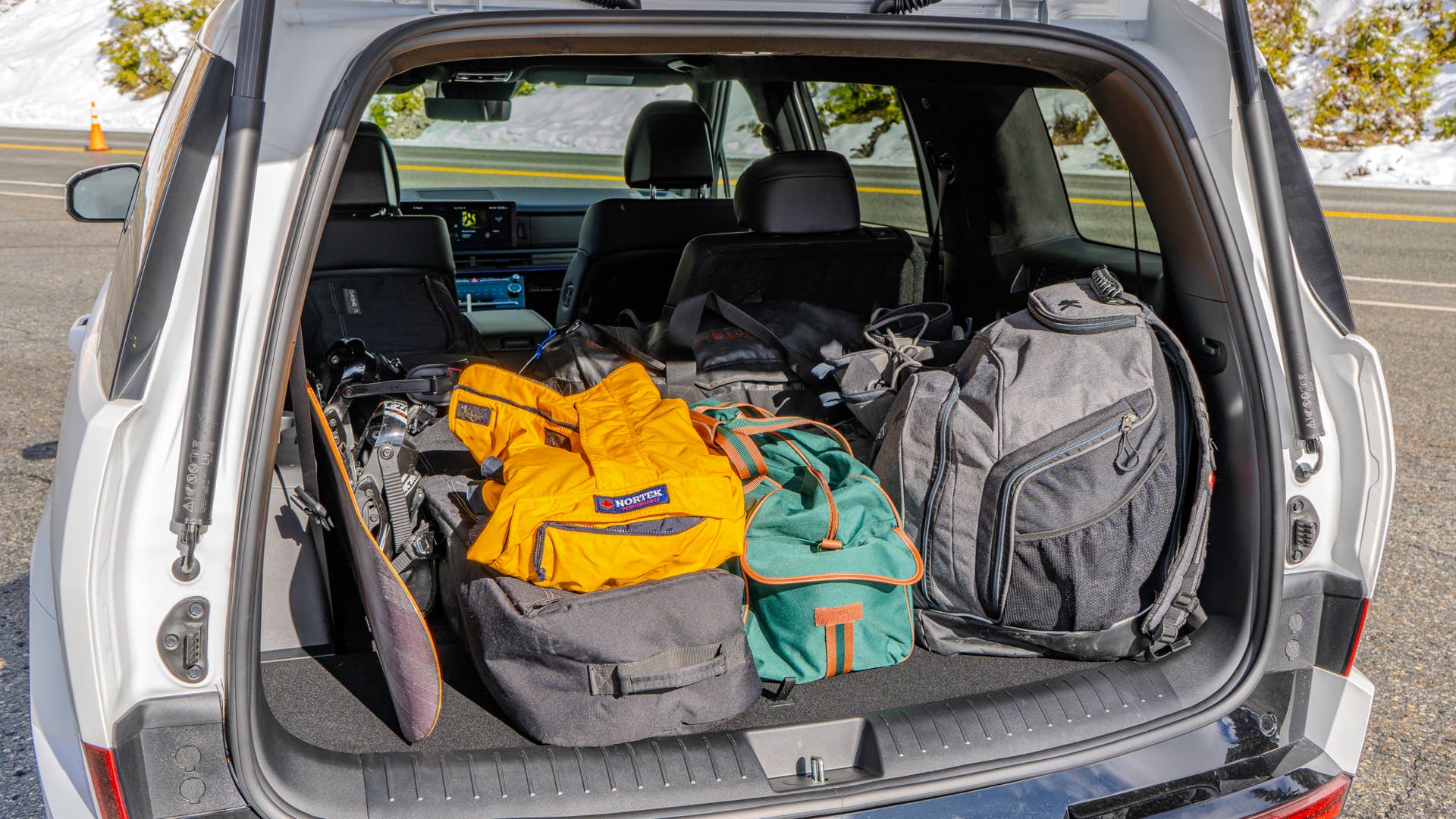
While the Outlander’s third row is useful, it’s not especially spacious. It is best treated as an occasional-use solution for children, short trips, or emergency carpool situations. That does not make it at all pointless—its appeal is the flexibility of seven-passenger seating in a compact, manageable SUV. The Santa Fe’s third row is simply more useful. It is still not Palisade-sized, and adults will not mistake it for business class, but it is much better suited to regular family use than the Mitsubishi models. The second row is also more generous, and the cargo area is noticeably larger.
Cole Attisha
The numbers back that up. The Outlander’s cargo volume is 64 cubic feet behind the front row, 31 behind the second row, and 11 behind the third row. The Santa Fe offers 40.5 cubic feet behind the second row, nearly 80 cubic feet behind the front seats, and 14.6 cubic feet with all seats in place. Towing also favours Hyundai, depending on the version. The Santa Fe is rated for up to 3,500 pounds of towing for most gas models and 4,500 pounds for the XRT. The Santa Fe Hybrid, however, is rated at 2,000 pounds, which is also the Outlander’s rating with the 1.5T. Go for the plug-in hybrid Outlander, and the tow rating drops to 1,500 pounds.

Cole Attisha
Pricing And Value: Mitsubishi Makes a Stronger Bargain Argument
The Outlander’s greatest strength is that it gives you a lot for the money, especially if you do not need the extra space of the Santa Fe. In the U.S., the base 2026 Mitsubishi Outlander starts at just $29,995, or $31,795 when equipped with S-AWC. The base 2026 Hyundai Santa Fe, on the other hand, starts at $35,050 with front-wheel drive, or $36,850 with HTRAC all-wheel drive. Opt for enhanced electrification, and the Santa Fe Hybrid jumps even further north, asking $36,500 for the base model, or $38,300 with all-wheel drive. American pricing for the 2026 Mitsubishi Outlander PHEV is not yet listed, but leftover 2025 models begin at $40,445 and come with standard S-AWC all-wheel drive.
Cole Attisha
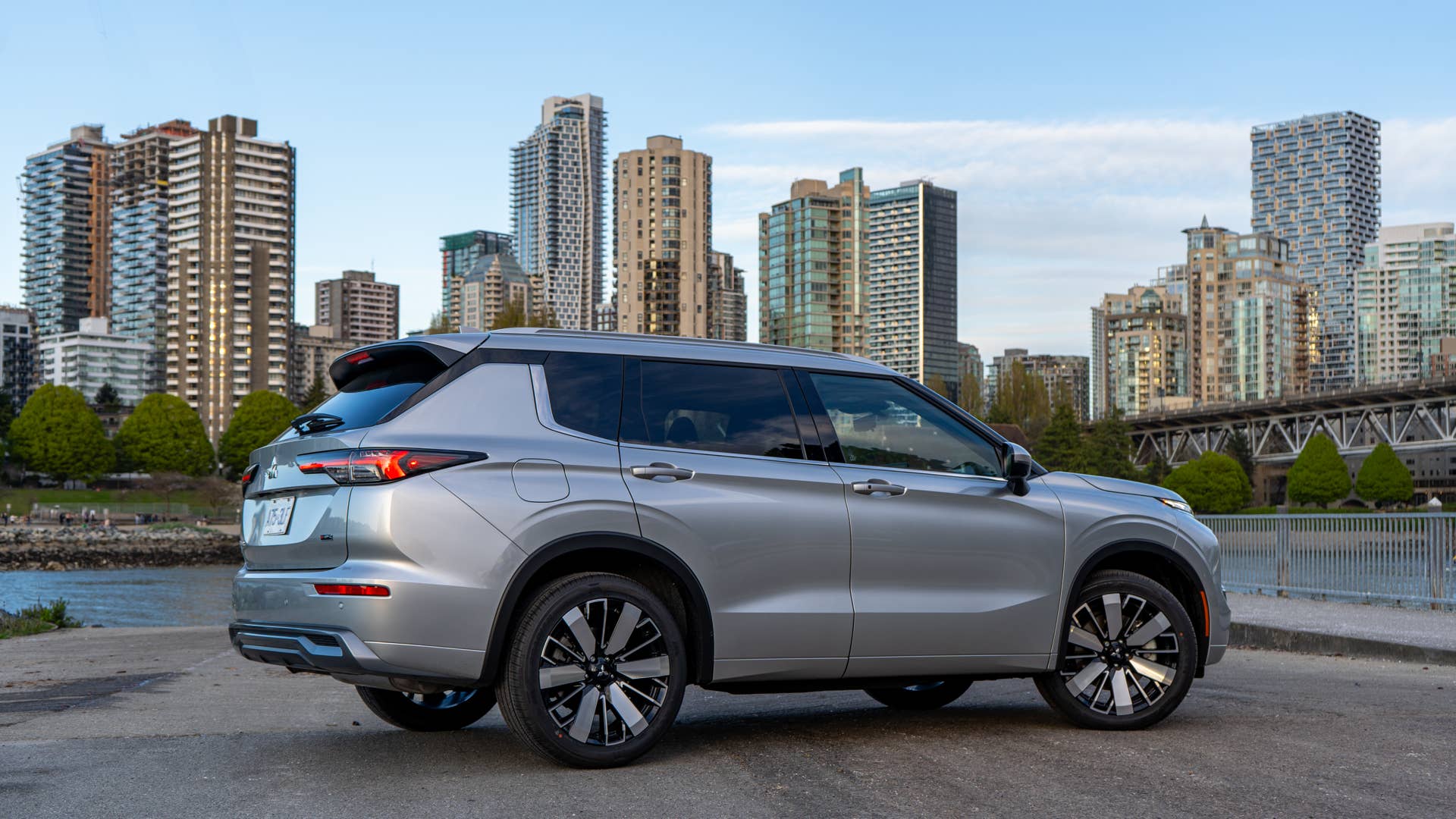
The Santa Fe costs more, especially in Hybrid Calligraphy form, but it offers more capability. More space, more refinement, better dynamics, better family packaging, and stronger hybrid efficiency. Although the Outlander is technically a mild hybrid, the Santa Fe offers more meaningful electrification for not much more money than its gas-powered variant, whereas springing for the plug-in Outlander comes with a hefty price increase. So ultimately, the Santa Fe Hybrid is arguably the smartest Hyundai in this comparison, in terms of overall value. It is not nearly as inexpensive as the Mitsubishi, but it improves on the Outlander’s biggest weakness—the driving experience—while delivering superior space and efficiency. The Mitsubishi is the better bargain if you value price, cabin richness, city-friendly size, and occasional third-row use, but the Hyundai is the better value if you need the SUV to solve more problems more often.
Cole Attisha
What About The Outlander PHEV?
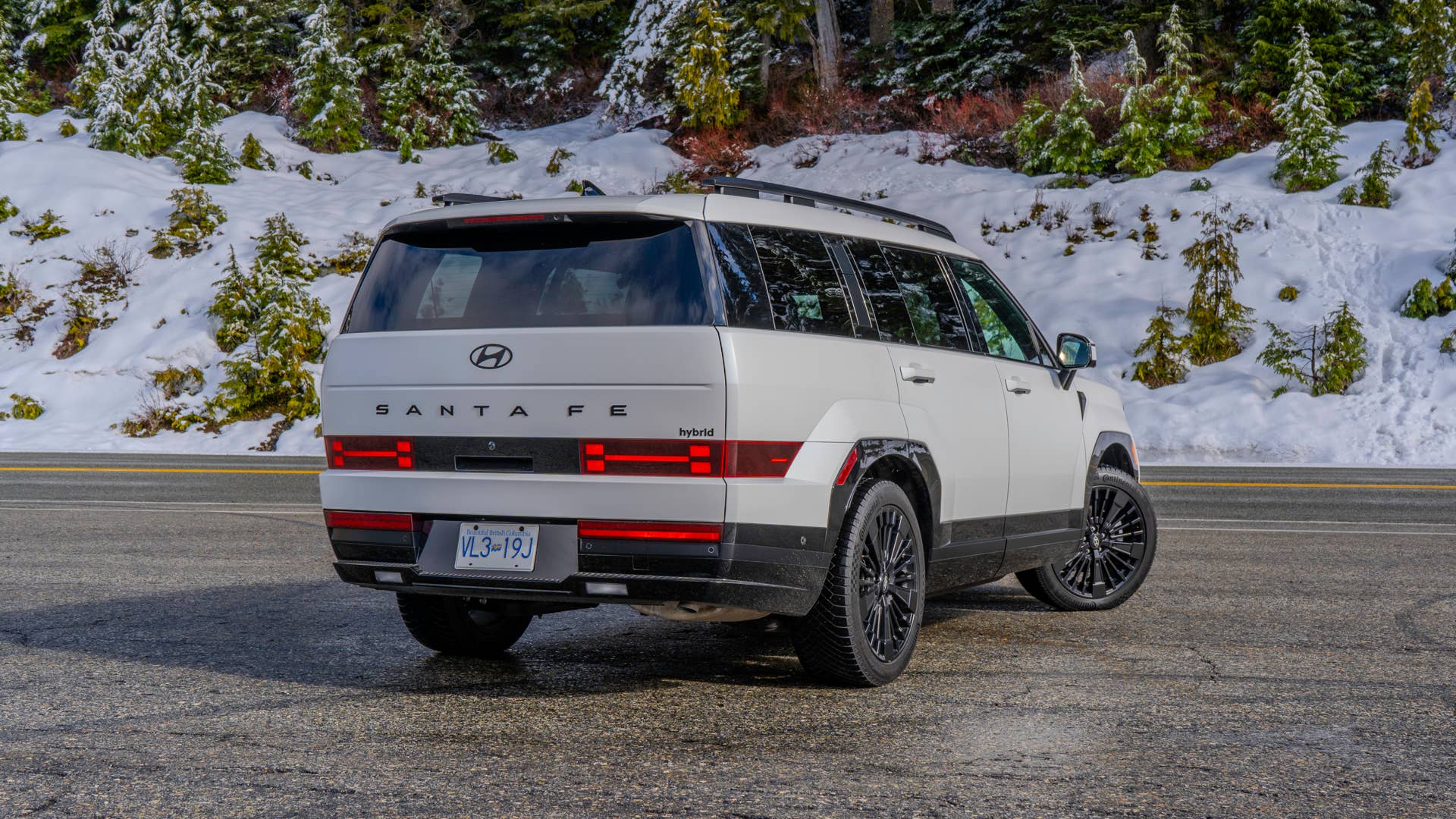
The Outlander PHEV deserves a note, because it is probably the most interesting Outlander powertrain. It is stronger, more electrified, and more appealing for buyers who can charge at home and handle much of their daily driving on electricity. But it also moves the Outlander into a different price category. Once you start looking at well-equipped Outlander PHEV trims, the Mitsubishi is no longer simply the less expensive alternative to the Santa Fe. It becomes a more specialized plug-in-hybrid choice, which dramatically changes the comparison.
Cole Attisha
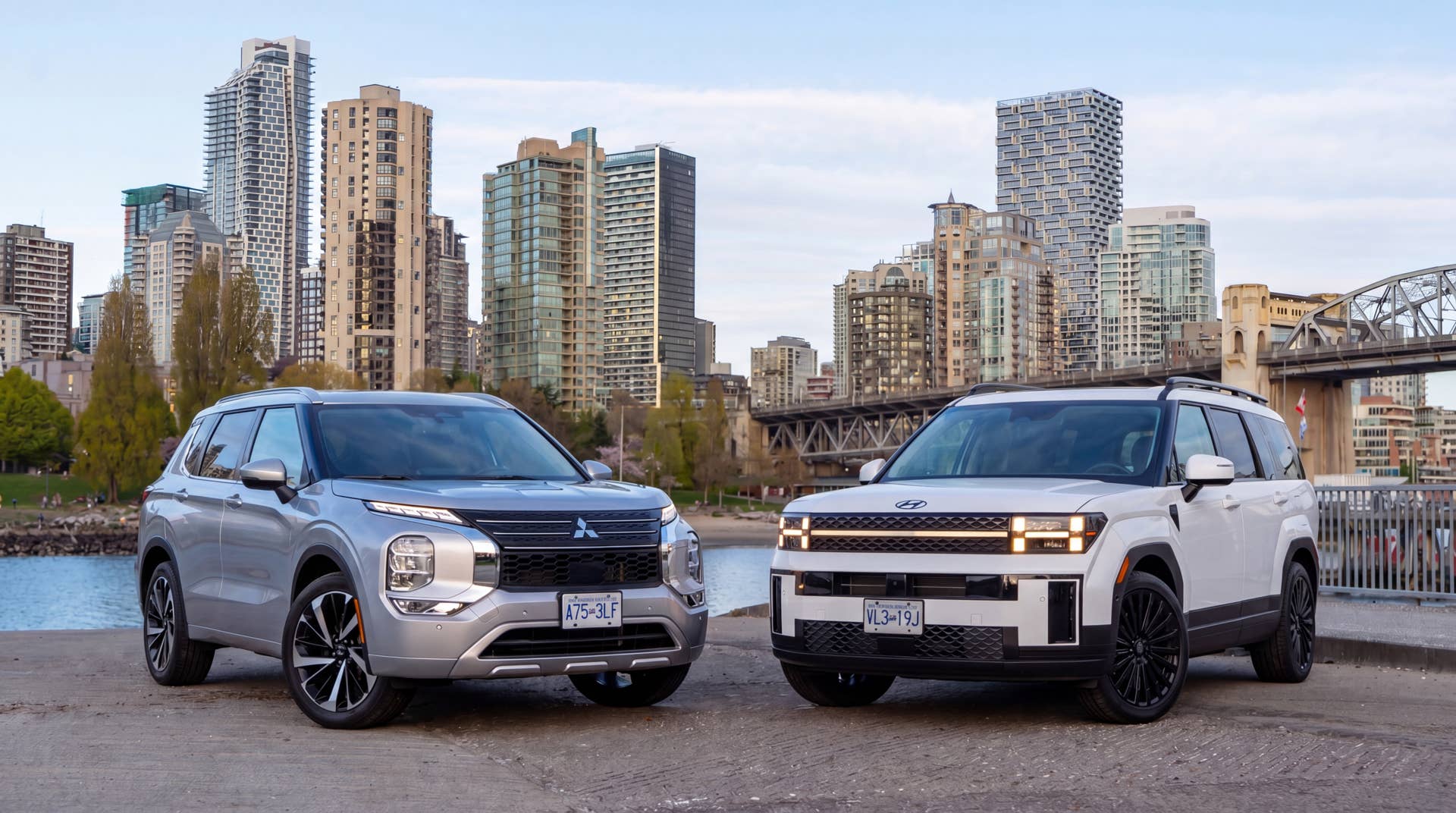
That’s why the Santa Fe Hybrid feels like such a strong middle ground here. It gives you some of the benefits people want from electrification—smoother low-speed driving and better fuel economy—without requiring plug-in charging or climbing into the higher price territory of the Outlander PHEV. For some buyers, the PHEV will be the Outlander to get. For this comparison, though, the Santa Fe Hybrid is the more obvious bridge between Mitsubishi’s regular Outlander and its plug-in flagship.
Cole Attisha
Verdict: The Outlander Is The Surprise, The Santa Fe Is The Solution
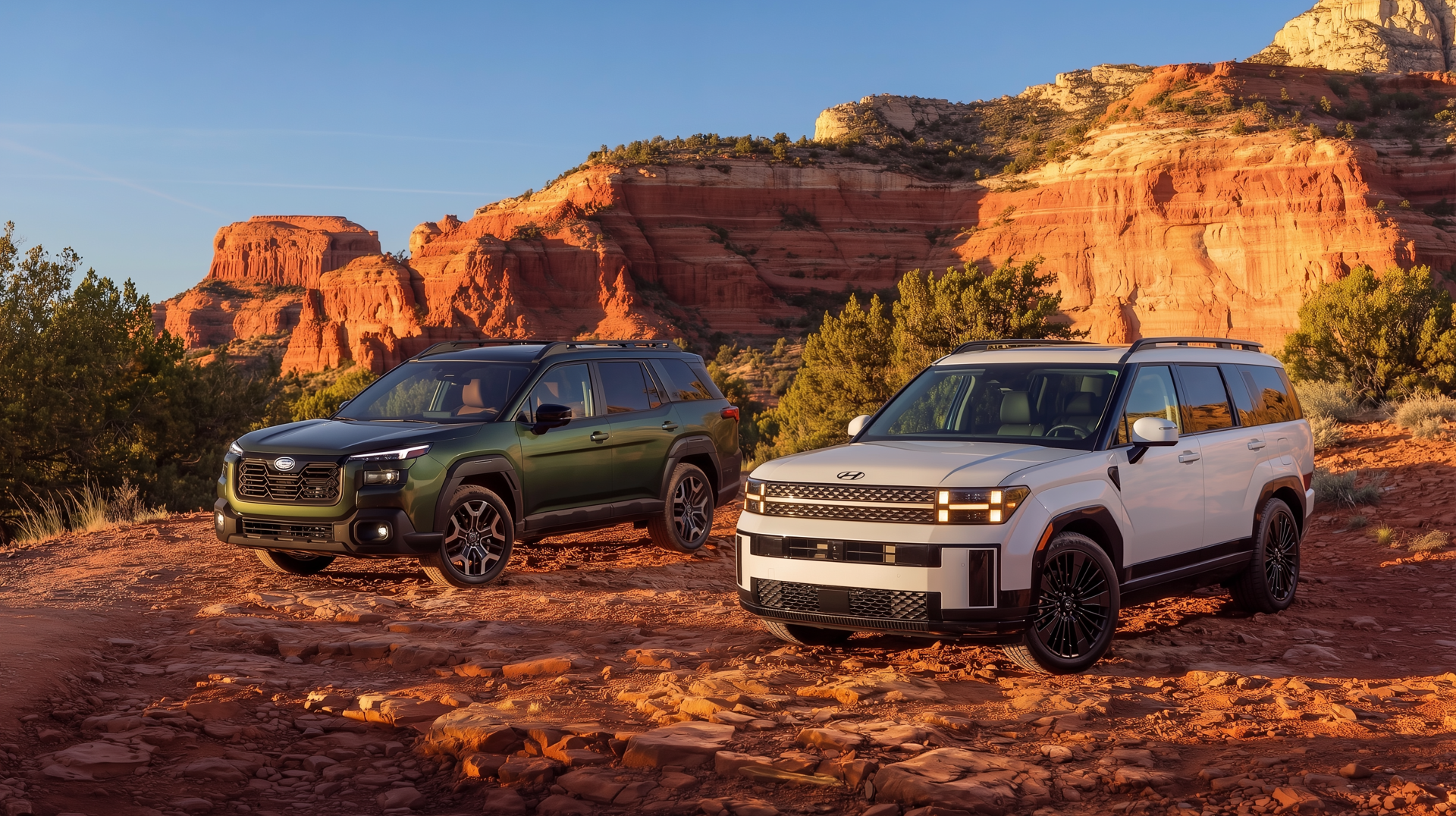
The 2026 Mitsubishi Outlander GT S-AWC and 2026 Hyundai Santa Fe Hybrid Calligraphy both understand that not every family wants a massive SUV, and thanks to their existence, not every family needs one just to have three rows of seating. But they also understand that their own individual buyers are looking for unique answers to a similar question. The Outlander is the more surprising vehicle, and is certainly the better budget play here. It is easier to park, cheaper to buy, and more premium-feeling inside than expected—especially in the highly-equipped configuration I drove, with its brown semi-aniline leather-appointed seats and 12-speaker Yamaha audio system. It makes a strong first impression from the driver’s seat. It feels warmer and richer than the Santa Fe in many ways, and that is not something I ever expected to write about. But the Santa Fe still feels like the more complete package if you’re willing to cough up the extra dough. It drives better, carries more, has a more usable third row, offers more cargo space, and, in hybrid form, delivers better efficiency than the Outlander. It costs more because it gives you more.
Buy the Mitsubishi if you want to save money, mostly drive in the city, value a genuinely premium-feeling cabin, and only need the third row occasionally. It is the clever bargain, and in the right trim, it has a cabin that punches far above its badge. Buy the Hyundai Santa Fe Hybrid if you want a better all-around family SUV, and don’t mind spending the extra cash. It is roomier, smoother, more polished, and more efficient than the gas Outlander, and much nicer to drive. It sits neatly between the regular Outlander and the Outlander PHEV, which may be exactly where many families want to land.
About the author

Cole Attisha
Staff Writer, Autoblog