
One year ago, President Obama used his State of the Union address to set a bold goal of U.S. consumers buying 1 million electric cars by 2015. But consumers aren’t biting, and the Department of Energy and the White House are backing away.
The only mention in this week’s State of The Union of EVs was a vague proposal for an “Energy Security Trust” with funding from oil and gas drilling royalties and use the money for research on electric vehicles, natural-gas vehicles and biofuels.
The truth is that enthusiasm for an EV car revolution is waning as too few U.S. car-buyers see themselves adjusting their driving lifestyles to make an EV part of their family fleet.
The DOE said on January 31 that it would no longer tout Obama’s million-car goal and will instead promote advanced-technology vehicles of every stripe. Cue the start of an “Energy Security Trust” that will support research for EVs, hybrids, natural-gas cars and fuel-cell powered vehicles.
Electric and plug-in electric hybrids got off to a tough start in January after a sluggish 2012.General Motors, Toyota Motor Corp. and Nissan Motor Co. all reported much lower sales of EVs and plug-in hybrids in January over December, citing lower inventory and the decision of many customers to buy before the end of the tax year. Chevy sold 1,140 Volts in January. Toyota sold 874 plug-in Priuses. Nissan sold 10,000 Leaf EVs in all of 2012. Ford is offering a $10,000 discount on the slow-selling Focus EV.
Those are paltry numbers. The lack of acceptance by consumers is creating a glut of batteries. LG Chem Michigan, a unit of the Korean conglomerate LG, for example, was awarded more than $150 million in funding by the U.S. Department of Energy under the 2009 Recovery Act to help construct a $304 million lithium-ion battery cell manufacturing plant in Michigan. It was supposed to create 440 jobs. But the company is still supplying batteries for the Chevy Volt from its Korean plant, and fewer than half the jobs in Michigan have been realized. Why? Lack of demand. LG Chem and the DOE have just been reprimanded by the DOE Inspector General for misusing tax-payer funds and not delivering on stated goals.
What’s dampened the push for EVs? Part of the problem is the continued high cost of lithium-ion batteries critical to EVs, and negative publicity around fires related to such batteries in a few cars, as well as the new Boeing Dreamliner airplane (though the batteries are sufficiently different that the aircraft company’s problems are not thought to be related to the car batteries.)
The dollars and cents
Here are some of the financials on the EVs and extended range electric vehicles consumers can buy today. The 2013 Nissan Leaf S, with about a 73-mile range in between re-charges, starts at $28,800. But after federal and state tax credits in California, dips the price to $18,800 in that state. It’s $21,300 with just the federal credit.
The Chevy Volt, which is an extended-range EV, meaning it gets 35 miles on a charge but has a gas-powered motor that continues to power the battery until the next charge-up, starts at $39,145, and $31,645 after the federal credit. But you can lease a Volt now for $328 per month with no money down for 39 months. That’s not as good as the low-price leases of last September–just above $200 a month with $1,000 down, but it is still a nice deal for a car packed with so much technology and that can take a driver 70 miles a day with no gasoline used and no worry of running out of battery charge because of the back–up gas motor.
A consumer who wants to drive electric and reduce their dependence on gasoline prices can, in fact, make a business case for buying an EV. I can put a charger in my garage for very little money after credits from the government and my utility company. I already have a charger at work. I could conceivably drive a Volt back and forth to my office, a round-trip of 100 miles a day, for two weeks on one tank of gas as I would, in fact, kick over to gasoline at the 35 mile mark. That’s roughly 1,000 miles on one tank of gas. But people who commute fewer than 70 miles a day – the vast majority of Americans – could drive months without going to a gas station.
Electricity does cost, but recharging at night at home is extremely cheap when electric rates at their lowest. And many work-places with chargers will let you charge up for free or for peanuts.
But here is the real problem for all but those who embrace new technology, especially green technology. If it’s new, and creates a big change in the way we think, or live our daily lives, a lot of us just think … “Nah. I’m comfortable with what I do now.”
Change is hard
I now have some sympathy for this. After years of using an iPhone, I added a second phone to my life: a Samsung Galaxy. I did this so that I could have two phones to interface with the cars I test. Not every car’s telematics system matches up with Apple’s operating platform. Most, for example, will not allow you to execute commands via a Bluetooth connection by voice command. But I hate this phone. It gets rave reviews from others. But what I hate about is that it’s very different from my iPhone, and I hate fumbling around with something new and unfamiliar that is as critical to my daily life as my smartphone. I really like the familiarity of my iPhone.
I love the Volt, more than the Leaf. And I feel the same way about the new Ford C-max and Toyota Prius extended-range EV. The extended-range EV system fits my lifestyle perfectly. But, yes, it does require hooking up a car to a charger about as often as I do my phone. That’s new and different. But unlike my hatred of my new Android phone, I don’t mind it all. And I love driving using so little gas.
When I hear people dis the Volt and EVs, I get frustrated. It’s often people who haven’t seriously looked at them, or considered just how easy they are to use if you have access to chargers. They are especially useful as second cars in a family, but can certainly be used as primary cars.
But my frustration with such car shoppers is on the wane. When I hear the objections, I think of my new Samsung and how much I dislike it because of how unfamiliar it is.
We can be creatures of habit and simply resistant to changing what works for us, no matter how many tax credits we are offered to take a different road.
Featured Gallery

Despite an almost constant drumbeat in the media and from politicians about an economic recovery that is moving too slowly, luxury car manufacturers at the North American International Auto Show say 2013 is going to be a very strong year for their brands.
The overall industry should be up to near 15 million units this year, with luxury brands expected to grow by double digits. The reason for such strength? The investor class has done well in a bull stock market and return of corporate bonuses and many are flush with cash after selling off stock in late 2012 to take advantage of low capital gains taxes before they likely go up this year.
The show this year was flush with new entries from Cadillac, Mercedes-Benz, BMW, Bentley, Porsche, Maserati, Lexus, Infinti, Acura and Tesla.
Have a look at our picks for best of the newest Dream Machines, as well as our pick for”Show Dog,” or the clunker of the show, which comes from the luxury/premium category this year.

It’s getting harder and harder to find a dog, a clunker at an auto show. Car companies are much more risk averse than they used to be. But even now, we always manage to find one that makes our entire staff say,”Yeah…um…no..ick.”
The car that drew that response from the combined AOL Autos/Autoblog editors was the Hyundai concept we are led to believe points to the design direction of the nextGenesis sedan.
The Genesis, which will run you from $34,200 to $46,800, has been well received and praised. Good stuff, considering it was Hyundai’s first foray into the rare air of luxury. The original Genesis benchmarked the BMW 5 Series, and did a helluva job of knocking it off and providing non-badge conscious buyers a value.
But this concept? We aren’t sure what the benchmark was. While we think the raked look of the car is drawn from cars like the Mercedes CLS, it looks more like an attempt by a Chinese automaker than by the far more established and respected Hyundai design studio.
The front end is massive and reminds us of baroque front ends from Chrysler in the 1990s or from Chinese automakers now. The Beijing Auto Show is full of such out-of-proportion, bad-taste sedans.
It’s a bit disappointing because of the headway and successes that Hyundai has been delivering: the current Sonata, Elantra, Santa Fe, the new 2013 Azera and the original Genesis. We realize this is a concept car meant to draw comments and give Hyundai feedback on how to proceed.
We recommend slamming on the brakes.
Read More
Hyundai HCD-14 Concept Info
Hyundai HCD-14 Concept Photos

This monster rumbled onto stage at the Detroit show moments after the 2014Mercedes-Benz E-class was serenaded by Bruce Hornsby.
That’s just the way it is.
This car didn’t need any music, as its engine did all the singing. The 550-horsepower sedan is meant to attract aggressive, Type-A people who live life full and fast (and make a lot of money.)
The E63 AMG can also be upgraded to pump out 577 horsepower, and come with the company’s 4Matic all-wheel drive system.– Sharon Carty
Read More
Mercedes-Benz E63 AMG Info
Mercedes-Benz E63 AMG Photos
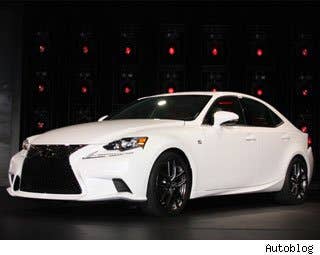
Lexus really wants to shake off the image that’s starting to grow on its shoulders like a moss– that it’s a car for older people. And with the IS, which will be tuned so it’s fast on racetracks like the Fuji Speedway and Nurburgring, they might actually convince some people they’re serious.
The IS looks mean and fast, with a black honeycomb grill that seems to grimace and slanted headlights that look like your mother’s best mean glare.
More details will come later, but for now we know the car will come with both rear- and all-wheel drive models in both 2.5-liter V6 (for the IS250) and 3.5-liter V6 (for the IS350) trims.– Sharon Carty
Read More
Lexus IS Info
Lexus IS Photos

The latest fashion statement in luxury is the four-door coupe. First came theMercedes CLS, Audi A7 and then came the BMW Gran Coupe. Anytime BMW applies its M-branded engineering to make an already sensational sport sedan zippier, it gets our attention.
The M-tuned Gran Coupe utilizes the same 4.4-liter forced-induction V8 that powers both theBMW M6 and the M5, with an output of 560 horsepower and 500 pound-feet of torque. The fast four-door brings up 60 miles per hour in just 4.1-seconds – the same sprint time as the M6 coupe and a few tenths quicker than the M5 – and up to a limited top speed of 155 mph.
Read More
BMW M6 Gran Coupe Info
BMW M6 Gran Coupe Photos

We named the Audi A7 our 2011 Car of the Year. What could be better?
If you have a burning desire to take yourself and four friends to 189 miles per hour, the 2014 Audi RS7 Sportback can help you out. The luxury hatchback bowed at the 2013 Detroit Auto Show, complete with a 560-horsepower twin-turbocharged 4.0-liter V8 engine thrashing under the hood. Getting to 62 mph takes a shave under 3.9 seconds thanks in part to the 553 pound-feet of torque on hand from just 1,750 rpm. While the base car comes with an electronically limited top speed of 155 mph, customers can request the governor be removed by purchasing the dynamic package plus, upping the max to 189 mph.
Audi says the RS7 can also yield up to 25 mpg on the US scale. With a cylinder-on-demand system, the V8 can deactivate up to four cylinders by closing their valves. Once the driver gets frisky with the throttle, the engine automatically kicks from four-cylinder to eight-cylinder mode in a few hundredths of a second.
Read More
Audi RS7 Info
Audi RS7 Photos

It’s not that often that we get to talk about a newMaserati model, but that’s all about to change. The Italian automaker is using the 2014 Quattroporte to begin a lineup expansion that will soon grow to no fewer than five models. Entering its sixth generation, the Quattroporte has been completely redesigned, and is also adding a new V6 engine and all-wheel drive.
The interior has also been brought up to date with modern infotainment technology and improved luxury courtesy of a longer wheelbase, bringing more space to rear-seat occupants. While the V8 we drove had a bench rear seat and oddly retro-modern wheels, the car on display had more conventional wheels and the two-passenger rear seat bucket seat layout.
Both engines used in the new Quattroporte are proprietary to Maserati and produced by Ferrari in Maranello.
Read More
Maserati Quattroporte Info
Maserati Quattroporte Photos

Shown at the Detroit Auto Show in a Mediterranean blue hue, the Bentley GT Speed Convertible definitely looks like it will fit into the lifestyles of the rich and famous.
The car comes with some impressive numbers: a 6.0-liter W-12 engine that pumps out 616 horsepower, 590 pound-feet of torque, and a top speed of 202 miles per hour.
Oh, and Bentley says it should get 15 percent better fuel economy. Not that anyone who can afford this car is worried about the price of gas.
Read More
Bentley Continental GT Speed Convertible Info
Bentley Continental GT Speed Convertible Photos
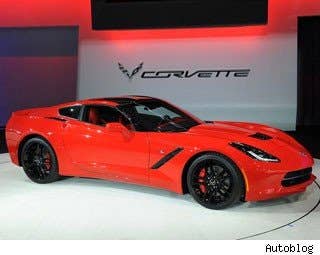
The star of the show is, by far, the new Chevy Corvette.
At 60 years old, it is the longest-running sports car in history. GM has revived the Stingray name for this model, a storied name that first made its debut in 1963.
GM focused on improving the interior, a priority since the older version was often criticized for feeling too plastic inside. The new interior has carbon fiber, aluminum and hand-wrapped leather trim. It also comes with two 8-inch infotainment screens, helping bring the car into the modern age.
GM had a whole new priority for this car– making it fuel efficient. The new Corvette uses a lot of aluminum – every 2014 model will be built on a lightweight aluminum frame, unlike the past models where only the high performance ‘Vettes were made from aluminum. That turns into a 99-pound weight loss for the sports car, and GM promises the car will get much better fuel economy than the current car. Today’s Corvette gets a meager 19 miles per gallon.
Read More
Chevrolet Corvette Stingray Info
Chevrolet Corvette Stingray Photos
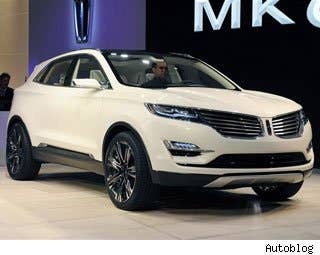
The Lincoln MKC was the sleeper hit of the Detroit auto show. Our partners over at Autoblog were blown away by the number of people who said they loved the SUV, a concept vehicle that strongly hints where Lincoln is heading with the compact crossover.
Although we don’t know many details about the vehicle, like when it will go on sale (maybe as soon as later this year), how much it’ll cost or even what kind of engine would be under the hood, people like the design.
With a grill that kind of looks like a face wearing cat-eye sunglasses, the front end is somewhat polarizing. Some people say they hate the look, and many critics went into the car show thinking the front grill was going to turn them off. But it works here, with just enough shiny bling to balance out the split-wing grill.
About the size of theFord Escape, the MKC looks like its skinnier, prettier sister. And given how desperately Lincoln needs a popular vehicle to help improve its image, we’re hoping the production MKC will look a lot like its concept. (Although the concept is notably missing door handles.) – Sharon Carty
Read More
Lincoln MKC Concept Info
Lincoln MKC Concept Photos

Can an extended range electric car be dreamy? Sure. When Chevy introduced theVolt, and we experienced all that get-up-and-go and torque, one thought we had was that maybe it should have been a Cadillac instead of a Chevy.
Now, Cadillac is readying the ELR, a leather-lined legitimate Cadillac coupe powered by the excellent electric power-train of the Volt.
The new Cadillac makes good use of the basic running gear from the Chevrolet Volt, including the 1.4-liter range-extending gas engine, a 15.6-kWh lithium-ion battery pack, an electric drive motor that offers 295 pound-feet of torque, and a total system output of 207 horsepower. All-electric range is down by just one mile versus its Chevrolet forebearer, for a total of 35, and Cadillac speculates that the total range with the gasoline generator figured in will top 300 miles.
For the uninformed, the ELR, like the Volt, gets its initial 30-35 miles of power from a battery charge. When that run downs, a gas powered motor kicks in to continue to power the battery, though not actually recharging it. Performance is crazy good. One need not worry about ever running our of juice as long as a gas station is near by. But the real benefit comes from getting at least 35 miles a day off a charge — 70 if you can recharge at the office.
Read More
Cadillac ELR Info
Cadillac ELR Photos

AutoBlog says: The Acura NSX is still a couple years away from production (isn’t it always?), but Acura has taken the dark window tint off last year’s concept and opened the doors to show us what the interior of the car looks like. From what we can tell on the show-floor display, Acura’s hybrid supercar will not only have a sexy exterior design, it will look great from the inside as well, but Acura pointed out that this is just “one possible direction” the interior could go. We suppose that means we can look forward to many more NSX concepts – you won’t hear any complaints from us.
Read More
Acura NSX Info
Acura NSX Photos