
Click image for photo gallery
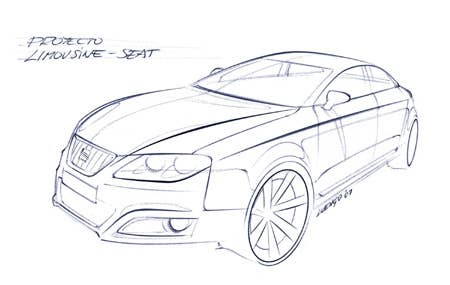
No longer content to just pump out hatchbacks and crossover-y little MPVs any more, Spanish VW subsidiary SEAT is getting ready to dip a toe into the highly-competitive D-segment, taking on the likes of the Ford Mondeo and Peugeot 407. That’s some pretty stiff competition, but if the sketches SEAT prez Erich Schmidt (above right) released this week are any indication, the larger SEAT’s styling is going to be mature and forward-looking while (apparently) shedding some of the brand’s overt visual quirkiness along the way.
In fact, the head-on sketch reminds us of the the new Mondeo, with touches of the Jaguar C-XF concept car and the current Aussie-market Ford Falcon thrown in for good measure. That’s not a bad thing at all, and as demonstrated by the new Mondeo, styling matters The new car will be offered in sedan and wagon variants, and it’ll be built at the company’s Martorell plant, when it ultimately bows in 2009.
And now, we wait…
UPDATE: We don’t know why the PR refers to the B-Segment. As a commenter points out, the Mondeo, et al are D-Segment competitors in Europe, so we updated the post to reflect that.
[Source: SEAT]

Featured Gallery

“The shortest distance between two points is under construction.” -Noelie Altito
While an amusing quote, it comes with a sting of truth for those that live in urban areas, where construction, accidents and the sheer amount of people on the road trying to get to different places contribute to maddening congestion.
It’s a way of life in the city, but some of these places are even worse than others.
GPS navigation manufacturer TomTom recently released its findings about the most congested cities in North America by compiling its own real-time traffic data. The company determined the top 10 worst cities for traffic congestion by comparing travel times between peak traffic hours and non-congested (free-flow) hours. The cities with the biggest difference between the two — expressed as a percentage increase in travel time — took on the not-so-illustrious distinction.
Click through to see the most congested cities in North America. To see more on how TomTom ranked the cities and for more information on each, such as the worst days of the week and times of day to be on the road,head over to the TomTom website.
We’re sorry if you’re a driver in one of these places.
Image Credit: Oran Viriyincy, Flickr

Increase in travel time (free-flow to peak hours): 25%
Delay per year with a 30 minute commute: 86 hours
Delay per hour driven in peak period: 36 minutes
Montreal has gotten better since TomTom’s last congestion study, but the Canadian city is still especially bad during evening rush hour. The delay per hour during peak traffic time is 36 minutes.
Image Credit: Goodnight London, Flickr

Increase in travel time (free-flow to peak hours): 25%
Delay per year with a 30 minute commute: 29 minutes
Delay per hour driven in peak period: 74 hours
Congestion in NOLA has been increasing in recent years. Drivers can expect lengthy delays on Friday evenings and Thursday mornings, especially on non-highways.
Image Credit: jczart, Flickr

Increase in travel time (free-flow to peak hours): 25%
Delay per year with a 30 minute commute: 78 hours
Delay per hour driven in peak period: 31 minutes
Gridlock on Washington’s roads mirrors the gridlock of the federal government. Traffic during peak hours is really bad on non-highways, resulting in drivers wasting about 78 hours per year sitting in traffic.
Image Credit: cbowns, Flickr

Increase in travel time (free-flow to peak hours): 25%
Delay per year with a 30 minute commute: 84 hours
Delay per hour driven in peak period: 35 minutes
Non-highways in San Jose are just brutal during peak hours. All of those tech visionaries in Silicon Valley have plenty of time to plan out the future while they’re sitting in traffic for 84 hours per year.
Image Credit: toprankonlinemarketing, Flickr

Increase in travel time (free-flow to peak hours): 25%
Delay per year with a 30 minute commute: 81 hours
Delay per hour driven in peak period: 31 minutes
Canada’s biggest city also sees some of its worst traffic congestion. Thursday mornings and Wednesday evenings are especially bad here, both on highways and non-highways.
Image Credit: elPadawan, Flickr

Increase in travel time (free-flow to peak hours): 25%
Delay per year with a 30 minute commute: 84 hours
Delay per hour driven in peak period: 35 minutes
Drivers in the Emerald City are delayed for a remarkable 84 hours per year. Although cars provide a shelter from Seattle’s notoriously rainy climate, it’s little consolation for those stuck in traffic on the freeway.
Image Credit: Atomic Taco, Flickr

Increase in travel time (free-flow to peak hours): 25%
Delay per year with a 30 minute commute: 84 hours
Delay per hour driven in peak period: 35 minutes
Between San Jose and San Francisco, the Bay Area is simply brutal for drivers. Thursdays are especially bad in SF and drivers can expect a delay of 35 minutes per hour behind the wheel at peak hours.
Image Credit: moonlightbulb, Flickr

Increase in travel time (free-flow to peak hours): 25%
Delay per year with a 30 minute commute: 86 hours
Delay per hour driven in peak period: 36 minutes
Although Hawaii provides plenty of ways to escape from stress, driving is not one of them, especially in the state’s capital. Drivers here spending 86 hours per year wishing they were doing something else.
Image Credit: Corey Leopold, Flickr

Increase in travel time (free-flow to peak hours): 25%
Delay per year with a 30 minute commute: 84 hours
Delay per hour driven in peak period: 35 minutes
Vancouver is consistently ranked as one of the best places in the world to live. That’s remarkable considering the traffic. Non-highways are awful during peak hours, especially during the middle of the week.
Image Credit: Tim in Sydney, Flickr

Increase in travel time (free-flow to peak hours): 25%
Delay per year with a 30 minute commute: 90 hours
Delay per hour driven in peak period: 39 minutes
No surprises here. LA has a reputation for congestion. Although the city recently announced it would be syncing its traffic lights to ease the traffic jams on non-highways, it’s likely to remain at the top of the list for a while. Commuters here waste 90 hours of their lives per year sitting in traffic.
Image Credit: USFS Region 5, Flickr
PRESS RELEASE:
SEAT TO EXPAND RANGE WITH NEW B-SEGMENT MODEL
SEAT’s intention to continue its growth and offer ‘auto emoción’ in yet more market sectors has been demonstrated once again, with the announcement that it will produce two new models in the B-segment.
The B-segment, still one of Western Europe’s largest market sectors with annual sales last year of 1,147,200 (source: AID), includes competitors such as the Ford Mondeo, Peugeot 407 and Toyota Avensis. SEAT S.A. President Erich Schmitt has confirmed that the company will enter into this market in 2009 with two variants: a saloon and an estate.
As with all SEAT models (with the exception of the seven-seat Alhambra, which is manufactured in Portugal), the new models will be built at the Spanish firm’s ultra-modern Martorell plant, located close to Barcelona. The company also has a substantial research and development facility at this location – the Martorell Technical Centre – employing around 1,250 highly qualified staff. No other car manufacturer based in Spain has the capacity to design, develop and produce its own vehicles in the country.
Commenting to Spanish media representatives in Martorell, at the announcement of the new models, Erich Schmitt said: ‘The assignment of these two new models to the plant in Martorell is an historic step for SEAT. By these means, we enlarge our current product range, which not only gives our clients the possibility to grow with the brand, but also enables us to increase the profitability of our dealer network thanks to the availability of these new models.’