

Toyota’s newest speedy offering
There’s only one reason for putting a picture of your supercar next to the race car version: it shows you mean business. Yes, it’s cliché, and yes, it’s a bit of a joke, but Toyota is very serious about its new GR GT racer. How serious? We combed the spec sheets and press releases to bring you every nerdy technical detail on the latest Toyota supercar.
A low center of gravity is key

Toyota
If it wasn’t apparent from the finger-thin gap between the bodywork and the tire, the GR GT sits low. Of course, that’s basic engineering. The lower the car, the lower the center of mass, and the less movement there is in the body (among other benefits). Gazoo Racing carefully considered how to lower both overall vehicle height and the driver’s position as much as possible.
You accomplish this with a low-mounted engine (check) made lower with dry-sump lubrication (check), and a rear-mounted transaxle gearbox (check). Each helps to lower the car’s components: dry-sump oil systems mean a big oil pan at the bottom of the engine isn’t needed, which means it can sit closer to the ground, with a transaxle gearbox eliminating yet more bulk and weight at the nose. That has the added effect of redistributing that weight more evenly, which resulted in a 45:55 front-to-rear weight distribution. Gazoo even says the driver’s and car’s centers of gravity have been made roughly identical.
All-aluminum frame keeps curb weights low, and aero-forward design keeps downforce high
Toyota
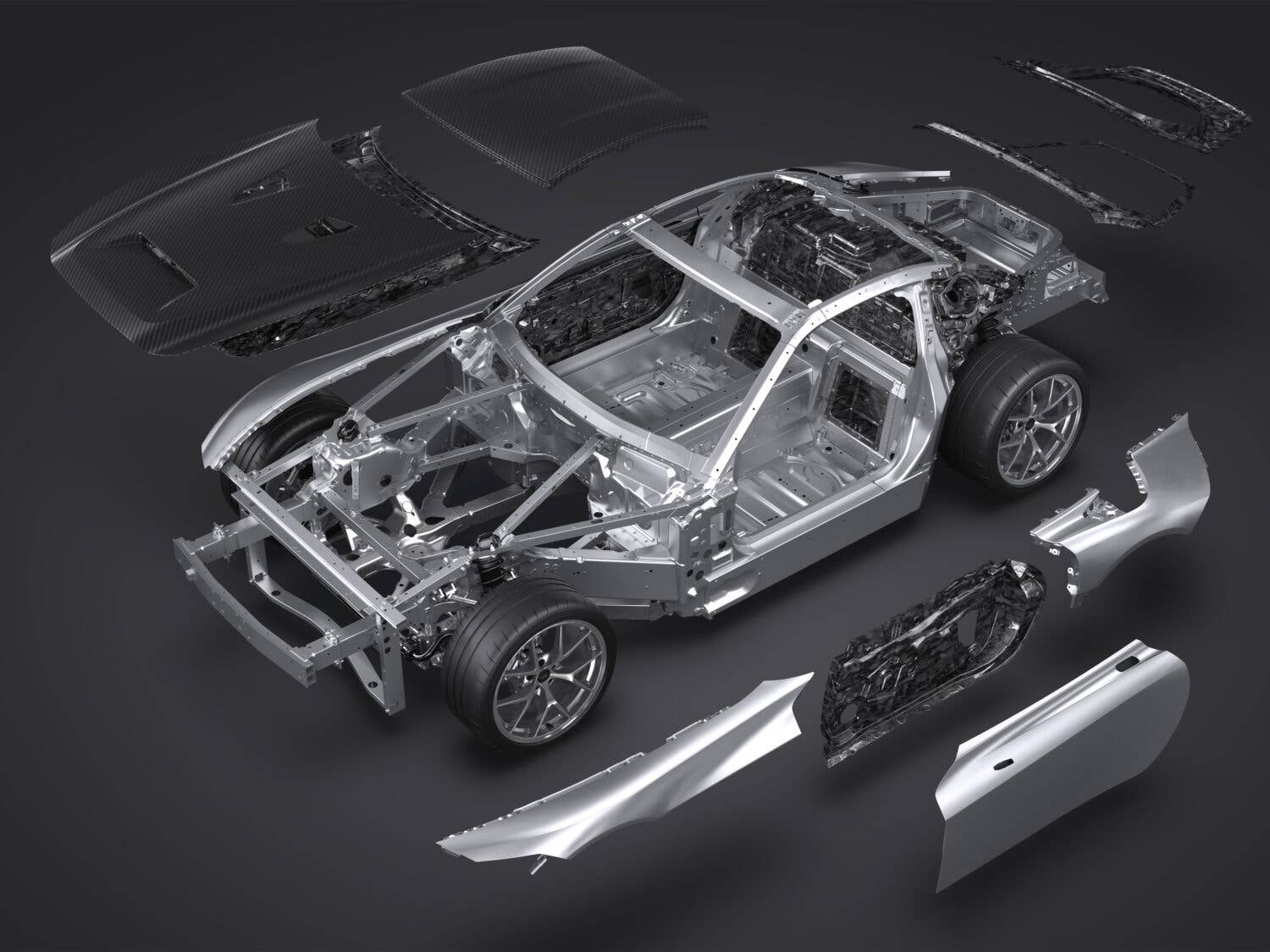
A first for Toyota, the GR GT’s all-aluminum frame is a clear choice for structural rigidity combined with lower weight penalties. The same logic extends to the car’s use of carbon fiber reinforced plastic (CFRP) and plastic. Toyota also says Gazoo used “other materials” in the body, but didn’t specify what.
As for suspension, Toyota used a new low-mounted double-wishbone system with forged aluminum arms, both front and rear. These will be paired with bespoke Michelin Pilot Sport Cup 2 tires. Braking is handled by Brembo carbon discs, tuned to the specs of Toyota’s own team of development drivers. All of this has been co-developed alongside the GR GT3 racer, such that “many of their components can be shared.” The GR GT’s Vehicle Stability Control system will also allow multi-stage adjustment of driving force and braking control, enabling you to choose just how “off” the car’s stability and braking assistance systems are. The same setup is also used in TGR’s Nürburgring 24-hour endurance cars.
Toyota
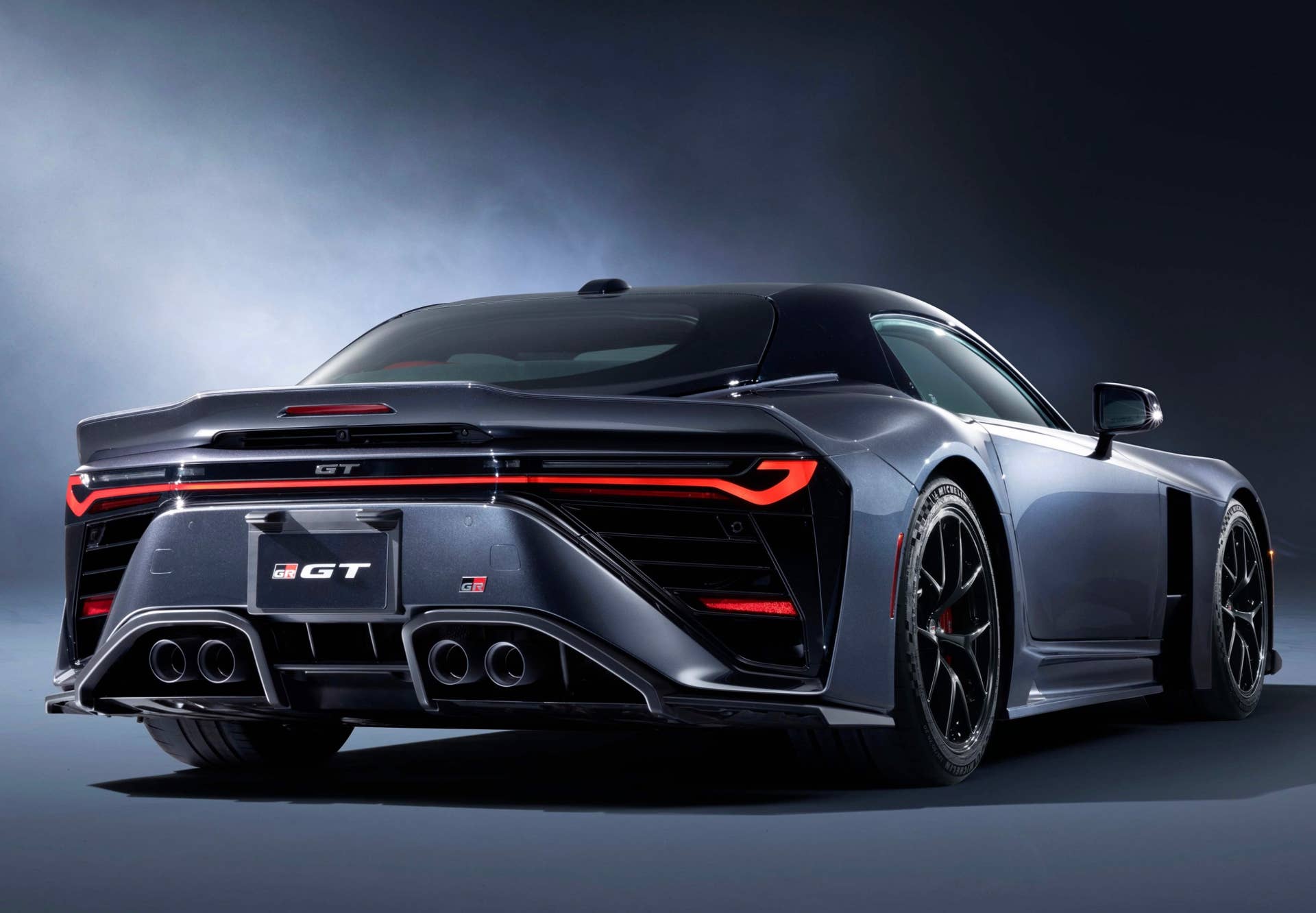
Toyota says the car’s aerodynamic design was “born from a process distinct from that of previous methods of Toyota car-making.” Usually, attention is given to aerodynamics only after finalization of exterior styling, but this time around, Toyota turned things around. Instead, the “ideal aerodynamic performance was established first,” then followed exterior styling elements. Aerodynamics engineers experienced in FIA WEC competition vehicle development were added to the GR GT development team. Overall vehicle packaging was based on an aerodynamic model that followed the car’s most efficient ideal form.
Everything you need to know about Toyota’s new V8
Toyota
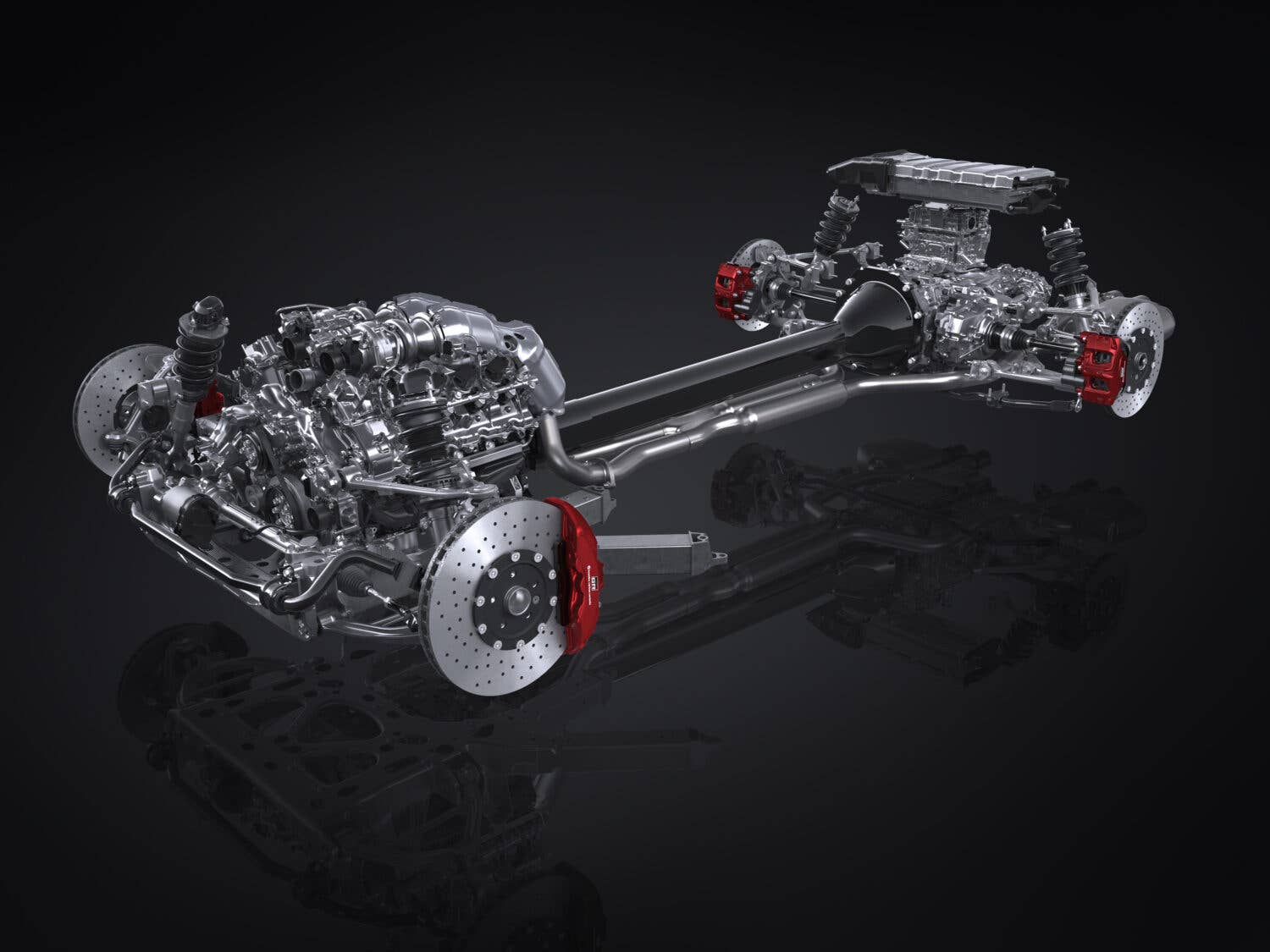
Just about everything you can think of was done to fit the hybrid twin-turbo V8 into the car’s low body. Toyota even shortened the 87.5 x 83.1 bore and stroke of the motor because it would, in turn, reduce overall engine height. The Hot-V turbo configuration was chosen not just for heat management and turbocharger efficiency, but to keep the engine compact. What little oil pan remains is also thinner than usual, again to keep the engine as low as it can be. The whole driveline and cockpit are slung so low that the tops of the turbochargers are about level with a driver’s chin.
The engine’s 641 hp and 627 lb-ft of torque (or more, says Toyota) are sent to the rear via a lightweight CFRP torque tube. In turn, a motor-generator unit (MGU) fed hybrid system helps put power to the rear via an 8-speed automatic gearbox and a mechanical limited-slip differential. That MGU is put in front of the transmission, and will help to make up for any lag in torque during gear changes. Speaking of, the transaxle will use a clever trick to minimize the wheelbase of the GR GT. Thanks to a conical gearset, the power sent through the torque tube will effectively make a U-turn through the gearbox before being routed into the differential. It means the two can be kept closer together, reducing overall mass and packaging.
Many of these principles are pure racing tech, brought to the road. On the GT3 calendar, cars with this tech aren’t out of place, but placing these items in a road-going car so closely tied to a racer will help the new GR GT stand out among other competitors. We’re unsure of pricing, and Toyota says things may change as the vehicle is still under development, but we’ve left all the specs below for you to scrutinize regardless.
| Body | Length | 189.8 in. | |
| Width | 78.7 in. | ||
| Height | 47.0 in. | ||
| Wheelbase | 107.3 in. | ||
| Body structure, cabin | Frame | All-aluminum body frame | |
| Occupancy | 2 | ||
| Vehicle weight | Vehicle weight | 3,858 lbs. or lower | |
| Front-rear weight distribution | Front: 45; rear: 55 | ||
| Powertrain | Engine displacement | 3,998 cc | |
| Engine bore x stroke | 87.5 × 83.1 mm | ||
| Engine type | V8 | ||
| Turbocharger | Twin-turbo | ||
| Electric motor | Transaxle-integrated single-motor hybrid | ||
| Transmission | Newly developed 8-speed automatic | ||
| Maximum system output | 641 hp or greater | ||
| Maximum system torque | 627 lb-ft or greater | ||
| Driving equipment, suspension & related items | Drivetrain | Front engine, rear-wheel drive | |
| Suspension | Front | Double wishbone with coil spring | |
| Rear | Double wishbone with coil spring | ||
| Brakes | Front | Carbon ceramic disc brake | |
| Rear | Carbon ceramic disc brake | ||
| Tire size | Front: 265/35ZR20; rear: 325/30ZR20 | ||
| Other | Top speed | 199 mph or greater | |
About the author

Chase Bierenkoven
Senior Editor, Autoblog