
Hybrids help you save gas at the pump, this is something we all know. We also know why burning less gasoline is good: fewer greenhouse gases are emitted to the atmosphere, it reduces our dependence on foreign oil and we spend less money at the pump. However, there is always the question about what is the overall impact of using a hybrid versus using a non-hybrid version. There are currently 17 hybrid models available in the U. S. market and all but one have a corresponding non-hybrid counterpart to compare with. As part of our Earth Day coverage today, we took a closer look at the following two questions:
- Question #1: How far can we drive with a hybrid powertrain compared to a non-hybrid?
- Question #2: When will the hybrid investment pay for itself through gas savings?
Before we go to the complete list let me explain the criteria we used. First of all we chose the “economy” powertrains, when we had the option. Therefore we’ll be comparing mostly 4-cylinder models. In the case of SUVs, we chose the AWD/4WD versions. For a few models, we’ve compared them to the European diesel versions data, although this should be taken with a pinch of salt due to the EU’s different driving cycles. Finally, we used $3.5/gal as the price of gasoline and added the car’s MRSP price. Don’t forget that some of these vehicles will qualify for various tax breaks, so you might have to recalculate our numbers for yourself. Got all that? Good, let’s see the results (after the jump).
Case 1: Honda Civic
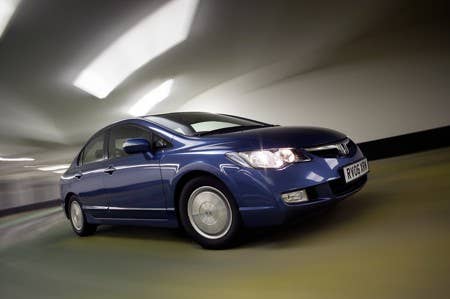
If you need a compact, sporty and nice sedan, the Civic is a good choice. It doesn’t hurt at all that the Civic is available not only with two gasoline engines, but a natural gas and a hybrid version as well. Let’s check how our two questions are answered for this model.
According to the official figures, the Honda Civic Sedan EX-L 1.8 gets 36/32 mpg (hwy/city). The Hybrid version gets 45/40 mpg. This is actually a good improvement, since we’ll get 16 percent more miles from a tank of gas with the hybrid (553 vs 475). However, you won’t be able to offset your savings until you drive 97,200 miles on the highway or 86,400 in city driving, because of the gasoline cost per mile.
Model | Power (HP) | MPG hwy | MPG city | Tank capacity | Miles per tank | MRSP | Gas cost per mile (hwy) | Gas cost per mile (cty) |
Honda Civic Hybrid | 110 | 45 | 40 | 12.3 | 553.3 | $22,600 | $0.0778 | $0.0875 |
Honda Civic Sedan EX-L 1.8 | 140 | 36 | 32 | 13.2 | 475 | $20,710 | $0.0972 | $0.1094 |
If we check the European diesel Civic, with a 2.2-liter engine, 140 HP and 53/33 mpg, we can make up to 753 miles with a single tank (highway).
Case 2: Domestic sedans: Chevrolet Malibu and Saturn Aura
If you want a domestic sedan, both the Malibu and the Aura have good credentials. The redesigned Malibu is catching a lot of attention and the Aura has a lot in common with the Opel/Vauxhall Vectra. Both cars can be purchased with I4, V6 and, now, hybrid powertrains.
According to the official figures, both non-hybrid sedans get 30/22 mpg (hwy/cty) while the hybrids get 32/24 mpg. That isn’t a spectacular leap. The hybrid will take us 6.7 percent further on a single tank, 512 vs 480 miles. We estimate you’ll offset your hybrid premium after 200,000 miles of highway driving or about 100,000 of city driving.
Model | Power (HP) | MPG hwy | MPG city | Tank capacity | Miles per tank | MRSP | Gas cost per mile (hwy) | Gas cost per mile (cty) |
Chevy Malibu Hybrid | 165 | 32 | 24 | 16 | 571 | $22,140 | $0.1458 | $0.1094 |
Chevy Malibu 2.4 | 169 | 30 | 22 | 16 | 480 | $19,645 | $0.1167 | $0.1591 |
Saturn Aura Hybrid | 165 | 32 | 24 | 16 | 571 | $23,650 | $0.1458 | $0.1094 |
Saturn Aura 2.4 | 169 | 30 | 22 | 16 | 480 | $20,045 | $0.1167 | $0.1591 |
If we check the European Opel/Vauxhall Vectra 1.9 DTi, with a 2.2-liter engine, 150 HP with automatic – which gets 42 and 24.5 mpg – we see it can go up to 662 miles with a single tank of diesel.
Case 3: Import sedans: Nissan Altima and Toyota Camry
If you’re interested in the sedan category, you will probably be looking at imports and domestics. Little more needs to be said about these two best-sellers. As above, we can buy them with an I4, a V6 or hybrid powertrains.
According to the official figures, the Altima Hybrid gets 35/33 mpg (hwy/cty) and the Camry Hybrid gets 34/33 while the non-hybrids get 31/23 and 31/21 mpg, respectively, offering quite an nice increase in city driving. Regarding how much we can run on a single tank, it’s 13 percent more for the Altima and two percent more for the Camry (note: tank capacity is different, check the estimation of cost per mile). An estimation of when you’ll offset your initial expense? You’ll need 300,000 miles for highway driving or about 70,000 of city driving.
Model | Power (HP) | MPG hwy | MPG city | Tank capacity | Miles per tank | MRSP | Gas cost per mile (hwy) | Gas cost per mile (cty) |
Nissan Altima Hybrid | 158 | 35 | 33 | 20 | 720 | $25,170 | $0.1000 | $0.1061 |
Nissan Altima 2.5 | 175 | 31 | 23 | 20 | 620 | $20,680 | $0.1129 | $0.1522 |
Toyota Camry Hybrid | 187 | 34 | 33 | 17.2 | 585 | $25,200 | $0.1029 | $0.1061 |
Toyota Camry 2.4 | 158 | 31 | 21 | 18.5 | 574 | $21,075 | $0.1129 | $0.1667 |
Case 4: Luxury sedans: Lexus
Now, let’s step up a level. Unfortunately, the only choice we have here is to speak about a single brand, Lexus. We have two options here, the GS and the LS. In this case, not many options were available to compare. If you wondered, only the IS has a diesel option for Europeans (with a very interesting 177 HP D-CAT engine).
According to the official figures, you shouldn’t really be considering the hybrid version if you do mostly highway driving. The savings for both sedans are only worth it in city driving. The GS hybrid gets three mpg more than the regular GS. In the case of the LS flagship , the savings are more spectacular, up to 22 mpg from 16. Regarding how much we can run on a single tank, we will consider city driving. You’ll drive six percent further in the case of the GS and a whopping 37.5 percent in case of the LS. To estimate when you’ll offset your hybrid premium? Let’s just say you’ll need to drive a lot due to the huge price gap between the hybrid and the regular versions.
Model | Power (HP) | MPG hwy | MPG city | Tank capacity | Miles per tank (city) | MRSP | Gas cost per mile (hwy) | Gas cost per mile (cty) |
Lexus GS450h | 340 | 25 | 22 | 17.2 | 378 | $54,900 | $0.1400 | $0.1591 |
Lexus GS350 | 303 | 29 | 19 | 18.8 | 357 | $44,150 | $0.1296 | $0.1842 |
Lexus LS600h | 483 | 20 | 22 | 22.2 | 488 | $104,000 | $0.1750 | $0.1591 |
Lexus LS460 | 380 | 24 | 16 | 22.2 | 355 | $72,000 | $0.1458 | $0.2188 |
Case 5: Ford Escape/Mazda Tribute/Mercury Mariner
SUVs aren’t considered very good green vehicles, but for someone who needs the carrying capacity, it’s good we have hybrid powertrains make them better performers. In this case, we considered AWD versions just because we thought that if you wanted an SUV it was because you really needed it. You wouldn’t buy an SUV if you didn’t, right? Right?
According to the official figures, these compact hybrid SUVs get 29/27 mpg (hwy/cty) while the standard versions get 24/19 (hwy/city). Regarding on how far they will take us on a single tank, part of the improvement (about 10 percent) is because of the difference of the tank size. Our estimate is that you’ll offset your initial expense after 200,000 miles of highway driving or about 80,000-100,000 of city driving. Like with the Lexus, this happens mostly because of the higher cost of the hybrid versions and not for the improvement in city mileage (which is about 30 percent).
Model | Power (HP) | MPG hwy | MPG city | Tank capacity | Miles per tank | MRSP | Gas cost per mile (hwy) | Gas cost per mile (cty) |
Ford Escape Hybrid | 155 | 29 | 27 | 15 | 435 | $28,390 | $0.1207 | $0.1296 |
Ford Escape 2.3 | 153 | 24 | 19 | 16.5 | 396 | $21,880 | $0.1458 | $0.1842 |
Mazda Tribute Hybrid | 155 | 29 | 27 | 15 | 435 | $27,060 | $0.1207 | $0.1296 |
Mazda Tribute 2.3 | 153 | 24 | 19 | 16.5 | 396 | $22,300 | $0.1458 | $0.1842 |
Mercury Mariner Hybrid | 155 | 29 | 27 | 15 | 435 | $29,090 | $0.1207 | $0.1296 |
Mercury Mariner 2.3 | 153 | 24 | 19 | 16.5 | 396 | $23,050 | $0.1458 | $0.1842 |
Case 6: Compact SUVs – Toyota Highlander, Saturn VUE and Lexus RX
Although we could include these SUVs in the case above, we separated them not to make the tables too large, but you can compare them easily, and see that the Vue is the winner in terms of mileage and price, although it plays in a different league with a less powerful engine compared to the Toyota/Lexus.
According to the official figures, the Toyota/Lexus get five percent more miles on a tank, (it’s smaller in the hybrid, though) and mileage is improved about 25 percent. In the case of the VUE, we run 23 percent more miles on a single tank of unleaded. Mileage is improved from 23/17 to 27/25 mpg (Highlander), 22/17 to 26/24 mpg for the RX. In the case of the VUE, improvement is remarkable, from 26/19 to 32/25 mpg. Payoff time? You need about 100,000 miles of highway driving to offset the price difference in the Highlander, 150,000 for the RX and the Vue. In case of city driving, figures go down to 35,000 miles, 65,000 and 93,000 miles, respectively.
Model | Power (HP) | MPG hwy | MPG city | Tank capacity | Miles per tank | MRSP | Gas cost per mile (hwy) | Gas cost per mile (cty) |
Toyota Highlander Hybrid | 270 | 27 | 25 | 17.2 | 464 | $33,799 | $0.1296 | $0.1400 |
Toyota Highlander Sport | 270 | 23 | 17 | 19.2 | 422 | $31,400 | $0.1522 | $0.2059 |
Lexus RX 400h | 270 | 26 | 24 | 17.2 | 464 | $42,680 | $0.1346 | $0.1458 |
Lexus RX350 | 270 | 22 | 17 | 19.2 | 422 | $38,800 | $0.1591 | $0.2059 |
Saturn Vue Hybrid | 172 | 32 | 25 | 19 | 608 | $25,370 | $0.1094 | $0.1400 |
Saturn Vue XE | 169 | 26 | 19 | 19 | 494 | $21,250 | $0.1346 | $0.1842 |
Case 7: Large SUVs – Chevy Tahoe and GMC Yukon
For those cases in which you really need a large SUV, it’s good that GM thought about installing a hybrid powertrain. While the hybrid system doesn’t produce miracles in highway driving, it does have an solid effect in city driving, basically by not having the V8 idle while waiting at traffic lights.
According to the official figures, the Chevy/Yukon gets 19/14 mpg (hwy/city) and the Hybrid version gets 20/20 mpg. This is actually a good improvement in the case of city driving. Calcualting how many city blocks we can drive with a tank of unleaded, we see we can drive 35 percent further if we choose the hybrid powertrains (once again, the tank is smaller in the hybrid version). In order to offset the hybrid premium we will need about 180,000 miles of city driving.
Model | Power (HP) | MPG hwy | MPG city | Tank capacity | Miles per tank (city) | MRSP | Gas cost per mile (hwy) | Gas cost per mile (cty) |
Chevrolet Tahoe Hybrid | 332 | 20 | 20 | 24.5 | 490 | $52,395 | $0.1750 | $0.1750 |
Chevrolet Tahoe 5.3 | 320 | 19 | 14 | 26 | 364 | $38,490 | $0.1842 | $0.2500 |
GMC Yukon Hybrid | 332 | 20 | 20 | 24.5 | 490 | $52,882 | $0.1750 | $0.1750 |
GMC Yukon 5.3 | 320 | 19 | 14 | 26 | 364 | $39,250 | $0.1842 | $0.2500 |
Case 8: Toyota Prius
We’ll end this post with a most unfair comparison. The Prius is a model which is completely different from any current offerings at Toyota, so we just compared it to a Toyota Corolla (and then with a diesel Toyota Auris which is itself a very different car).
According to the official figures, the Toyota Corolla 1.8 Automatic gets 35/26 mpg (hwy/city). The Prius has America’s best mileage with 48/45 mpg. It is actually a big difference and even with a smaller tank, we can driver 25 percent further in the case of the Prius. But when are you going to compensate for the difference in upfront cash? After about 210,000 miles of highway driving and 100,000 of city driving.
Model | Power (HP) | MPG hwy | MPG city | Tank capacity | Miles per tank | MRSP | Gas cost per mile (hwy) | Gas cost per mile (cty) |
Toyota Prius | 110 | 48 | 45 | 11.9 | 553.3 | $21,100 | $0.0729 | $0.0778 |
Toyota Corolla 1.8 Aut. | 126 | 35 | 25 | 13.2 | 475 | $15,205 | $0.1000 | $0.1346 |
If we check Toyota’s European counterpart, there’s the Auris, with a 2.0-liter engine, 126 HP and 48/33 mpg, we can make up to 680 miles with a single tank (highway). Again, bear in mind that this isn’t exact due to Europe’s and America’s slightly different measuring systems.
In all cases, we see that buying a hybrid is not exactly going to make financial sense right away. Still, these numbers were calculated using $3.50 as the cost of a gallon. The higher that goes, the lower all the distances become. Think it over.
[Sources: Autoblog, official automaker’s information]