
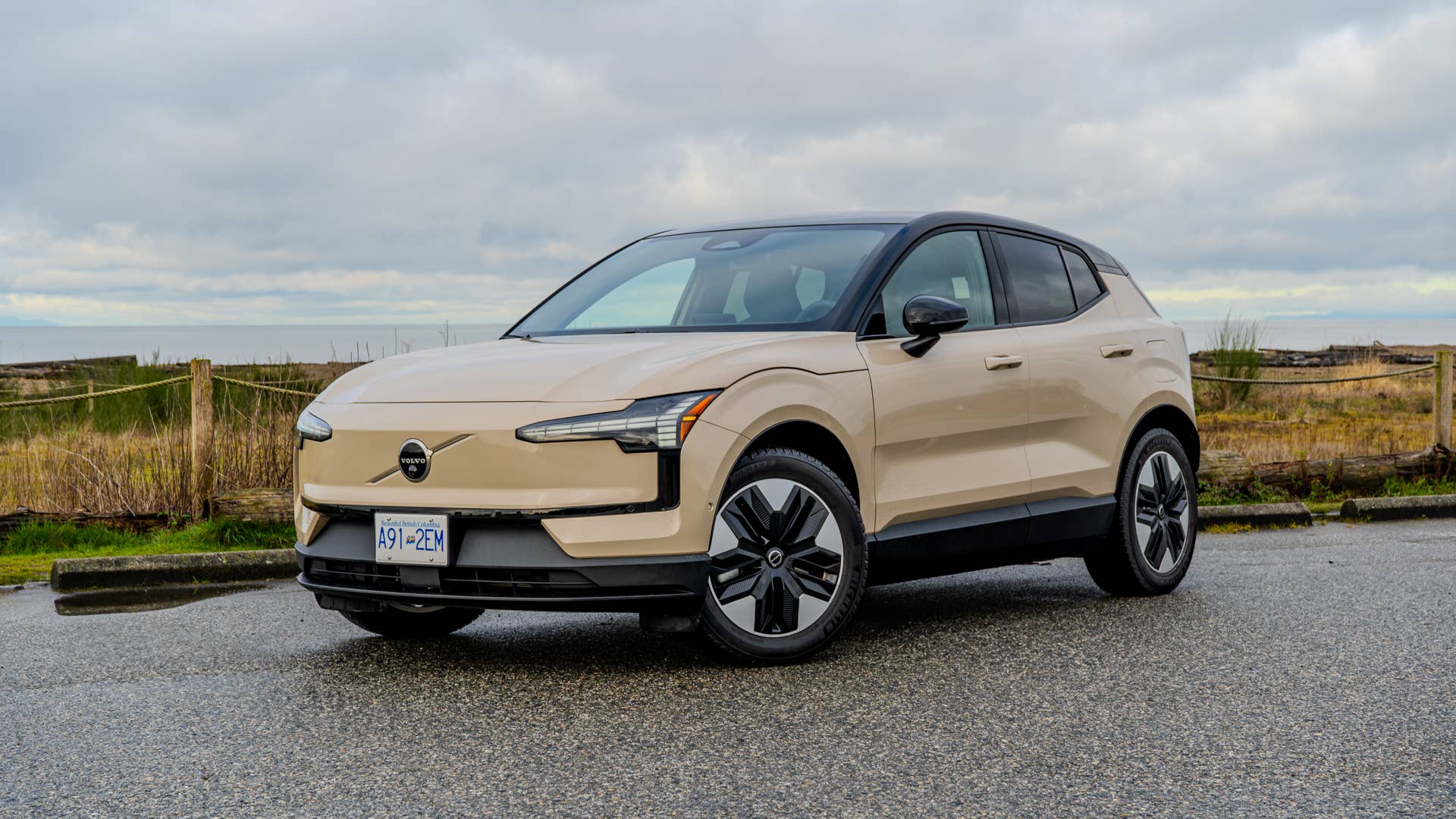
Electrification has created somewhat of an identity crisis for enthusiast cars. For decades, speed had a soundtrack. It had vibration and mechanical drama—a sense that the machine beneath you was working through its own act of controlled violence. EVs have rewritten all of that. They are often quicker than their gas-powered predecessors, yet many feel emotionally disconnected in the process. Which is why the 2026 Volvo EX30 Ultra Twin Motor Performance is such an intriguing little thing. On paper, it sounds like a formula that would never have made it past its first boardroom meeting proposal just ten years ago: a tiny premium crossover from Volvo with 422 horsepower, 400 lb-ft of torque, all-wheel drive, and a claimed 0-100 km/h time of 3.6 seconds, with up to 253 miles of all-electric range.
After spending a week with one in Vancouver, including two winter runs up Cypress Mountain, I came away more charmed than I expected to be. This bite-sized Volvo is playful, quick, comfortable, stylish, and more dynamically sorted than most EVs of its size have any right to be. It is also expensive for what it is, occasionally infuriating in its user interface, and compromised by a range that feels merely acceptable once cold weather, steep terrain, and real life enter the chat. In other words, it is not flawless. It is, however, interesting in a way many small EVs are not.
While the EX30 officially presents itself as Volvo’s smallest electric SUV, from behind the wheel, it feels like something else entirely: a rally-bred enthusiast hot hatch in disguise, wearing the costume of a premium urban crossover. I say that as someone who also writes for Autoblog partner site Road Ethos, where cars that blur emotional and practical boundaries tend to get our attention quickly. The EX30 does exactly that.
Cole Attisha
Powertrain & Driving Dynamics: 8.8/10
This is where the EX30 earns its keep. The Ultra Twin Motor Performance uses a dual-motor all-wheel-drive setup producing 422 horsepower and 400 lb-ft of torque, and Volvo’s quoted 3.6-second run to 100 km/h does not feel remotely inflated. In fact, full-throttle acceleration feels absurd in something this small. The best comparison I kept coming back to was the initial drop of Disneyland’s California Screamin’ (now Incredicoaster): that instant, stomach-repositioning launch that makes your brain briefly lag behind your body. It is a little excessive for the car’s size, yes. But it is also hilarious.
The funny thing is that the EX30’s appeal does not evaporate once the novelty of the thrust wears off. Many EVs feel like they have one party trick and spend the rest of the drive waiting for you to ask for it again. The Volvo is better than that. Its steering is light, but still communicative enough to encourage you. Its short wheelbase makes it eager to tuck into corners. And although it does not feel like a lightweight hot hatch in the traditional sense, it feels lighter on its feet than most EVs, which is really what matters.
That became especially obvious on Cypress Mountain’s Bowl Road. The EX30 was genuinely enjoyable to toss around in corners, with a kind of point-and-shoot energy that reminded me less of a GTI and more of something rally-bred and slightly unhinged. Not in the sense that it felt raw or old-school, but in the sense that it seemed happiest attacking compromised surfaces in bad weather with way more confidence than its cute dimensions would suggest. In my head, it ended up feeling less like a conventional hot hatch and more like a rally-bred electric one: a tiny, overpowered all-weather chaos device disguised as tasteful Scandinavian transport.
Cole Attisha
In the snow, that impression only deepened. One night, I took the EX30 up Cypress in near-blizzard conditions. We passed vehicles that had spun out, others that had slid into ditches, and more than a few drivers in large pickup trucks and SUVs who suddenly looked far less bravado-fuelled than their comparatively huge machines suggested. The little Volvo just kept climbing. It felt planted, composed, and confidence-inspiring, even without dedicated winter drive modes or some exaggerated “off-road” persona—this wasn’t even the “Cross Country” variant. It was still playful without ever being timid.
Ride quality was another pleasant surprise. On Vancouver roads, the EX30 soaked up potholes and bumps more smoothly than I expected, and at highway speeds it remained quiet and comfortable, with minimal road noise. One-pedal driving also proved to be a genuine plus. Lift off the accelerator too abruptly, and the initial deceleration can feel a bit jolting, but once your right foot recalibrates, the system becomes deeply intuitive. With creep mode switched off, I found myself almost never touching the brake pedal. So yes, this is a very fast, small EV. But more importantly, it is a fast, small EV that still knows how to be fun at five-tenths.
Cole Attisha
Exterior Design: 9.1/10
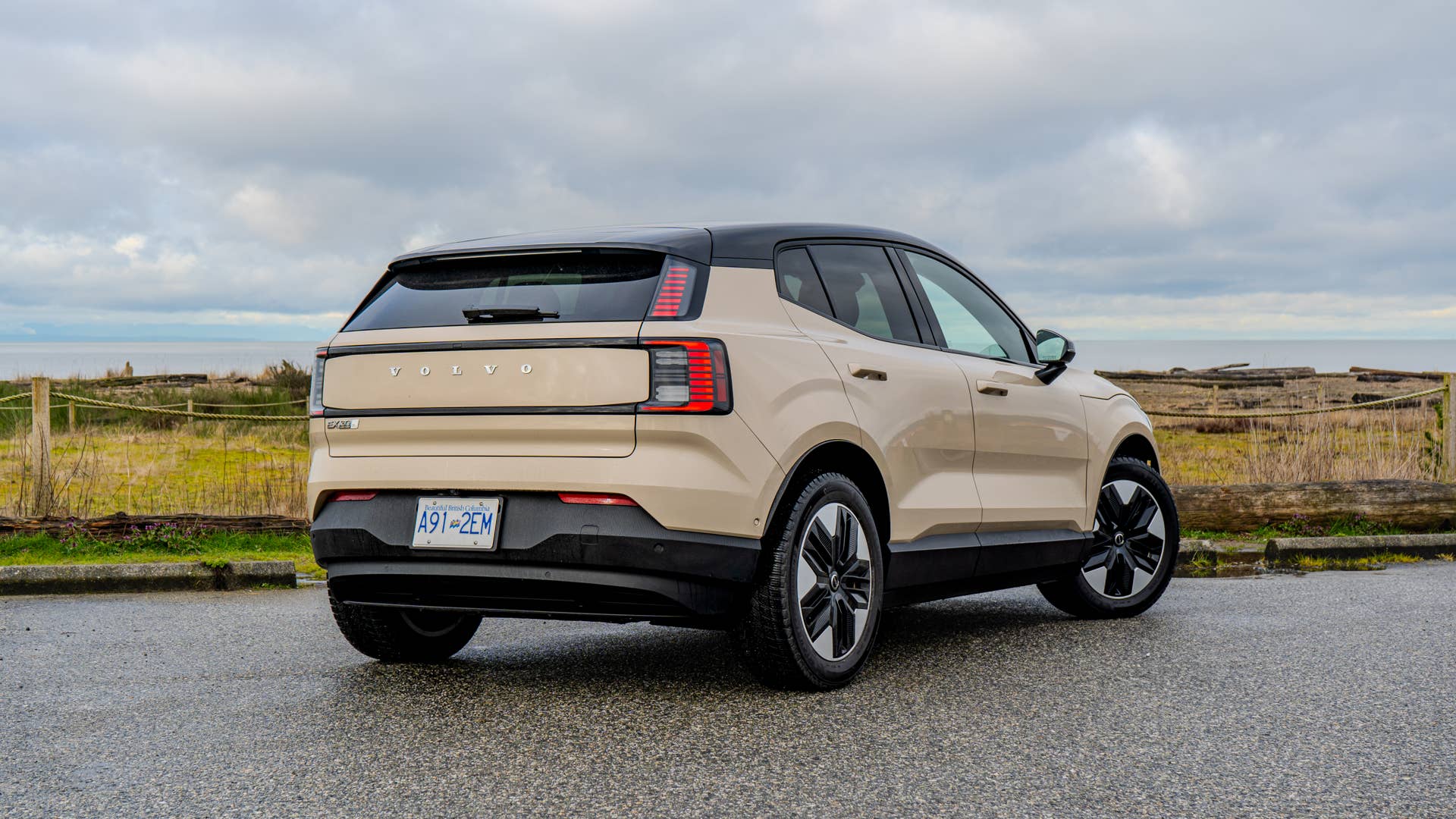
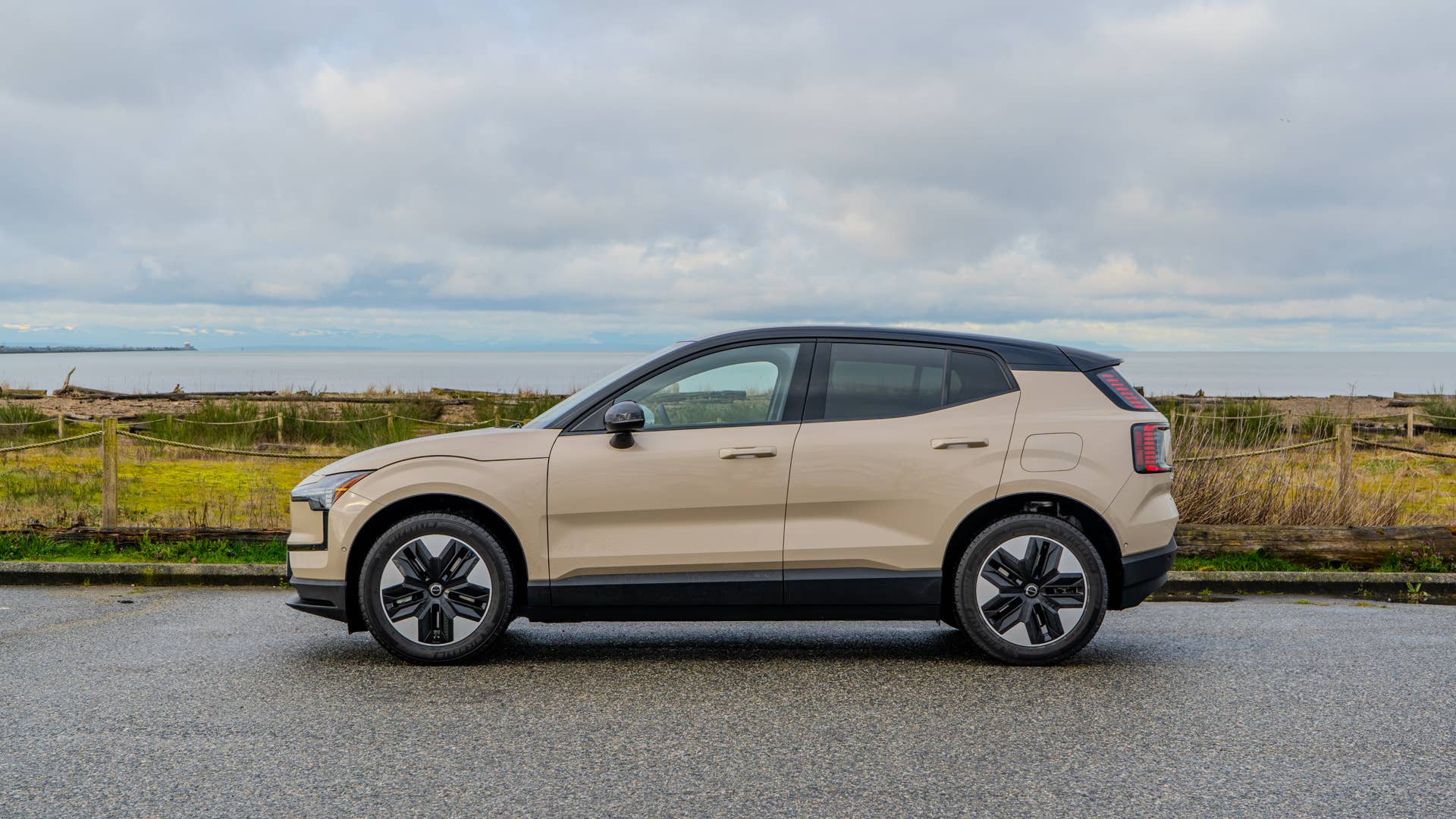
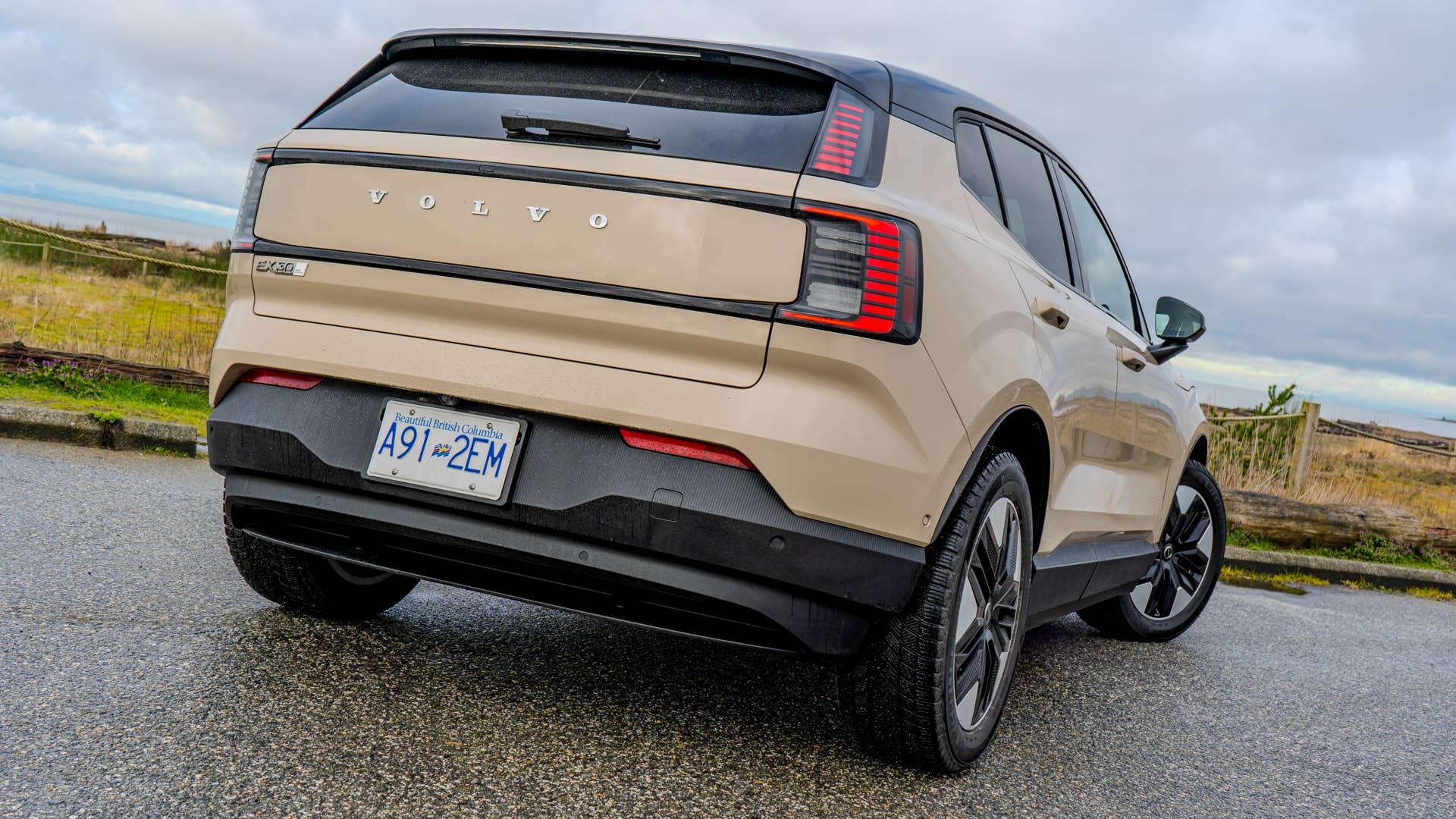
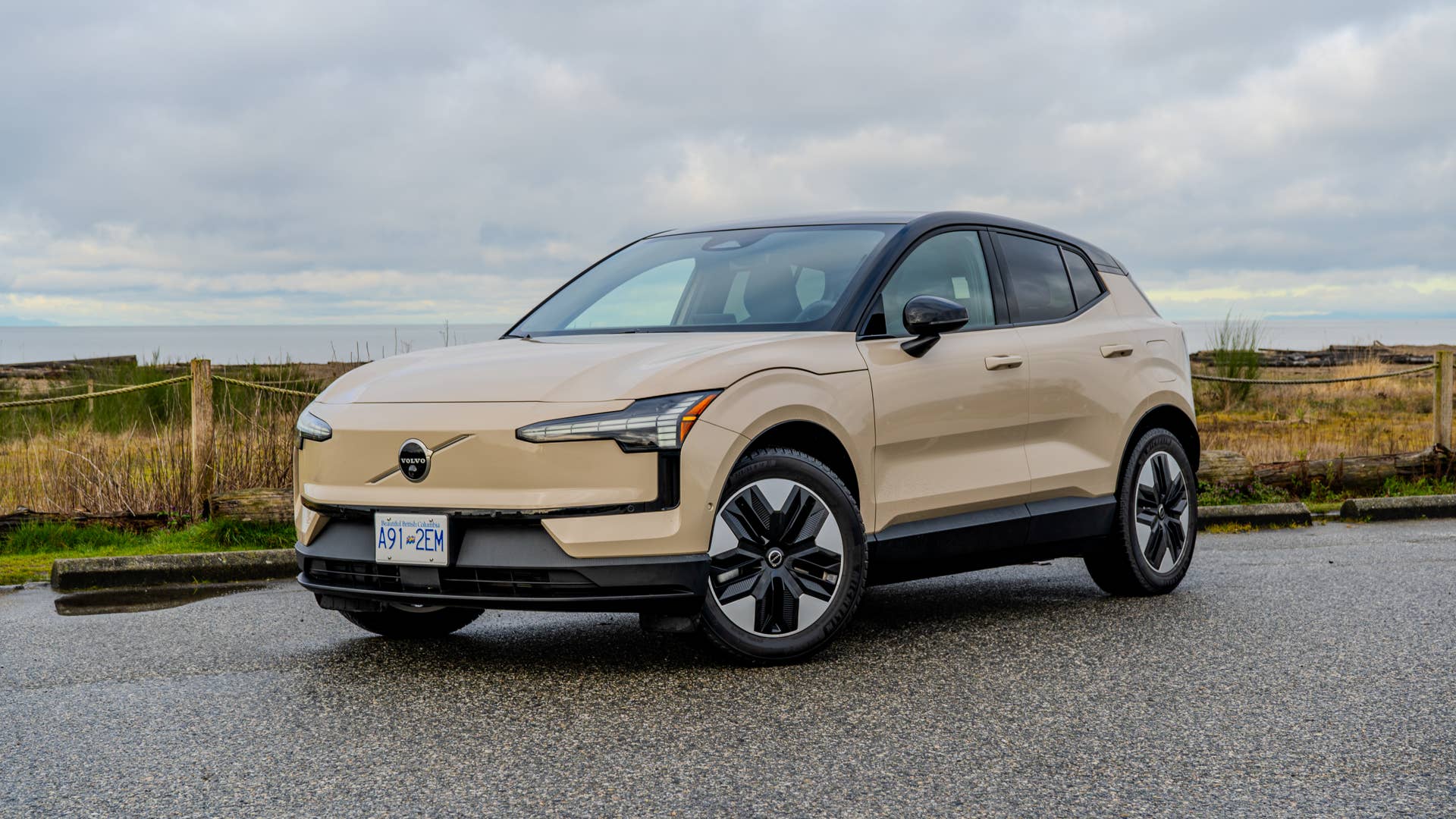
The EX30 is one of the best-looking small EVs on sale right now. Part of that is proportion, and part of it is restraint. What’s obvious is that Volvo resisted the urge to make the car look like too much of a concept sketch or to try too hard to prove it came from the future. The EX30 is modern, certainly, but not self-conscious about it. It looks clean rather than overwrought, intentional rather than theatrical. That offers real value in this segment, where many compact EVs either disappear into appliance anonymity or overcompensate with awkward visual gimmicks.
In Sand Dune, the EX30 looked especially good. That adventure-evocative paint colour gives the car warmth and character without compromising its Scandinavian crispness. Generally speaking, the design strikes a lovely balance between modern Volvo understatement and the quirky charm of the brand’s older compact cars. There is a little C30 spirit in here, not in literal shape, but in attitude. It feels playful and restrained at once. People noticed it, too. Not in a loud, fire-breathing supercar sense, obviously, but in the way a genuinely well-resolved design tends to draw curiosity. It was photogenic from every angle, and I never once looked back at it in a parking lot and thought it lacked presence.
Cole Attisha
Interior Design & Quality: 7.4/10
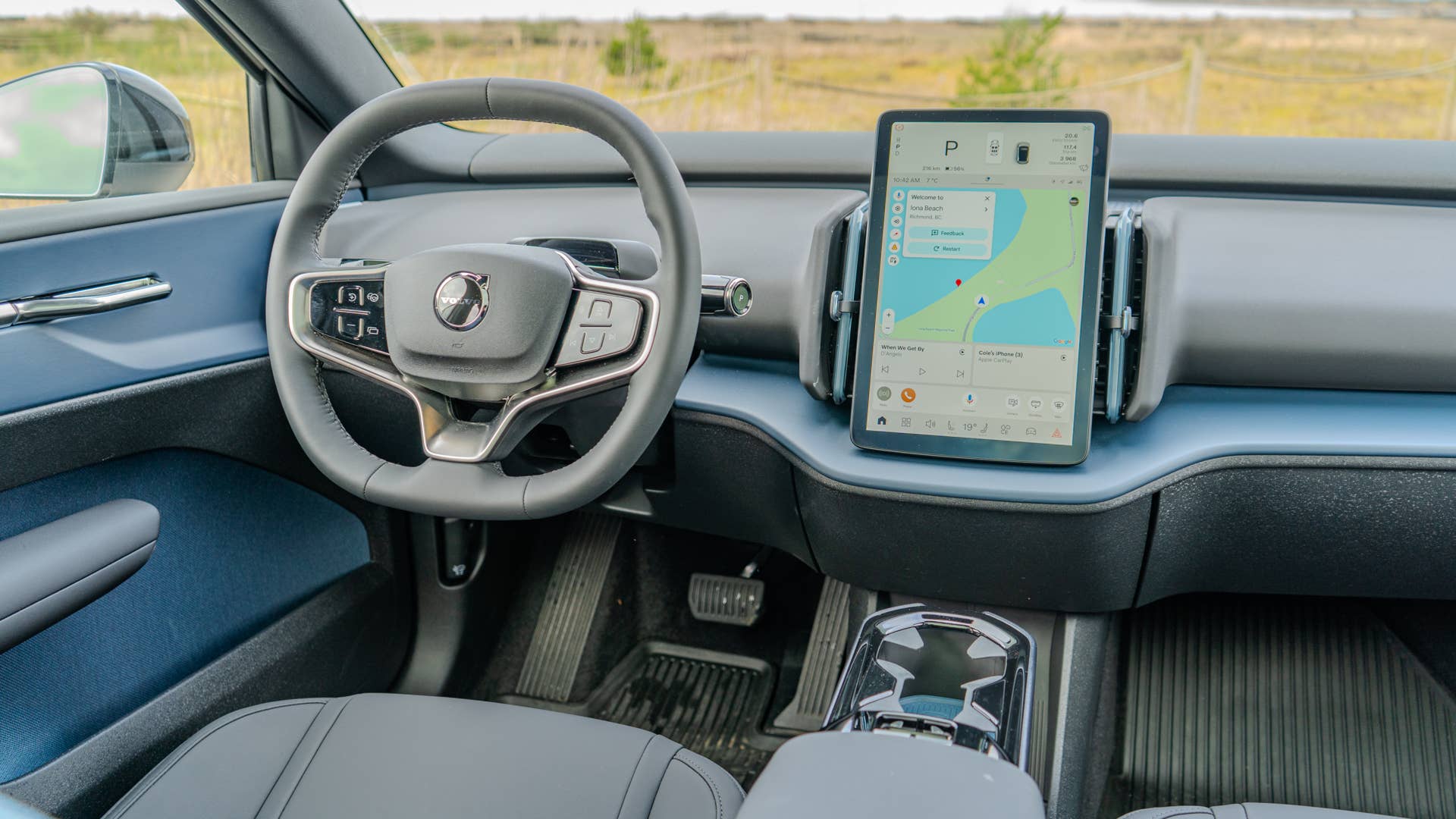
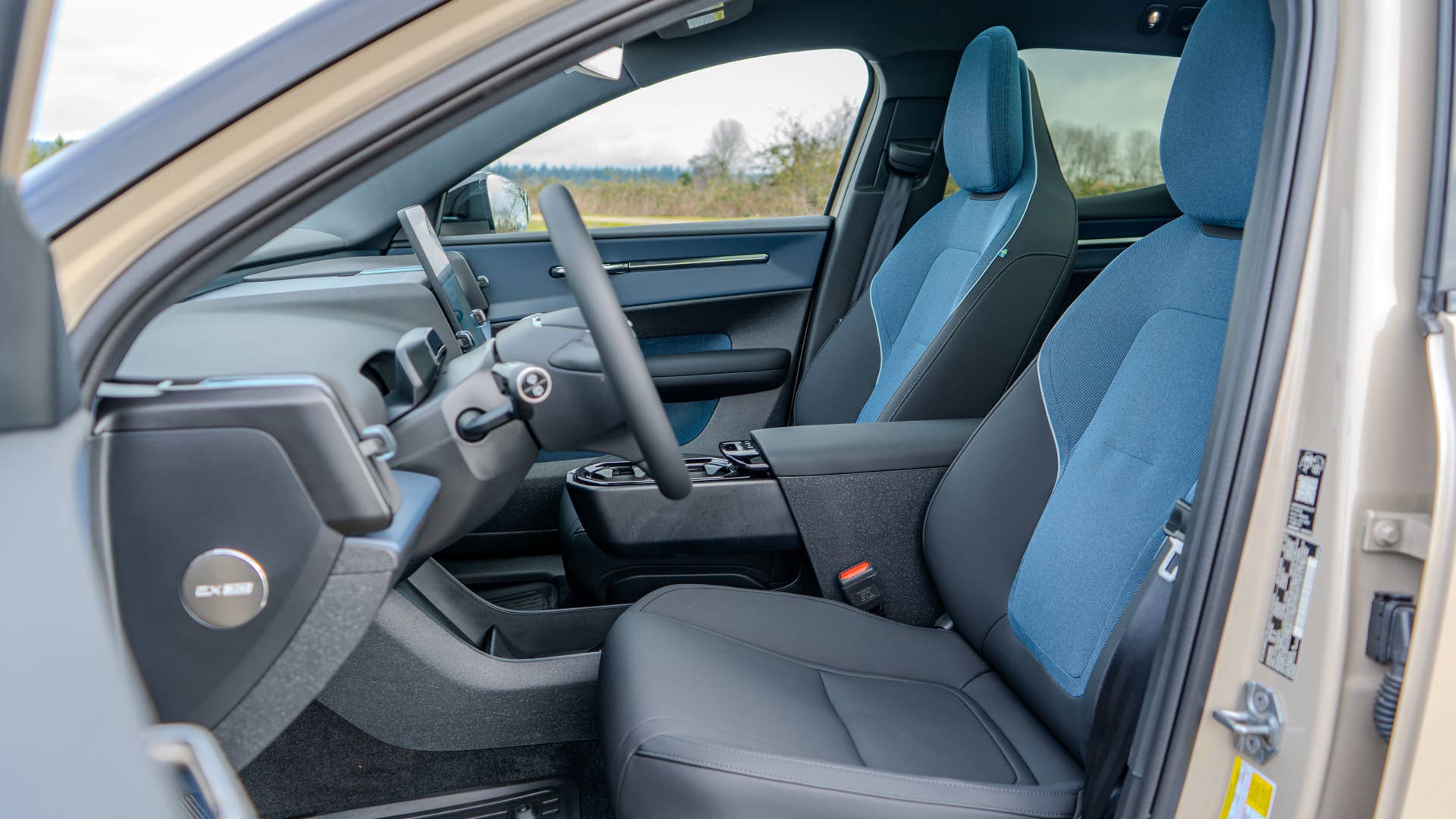
Inside, the EX30 is both one of its biggest strengths and one of its more frustrating contradictions. Visually, I liked it. The Indigo/Nordico interior paired with the Sand Dune exterior gave the car real personality. The two-tone blue accents and varied material choices helped prevent the cabin from feeling sterile, despite its minimalistic cues, and the full glass roof made the interior feel brighter and airier than the exterior dimensions suggest. I only wish that roof opened, even partially.
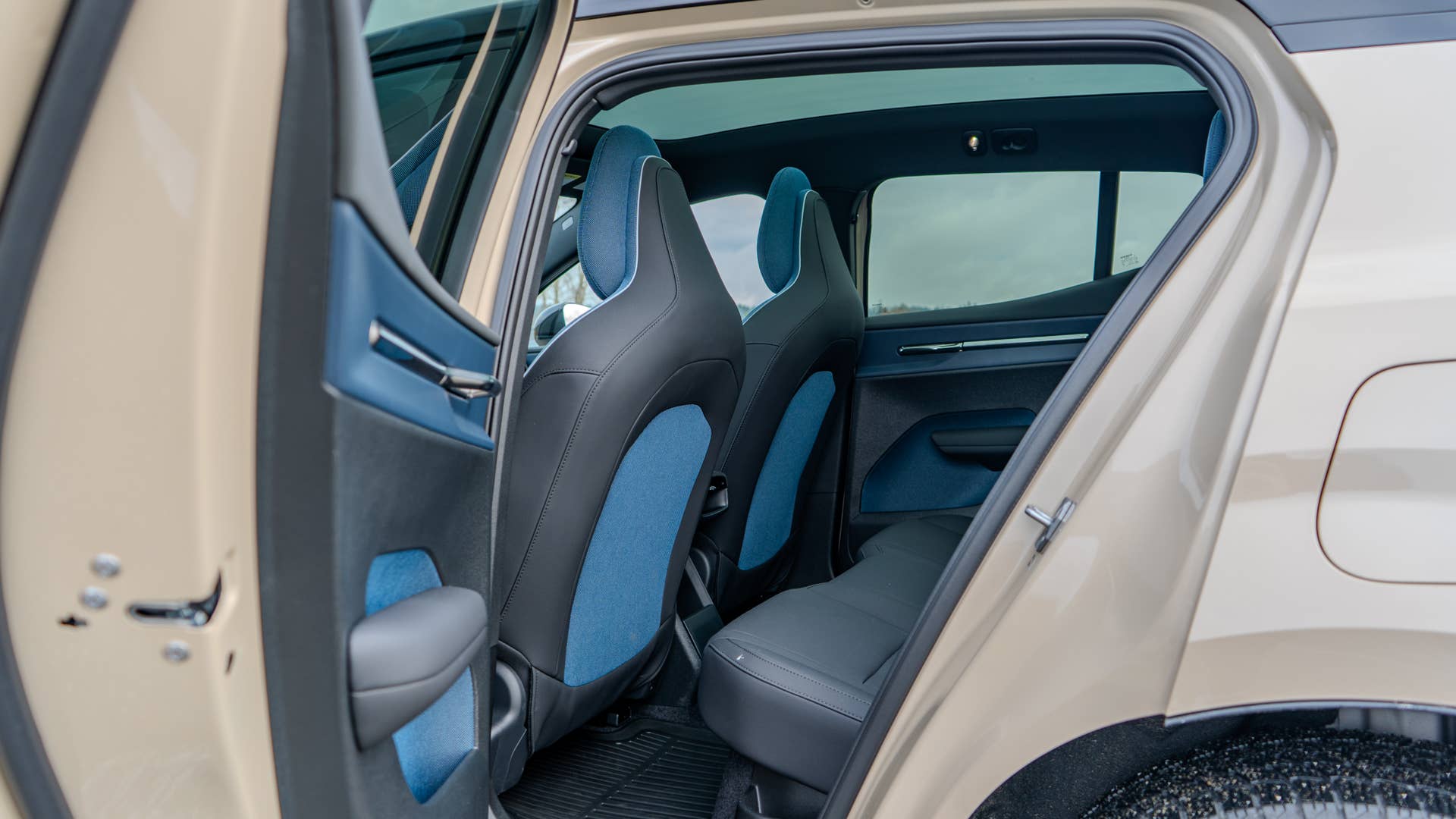
The seats were also excellent. Comfortable, supportive, and easy to settle into over longer drives, they delivered that familiar Volvo sense of everyday ergonomic competence. Passengers were pleasantly surprised, too. Rear-seat comfort was better than expected, and there was more legroom than the EX30’s compact footprint suggests. But then there is the question of material quality.
Cole Attisha
At this price, the cabin does not consistently feel as premium as it should. Some trim and surfacing choices are clever and attractive, but I also noticed bubbling on leather surfaces in the door panels (look closely enough at the photos and you’ll see it, too), which is not the sort of detail you want to see in a car pitching itself as a premium object. It undercuts the mood. So does the all-screen control philosophy, which I’ll complain about more in the tech section, but also deserves mention here because it directly affects the cabin’s lived experience.
Still, I would not call the EX30’s interior a failure. Far from it. It is a nice place to spend time. It feels distinctive, and it has real atmosphere. And unlike some minimalist cabins, it does not come across as empty or cold in an attempt to look expensive. It sometimes just feels like Volvo spent more time thinking about visual elegance than about tactile common sense.
Cole Attisha
Technology: 7.2/10
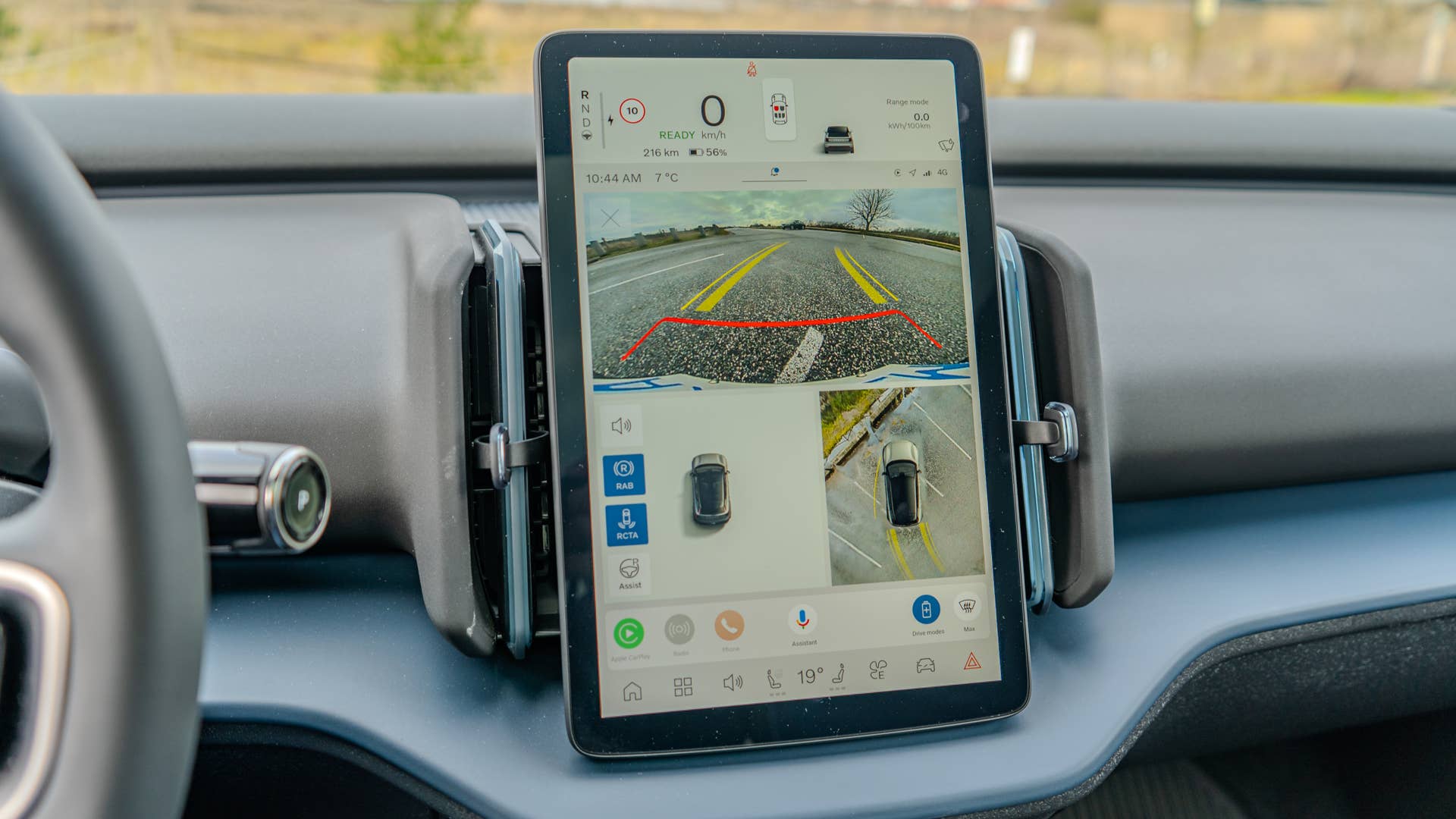
The EX30 is one of those cars that can make you admire a tech philosophy and still occasionally want to turn that philosophy into an electrical fire. On the positive side, Volvo’s central 12.3-inch display works far better here than it has in some of the brand’s larger products I have tested. The interface felt responsive and modern during my week with the car, and wireless Apple CarPlay worked properly. Google built-in is standard, and the EX30 also offers a respectable list of convenience and safety tech, including a 360-degree camera, Park Pilot Assist, and Harman Kardon audio, depending on spec.
The problem is not whether the screen works. The problem is how much of the car Volvo decided to bury inside it. Mirror adjustment in menus is where my patience began to fray. Volume control and other basic tasks are also more screen-dependent than they should be. Then there are the window switches. You get two main toggles and a separate control to switch them to the rear windows, which sounds clever in the abstract and mildly ridiculous in the real world. It is a layer of complication added to a task that should be seamless, especially while driving. This is the kind of minimalist thinking that looks tidy in a design presentation, but is far less charming when you are parked on the side of the road, digging through submenus just to angle a mirror correctly.
Cole Attisha
The EX30’s driver-monitoring system was another annoyance. It is one thing for a car to keep an eye on you. It is another for it to become a hyper-vigilant Scandinavian hall monitor. It felt like learning to drive with my dad in the passenger seat, screaming “control your speed!” even when I was going 10 miles per hour under the limit. If I drove one-handed for too long, it would complain. If I yawned, it would suggest a break. If I looked sideways through a corner, it was sometimes interpreted as inattentiveness. The rest of the safety suite was mostly unobtrusive, but that one system could get irritating quickly.
So the EX30’s tech is not bad. Far from it. It is quick, clean, and usable. But it also overcomplicates things that did not need to be solved, and in a car with such a playful dynamic character, that mismatch becomes harder to ignore.
Cole Attisha
Pricing & Value: 7.2/10
As tested, this Sand Dune 2026 Volvo EX30 Ultra Twin Motor Performance, equipped with the optional Protection Package ($850 CAD), came in at $62,950 CAD (just shy of $46,000 USD). In the U.S. market, a base EX30—the rear-driven ‘Plus’ model—starts at $42,548, and the Ultra Twin Motor Performance comes in at $50,248. It is strategically aimed at the Hyundai Ioniq 5, Tesla Model Y, Kia Niro EV, and MINI Countryman SE. The EX30 made more sense to me once I compared it with rivals, but it still didn’t feel like tremendous value for what it is. In the U.S., the 2026 EX30 Twin Motor Performance is rated at up to 253 miles of EPA range and produces 422 horsepower, giving it a very real performance advantage over most similarly priced mainstream EV crossovers, but not a major advantage in battery range. Volvo positions it as a compact premium EV with serious pace, and on that front, it absolutely delivers.
The 2026 Hyundai Ioniq 5 lineup starts at $41,000 for the SE AWD and $45,075 for the Limited AWD, with AWD models making 320 horsepower and offering up to 290 miles of EPA range on SE/SEL AWD trims and 269 miles on the Limited AWD. In other words, the EX30 gives you a pretty major bump in acceleration and power without completely falling off a cliff in terms of range, even if the Hyundai still offers more space and a slightly better value-for-money case. Tesla’s Model Y offers a compelling value comparison, too. As of early 2026, the U.S. lineup starts at $41,990 for the AWD, $48,990 for the Premium AWD (most directly comparable to the EX30 Ultra Twin Motor Performance), and $57,490 for the Performance AWD. Although the EX30 T-M-P outperforms the Model Y Premium AWD on the road and offers far more emotional character, there’s no escaping the fact that the Tesla offers significantly more battery range, with an EPA-estimated 327 miles.
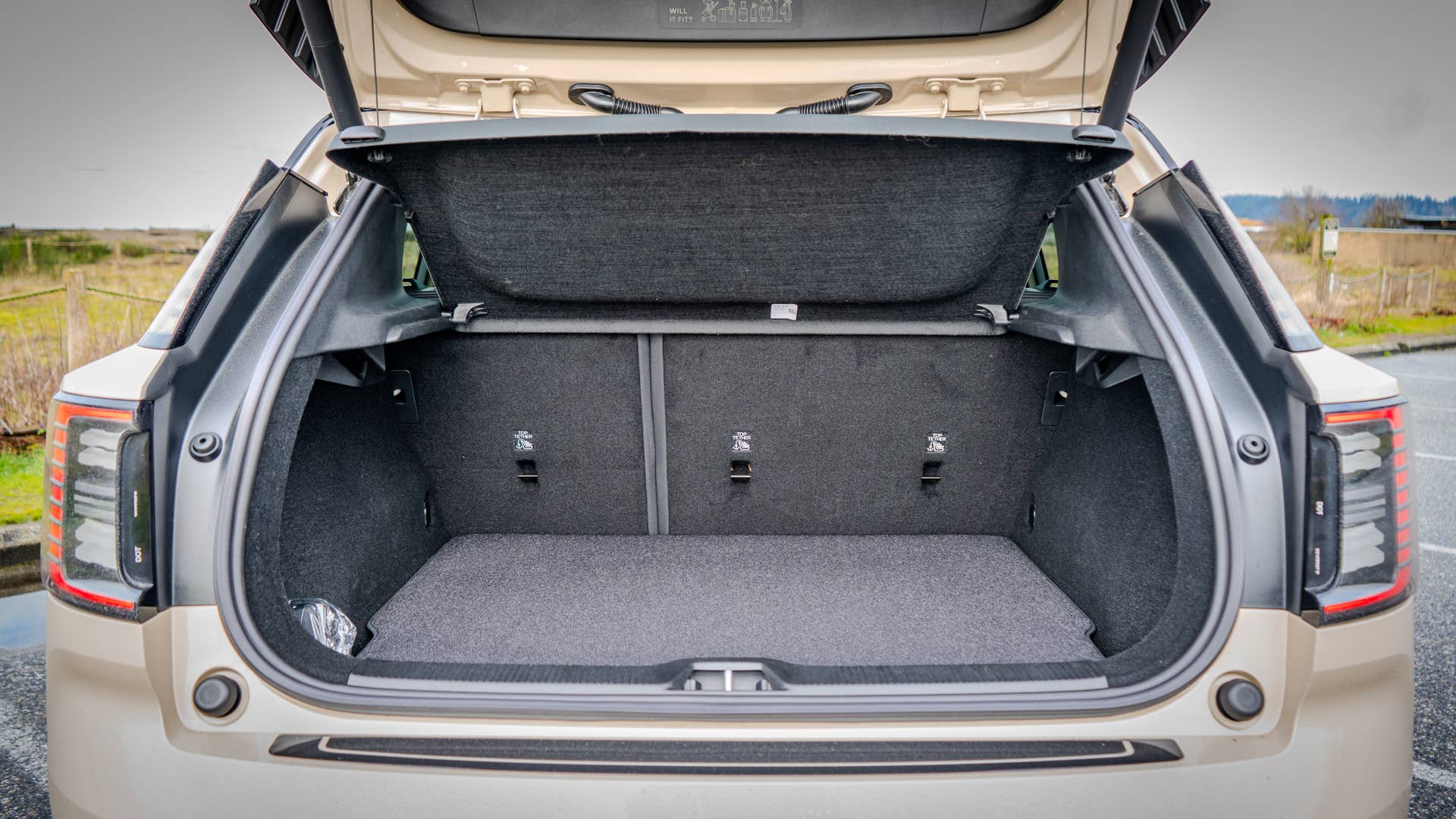
The biggest caveat here is that the Volvo is also notably smaller than its popular rivals. At 166.7 inches long, it is over a foot shorter than the 183.3-inch Ioniq 5 and roughly 22 inches shorter than the Model Y. That makes it more city-friendly, easier to place on narrow streets, and more in line with the kind of compact, tossable character that defines the car’s appeal in the first place, but sacrifices notable cabin and cargo space to do so.
So I wouldn’t go so far as to call the EX30 bad value—that feels unfair and even untrue. But I would call it slightly expensive for what it is. In Ultra Twin Motor Performance form (a mouthful, I know), it earns much of its price through style, personality, and ravenous pace. It’s just not quite the sort of value proposition I can defend without at least adding an asterisk. In the end, the EX30’s value depends on whether your priorities align with the car’s. If you care most about maximum range per dollar or outright cabin space, there are stronger choices. But if you want a compact premium EV that feels quick, playful, and unusually full of character, the EX30 still makes a case for itself.
Cole Attisha
Final Verdict: 8.0/10
The 2026 Volvo EX30 Ultra Twin Motor Performance is a car that, on paper, perhaps should not work as well as it does in practice. It is too quick for its own good, too expensive for its size, too reliant on a central screen for basic controls, and not quite robust enough in range to feel carefree in colder, hillier environments. Yet after a week behind the wheel, it still left me more smitten than skeptical. I almost did not want to give it back. And that, in the end, is the strongest compliment I can give it.
Because the EX30 is not great in the usual spreadsheet sense. It is great in a more dangerous sense. It got under my skin. It did that with style, with charm, with an unexpectedly sorted chassis, and with a kind of compact, all-weather mischief that makes it feel more alive than a lot of EVs twice as serious-looking. The more time I spent with it, the more I understood why owners of these things are already accessorizing them with roof racks, rally lights, turbofan-inspired wheels, and other little hints that they see what I saw in it, too. It is a premium small crossover, yes. But it is also an enthusiast EV in disguise.
As someone who also writes for Road Ethos, I found that most compelling about it. Not that it perfectly recreates the old hot-hatch formula, but that it channels some of the same spirit through an entirely different set of tools. It is proof that fun does not have to disappear just because the soundtrack has. The 2026 Volvo EX30 Ultra Twin Motor Performance ultimately feels like a car of contradictions: rational enough to function as a daily urban tool, irrational enough to make you smile on a snowy mountain road, stylish enough to turn heads, but it makes enough compromises to deter more logical buyers.
It is perhaps best for single urban professionals, young couples, design-conscious downsizers, and existing Volvo buyers who want something compact, quirky, practical, and unexpectedly entertaining. Buyers who prioritize maximum range, outright cabin luxury, or cold-blooded value for money will likely find stronger alternatives elsewhere.
Cole Attisha
An unfortunate loss, in the end
There is also now a slightly bittersweet footnote hanging over the whole thing. Autoblog reported this week that Volvo will discontinue the EX30 and EX30 Cross Country in the United States after the 2026 model year, while keeping the model on sale in Canada and Mexico. The reported reasons center on shifting market conditions, financial pressures, and the impact of U.S. import tariffs on the Belgian-built EX30. I cannot say I am surprised. A small, stylish, unusually fast EV with limited real-world range and a price tag that pushes buyers toward larger, more premium alternatives was always going to be a difficult sell in America. But having spent a week with one, I am still a little sad about it. Cars this quirky, this well-resolved, and this unexpectedly entertaining do not come around all that often.
About the author

Cole Attisha
Staff Writer, Autoblog