

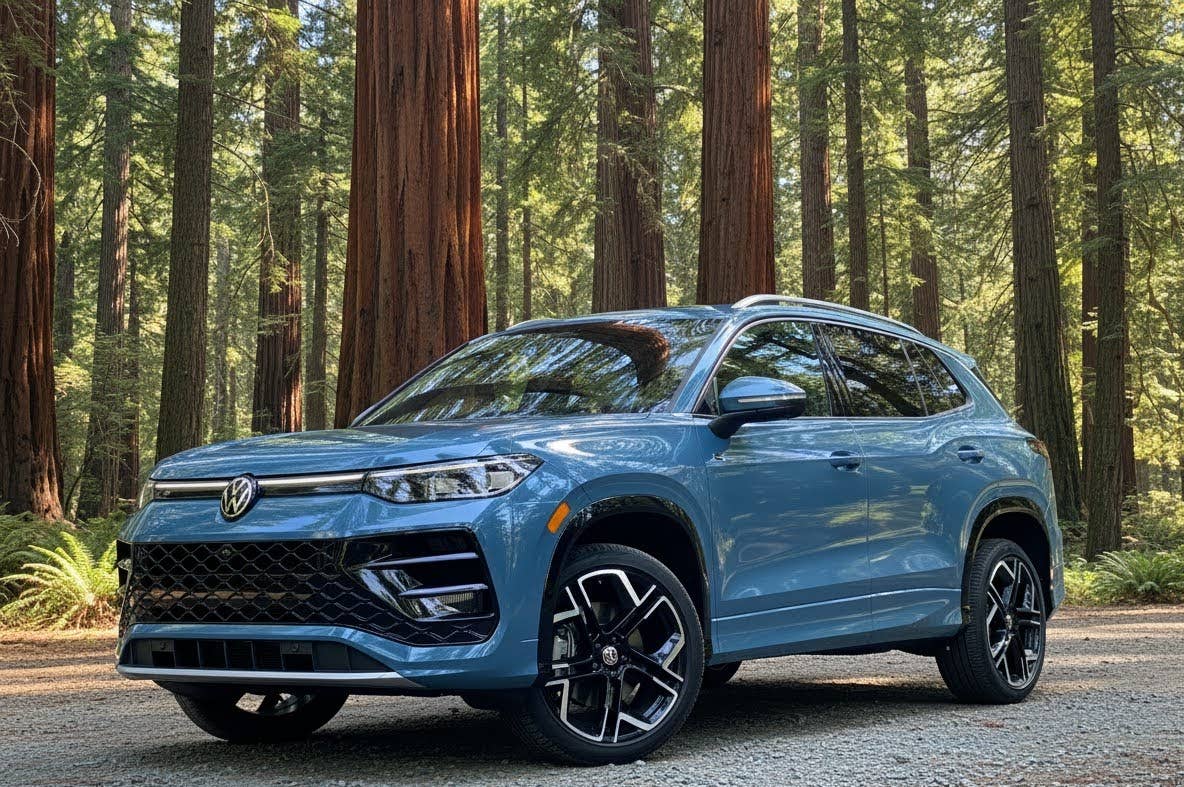
The perfect mix of mainstream and premium
After driving the 2026 Volkswagen Tiguan SEL R-Line Turbo in and around Ann Arbor, Michigan, I can confidently say that it easily stands out from its competition with a defined set of features that they could only hope to touch. Not only does it boast more power, but it also rises above the competition in terms of luxury, technology, and driver-assist features. It offers so many unique features that it starts to blur the line between mainstream and premium. Let me tell you all about it.

Class-leading power
The SEL R-Line Turbo model is new this year and sits at the top of the Tiguan lineup. The additional power is this model’s calling card, and it’s responsible for the Turbo in the Tiguan SEL R-Line Turbo name, even though other Tiguans are also turbocharged. Like those models, it draws its power from the familiar EA888 2.0-liter turbocharged four-cylinder engine, but this fifth evolution of the powerplant ups the output to 268 horsepower and 258 pound-feet of torque. That bests the base engine in 4Motion all-wheel drive Tiguans by 61 horsepower and 37 lb-ft of torque (or 51 lb-ft more than front-drive Tiguans).
The extra power comes from a larger turbocharger with more boost pressure and a lower 10.5:1 compression ratio. The engine also gets stronger pistons and connecting rods, a nitride-hardened crankshaft, oil cooling for the pistons, and variable valve lift on both the intake and exhaust sides. For better fuel economy, it runs on the Miller cycle, and EPA fuel economy comes in at 22 mpg city, 29 highway, and 25 combined, the same combined number as the lower-power version of the same engine.

The Tiguan Turbo’s power output puts it in the realm of the premium-class Acura RDX, which makes 272 hp and 280 lb-ft of torque. The closest mainstream competitor is the Mazda CX-5 Turbo, which makes 227 hp and 310 lb-ft of torque on premium gas or 256 hp and 320 lb-ft on regular fuel. The Tiguan’s numbers are on regular gas, though.
On the road, the extra power helps the Tiguan Turbo get off the line quicker and provide more passing punch, but it doesn’t pack the wallop you get with better 2.0-liter turbocharged four-cylinders from BMW and Mercedes. Volkswagen quotes a 0-60 mph time of 7.0 seconds, and that feels about right. It’s a little more than a second quicker than the base engine and is considerably quicker than all mainstream rivals except the CX-5 Turbo, which Car and Driver launched from 0-60 mph in 6.2 seconds.
The Tiguan Turbo’s power flows through an eight-speed automatic transmission to all four wheels via VW’s 4Motion all-wheel-drive system that favors front-wheel drive but can send half the power to the rear wheels when needed. The transmission is generally smooth, but it shifts up too quickly to make power readily accessible in traffic. A Sport mode for the transmission, accessed by twisting the column-mounted shifter forward, changes that, but even then the engine isn’t always in the meat of its power band.
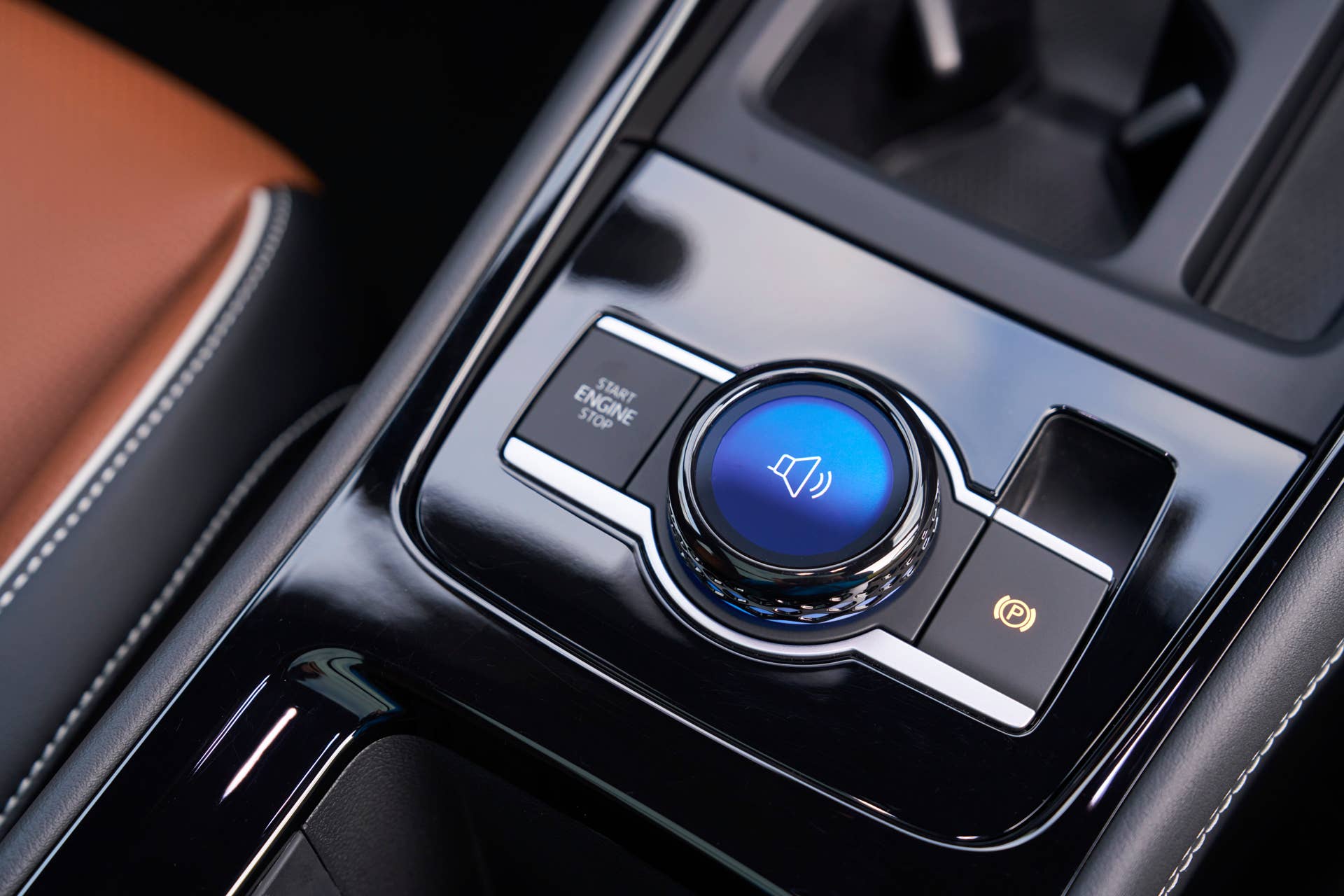
Drivers can also choose a Sport drive mode through the so-called Driving Experience Dial on the center console. It’s a single dial that acts as a volume knob, a drive mode selector, and a controller for the Tiguan’s Atmospheres function (more on that later).
Press down on the dial to switch it out of volume control, then swipe the top to choose between the Drive Mode Select and Atmospheres functions. Drive modes include Normal, Sport, Eco, and a programmable Individual mode, and they all adjust the throttle response, steering weight, adaptive cruise control, and climate control settings. Additional modes for all-wheel-drive versions like the Turbo include Snow, Offroad, and Custom Offroad. Hill Descent Assist and Hill Start Assist come standard with all-wheel drive, but the Tiguan Turbo’s 255/40R20 all-season tires and modest 7.0 inches of ground clearance mean it’s not much of an off-roader.
Nothing in the drive modes adjusts the handling, as the Tiguan Turbo does not offer adaptive dampers, but it doesn’t need them. Every Tiguan has controlled handling with direct steering and a ride that borders on firm. It’s a sportier overall feel than you get in anything but a Mazda, and it also helps set the Tiguan apart from its Honda CR-V and Toyota RAV4 rivals.
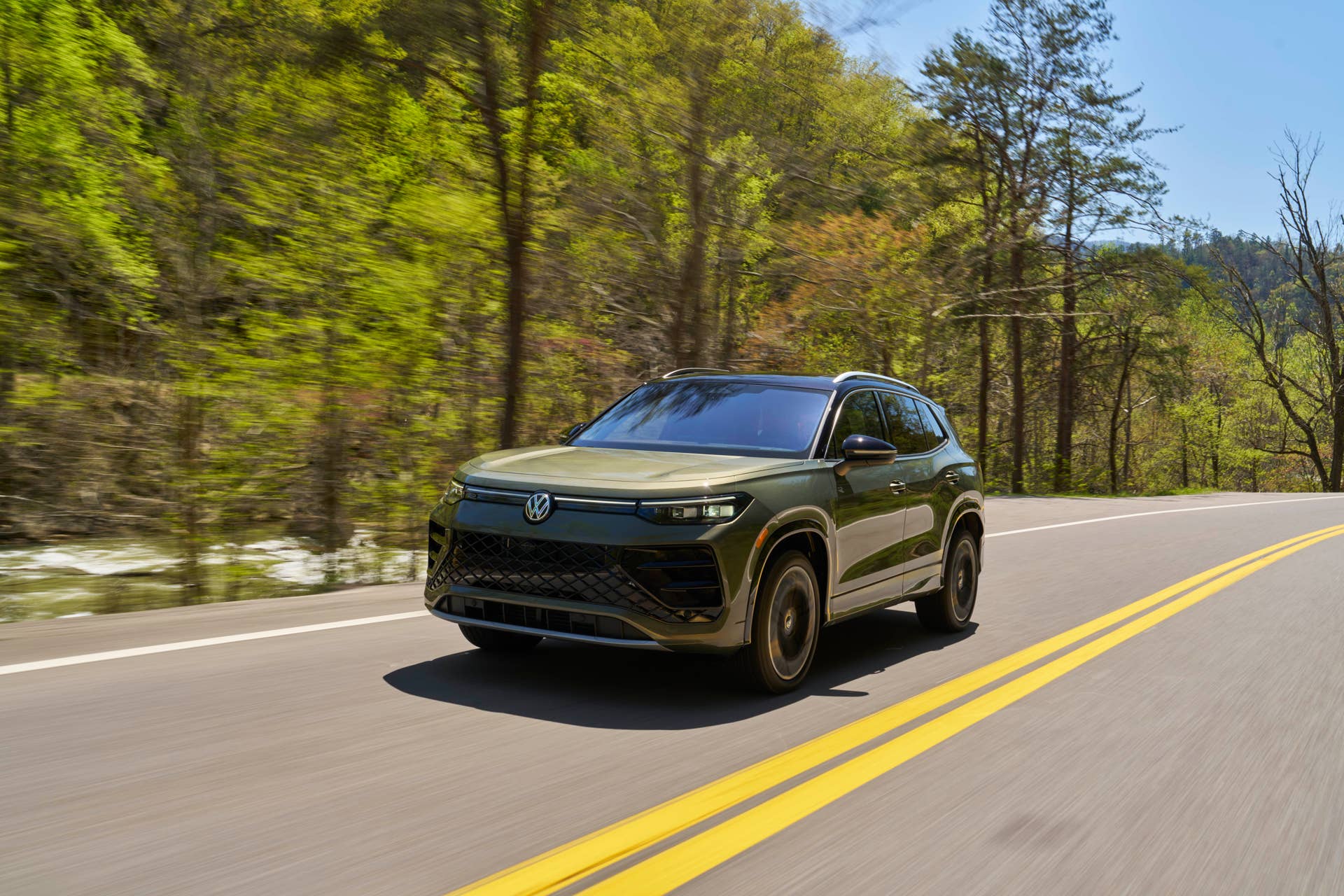
The only change VW makes to the Turbo model’s dynamics won’t ever be felt. Rather than the standard rear brakes, VW fits the Turbo with the larger 12.2-inch vented rotors from the sporty VW GTI hatchback in place of 11.8-inch solid rotors. It makes no difference to the driver, though, as the Tiguan Turbo has a natural brake feel with a progressive pedal, but not the strong braking power of a crossover tuned for canyon carving.
Upscale and tech-rich cabin
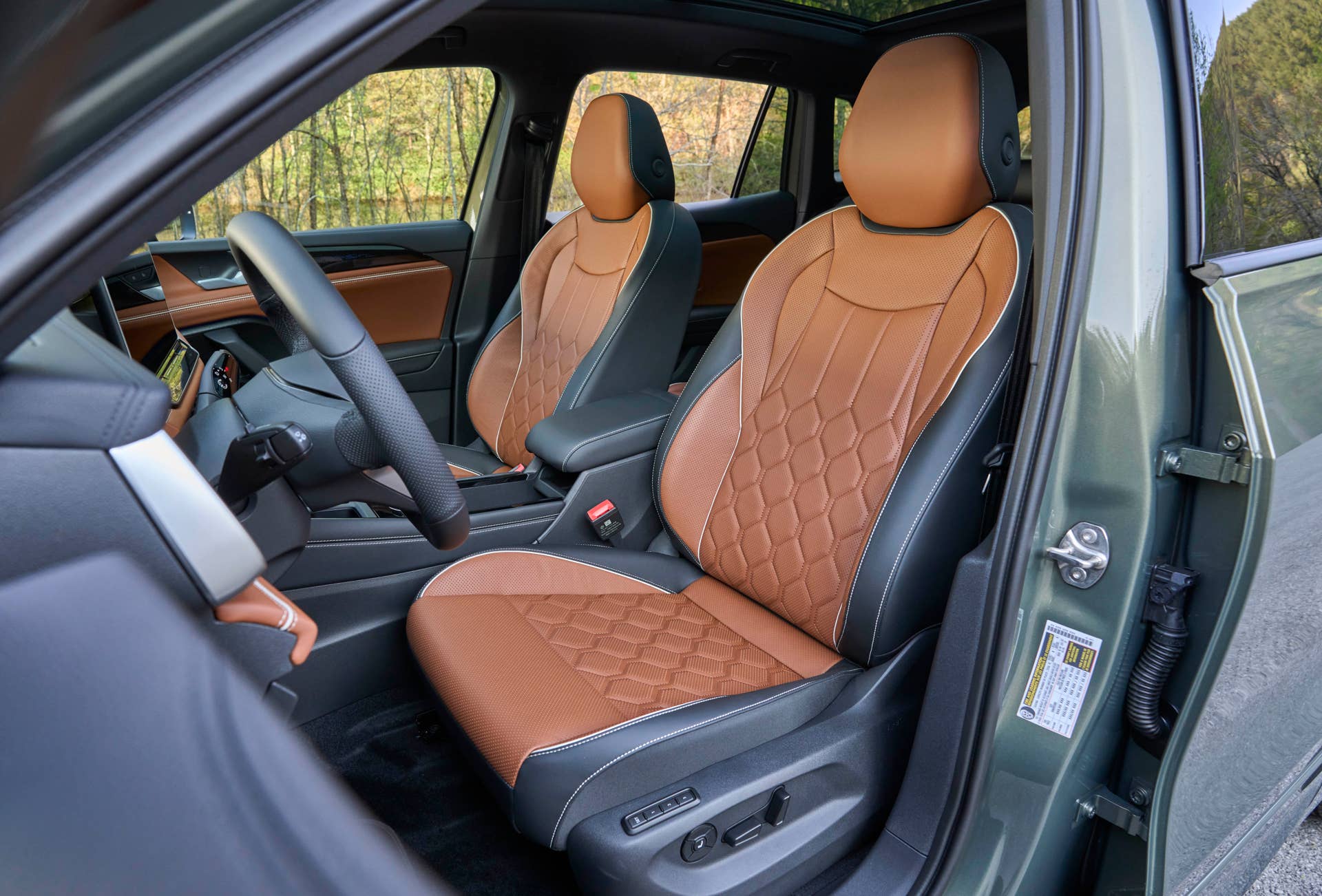
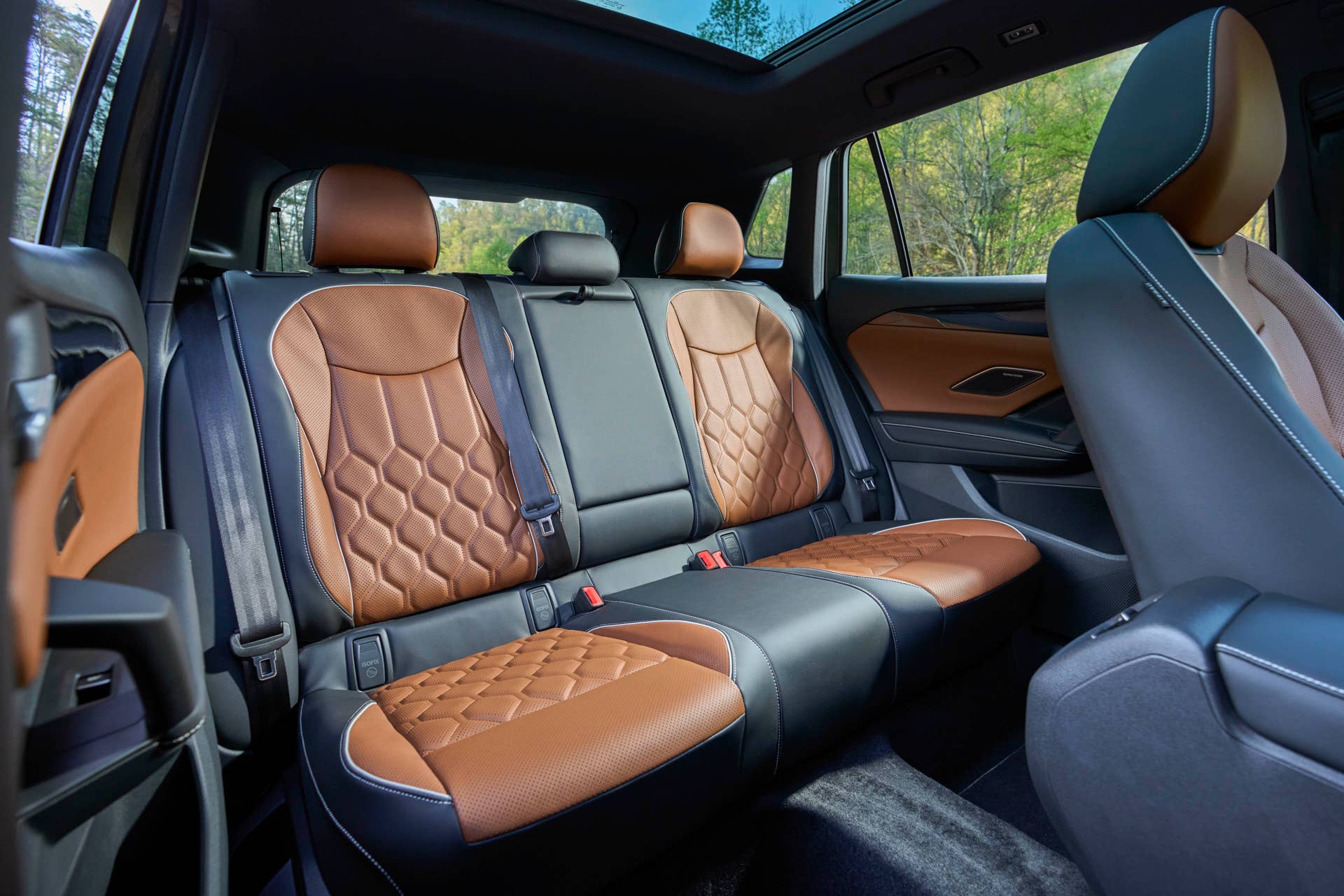
The Tiguan Turbo’s cabin takes on an upscale look thanks to premium materials and top-notch technology. It upgrades to quilted Varenna leather upholstery, a padded double-stitched center console, and American walnut dash trim, all of which provide a luxury feel uncommon for the class. Additional comfort features include a sound-insulating windshield, three-zone automatic climate control, front seat memory, four-way lumbar adjustments for the eight-way power-adjustable front seats, front seat back massagers, and heated outboard rear seats. The massagers, especially, are not expected for a mainstream crossover.
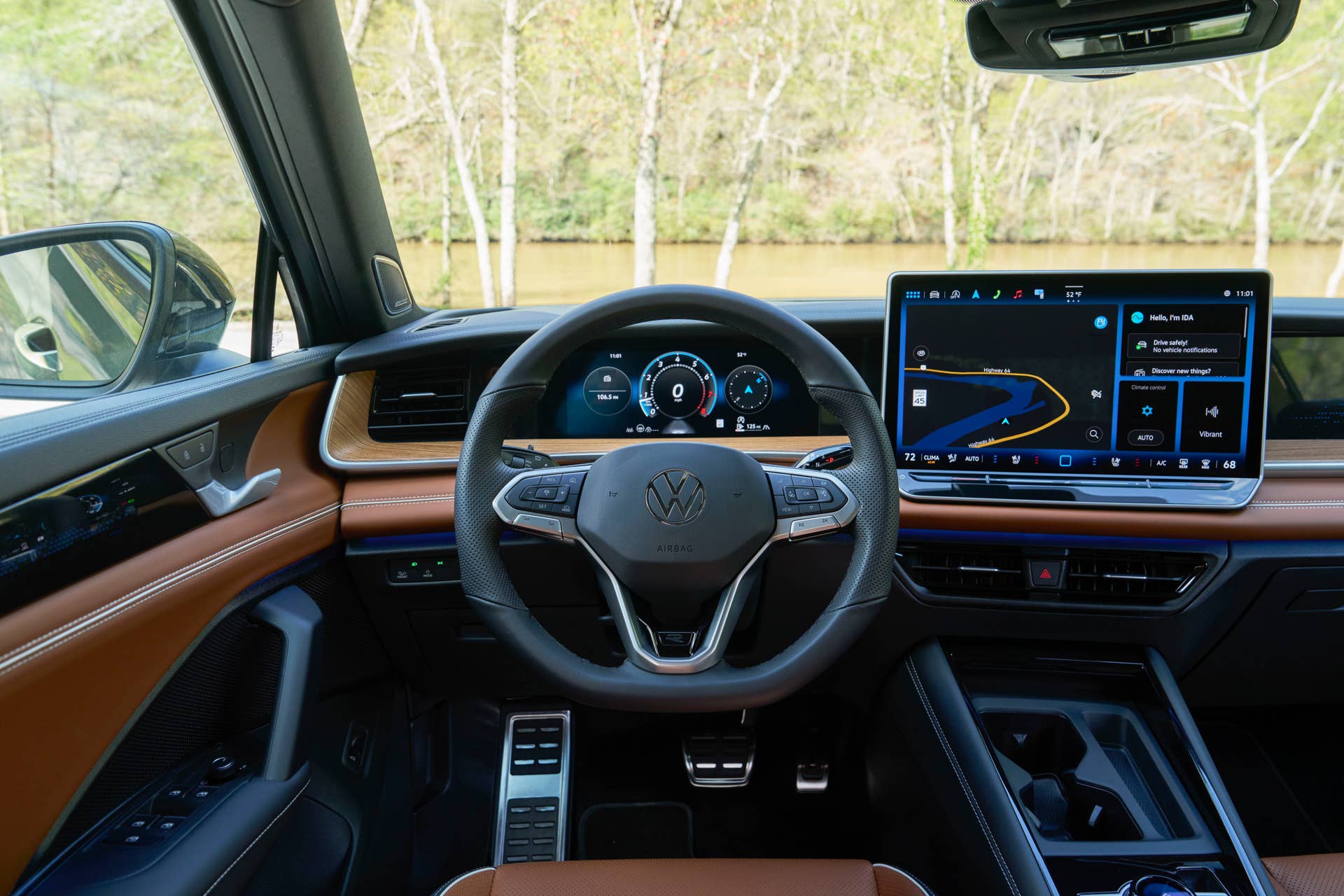
Technology and entertainment features that other Tiguans wish they had include a massive 15.0-inch infotainment touchscreen and a 700-watt Harman Kardon 12-speaker audio system. The touchscreen is even bigger than the already large 12.9-inch screen in other Tiguans. It reacts quickly to driver inputs, comes with wireless Apple CarPlay and Android Auto, and offers Plus Speech with AI, a generative AI-enabled voice assistant that requires a subscription after a one-year trial. The big touchscreen teams with a 10.25-inch Digital Cockpit Pro screen that’s standard in all Tiguans. Cockpit Pro can be customized with numerous viewing options, including full-screen navigation, driving data, phone information, and driver-assist features.
The Turbo also gets 30-color ambient lighting, up from 10 colors in other models, as part of the Atmospheres feature, which adjusts the lighting color, the audio and equalizer presets, and the instrument cluster color and layout. Themes include Lounge, Joy, Nature, Energetic, Minimal, and a programmable custom setting. Atmospheres is a nice little party trick, and drivers might enjoy the color changes, but it’s not as effective as a means of relaxation as the Mercedes-Benz Energizing Comfort system that also incorporates seat massagers, audio tracks, scent, and climate control.
VW also adds automatic parking, traffic sign recognition, and a surround-view camera system to the Tiguan Turbo, all of which join an already generous list of driver-assist features that includes automatic emergency braking with pedestrian detection, blind-spot monitors with steering assist, rear cross-traffic alerts, adaptive cruise control with stop and go, lane-keep assist, front and rear parking sensors, an exit warning system, and automatic high beams. The Tiguan even has Travel Assist, a Level 2 semi-autonomous driving system that requires hands on the wheel and can perform lane changes when the driver signals for them.
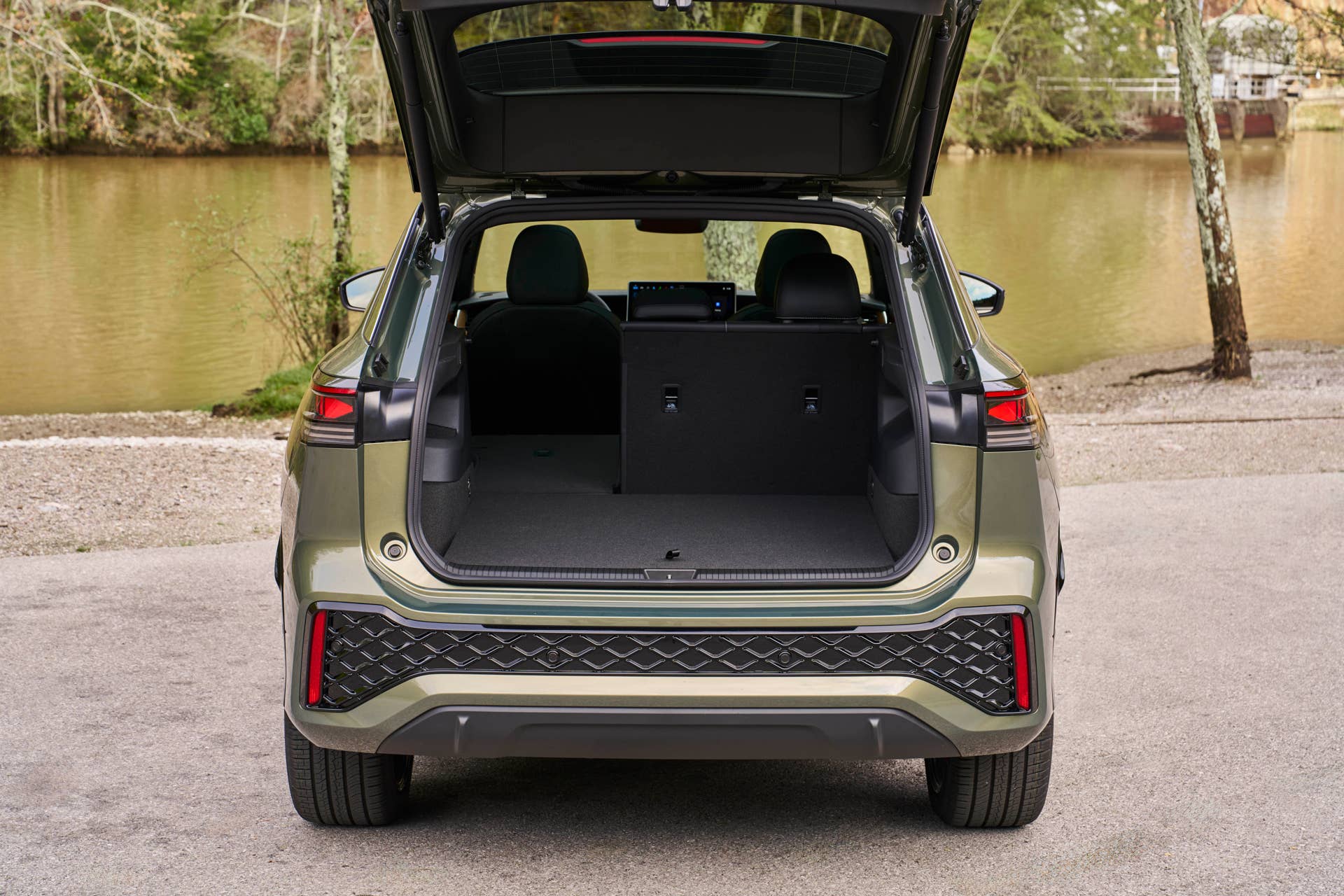
Otherwise, the interior is like other Tiguans, which is to say spacious. It has plenty of room up front on comfortable seats, and the second row will accommodate six-footers easily. The almost useless third row from the last generation doesn’t carry over for this generation, leaving more room for cargo space, which checks in at a useful 33.8 cubic feet behind the second row and 69.8 cubic feet with the 60/40-split second row folded down. Those numbers are among the best in the class.
Final thoughts
The Tiguan Turbo’s extra power and additional equipment come at a cost. It starts at $44,560, $4,340 more than the all-wheel-drive version of the step-down Tiguan SE R-Line Black trim level. While that’s a reasonable upcharge given the added features, it also puts the Tiguan Turbo in the ballpark of the base versions of the Acura RDX ($45,450) and Genesis GV70 ($50,480).
The fact that the Tiguan Turbo can be mentioned in the same sentence as those upscale rivals is a testament to how powerful and well-equipped it is. It also makes the Tiguan Turbo an enticing choice among accomplished competitors like the Honda CR-V and Toyota RAV4. If you want a mainstream crossover with an extra dose of power and features, the Tiguan Turbo should make its way onto your shopping list.