
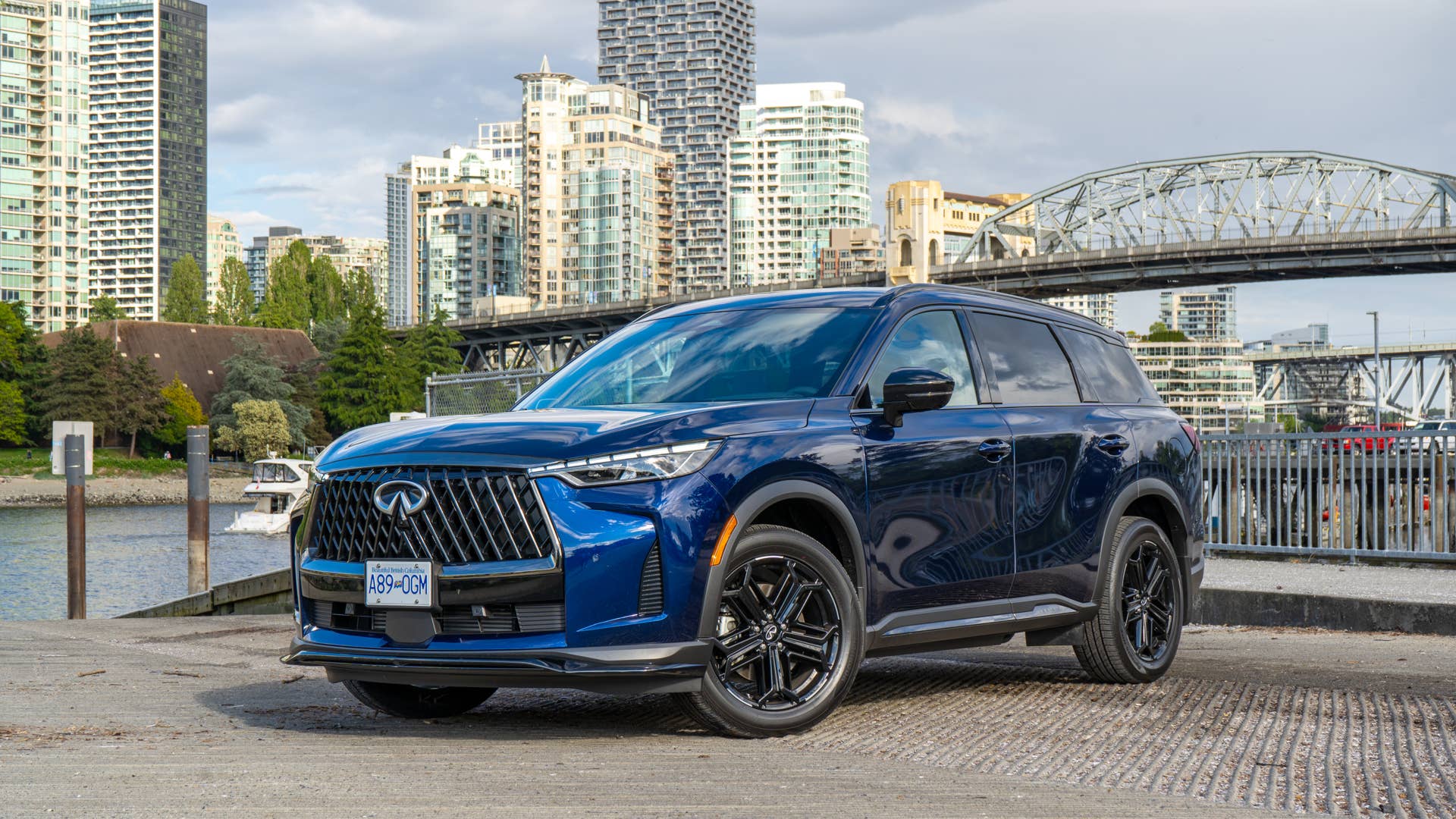
Reviewing a car you feel genuinely cold toward is one of the more challenging professional obligations in this business. I don’t mean cold in the way you feel toward something that has actively offended you—a truly poor car at least gives you something to work with; some sort of fire in your belly that often results in an editorial that’s more fun to read than a positive one. But cold in the way you feel toward something that simply never found a way to make you care. You drive it, take your silly notes, and try to find an angle that makes it interesting, but if, by the time you’ve handed back the keys, you’ve entirely forgotten you even drove it, crafting a meaningful story becomes a tiresome ordeal. That was my experience with the 2026 Infiniti QX60 Sport, so bear with me here as I try to make some sense of it for you.
I want to be careful about what I mean exactly, because the QX60 is certainly not a bad car, and for many families, it may be exactly the right one. It is spacious enough, competent enough, well-equipped enough, and priced sensibly enough that its shortcomings can be forgiven if your priorities are practical rather than emotional. If you need three rows, want something that looks more distinctive than a Pilot or a Highlander, and can live without a truly prestigious interior experience, the QX60 makes a more-than-reasonable case for itself. But I am an automotive journalist and lifelong car enthusiast, and so the QX60 Sport spent a week trying and mostly failing to make me feel anything at all.
To be specific, I drove a Canadian-market 2026 QX60 Sport AWD, totalling C$72,440 with freight, through Vancouver’s streets and up the Sea-to-Sky Highway. In the U.S., the QX60 Sport AWD starts at $62,390 before destination. Here is my honest account of the week.
Cole Attisha
Exterior Design: 7.5/10
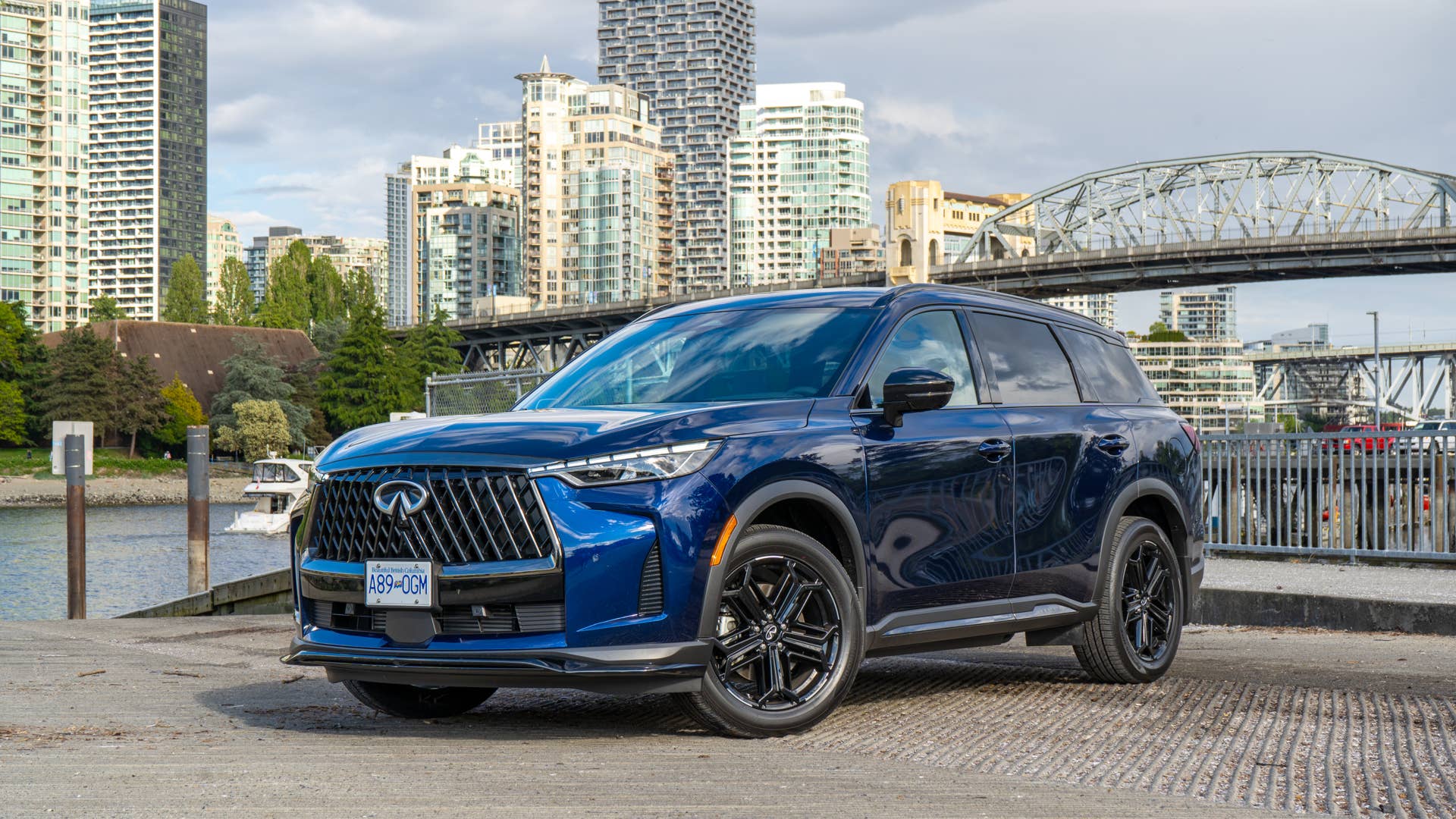
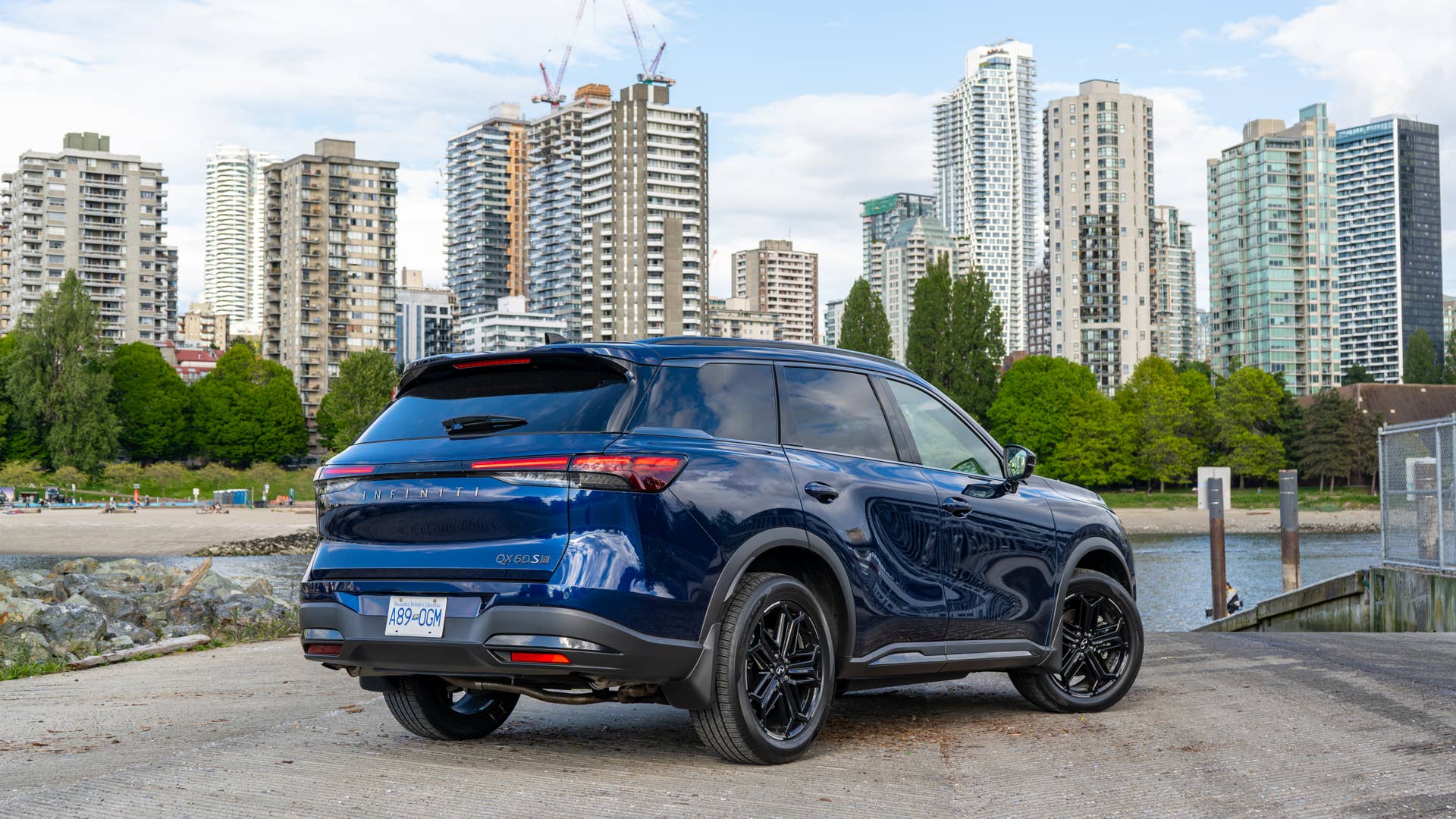
The 2026 QX60 is a significantly better-looking vehicle than its predecessor, and the Sport trim, with its exclusive dark appearance package, pushes that improvement further still. The refreshed grille—inspired, Infiniti tells us, by the intersecting geometry of a bamboo forest—is bold and distinctive, with an illuminated, three-dimensional Infiniti emblem at its centre. The restyled lower fascia gives the nose a more planted, purposeful stance, and the cleaner liftgate and wider-appearing rear end complete a silhouette that finally feels cohesive rather than misguided.
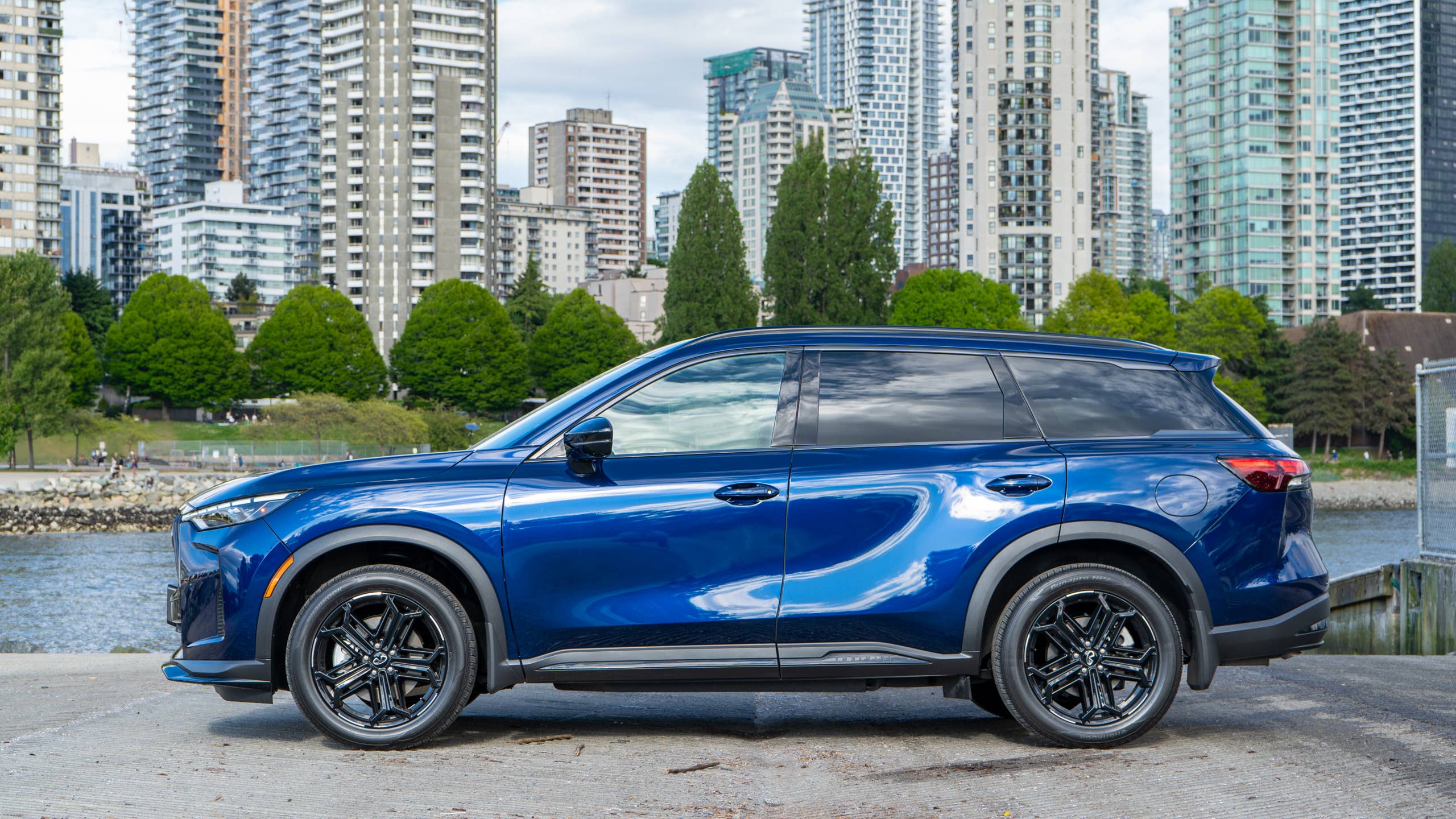
The Sport trim adds gloss-black exterior accents, black roof rails, 20-inch sport-design wheels in a gloss-black finish, and dark trim throughout the grille, window surrounds, and body-side mouldings. On my deep blue tester, parked against the Vancouver waterfront with the Burrard Street Bridge lingering in the background, the overall effect was genuinely appealing. It appears purposeful and assertive in a way that previous generations never quite managed.
My question is, though: does any of this really matter? Does throwing dark chrome and a new set of badges at a Nissan Pathfinder really make it look like a legitimate luxury product? Can a bamboo-themed grille really make up for the cost-effective four-cylinder replacement for the V6 that many of its rivals still use? Can a panoramic sunroof really make a tight third row feel less claustrophobic? Are black-painted wheels enough on their own to justify a “Sport” badge in 2026? These are all things I was left wondering at the end of my week with the QX60.
Need New Tires? Save Up To 30% at Tire Rack
Find the perfect tires for your exact vehicle and driving style. Click here to shop all top-tier brands, including Michelin, Bridgestone, and more, directly at Tire Rack.
Cole Attisha
Powertrain & Driving Dynamics: 7.5/10
The 2.0-litre VC-Turbo four-cylinder—Infiniti’s variable compression engine, a genuinely intriguing piece of engineering—produces 268 horsepower and 286 lb-ft of torque, routed through a nine-speed automatic and Infiniti’s Intelligent All-Wheel Drive. On paper, those are modest figures for a three-row SUV weighing in at the better part of two tonnes—the Acura MDX, by comparison, offers 290 horsepower from a smoother, less complicated 3.5-litre V6 with single overhead cams—a Honda J-Series unit that has more than proven its durability over many years. In practice, the powertrain is adequate but uninspiring: there is a noticeable pause off the line before the turbo builds pressure, and the surge that follows, while capable, never builds to anything that could be described as exciting, despite the extra “S” on the tailgate. The nine-speed gearbox is generally well-matched to the engine’s character, smooth in everyday driving and relatively drama-free, for better or for worse.
What redeems the driving experience is the chassis. The QX60 Sport handles with a composure and agility that genuinely surprises. Body roll is a bit floaty but well-contained for a vehicle of this size and height, steering is more responsive than the soft, vague setup in some rivals, and the car rotates through corners with genuine confidence. On the winding stretches of the Sea-to-Sky Highway, the QX60 encouraged a level of commitment that few three-row family SUVs invite without a rear-biased drivetrain and a longitudinally mounted powertrain. It is not a driver’s SUV in any meaningful sense—the engine’s reluctance to excite suggests as much—but the chassis beneath it deserves commendation nonetheless.
Cole Attisha
The ride, however, is a bit of a mixed bag over unkempt urban pavement. The QX60 absorbs long-wave undulations gracefully, and at highway speed, it is genuinely serene. But sharp impacts and patchy city surfaces transmit into the cabin with more force than you’d expect from a luxury product, occasionally interrupting the otherwise calm experience. It does not ruin the car, but it does remind you quite regularly that you are not in a Lexus or a Genesis. Fuel economy is rated at 22 city / 27 highway for the AWD Sport. In real-world driving, expect the combined figure to hover around 24 mpg—reasonable enough for the segment and the powertrain.

Cole Attisha
Technology: 6/10
The 2026 QX60 brings meaningful technology upgrades over the outgoing car, and it would be unfair not to acknowledge them. The dual 12.3-inch displays—one for the instrument cluster, one for infotainment—are a genuine improvement over the previous generation’s setup, and the addition of Google Built-In, with its always-updated Google Maps, Google Assistant, and native navigation, brings the QX60 closer to where it needs to be. Wireless Apple CarPlay and wireless Android Auto are now standard. ProPilot Assist, Infiniti’s semi-autonomous highway driving system, operates with reasonable confidence on the freeway and meaningfully reduces fatigue on longer drives.
The problem is the InTouch infotainment system surrounding all of that. Beneath the Google Built-In layer, InTouch remains sluggish, incoherent, and prone to menu-diving that makes you long for something—anything—simpler. Response times lag behind what you would find in a Genesis, BMW, or even a Volvo, which isn’t exactly known for its responsive infotainment software. The interface logic is inconsistent: some functions require three taps to register, others are buried in submenus with no obvious rationale. The haptic-touch button layout surrounding the screens is useful in theory, but a bit annoying to use. And to top it all off, throughout my entire week with the vehicle, wireless Apple CarPlay did not work properly even once—it would pair to my phone briefly, start playing a song, then disconnect entirely, and freeze the system when I attempted to reactivate CarPlay through the connection screen. I resorted to playing my music over Bluetooth alone, and even that was spotty.
The 12.3-inch screens themselves, while adequately sized for the segment in 2022, feel modest in a 2026 market where 27-inch OLED installations are now available at comparable price points. ProPilot Assist does its job reliably, and the 3D Around View Monitor—which stitches together a surprisingly clear overhead view of the vehicle in tight spaces—is genuinely handy. But the technology package as a whole is unbalanced: excellent in some places, frustratingly dated in others.
Cole Attisha
Interior Design & Quality: 6.5/10
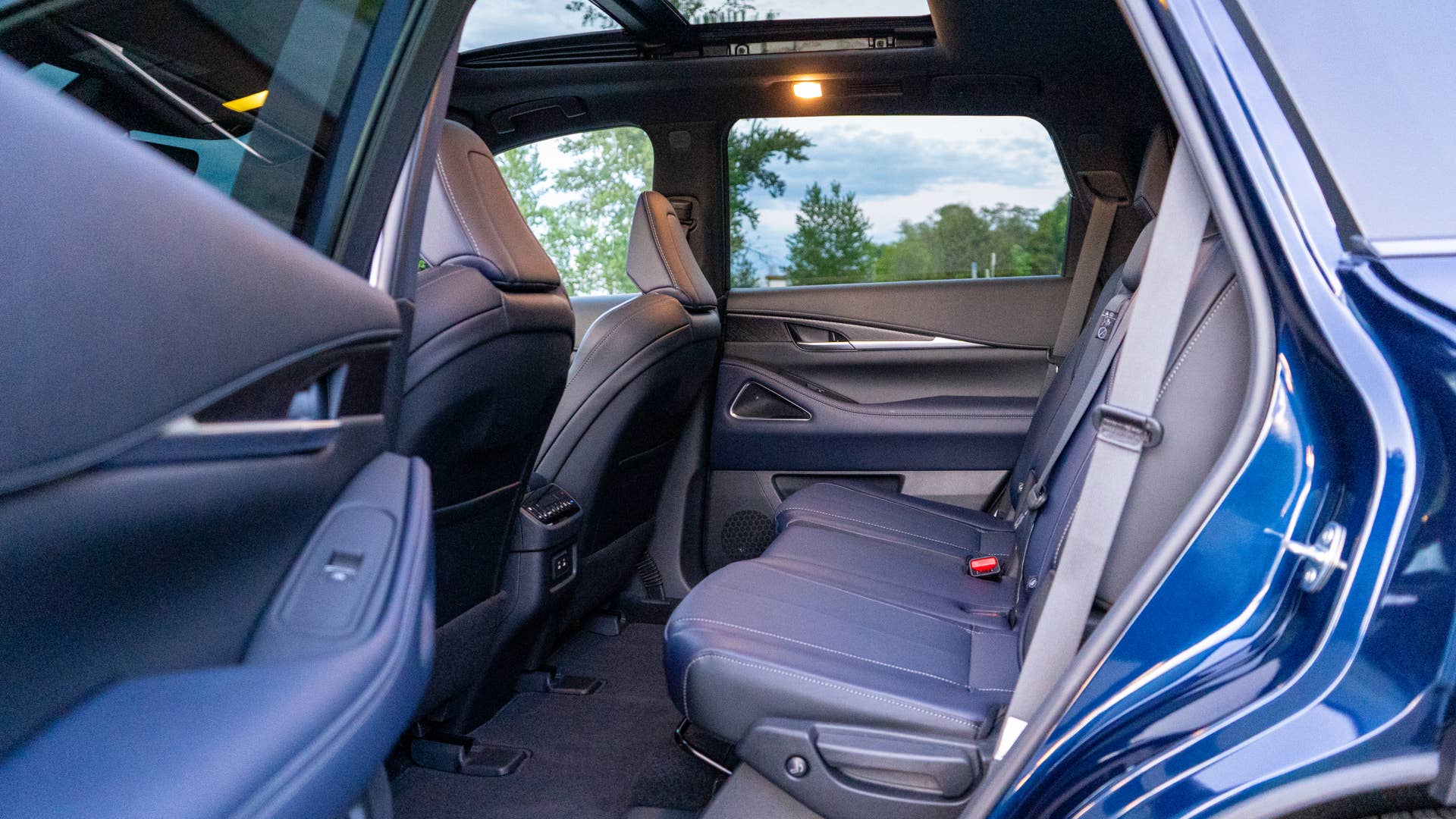
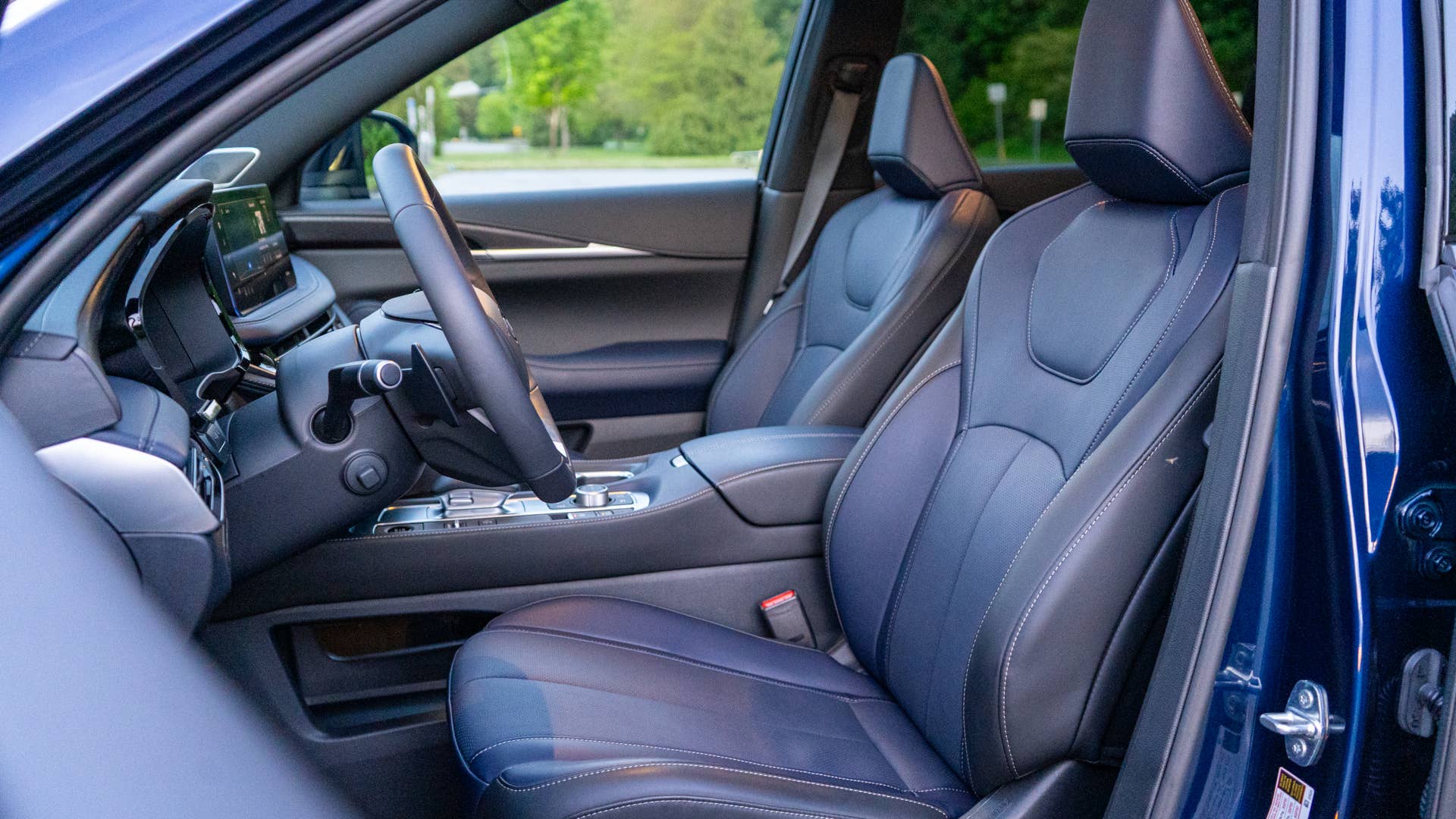
Inside the cabin, the QX60’s identity crisis is most apparent, and it’s difficult to overlook. The interior is warm, well-proportioned, and carefully assembled. The Sport’s exclusive Dusk Blue TailorFit seating is attractive and distinctive, the black headliner adds a sense of enclosure that feels appropriately driver-focused, and the second-row captain’s chairs are legitimately comfortable, with easy third-row access via Infiniti’s fold-and-tumble mechanism. The Klipsch 16-speaker audio system fills the cabin with competent sound, and the tri-zone automatic climate control keeps everyone comfortable regardless of where they’re sitting.
But sit in this cabin after spending time in a Genesis GV80, a Lexus TX, or even a well-equipped Acura MDX, and the QX60’s shortcomings become difficult to ignore. The materials, while adequate, never quite cross the threshold from premium to genuinely luxurious. The TailorFit seating—Infiniti’s proprietary synthetic leather—is durable and easy to clean, which is admirable, but it lacks the tactile richness that buyers paying the better half of six figures for a three-row SUV expect. The dashboard architecture is tidy enough, but it carries the faint scent of a Nissan Pathfinder that’s been fitted with more expensive carpets. For a brand that positions itself above the mainstream and prices accordingly, the cabin stops short of where it needs to be.
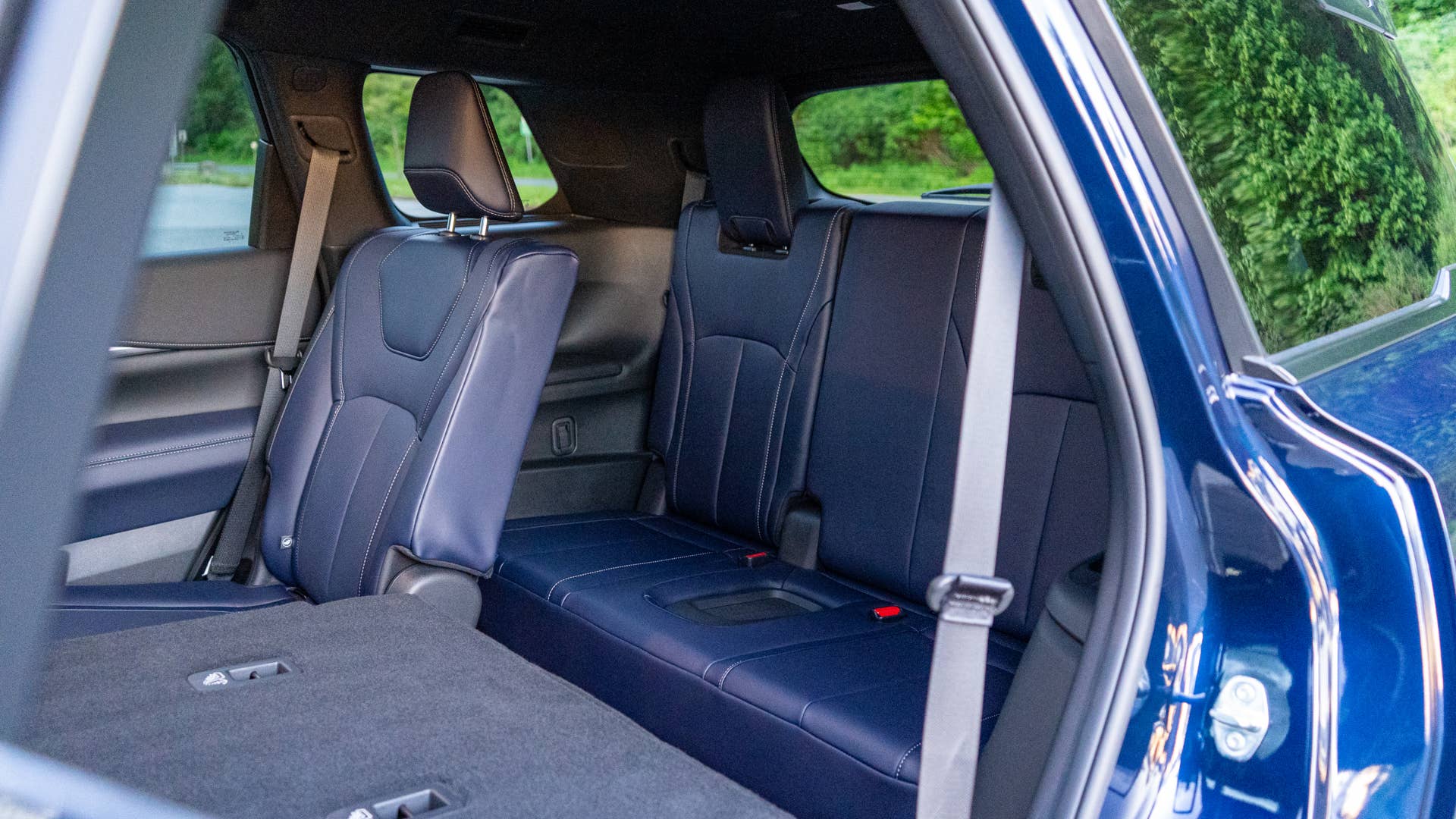
The seven-seat layout is more of a five-plus-two layout in practice. The third row is technically there, but it is best reserved for children or adults on very short trips. Legroom is tight, headroom is marginal, and the experience of actually occupying it undermines the QX60’s pitch as a genuine family hauler. Rivals like the Kia Telluride and Hyundai Palisade offer more usable three-row accommodation for considerably less money, and even within the luxury segment, the Acura MDX packages its third row with more dignity.
Cole Attisha
Pricing & Value: 7/10
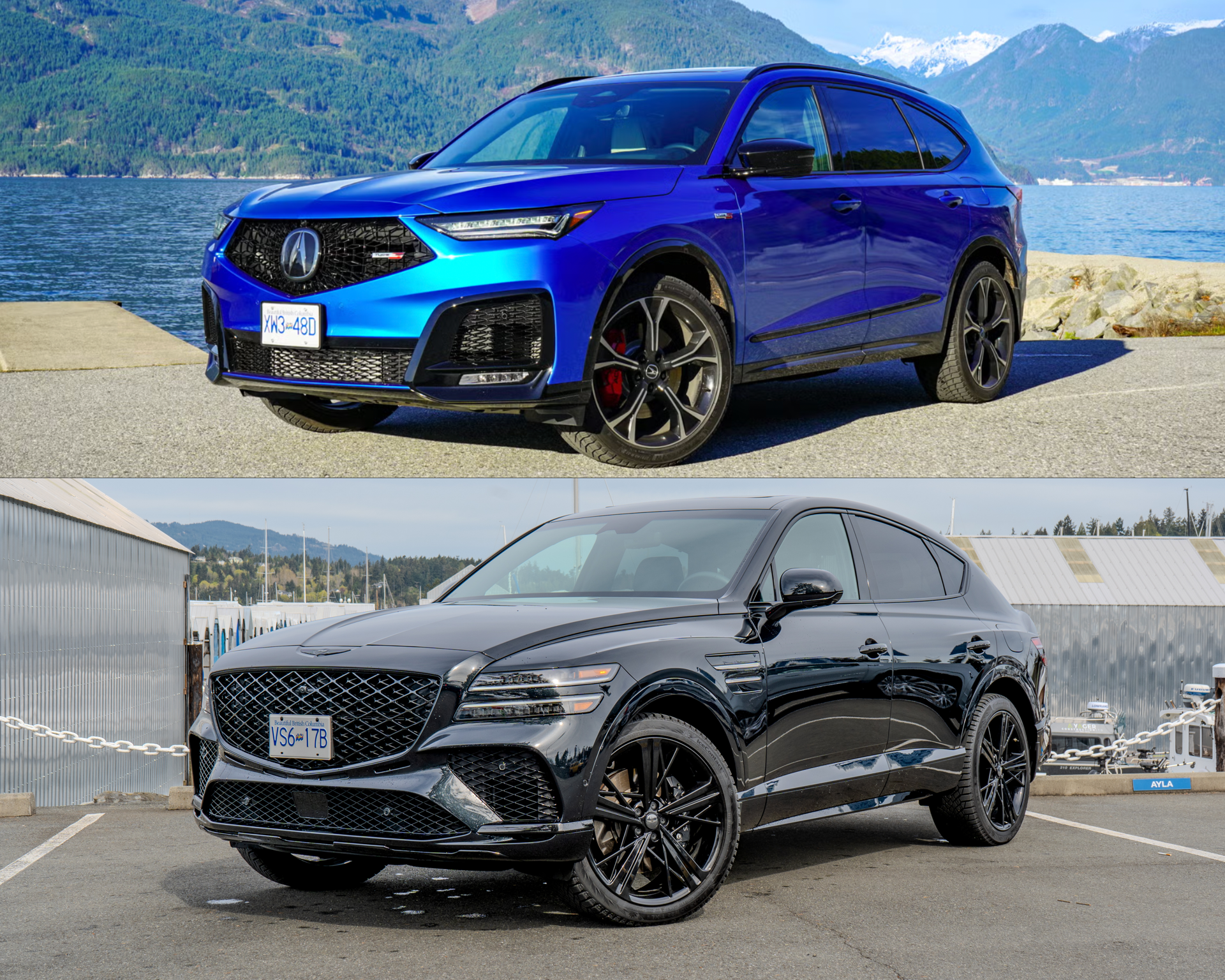
The Canadian-market QX60 Sport tested here stickered at C$72,440 including freight. American buyers will find the QX60 Sport AWD starting at $62,390 before destination—a figure that places it directly alongside the Acura MDX ($62,400 for an A-Spec model) and the Lexus TX ($62,690 for a 350 Premium AWD model) when comparably equipped. In the non-luxury three-row segment, the gap is relatively thin: a well-optioned Kia Telluride or Hyundai Palisade can be had for significantly less, with more usable space, fresher design, and, arguably, nicer interiors.
The standard equipment list is strong for the Sport package. The 16-speaker Klipsch audio, wireless CarPlay and Android Auto, ProPilot Assist, tri-zone climate control, panoramic moonroof, 3D Around View Monitor, and the full suite of driver-assist technologies are all included at the Sport’s entry price. Infiniti’s Premium Care programme covers three oil changes and six tire rotations, which softens the ownership cost over the first few years.
The value case exists, but it’s conditional. It holds if you need three rows, want a more distinctive-looking alternative to the usual suspects, and can forgive a powertrain that prioritizes efficiency over composure and an infotainment system that remains a work in progress. Still, it’s impossible to overlook its rivals, which are, more often than not, better to drive, nicer to look at, and more confidently dependable throughout long-term ownership, all at a nearly identical price point.
Cole Attisha
Final Verdict: 7/10
The 2026 Infiniti QX60 Sport is a vehicle that is genuinely difficult to place, and that difficulty is, I think, the most honest verdict I can offer. It handles better than its size and powertrain suggest it should; it looks more assertive and purposeful than any previous QX60 or JX35; it offers a competitive feature list for its price point; and it is available at a starting price that makes the European alternatives feel like lavish indulgences by comparison.
It is also let down by a cabin that stops noticeably short of true luxury, an infotainment system from a previous generation, and a four-cylinder engine that asks you to pull back your expectations of what a Sport-badged luxury SUV should feel like when you press the accelerator. These are not minor quibbles—they are areas where the QX60’s competitors, including some that cost less, do notably better.
A full redesign feels overdue, and its recent refresh, while genuine and welcome, does not fully address the QX60’s structural challenges. It patches, refines, and adds personality where there was less before. What it cannot do is replace the sense that this generation has reached its ceiling. If Infiniti is serious about competing at the level the QX60 Sport’s price tag implies, the next generation needs to raise its ambitions considerably—in the cabin, at the infotainment screen, and under the bonnet.
Cross-shop the Acura MDX, the Genesis GV80, and the Lexus TX before you decide. They are similarly priced, more polished, and, in my view, more complete luxury propositions. If the QX60’s value equation, visual identity, or three-row packaging speaks to you specifically, buy it with your eyes open. You will find things to appreciate, but you will also find things that, with some persistence, remind you that Infiniti has more work to do.
Canadian-market 2026 Infiniti QX60 Sport AWD as tested: C$72,440 including freight. U.S. QX60 Sport AWD starting MSRP: $62,390. EPA: 22 city / 27 highway / 24 combined mpg. Engine: 2.0L VC-Turbo four-cylinder. Power: 268 hp / 286 lb-ft. Transmission: 9-speed automatic. Seating: 7 passengers. Drivetrain: Intelligent AWD.
About the author

Cole Attisha
Staff Writer, Autoblog