
The sounds of silence could soon be getting a microphone.
Hybrid and electric cars, typically far quieter than their more conventional counterparts, could soon be required to make more noise while they’re traveling down the road.
A rule proposed Monday by the National Highway Traffic Safety Administration would require that automakers install devices on hybrids and electrics that make additional noise when the car is traveling at or below 18 miles per hour, when it’s stationary or in reverse.
Hybrids and electrics have sometimes proven problematic for pedestrians and bicyclists. Without the familiar hum of a gas or diesel engine, there are fewer audible cues that alert others to the presence and direction of the cars.
Hybrid vehicles are 1.38 times more likely to be involved in collisions with pedestrians at low speeds and 1.33 times more likely to be involved in a crash with a cyclist, according to NHTSA data.
“We believe that this difference in accident rates is mostly attributable to the pedestrians’ inability to detect these vehicles by hearing them during these maneuvers,” NHTSA officials wrote in their notice of public rule-making.
NHTSA estimates the new rule would prevent 2,790 collisions, and save 35 lives per year. The public has 60 days to comment on the proposed rule before administrators begin crafting the wording of the final rule.
TOP 5Most Popular Green Cars On AOL Autos
2013 Honda Fit EV
MSRP : $36,625
2012 Mitsubishi i-MiEV
MSRP : $29,125
2012 Ford Focus Electric
MSRP : $39,200
2012 Toyota Prius c
MSRP : $18,950
2013 Ford C-Max Hybrid
MSRP : $25,200
Sound-making devices would cost auto manufacturers approximately $35 per vehicle to install and would give enough information for “pedestrians, bicyclists and the visually impaired to detect and recognize a vehicle,” NHTSA administrator David Strickland said, “and make a decision about whether it is safe to cross the street.”
NHTSA tested EVs and cars powered by internal combustion engines in a number of scenarios, and found that, on average, it took pedestrians longer to detect hybrids and electrics in “high ambient sound” scenarios, which mimicked the background noise pedestrians might hear, for example, when walking along a busy road.
Pedestrians will still want to keep a sharp eye on the road – a final rule isn’t expected until January 2014, and will be phased in over a three-year period that may not begin until September 2015.
U.S. Secretary of Transportation Ray LaHood hailed the proposal as one that keeps all road users safe, but especially for blind people.
For others, it doesn’t hurt, but it’s “not a game changer,” said Robin Stallings, the executive director of BikeTexas.org, a nonprofit organization that advocates for bike safety at local, state and federal levels. “For bicyclists and the speed that bicyclists go, even when we can hear them coming, it’s often going to be too late.”
He stressed the most significant step transportation officials can take to protect bicyclists is speed-specific lanes that separate traffic, such as the bike lanes that have become popular in New York and Chicago. “We believe that’s going to be an even better solution than cyclists looking over their shoulders,” Stallings said.
The proposed rule fulfills a 2010 mandate from Congress that hybrid and electric vehicles meet a minimum sound requirement so they can be detected. The proposed rule gives manufacturers flexibility in choosing the sound and setting the decibel level, but does require that it be consistent for each make and model. The sound should be recognized as vehicle, the report recommends.
Some automakers have already been researching the problem and possible solutions. Nissan conducted a survey of customers of its all-electric Leaf to gauge what sounds they found acceptable and annoying, and also interviewed blind pedestrians to ask which sounds are most useful.
Administrators arrived at the 18-mph point because at higher speeds, tire noise, wind resistance and “other factors” eliminated the need for additional sound devices.
Featured Gallery

As technology advances, cars and trucks arrive with more and more features. Some make the driving experience safer while others make the ride more convenient.
And over time, as more features are adopted, the price of it goes down and more carmakers incorporate it into their vehicles.
It wasn’t that long ago that power windows and air conditioning were considered luxury options. Now, even the most basic car typically offers these features as standard.
So what are some of the features that are optional on some vehicle or not even available from some automakers but should be standard on every vehicle? Click through to see the five features we think every vehicle should have.
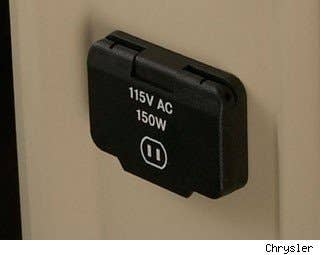
We have a lot of electronic needs in our cars these days. Phone rechargers, portable DVD players, iPods, etc. Automakers have been good about providing electrical outlets in the front, as well as in the rear seating area. But most often, these outlets are in the form of cigarette-lighter style plugs.
The number of people who are recharging phones far outstrips the number of people still smoking in their cars.
A handful of cars, such as the Volkswagen Jetta and Dodge Caravan, have the house-style plugs, but most do not. The advantage? Obviously, you don’t have to buy special cable and adapters. With a house-style two-prong or three-prong outlet, it’s great for recharging, simply, phones and laptops as you drive, as well as powering kids’ portable devices on a long trip.

Dawn and dusk are dangerous times to drive, in part, because it can become more difficult to see other vehicles on the road. The safest thing to do is click on your headlights. However, it can be difficult to determine when that time is.
It’s even easier if the car detects that ambient light is getting too low and turns your headlights on for you. Many cars, such as the Hyundai Santa Fe and Chevy Equinox, offer this feature, using a simple light sensor to turn on your headlights. But not every car offers it even as part of a feature package you can buy.
What are they waiting for?

As the bed ofpickups has grown higher and higher, climbing into the back of a truck has gotten more difficult–especially for drivers beyond a certain age–often resulting in a knee-to-steel grinding that leaves a truck owner grumbling and in pain. Seriously, with baby boomers getting knee and hip replacements at a fast rate, this state of affairs with pickup beds is terrible.
Then, Ford Motor Co. offered a simple solution: The tailgate step. It’s a simple device that is incorporated into the tailgate that includes a single pull out step and a locking pole that acts as a hand-hold. Brilliant!
Ford introduced the device in 2007 with its new SuperDuty pickups and its popularity allowed Ford to put the step onto all of its pickups. It’s easy to set up and easier to use.
Some pickup makers (are you listening Chevy and Ram?) may be loathe to use a Ford system but that should not stop them from adopting a feature that most people will love once they start using it.

Every car is required to have some sort of tire pressure monitor nowadays. However, not all systems are equal.
It seems unfair and a waste of time for a car to warn you that one of your tires has low pressure, but not tell youwhich tire is posing a safety hazard. Argh!
If the system is monitoring all of the tires, it should have the courtesy to at least let you knowwhich one is low.
Instead, most systems require the car’s owner go out and test all of the tires with a tire-pressure gauge, and figure out which one is low and then fill it up.
Nissan took everyone by surprise this year with a system that not only tells you which tire is low, but it will tell you when the tire you are adding air to is at the optimal air pressure. Start filling up the tire, and the four-way flashers start going to tell you air is flowing. And the horn chirps when the prescribed air pressure is reached. We love this feature, and our judges in AOL Autos Technology of the Year award nominated the system a finalist in the competition.
Even smarter: Nissan says the system didn’t cost a cent to put into its cars. All the parts and sensors were already in the new2013 Altima sedan when it debuted this year, so Nissan just had to program the car’s software differently to make the system work.
We think every company should adopt the system.

It’s a fact of life that people talk on their phones when their driving. It’s also a fact that more states have begun to require drivers to use some sort of hands free device to do that. (Ten states ban all drivers from operating a cell phone without a hands-free device and 32 states ban novice drivers from doing so.)
The easiest and safest way to talk on your phone while driving is to have a phone connected via Bluetooth through the stereo system. This allows the stereo to drop the volume when the phone rings and the driver to answer the phone, often by pushing a button on the steering wheel. Using a small speaker, typically near the rear view mirror, the driver can speak.
All of this works effortlessly through a Bluetooth connection.
While many carmakers offer some sort of system, there are many vehicles still sold without some sort of Bluetooth connectivity inside the vehicle, thus forcing drivers either to use a balky aftermarket kit or, worse, wear one of those silly looking ear pieces that they often leave in no matter where they go.
It’s time to make Bluetooth connectivity standard on every car.

While not every car comes with a backup camera, it’s likely they will in the near future. The National Highway Traffic Safety Administration is considering making it a law.
Carmakers have used ingenious ways to incorporate these systems into cars. Some have video screens in the rear view mirror, cameras and sensors are hidden in the trunk or bumpers, and other cameras offer a computer generated bird’s eye view of the vehicle.
The systems work superbly to keep a driver from backing into a small child, or over something left in the driveway–bike, scooter, skateboard. And for aging baby boomers with arthritic necks, it is a God-send.
As the cost of these systems continue to decrease, it only makes sense to see every car get a backup camera, as it’s something every person does when driving every day.

Joe Molinari is a social worker in Arizona. Earlier this year, he was driving his Subaru Outback and was T-boned by a minivan. The crash sent his Outback rolling multiple times. When the car settled, Molinari unbuckled and walked away with only a few bruises. In many vehicles, the Pinetop, Arizona resident would have been killed or severely injured. Stories of drivers and passengers in rollover accidents ending up paraplegics are common. In so many rollover accidents, the thing that kills the driver is the roof collapsing.
Why did Molinari survive the accident so well. Subaru has technology in the B-pillar of its cars–the pillar that separates the front door from the rear–that is extra reinforced. Subaru calls it the”Rings of Safety,” and it involves eight layers of high-strength steel around a steel rod. While Subaru’s technology gives it the highest roof-safety ratings possible, it does present some problems for rescue workers if they have to cut the B-pillar to extricate a driver or passenger. But we like the technology because without it–there would be no reason for first responders to rush to cut a victim out in the first place following a rollover accident.
Molinari’s accident totaled his car, but not his body. What did he buy with the insurance money? Another Subaru Outback.