

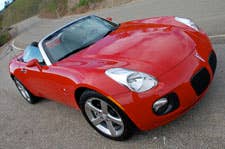
2007 Pontiac Solstice GXP – Click above for high-res image gallery
The Pontiac Solstice is the crown prince of the General’s lineup. With curves and flares, bulges and rakes, it’s the modern equivalent of the Coke bottle aesthetic of yesteryear. Sure, some may prefer its sheetmetal sibling the Sky, but regardless of your chosen chariot, they’re both head-turners. When the Solstice was introduced last year, however, it lacked the firepower to back up its sex-on-wheels image. Until now.
Featured Gallery

MSRP:$33,990 – $58,200
The Mercedes-Benz C-Class remains the most accessible of the brand’s models sold in the United States. Completely redesigned in 2008, the fourth-generation C-Class continues to deliver the expected levels of advanced engineering, design and safety features that keep it highly competitive within the entry luxury segment.
Why It’s Luxury: Anything with the tri-star ornament on the hood is going to be seen as luxury. An E Class owner who hits on hard times isn’t going to feel like a loser trading down to the current C Class.
Why It’s Not: A soppy performing V6 and austere interior shows where they cut the costs to make this sedan start at $33,000. Even at that, though, certain Acuras and even a Buick LaCrosse feels like a much better ride and deal.
- Research the Mercedes-Benz C-Class
- Mercedes-Benz C-Class Photos & Information
- Mercedes-Benz C-Class Specs
- Mercedes-Benz C-Class Local Dealer Price Quote

MSRP: $33,000 – $43,000
The Hyundai Genesis sedan is designed to offer the luxury appointments of much more expensive cars, for less.
Why It’s Luxury: Quiet and luxurious cabin, and silky, peppy engine. This is one of the cars we recommend before signing on for a Mercedes C Class. The brand over-achieved on materials, features, and design to make it’s point that it belongs in the club.
Why It’s Not: For a lot of people, that Hyundai logo will just never be seen as a legit luxury product worthy of bragging on. We think it’s worth noting that the Hyundai logo is meant to reflect two people shaking hands. It’s a nice back story, and a very nice car.
- Research the Hyundai Genesis
- Hyundai Genesis Photos & Information
- Hyundai Genesis Best Deals
- Hyundai Genesis Local Dealer Price Quote

MSRP: $44,450 – $57,500
The second-generation Volkswagen Touareg sport utility vehicle is larger and more spacious, yet lighter and more economical than the model it replaces.
Why It’s Luxury: Priced above $40K, and above $60K for the hybrid, the Touareg shared development and shares an engineering platform with the Porsche Cayenne SUV.
Why It’s Not: Volkswagen does not equal luxury. Someone buying a VW today priced above $40K is not looking for a luxury statement, because it’s just not there.
- Research the Volkswagen Touareg
- Volkswagen Touareg Photos & Information
- Volkswagen Touareg Best Deals
- Volkswagen Touareg Local Dealer Price Quote

MSRP:$30,975 – $37,700
The Volvo S60 is a sporty, dynamic sedan combining excellent performance and a great design with outstanding safety features. New for 2012 is a front-wheel drive T5 model.
Why It’s Luxury: Well put together, and good materials. The Swedes are good on fit and finish. Priced around $30L, but you can get up closer to $40K after adding features with no problem. Nobody over 45 needs an explanation of why you’d buy a Volvo if you could afford a Bimmer.
Why It’s Not: Out of date controls in the car. Old power-plant under the hood. Volvo has always been more of a car Subaru owners graduated to than a brand that really rivaled BMW or Benz.
- Research the Volvo S60
- Volvo S60 Photos & Information
- Volvo S60 Best Deals
- Volvo S60 Local Dealer Price Quote

MSRP:$29,610 – $35,150
The Acura TSX is a sport sedan that offers a satisfying blend of performance, style and efficiency. The TSX boasts a muscular appearance and great handling, complemented by enhanced comfort, convenience and safety features. New for 2011, the TSX will be available as a Sport Wagon.
Why It’s Luxury: The top of the line Acura , the RL, is priced above $50K. Honda calls Acura its luxury brand.
Why It’s Not: Starts under $30K, and is built off a Honda Accord. Not a great four-cylinder engine. Acura doesn’t have the marketing imagery right yet. But it’s only been 25 years working on it. Give them a chance.
- Research the Acura TSX
- Acura TSX Photos & Information
- Acura TSX Best Deals
- Acura TSX Local Dealer Price Quote

MSRP: $34,605 – $36,495
Lincoln’s entry-level MKZ has dynamic American luxury styling with features only found on cars costing thousands more.
Why It’s Luxury: Sweet job on the interior to differentiate it from the Ford Fusion on which it is based. Lincoln brand has more claim to luxury status than Acura. Tradition.
Why It’s Not: It was badged engineered. That means it starts out life as a Ford Fusion, and then they start bolting different stuff on. That’s no way to run a luxury brand. Happily, the replacement will be distinguished from the Fusion replacement.
- Research the Lincoln MKZ
- Lincoln MKZ Photos & Information
- Lincoln MKZ Best Deals
- Lincoln MKZ Local Dealer Price Quote

MSRP: $26,995 – $33,765
The Buick LaCrosse is a sophisticated mid-size sedan, available in both front-wheel and all-wheel drive configurations. It seats five passengers in comfort while providing confident handling and a smooth ride.
Why It’s Luxury: Quieter than a Lexus ES350, better performing and cooler styling than the Lexus or the Acura TSX. What’s not to like? Sweet ride.
Why It’s Not: Starting price below $30K. Luxury of your name is Homer Simpson in terms of the brand cachet of Buick after so many years of many misfires. Premium? Yes. Luxury? Stay tuned. Show us more.
- Research the Buick LaCrosse
- Buick LaCrosse Photos & Information
- Buick LaCrosse Best Deals
- Buick LaCrosse Local Dealer Price Quote

MSRP: $19,245 – $31,740
Replacing the Sebring, the 200 forges its own identity with modern styling and a refined cabin, underpinned by responsive handling and innovative technologies.
Why It’s Luxury: It just isn’t. Maybe the replacement will get closer to the mark. But we just don’t think a car whose starting price is under $20K can claim “luxury” status. The Chrysler brand can get to Volvo-like status. And that is true luxury for someone who has been driving Toyota Yarises for most of their life.
Why It’s Not: Because anyone with sanity and a pulse will tell you so.
- Research the Chrysler 200
- Chrysler 200 Photos & Information
- Chrysler 200 Best Specs
- Chrysler 200 Local Dealer Price Quote

MSRP: $41,910
The Jeep Grand Cherokee retains Jeep’s legendary off-road prowess while providing many luxurious and technical amenities. For 2011, the Grand Cherokee has been completely redesigned and offers a new stiffer body structure, a new V6 engine and more advanced technology features.
Why It’s Luxury: Jeep is a transcendent brand. Nobody we have ever known who had a luxe brand like BMW or Benz on one side of the garage and a Jeep on the other side ever had to explain it. Jeep has always been a member of the club.
Why It’s Not: From time to time, Jeep turns out a real dog, like the Jeep Commander or the original Compass. Those misfires hurt the brand with Niemen Marcus crowd. Also, with Lexus, Mercedes, BMW and Acura all full-on in the SUV game, some old Jeep buyers have left the brand.
- Research the Jeep Grand Cherokee Overland Summit
- Jeep Grand Cherokee Overland Summit Photos & Information
- Jeep Grand Cherokee Overland Summit Best Deals
- Jeep Grand Cherokee Overland Summit Local Dealer Price Quote

MSRP: $48,950 – $109,800
The Chevrolet Corvette is the best high-performance value in America. The Corvette delivers supercar performance for the price of a midsize luxury sedan.
Why It’s Luxury: The ZR1 version of the Vette costs North of $100K. Though it carries a Chevy badge, the Corvette has long been its own brand under the GM tent.
Why It’s Not: The Chevy badge will make it a non-starter with many well-heeled car collectors and sports car enthusiasts. That goes especially for import buyers. Sometimes we see parts in the Corvette from much cheaper GM cars. C’mon fellas.
- Research the Chevrolet Corvette
- Chevrolet Corvette Photos & Information
- Chevrolet Corvette Best Deals
- Chevrolet Corvette Local Dealer Price Quote
All Photos Copyright ©2007 Damon Lavrinc / Weblogs, Inc.
With close to 3,000 pounds of metal to move, the 2.4-liter Ecotec four found in the base Solstice left much to be desired, so Pontiac replaced the 177 HP mill with a direct-injected, turbocharged 2.0-liter I-4 producing 260 HP and an equal amount of torque. Peak horsepower is achieved at 5,300 RPM, while the torque curve is as flat as Bonneville from about 2,500 to 5,000 RPM. However, our seat-of-the-pants dyno suggests that those torque figures are underrated by at least ten-percent – nothing new when it comes to the General’s forced-induction offerings.
On the outside, there’s little to indicate that this particular Solstice is anything above and beyond its base brethren. As a matter of fact, excluding the 18-inch chrome rolling stock, it’s downright subdued. The naturally aspirated version’s brushed metal grilles have been replaced with blacked out inserts, while the fog lamp recesses have been reshaped, broadened and painted to match. With the exception of a discreet GXP badge on the boot and a second exhaust tip, only the most hardened pistonheads will see the intercooler peering from behind the grille. Our only styling concern is for those who reside in a state that requires a front license plate, effectively turning the Solstice into a Bugs Bunny look-alike in drag.
Search out pictures of the Solstice online, and you’ll be hard pressed to find a shot with the top up. There’s a reason for that. Our initial impression that the design lacked the refinement of other open-top offerings never really subsided, but the steep upward angle of the window line, beginning with the A-pillar and extending up towards the rear of the canvas roof, provided a subtle reminder of the chopped-top hot-rods of yore.
Open the driver’s side door and you’re instantly reminded that this is truly an American interpretation of the roadster. It’s heavy, and when it closes, the resounding “thud” is affirmation that the Solstice is no featherweight.
Much has been made about the General’s interior design renaissance, but the Solstice is decidedly behind the curve. The extra large dimensions of the exterior – particularly the elongated hood and bulbous badonkadonk – find their way inside and manifest themselves in a dashboard that consumes more real estate than the Donald.
Most of the materials that make up the interior are of a mildly higher grade than we’ve seen in the past, save the top of the door panels and the area aft of the center console, which seems to have stolen bits of our Project Big Wheel to make the bean counters happy.
The wrap-around instrument panel, a lighter shade of higher-quality gray plastic than the rest of the interior, provides a nice contrast that gives the Solstice a driver-oriented feel. The stereo, HVAC controls and the redundant steering wheel mounted buttons are all rather straight forward, although the “mute” symbol on the right side of the wheel is almost an exact duplicate of the icon used in Honda’s products for its voice-command controls – a temporary moment of confusion ensued.
The Preferred Package has replaced the Performance Package for 2007, which makes sense considering that all the accoutrements – power windows, door locks and keyless entry – had little to do with performance in the first place. One glaring omission is the utter lack of places to put any personal belongings. With the exception of the glove box and a mesh map holder underneath the passenger’s legs, we were hard-pressed to find a secure location for our phone or iPod – the latter being overly problematic considering the stereo has an auxiliary input for just such a device.
The leather seats, complete with red stitching that matches the shifter boot and steering wheel, are clearly geared towards Grade-A American butts. As such, any kind of lateral support was eschewed by having to grip the wheel to keep our body from sliding side-to-side. Not what we’d expect from a performance-oriented offering, but admittedly, we’re skinny.
Press the trunk release button on the key fob, and those two awkward triangular slats of canvas pop up with purpose. From there, you can easily pull the trunk lid up and instantly see why the Solstice will forever be relegated to Sunday-drive duty. The large gas tank protruding from the floor takes up the majority of usable space, requiring any parcels that wish to be stowed in the back be soft, small and devoid of anything breakable. If there’s any aspect of the Solstice that reveals it was rushed to production, this is it.
The process for putting the roof down is a bit convoluted, especially compared to some of the other convertibles offered in this segment. The procedure goes something like this: pop the trunk, get out of the car, open the rear clamshell, get back in the car and wrestle with the center-mounted lever that unlatches the roof from the windshield pillar. Get out of the car again, pull up on the roof and guide it into the now entirely useless cavity in the rear. After one or two (or three or four) hard pushes to make sure the roof is completely stored, you can close the clamshell – except it doesn’t click in securely. Pull the key fob out again, pop the trunk, re-raise it, and shove down the roof an extra 2mm, then try again. Thankfully, putting the roof back into place was less of a chore; again, with the small exception of making sure the trunk closes completely. We found that re-latching the triangular extensions of the roof could be a bit annoying, but we were able to get over it in quick order.
Aesthetic and design foibles aside, it was time to see if the GXP’s power and poise make it into a competent corner carver or a pretentious poseur.
Shifting into reverse and letting up on the pedal to the left revealed a clutch with plenty of travel and a tough-to-define friction point. Once into first, some mild application of the throttle was met with a disturbing amount of driveline shutter. Poking around in first gear was an exercise in neck restraint, but once underway clutch slippage was rarely encountered.
Around town, the steering rack and five-speed manual provided a perfect environment for schlepping to and fro. With the top down, visibility was top notch, although the amount of wind entering the cabin at any speed above 35 MPH was enough to mess even the most product-enhanced hair. Because of this lack of wind suppression, there were several times that we wanted to put the top down, but didn’t feel like battling the elements outside (let alone the aforementioned procedure). However, even with the roof in place, visibility wasn’t nearly as bad as expected. Unlike other soft-top offerings, lane changes in the Solstice were never sphincter-clutching maneuvers.
It took a day or two to get used to the Solstice’s larger dimensions, but after that, we were ready to sample the dynamic thrills anticipated from the addition of the Bilstein dampers, 245mm performance rubber and LSD, all standard on the GXP.
After some time spent at our local performance shop poking around the Solstice to see what, if any, mods could be performed to free up some ponies and drop the curb weight (look for a report on that later), we headed south towards one of our favorite bombable back roads.
While on a deserted stretch of straight tarmac, we switched the LCD underneath the tach to display the boost level when our right foot hit the floor. Judicious application of the throttle in third gear creates a swell of abnormally aspirated thrust, coupled with a burbling soundtrack that doesn’t quite match the GXP’s speed. Boost levels at full throttle normally reach 18 PSI, but for the most part, you’ll find yourself somewhere in the 8 to 16 PSI realm.
Turbo lag? Look elsewhere. With the reduction of displacement in the GXP, not only does power come on instantly, but the revs shoot up and almost outrun the tach. The sub-six second sprint to 60 is easily repeatable, especially with the traction control set to “Sport,” allowing just the right amount of wheel spin to get a clean launch from 4,500 RPM.
By the time we had reached the first set of bends, our initial impression of the Solstice was confirmed – it feels like every body panel has been injected with lead, with all the dynamic sensibilities that implies. While traveling around at a mildly quick clip, the GXP is a brilliant machine; push harder though, and things begin to fall apart.
Where before, the steering was quick and intuitive, at anything beyond 7/10ths, you feel as if you’re reacting to the corner rather than taming it. Body roll, where before none existed, now becomes disturbingly apparent and extremely disconcerting. Any tight bends taken at speed are met with copious quantities of understeer, making left foot braking a necessity to avoid dropping off onto the shoulder, or worse – crossing the double yellow. And while a heavy right foot can cause the rear to break free, rather than controllable oversteer, you’re faced with more buzzkillling push.
We understand that the Solstice was originally designed to be the ultimate drop-top head turner, and in almost every sense, GM’s designers have outdone themselves. From a dynamic standpoint, comparisons to the MX-5s of the world are inevitable, but that kind of pigeonholing does the Solstice a disservice. The GXP isn’t a Miata-fighter or a Z4-competitor; it’s a Corvette at two-thirds scale. And if you’re enamored with the styling, sold on a convertible and disinclined to push the envelope, the Solstice is for you, and the GXP is the only one to have.
Featured Gallery
MSRP:$33,990 – $58,200
The Mercedes-Benz C-Class remains the most accessible of the brand’s models sold in the United States. Completely redesigned in 2008, the fourth-generation C-Class continues to deliver the expected levels of advanced engineering, design and safety features that keep it highly competitive within the entry luxury segment.
Why It’s Luxury: Anything with the tri-star ornament on the hood is going to be seen as luxury. An E Class owner who hits on hard times isn’t going to feel like a loser trading down to the current C Class.
Why It’s Not: A soppy performing V6 and austere interior shows where they cut the costs to make this sedan start at $33,000. Even at that, though, certain Acuras and even a Buick LaCrosse feels like a much better ride and deal.
- Research the Mercedes-Benz C-Class
- Mercedes-Benz C-Class Photos & Information
- Mercedes-Benz C-Class Specs
- Mercedes-Benz C-Class Local Dealer Price Quote
MSRP: $33,000 – $43,000
The Hyundai Genesis sedan is designed to offer the luxury appointments of much more expensive cars, for less.
Why It’s Luxury: Quiet and luxurious cabin, and silky, peppy engine. This is one of the cars we recommend before signing on for a Mercedes C Class. The brand over-achieved on materials, features, and design to make it’s point that it belongs in the club.
Why It’s Not: For a lot of people, that Hyundai logo will just never be seen as a legit luxury product worthy of bragging on. We think it’s worth noting that the Hyundai logo is meant to reflect two people shaking hands. It’s a nice back story, and a very nice car.
- Research the Hyundai Genesis
- Hyundai Genesis Photos & Information
- Hyundai Genesis Best Deals
- Hyundai Genesis Local Dealer Price Quote
MSRP: $44,450 – $57,500
The second-generation Volkswagen Touareg sport utility vehicle is larger and more spacious, yet lighter and more economical than the model it replaces.
Why It’s Luxury: Priced above $40K, and above $60K for the hybrid, the Touareg shared development and shares an engineering platform with the Porsche Cayenne SUV.
Why It’s Not: Volkswagen does not equal luxury. Someone buying a VW today priced above $40K is not looking for a luxury statement, because it’s just not there.
- Research the Volkswagen Touareg
- Volkswagen Touareg Photos & Information
- Volkswagen Touareg Best Deals
- Volkswagen Touareg Local Dealer Price Quote
MSRP:$30,975 – $37,700
The Volvo S60 is a sporty, dynamic sedan combining excellent performance and a great design with outstanding safety features. New for 2012 is a front-wheel drive T5 model.
Why It’s Luxury: Well put together, and good materials. The Swedes are good on fit and finish. Priced around $30L, but you can get up closer to $40K after adding features with no problem. Nobody over 45 needs an explanation of why you’d buy a Volvo if you could afford a Bimmer.
Why It’s Not: Out of date controls in the car. Old power-plant under the hood. Volvo has always been more of a car Subaru owners graduated to than a brand that really rivaled BMW or Benz.
- Research the Volvo S60
- Volvo S60 Photos & Information
- Volvo S60 Best Deals
- Volvo S60 Local Dealer Price Quote
MSRP:$29,610 – $35,150
The Acura TSX is a sport sedan that offers a satisfying blend of performance, style and efficiency. The TSX boasts a muscular appearance and great handling, complemented by enhanced comfort, convenience and safety features. New for 2011, the TSX will be available as a Sport Wagon.
Why It’s Luxury: The top of the line Acura , the RL, is priced above $50K. Honda calls Acura its luxury brand.
Why It’s Not: Starts under $30K, and is built off a Honda Accord. Not a great four-cylinder engine. Acura doesn’t have the marketing imagery right yet. But it’s only been 25 years working on it. Give them a chance.
- Research the Acura TSX
- Acura TSX Photos & Information
- Acura TSX Best Deals
- Acura TSX Local Dealer Price Quote
MSRP: $34,605 – $36,495
Lincoln’s entry-level MKZ has dynamic American luxury styling with features only found on cars costing thousands more.
Why It’s Luxury: Sweet job on the interior to differentiate it from the Ford Fusion on which it is based. Lincoln brand has more claim to luxury status than Acura. Tradition.
Why It’s Not: It was badged engineered. That means it starts out life as a Ford Fusion, and then they start bolting different stuff on. That’s no way to run a luxury brand. Happily, the replacement will be distinguished from the Fusion replacement.
- Research the Lincoln MKZ
- Lincoln MKZ Photos & Information
- Lincoln MKZ Best Deals
- Lincoln MKZ Local Dealer Price Quote
MSRP: $26,995 – $33,765
The Buick LaCrosse is a sophisticated mid-size sedan, available in both front-wheel and all-wheel drive configurations. It seats five passengers in comfort while providing confident handling and a smooth ride.
Why It’s Luxury: Quieter than a Lexus ES350, better performing and cooler styling than the Lexus or the Acura TSX. What’s not to like? Sweet ride.
Why It’s Not: Starting price below $30K. Luxury of your name is Homer Simpson in terms of the brand cachet of Buick after so many years of many misfires. Premium? Yes. Luxury? Stay tuned. Show us more.
- Research the Buick LaCrosse
- Buick LaCrosse Photos & Information
- Buick LaCrosse Best Deals
- Buick LaCrosse Local Dealer Price Quote
MSRP: $19,245 – $31,740
Replacing the Sebring, the 200 forges its own identity with modern styling and a refined cabin, underpinned by responsive handling and innovative technologies.
Why It’s Luxury: It just isn’t. Maybe the replacement will get closer to the mark. But we just don’t think a car whose starting price is under $20K can claim “luxury” status. The Chrysler brand can get to Volvo-like status. And that is true luxury for someone who has been driving Toyota Yarises for most of their life.
Why It’s Not: Because anyone with sanity and a pulse will tell you so.
- Research the Chrysler 200
- Chrysler 200 Photos & Information
- Chrysler 200 Best Specs
- Chrysler 200 Local Dealer Price Quote
MSRP: $41,910
The Jeep Grand Cherokee retains Jeep’s legendary off-road prowess while providing many luxurious and technical amenities. For 2011, the Grand Cherokee has been completely redesigned and offers a new stiffer body structure, a new V6 engine and more advanced technology features.
Why It’s Luxury: Jeep is a transcendent brand. Nobody we have ever known who had a luxe brand like BMW or Benz on one side of the garage and a Jeep on the other side ever had to explain it. Jeep has always been a member of the club.
Why It’s Not: From time to time, Jeep turns out a real dog, like the Jeep Commander or the original Compass. Those misfires hurt the brand with Niemen Marcus crowd. Also, with Lexus, Mercedes, BMW and Acura all full-on in the SUV game, some old Jeep buyers have left the brand.
- Research the Jeep Grand Cherokee Overland Summit
- Jeep Grand Cherokee Overland Summit Photos & Information
- Jeep Grand Cherokee Overland Summit Best Deals
- Jeep Grand Cherokee Overland Summit Local Dealer Price Quote
MSRP: $48,950 – $109,800
The Chevrolet Corvette is the best high-performance value in America. The Corvette delivers supercar performance for the price of a midsize luxury sedan.
Why It’s Luxury: The ZR1 version of the Vette costs North of $100K. Though it carries a Chevy badge, the Corvette has long been its own brand under the GM tent.
Why It’s Not: The Chevy badge will make it a non-starter with many well-heeled car collectors and sports car enthusiasts. That goes especially for import buyers. Sometimes we see parts in the Corvette from much cheaper GM cars. C’mon fellas.
- Research the Chevrolet Corvette
- Chevrolet Corvette Photos & Information
- Chevrolet Corvette Best Deals
- Chevrolet Corvette Local Dealer Price Quote
All Photos Copyright ©2007 Damon Lavrinc / Weblogs, Inc.