The best trim on Chevrolet’s first-year Pony Car
The Chevrolet Camaro debuted in 1967 to compete in a growing Pony Car market segment pioneered by the Ford Mustang. The rivalry with the Mustang would continue throughout the original four generations that ended in 2002, and in the resurgent fifth and sixth generations from 2010 to 2024. For those last few years, only the Camaro and Mustang were left in the race, but unfortunately, the Camaro was retired while the Mustang continues to be sold to this day. Nevertheless, enthusiasts hope for a second dark horse return, and it’s not entirely outlandish for them to do so.
Chevrolet had the same team that designed the successful second-generation Corvair, a decision that turned out to be a winner as the first-generation Camaro remains beloved for its styling. Another clever decision Chevrolet made with its first-generation Camaro was to share much of the frame and body parts with the more economy-class Nova, allowing for greater economies of scale and ensuring cost savings. This particular Camaro was refurbished some time before the current owner acquired it in 2023, where it was fitted with a new and improved V8 engine as well as a four-speed manual transmission, though the intense gold on gold is all the factory-original color, though we’re not certain whether it received any touch-ups as part of the restoration.
Thinking of selling your car?
Get a value estimate and list it online with Exotic Car Trader. Click here to learn more.
Gold is a timeless symbol of power
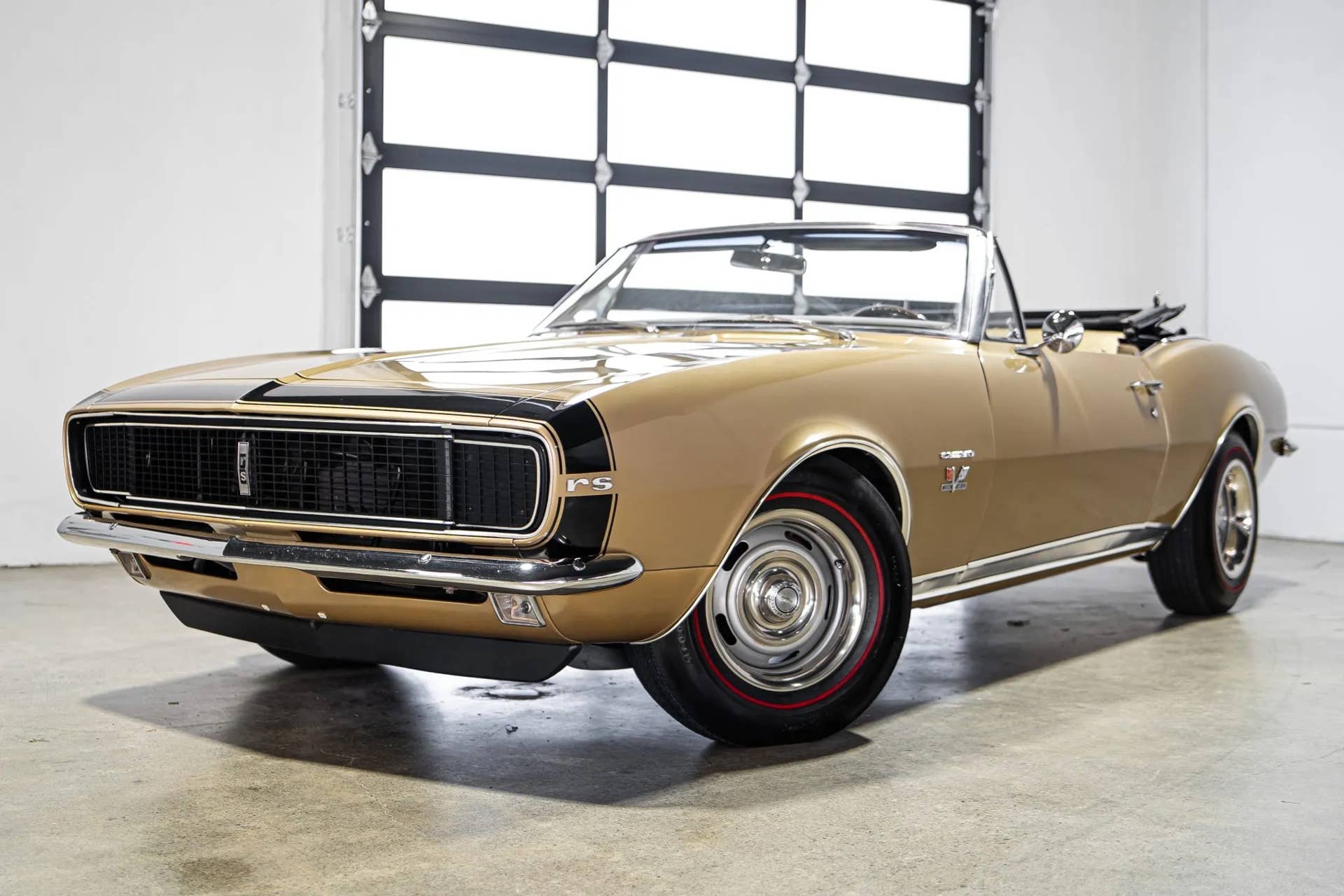
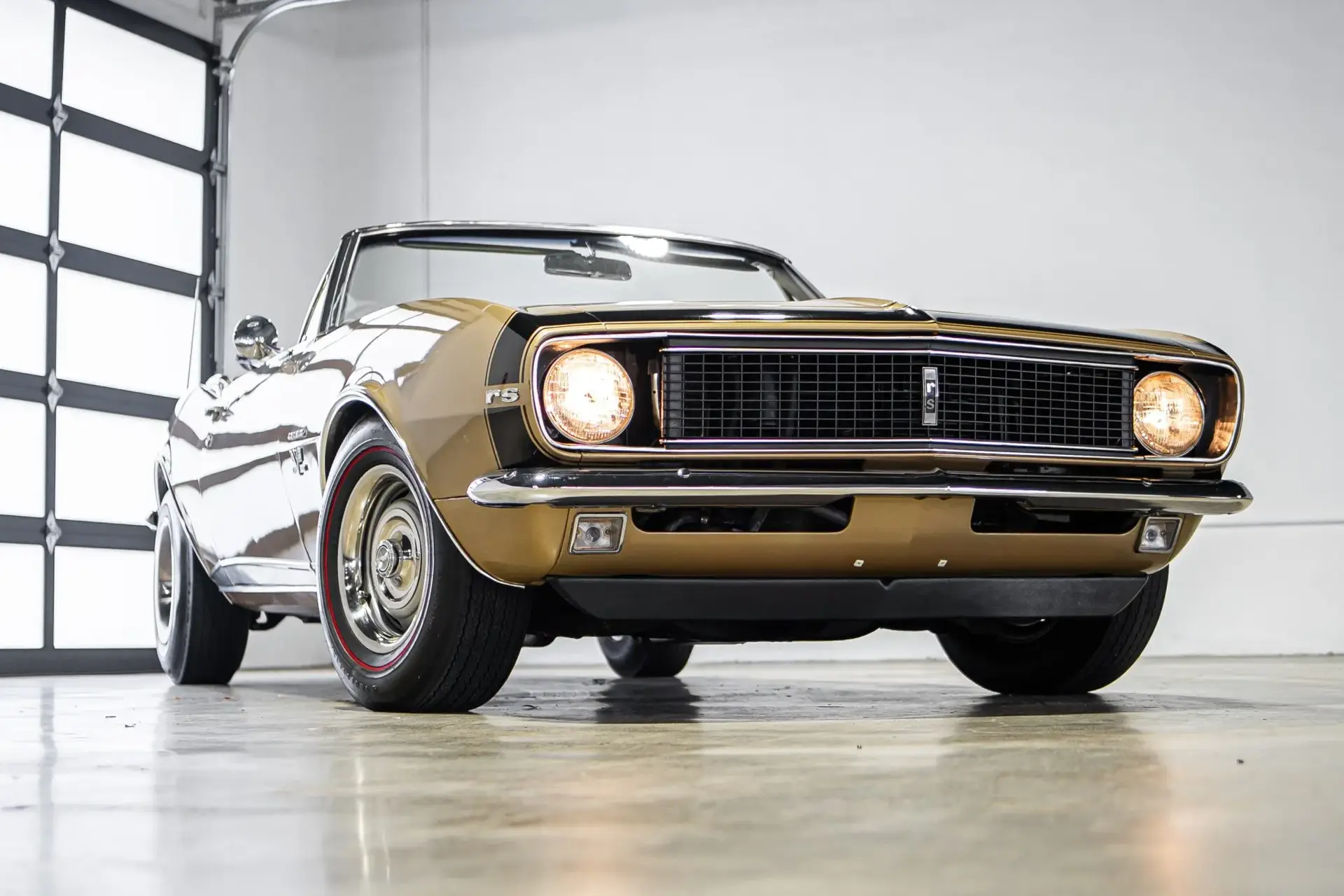
This first-year Camaro still wears its factory-original Granada Gold paint job, which is so good we’re suspicious that it has had a re-coat sometime in the past. Minimalist chrome straight-bar bumpers give a serious, professional look, while the rectangular grille is flanked by large round headlights, both set inside a chrome-trimmed frame surrounded by a black nose stripe. Since this is an RS package, the headlights do have black retracting covers for that extra cool factor, as well as badging on the fenders.
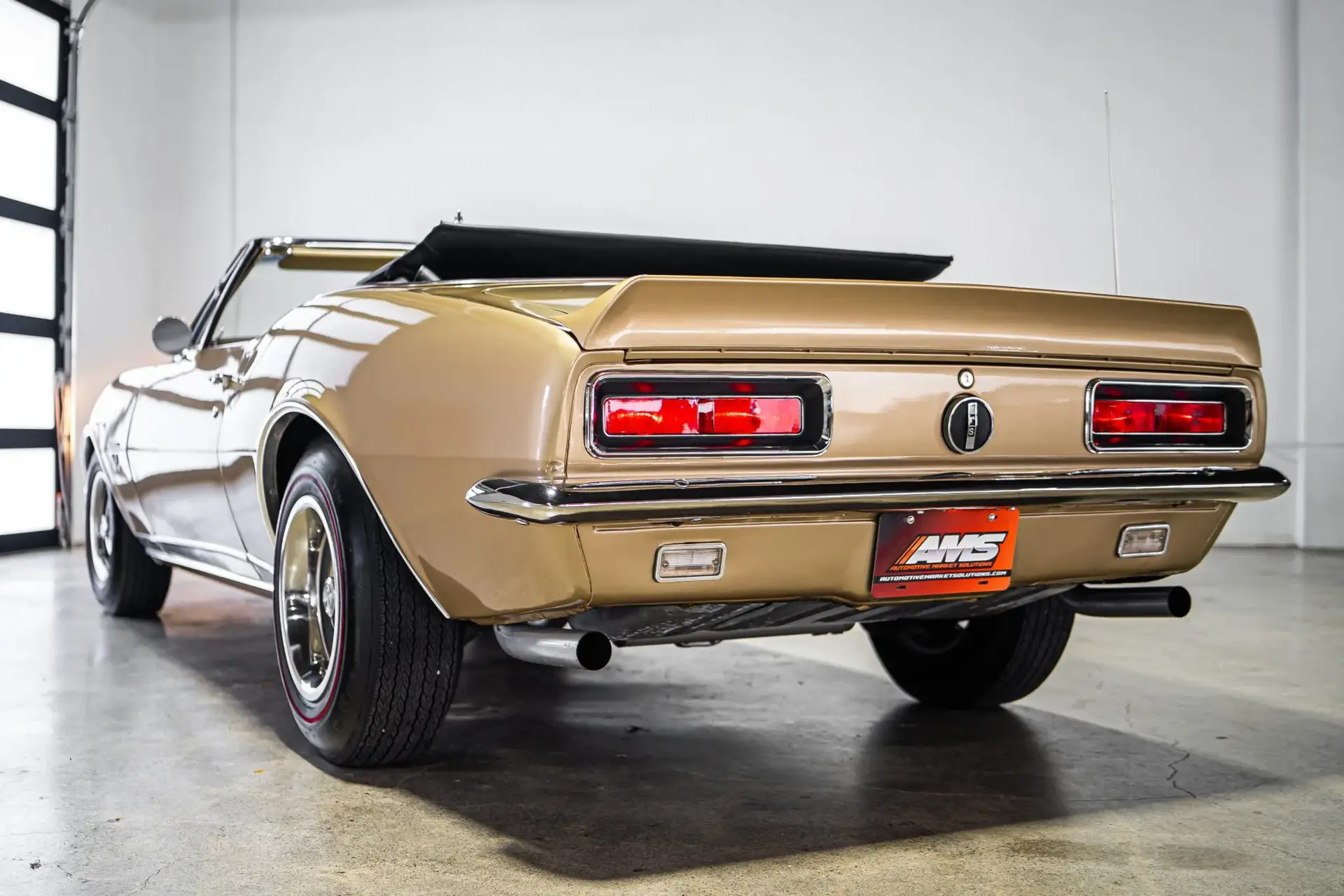
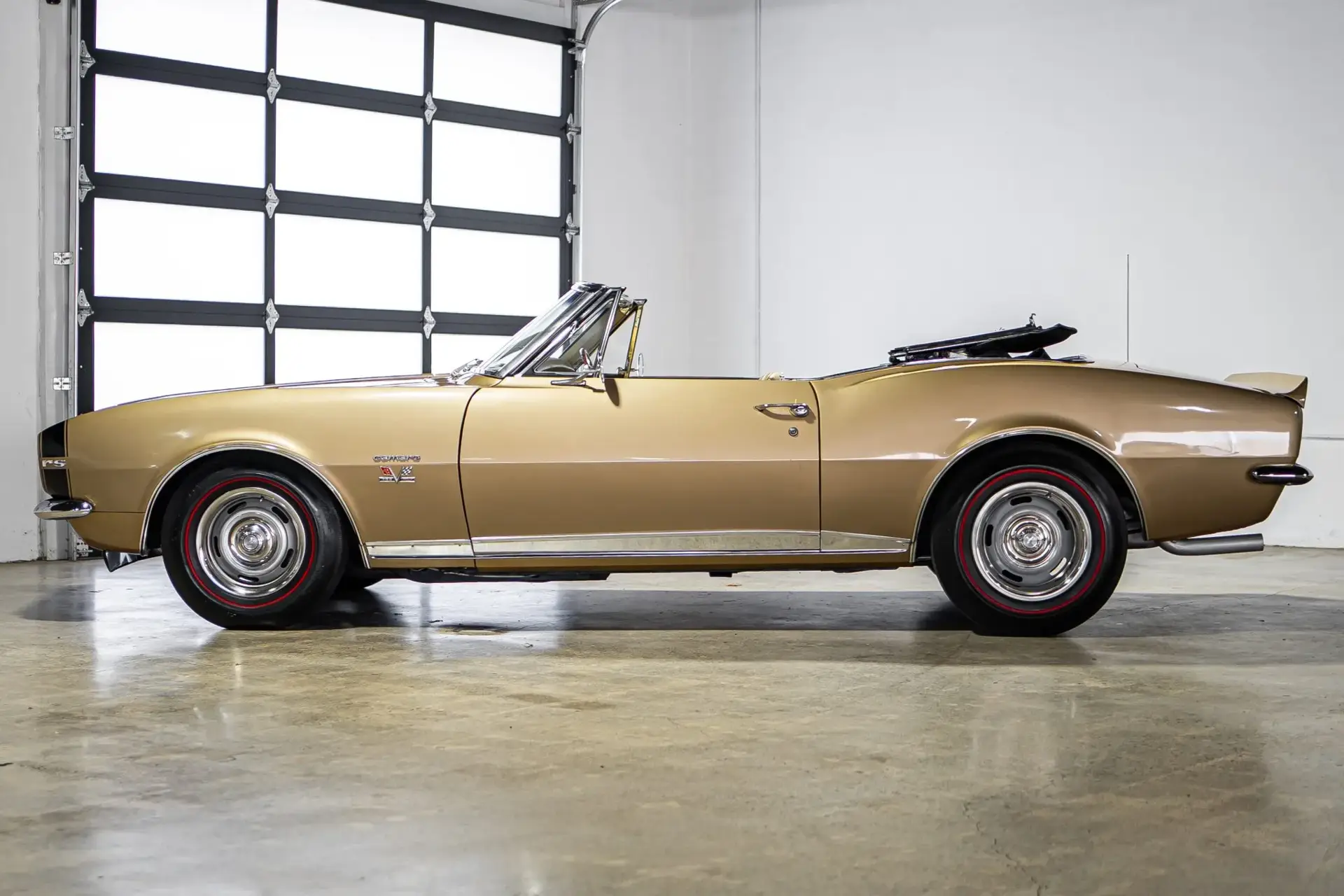
The front has a black air-dam spoiler, with a more conventional raised spoiler present at the rear. A power-operated black soft-top can be raised for poor weather or folded back, exposing it for that convertible feel. Sporty chrome trim around the wheel arches, as well as a rocker along the bottom side-walls, adds a bit of extra refinement. Staggered silver Rally wheels come in 14″ up front and 15″ in back, both with chrome hubcaps and trim rings, and both shod with F70 Firestone Super Sports bias-ply tires at their respective diameters, each with a thin red line along the sidewalls.
This Camaro gold-plated everything
Matching the outside, almost every square inch of the interior is also done in gold. Gold
vinyl on the Strato front bucket seats and rear bench, gold door panels, gold dash, and even gold-yellow carpeting. The center console, pedals, and gauge housings are done in a contrasting black, while silver accents and a white knob on the aftermarket Muncie shifter are the only real contrasts.
Both heat and air conditioning are functional, power steering is integrated, and there is also a retro Delco AM radio built in as well. The tri-spoke steering wheel is wrapped in wood around the rim with silver, slender cut-out spokes. Behind the sheel sit two deep wells for a 0-120 mph speedometer and a tachometer with a 7,000rpm redline. Additional gauges for fuel, coolant, oil, and amperage, as well as an in-built clock, sit in the center console where it meets the dash.

An extra-powerful engine
The original engine’s specs are not known, but the replacement engine is a 396ci (6.5L) V8 that was installed before current ownership, decked out with chrome air cleaner and valve covers. While a 396ci engine was available for this era, it was only offered on the SS package. All of that upgraded power is sent to the rear wheels via a replacement four-speed manual transmission installed at the same time as the engine to replace the factory automatic transmission. Aftermarket chrome finishers are fitted on the dual exhaust, while braking is handled by power-assisted front discs and regular old rear drums. The true mileage is unknown, but the odometer shows 11,000 miles, of which about 1,500 were put on by the current owner.

Final thoughts: This legendary nameplate started here
The Camaro may be put out to pasture in the Pony Car race for now, but it’s come back before and may well come back again. Regardless of the current race, however, it doesn’t take a Chevrolet fanatic to appreciate how impressive these first-generation machines were, and how that enabled them to stand toe-to-toe with the legendary Mustang for decades to come. Everything on this particular example is blinged out in gold, while the guts of the engine and transmission have been upgraded from lower-power and automatic to high-power and manual, respectively. If you are a lover of the early era of American Muscle, or just really like gold, this one’s for you!