
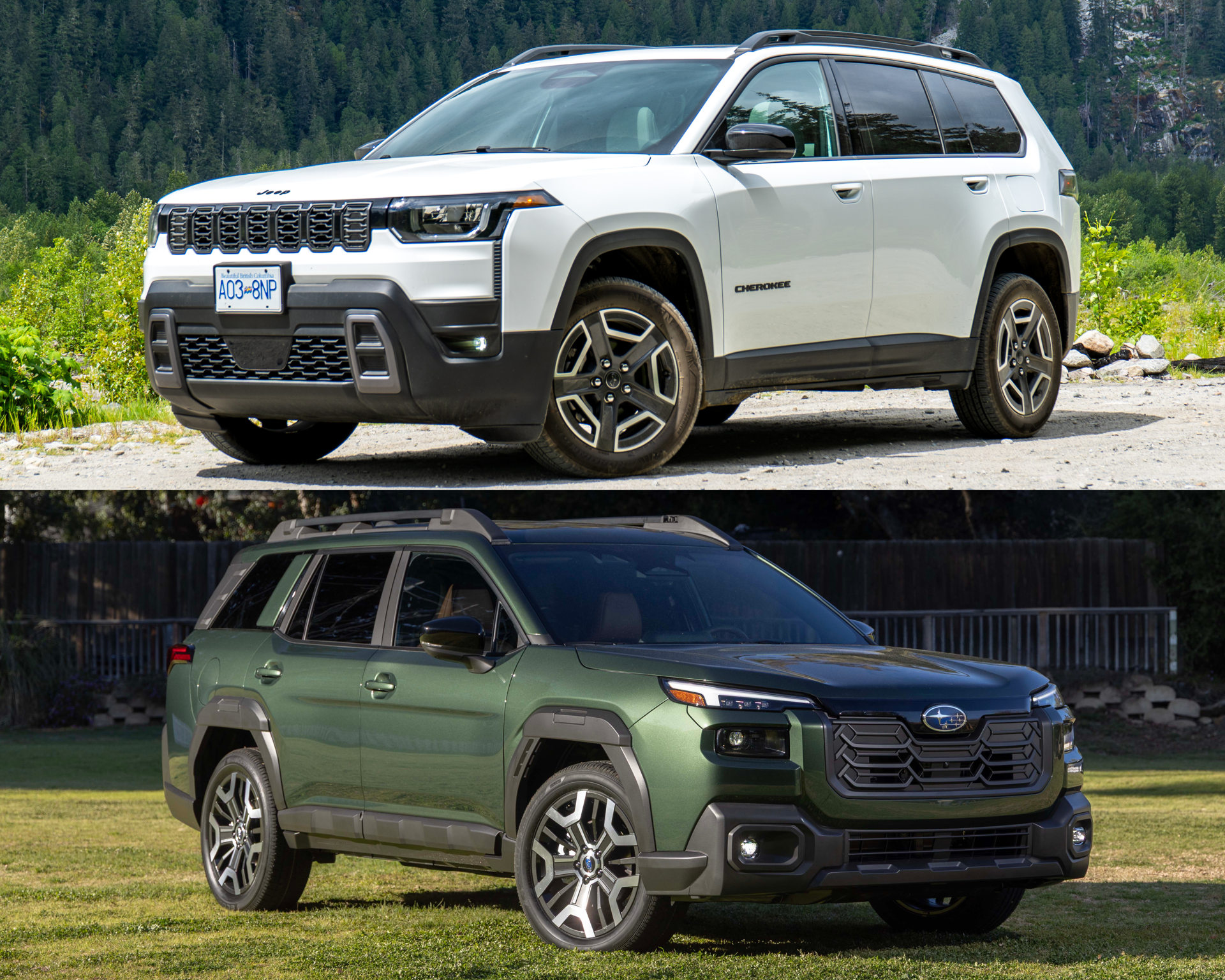
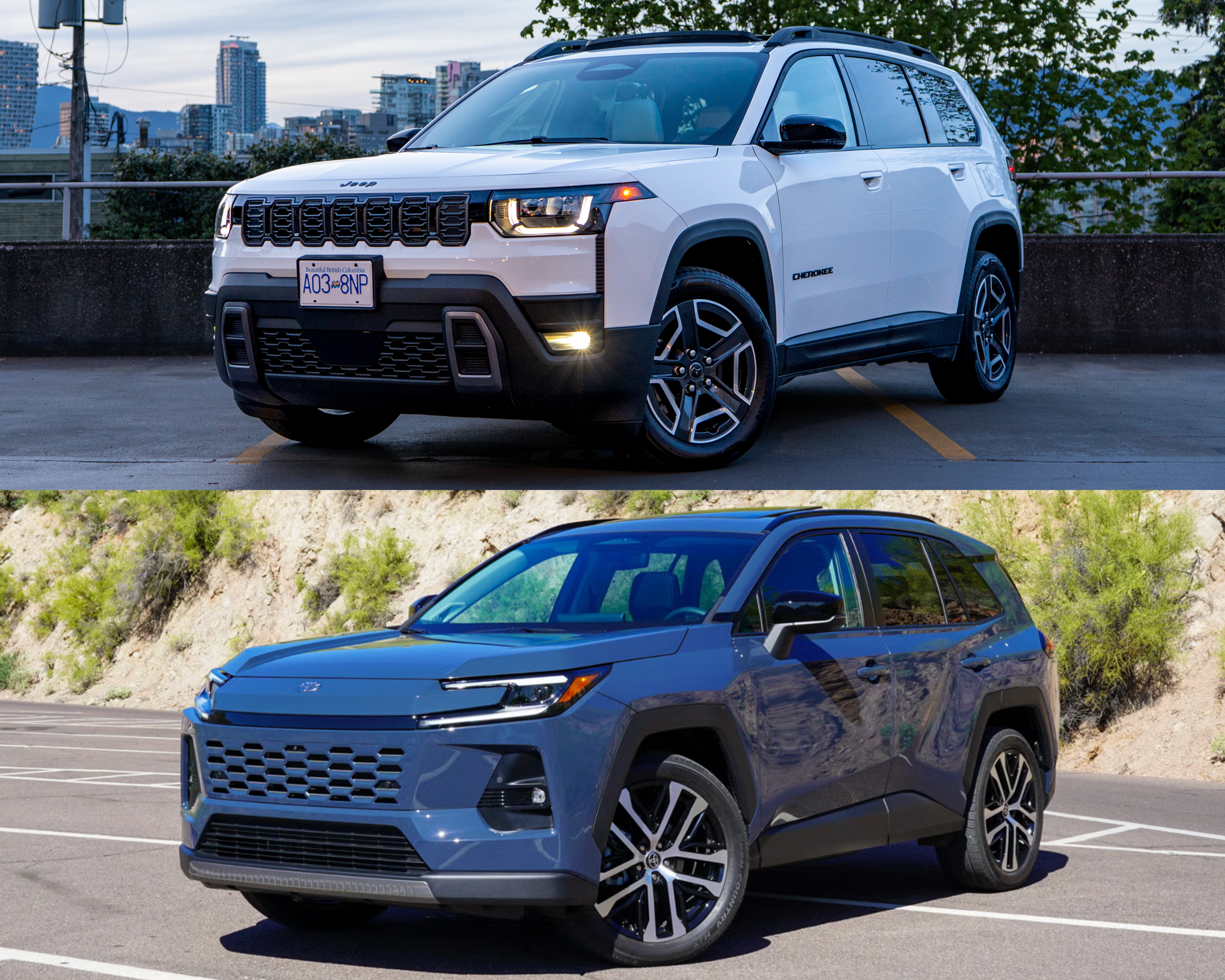
The 2026 Jeep Cherokee and 2026 Subaru Outback are two SUVs that, in very unique ways, feel like they were designed for the same person: someone who owns more than a few pairs of tattered hiking boots, lives somewhere where the weather is entirely unpredictable no matter the season, occasionally traverses into forest service road territory, and still needs to sit in stop-and-go traffic without feeling the consequences of having bought a hardened rock-crawler. The Jeep Cherokee is back after a brief absence, now redesigned from the ground up with a standard hybrid powertrain, standard four-wheel drive, and a boxier, XJ-inspired shape. The Subaru Outback, meanwhile, has entered its seventh generation with the most dramatic restyling in the model’s history, moving further away from its lifted-wagon roots and closer to conventional SUV territory.
I drove the Cherokee for a full week at home in Vancouver, where it dealt with dense city traffic, tight parking lots, the extraordinary Sea-to-Sky Highway, seemingly endless construction zones, and some light trail use around Squamish Valley. I drove the Outback at a Subaru launch event in Sedona, Arizona, where it tackled scenic highways, desert mountain trails, and plenty of red dust, and tried my hand at the Outback Wilderness at NWAPA’s Mudfest event in Washington, where it tackled both a road course and an off-road course over two days, alongside 17 other trucks and SUVs. The Jeep had the advantage of a full week in my normal routine, and the Subaru had the advantage of curated driving routes that showcased exactly what capabilities Subaru hoped to emphasize. Still, having driven both, I’ve come away with a pretty clear sense of how these two adventure-ready SUVs differ and which one makes more sense, depending on what kind of buyer you might be.

Cole Attisha
2026 Jeep Cherokee vs 2026 Subaru Outback specs
| Specification | 2026 Jeep Cherokee Hybrid | 2026 Subaru Outback 2.5 | 2026 Subaru Outback XT / Wilderness |
|---|---|---|---|
| Engine | 1.6L turbo hybrid inline-four | 2.5L flat-four | 2.4L turbo flat-four |
| Output | 210 hp | 180 hp | 260 hp |
| Torque | 230 lb-ft | 178 lb-ft | 277 lb-ft |
| Transmission | Electronic variable transmission | Lineartronic CVT | High-torque Lineartronic CVT |
| Drivetrain | Standard 4×4 | Standard AWD | Standard AWD |
| EPA fuel economy | 39 city / 35 highway / 37 combined mpg | 25 city / 31 highway / 27 combined mpg | 21 city / 29 highway / 24 combined mpg; Wilderness 21 city / 27 highway / 23 combined mpg |
| Ground clearance | 8.0 inches | 8.7 inches | 8.7 inches; Wilderness 9.5 inches |
| Towing capacity | 3,500 pounds | Up to 2,700 pounds | Up to 3,500 pounds |
| Length | 188.1 inches | 191.7 inches | 191.7 inches |
| Width | 74.7 inches | 74.0 inches | 74.0 inches |
| Height | 67.5 inches | 67.5 inches | 68.3 inches for Wilderness |
| Wheelbase | 113.0 inches | 108.1 inches | 108.1 inches |
| Base MSRP | $35,000 | $34,995 | $44,365 Limited XT / $44,995 Wilderness |

Cole Attisha
2026 Jeep Cherokee vs 2026 Subaru Outback interior and cargo dimensions
| Interior / cargo measurement | 2026 Jeep Cherokee Hybrid | 2026 Subaru Outback |
|---|---|---|
| Seating capacity | 5 | 5 |
| Passenger volume | 107.4 cu-ft | 112.3 cu-ft; 111.1 cu-ft with moonroof |
| Front headroom | 40.3 inches; 38.0 inches with moonroof | 41.0 inches; 40.2 inches with moonroof |
| Rear headroom | 40.2 inches; 38.1 inches with moonroof | 40.5 inches |
| Front legroom | 40.2 inches | 43.0 inches |
| Rear legroom | 38.1 inches | 39.5 inches |
| Front shoulder room | 58.5 inches | 57.9 inches |
| Rear shoulder room | 55.1 inches | 57.4 inches |
| Front hip room | 55.1 inches | 55.0 inches |
| Rear hip room | 54.3 inches | 55.1 inches |
| Cargo space behind rear seats | 33.6 cu-ft | 34.6 cu-ft |
| Maximum cargo space | 68.3 cu-ft | 80.5 cu-ft |

Cole Attisha
The Jeep Cherokee feels like the comeback kid
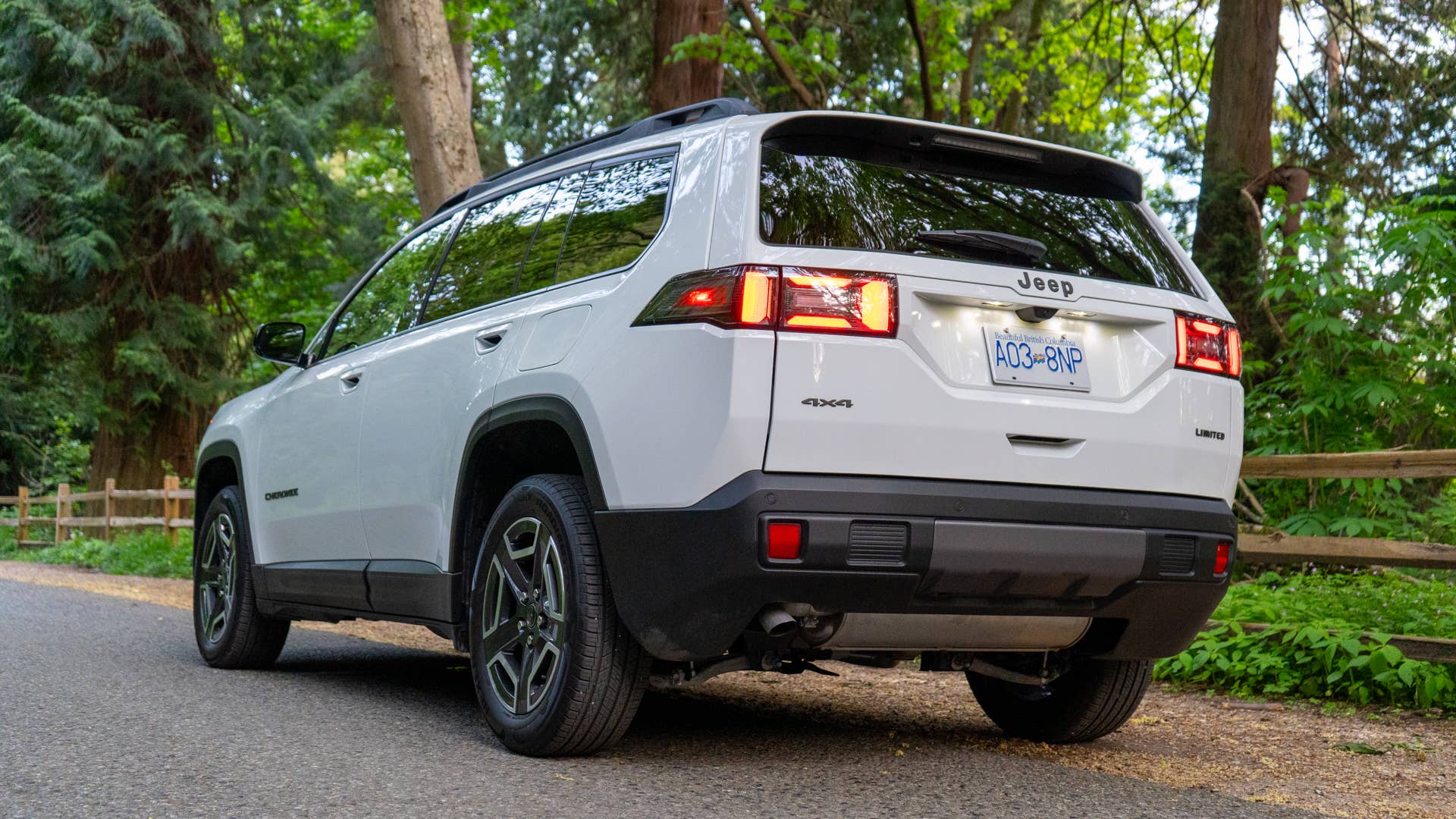
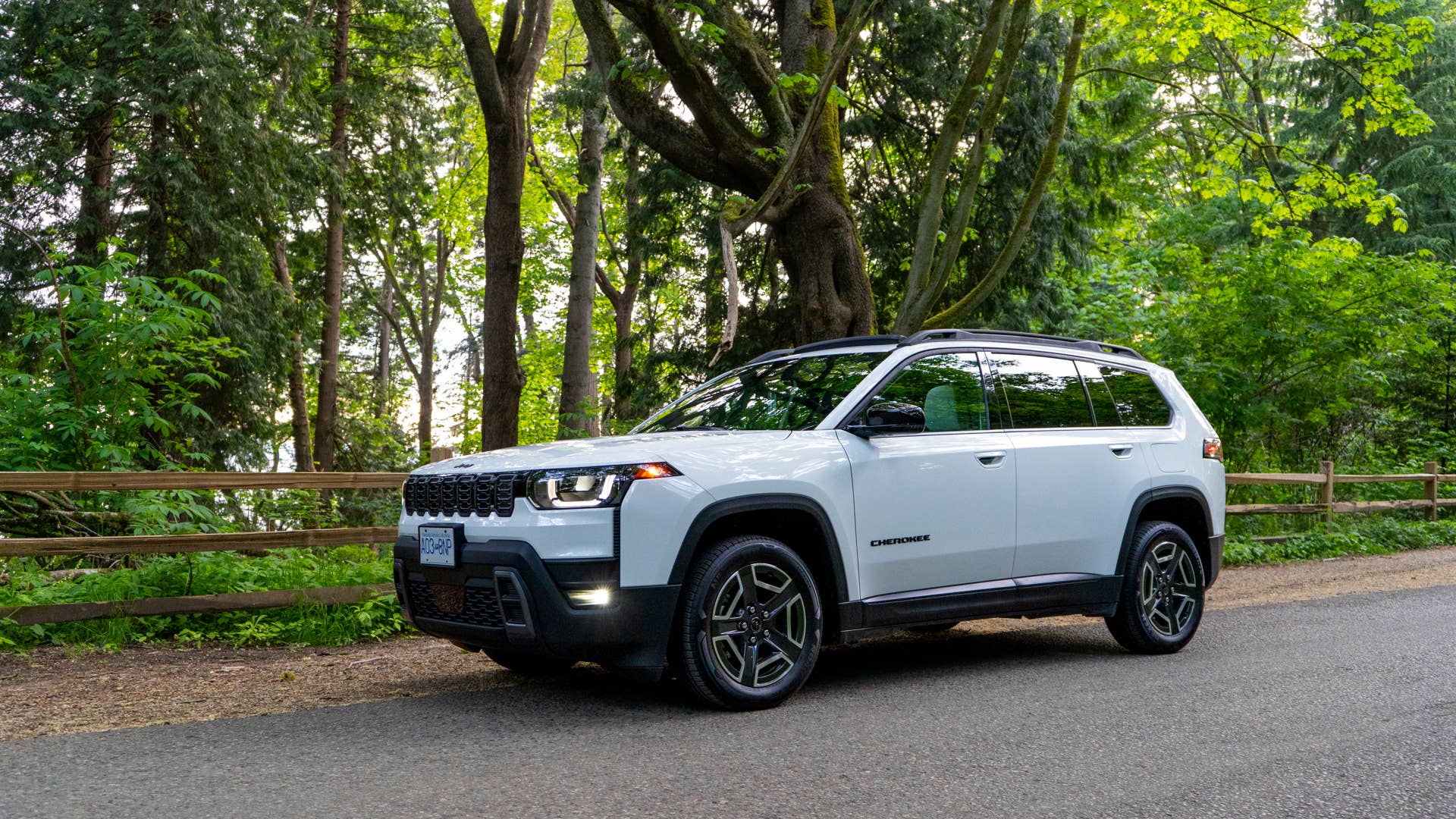
The 2026 Cherokee’s greatest strength is that it feels far less misguided in its approach to the compact SUV segment than its predecessor did. The previous Cherokee was a bit of a awkward thing: it was capable in the right trims and occasionally even charming with the right engine under its hood, but it was visually divisive, especially before its major facelift, and rarely at the forefront of compact SUV consideration. This new one, however, feels like a worthwhile reset. Visually, the Cherokee is much cleaner, and Jeep’s styling choices come across as far more deliberate. It’s boxy, upright, and far more faithful to the spirit of the original XJ Cherokee than the outgoing model ever was. It doesn’t quite recapture the old XJ’s elemental simplicity entirely, but it feels much closer to the idea of a useful, honest, outdoorsy Jeep. The long roofline and relatively low stance also give it a subtle wagon-like quality, which makes this comparison with the Outback feel especially appropriate.
Cole Attisha
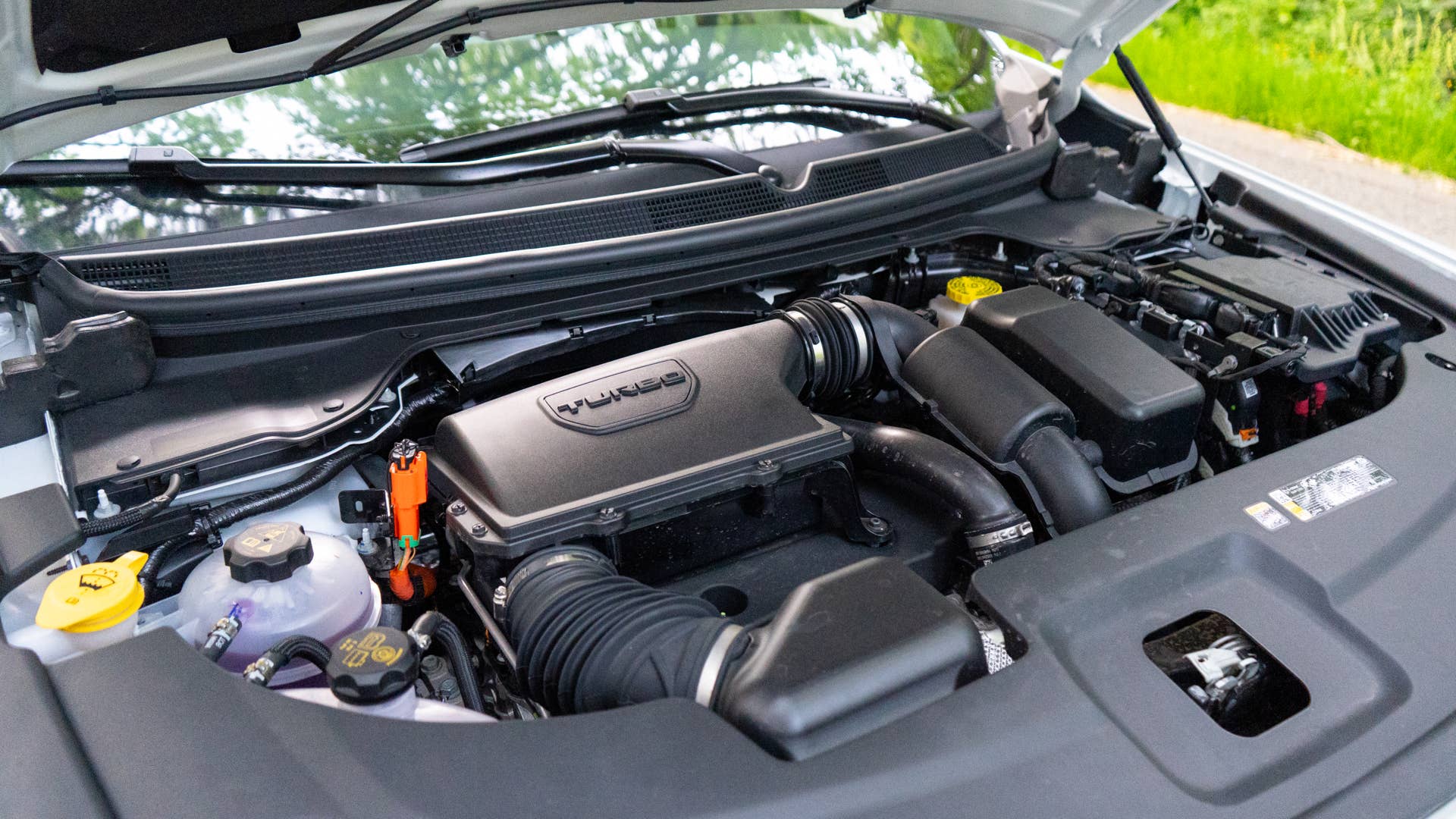
The most surprising part, after living with it for a week, is how much more refined everything feels. The hybrid powertrain doesn’t magically rewrite the Cherokee’s performance credentials, but it works beautifully in daily use. Jeep’s 1.6-litre turbocharged hybrid setup delivers 210 horsepower and 230 lb-ft of torque, and while that will never challenge the muscle of a Subaru Outback XT, it does afford the Cherokee an easy, smooth, low-speed confidence that suits everyday driving extremely well. Around Vancouver, the Cherokee felt relaxed, quiet, and composed. It moved through traffic without the strained, rubber-band-like awkwardness that can define some compact SUVs with conventional CVTs, relying instead on its dual electric motors to transmit power to all four wheels. On the Sea-to-Sky Highway, it was never fast, but it never felt overwhelming either, and handled sweeping corners with real dignity. Power delivery was linear, the hybrid transitions were smooth, and the real-world fuel economy was genuinely impressive. I averaged roughly 36 mpg over the week without even trying, which was almost perfectly in line with its 37-mpg combined EPA rating.
Adventure-ready SUVs might be fun to romanticize, but most of their lives are typically spent commuting, running errands, driving to and from school, heading to Costco, and occasionally being packed with enough outdoor gear to justify fitting one of those cute Thule baskets to their roof racks. In that sense of reality, the Cherokee’s hybrid efficiency gives it a major advantage.

Cole Attisha
The Subaru Outback still understands the assignment
The Outback’s appeal is very different from the Cherokee’s. Subaru didn’t reinvent the formula mechanically for 2026, but it did refine almost everything owners interact with, and visually speaking, it looks unlike any Outback which came before it. The styling is the most obvious source of controversy: the new Outback is taller, boxier, and more SUV-like than before, and I will admit that when it was first revealed, I was not sold on its design. The Outback has always been appealing because it resisted becoming just another crossover. For 2026, it feels like it’s joined the dark side.
In person, the proportions admittedly work better than in photos, though I’m not entirely convinced of any real charm yet. It still has enough wagon-like length to feel distinct, even if the front-end styling is more divisive than the rest of the package. In Sedona, surrounded by red rock and dust, the new Outback’s appeal made a bit more sense. It looks tougher and a bit meaner now, in a way that is far less subtle about its adventure-readiness; instead, making a bit of a show out of itself.

Cole Attisha
The Outback also remains very comfortable, as it always has. Subaru’s changes to cabin refinement are immediately noticeable, especially on pavement. Wind and road noise are better controlled, the ride is compliant, and the whole vehicle has a familiar Subaru quality of being easy to trust. It doesn’t really ever feel sporty, even in the right drive mode, nor does it try to. It feels like a car built by people who know their buyers will load it with wet dogs, mountain bikes, ski gear, Clif bars, muddy boots, and Stanley cups before ever daring to plant their right foot to the floor.
I drove both the naturally aspirated 2.5-litre and turbocharged 2.4-litre versions in Arizona. The 2.5-litre is adequate, but just barely. With 180 horsepower and 178 lb-ft of torque, it gets the job done, but it rarely makes the Outback feel eager to move. The turbocharged XT and Wilderness models, with 260 horsepower and 277 lb-ft of torque, are much more satisfying to operate. If you find yourself regularly driving through mountain passes, carrying more than a few passengers, or simply prefer not to anticipate every highway overtake like a chess move, the turbocharged Outback is the one to get.
Cole Attisha
On-road driving: Cherokee efficiency vs Outback confidence
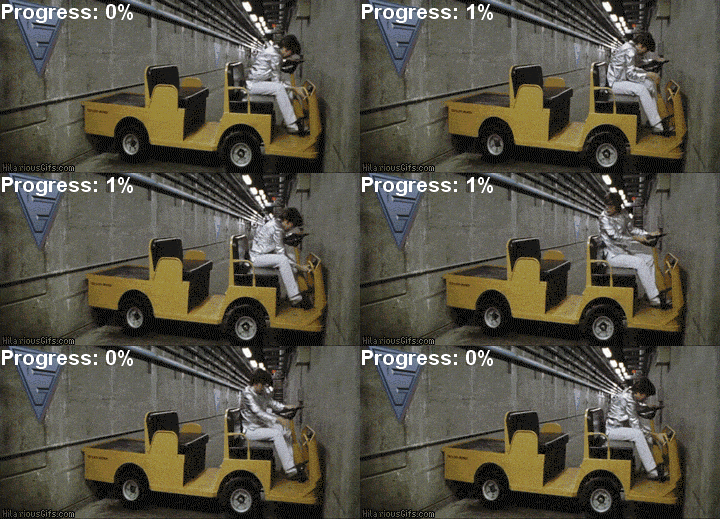
On pavement, the Cherokee simply feels more modern because of its hybrid system. Its torque delivery is smoother at low speeds, its fuel economy is dramatically better than the Subaru’s, and the overall driving experience is impressively refined for a Jeep compact SUV. It also feels structurally solid, likely helped by its STLA Large underpinnings. For daily use, it has a calmness that gives it a surprisingly premium feel. The Cherokee’s major on-road weakness is, frankly, its abysmal turning radius. In normal suburban and urban use, this hinders ease of use far more than people might expect. Tight parking structures, narrow alleyways, awkward U-turns, and even cramped trailhead lots quickly expose the Jeep’s maneuverability problem. There were many times when I felt like Austin Powers attempting a 12-point hallway U-turn in that yellow buggy. It isn’t necessarily a dealbreaker, but it is absolutely something buyers should be aware of during a test drive.
GIPHY
The Outback, on the other hand, feels more familiar from behind the wheel. Its steering, ride, and powertrain behaviour are recognizably Subaru, especially if you have driven recent Outbacks, Foresters, or Crosstreks. The CVT is better behaved than older Subaru units, and the simulated ratios help make it feel less like there’s a blender stuck under the hood. Still, the Cherokee’s hybrid system simply feels more advanced in normal driving. Where the Subaru counters, though, is with its overall sense of stability and confidence. The Outback feels like it’s been better built to endure long distances, bad weather, and poorly maintained pavement. Even if the base engine is a bit uninspiring, the chassis has a relaxed, durable character that makes it very easy to live with. The turbocharged versions add the shove the chassis deserves, though they do so at the expense of poorer fuel economy.

Cole Attisha
Off-road capability: Subaru has the bag
The Cherokee is still relatively capable for a compact crossover. With standard 4×4, Selec-Terrain drive modes, 8.0 inches of ground clearance, and a 3,500-pound towing capacity, it has real credibility for light off-road use, snow-covered roads, forest service trails, and weekend adventure duties. For the average buyer, that may very well be enough. But Subaru has spent decades training its customer base to expect more from an all-wheel-drive family vehicle, and the Outback reflects that. Every 2026 Outback comes standard with all-wheel drive, active torque vectoring, X-MODE, hill descent control, and 8.7 inches of ground clearance. The Wilderness pushes that clearance to 9.5 inches and adds more trail-focused equipment.

Cole Attisha
In Sedona, even non-Wilderness Outbacks handled rougher terrain with impressive ease. The suspension absorbed small rocks and uneven surfaces comfortably, and the X-MODE system worked smoothly without feeling overly aggressive. Subaru’s off-road philosophy is less about shouty capability and more about unwavering competence, even if the Outback’s recent redesign attempts to rewrite these rules to some extent. The Jeep name still carries enormous off-road credibility, and the upcoming Cherokee Trailhawk (confirmed by Stellantis) will likely change the tone of this comparison. But as these 2026 models stand, the Outback—especially the Wilderness—feels like the better-developed soft-roader.
Cole Attisha
Interior and technology: both are much better than expected
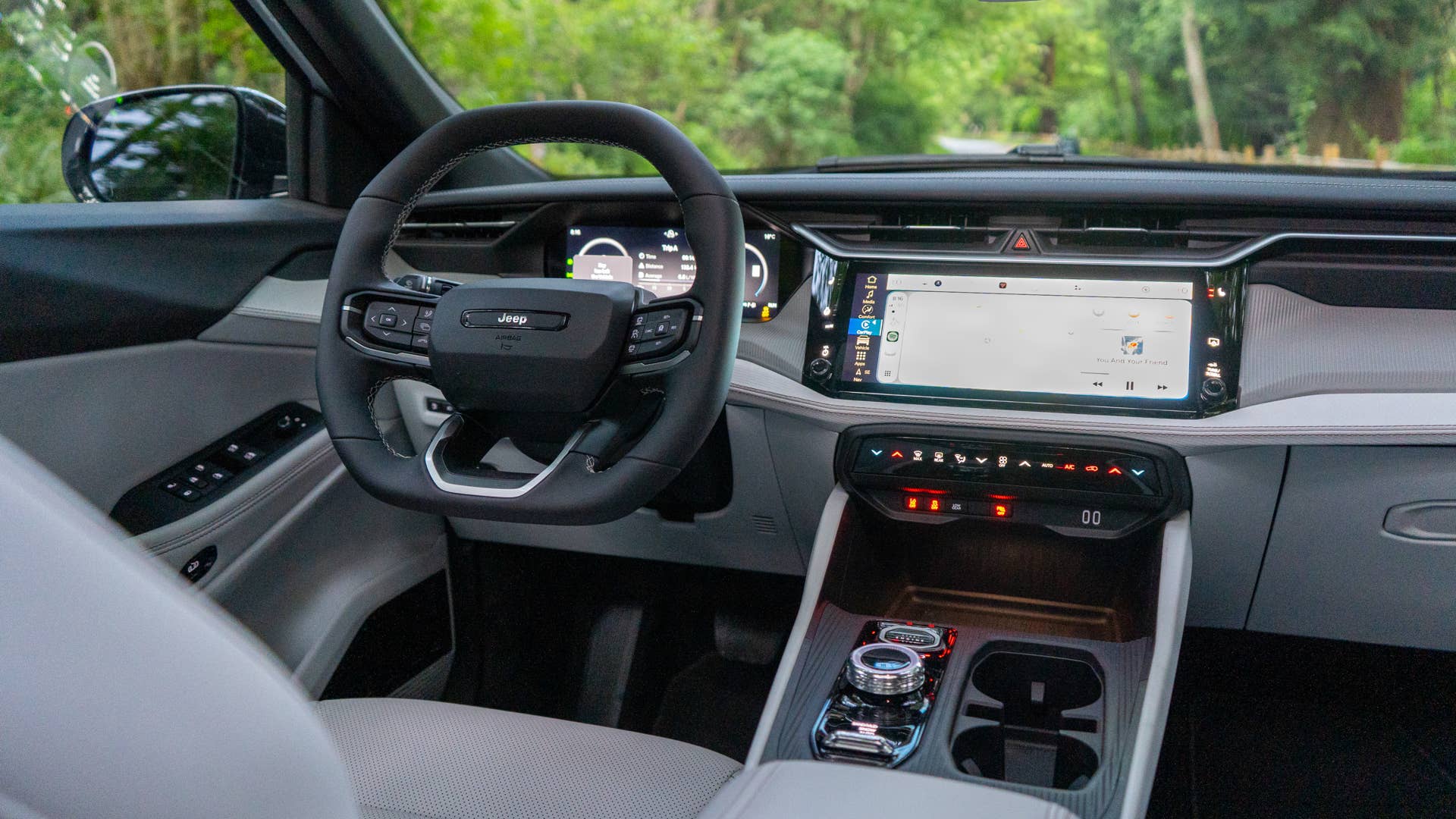
The Cherokee’s cabin is one of its biggest surprises. My Limited-trim tester felt genuinely premium, with a strong sense of occupant spaciousness, solid material choices, and a layout that made the vehicle feel legitimately more expensive than its segment positioning suggests. The 12.3-inch Uconnect 5 touchscreen is responsive and logically organized, wireless Apple CarPlay and Android Auto are standard, and the 10.25-inch digital cluster gives the cabin a truly polished feel.
Subaru
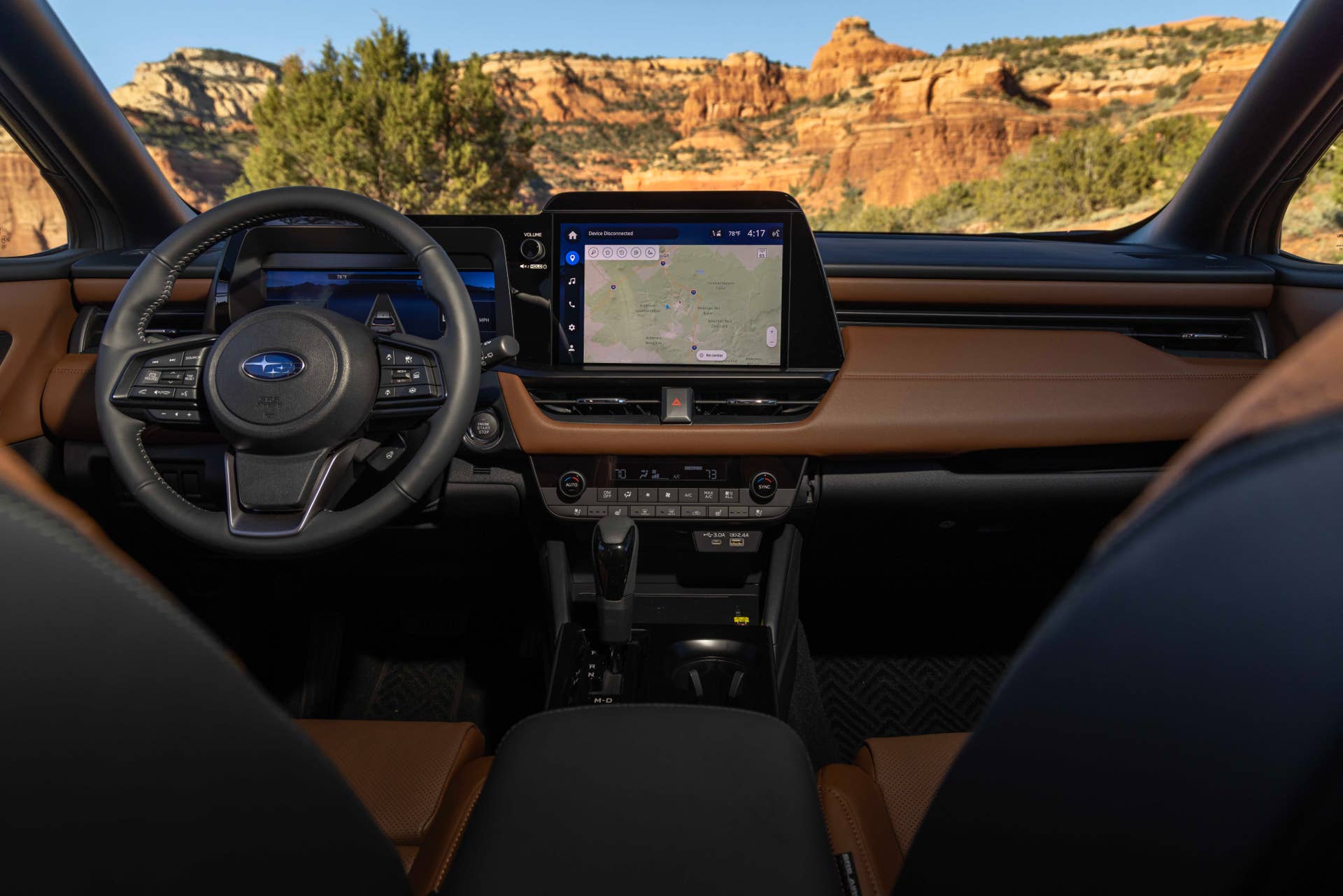
The Outback’s interior improvements are just as meaningful, but the overall vibes lean towards a different direction. Instead of chasing that upscale feel, the new Outback feels more functional and more ergonomic than it has for quite some time. Subaru finally addressed one of the biggest frustrations with the old car: the over-reliance on screen-based climate controls. Physical HVAC controls have returned, and they make an enormous difference while on the go. The new infotainment system is also much faster and easier to use, while the cabin generally feels quieter and more thoughtfully arranged. The Subaru also wins in terms of pure interior space. It benefits from greater passenger volume, slightly more rear legroom, more cargo space behind the second row, and a much larger maximum cargo figure with the seats folded—a critical trait for those planning to sleep on inflatable mattresses inside the vehicle. The difference between 68.3 cubic feet in the Cherokee and 80.5 cubic feet in the Outback is far from trivial if you plan on living out of one for a weekend.
Cole Attisha
Fuel economy and value: Jeep lands a major punch here
This is perhaps where the Cherokee makes its strongest case, aside from its overall more upscale feel. The Outback might be more spacious and more thoroughly developed for soft-road adventure use, but the Cherokee’s standard hybrid powertrain gives it a serious efficiency advantage. At 37 mpg combined, it operates in a different world entirely from the gas-only Outback lineup. The base Outback’s EPA figures of 25 city and 31 highway mpg are acceptable, but no longer exceptional in a segment increasingly defined by hybrid models. The turbocharged versions are quicker and more desirable, but their efficiency drops even further. The Wilderness, for all its capability, is rated at 21 city and 27 highway mpg.
That gap will become more apparent with every week spent driving, not just during long road trips. It also gives the Cherokee a stronger philosophical position in 2026. Jeep managed to make its comeback SUV a standard hybrid without forcing buyers into a plug-in setup or sacrificing the basic outdoorsy capability people expect from the badge. That is precisely the kind of progress buyers in this segment are looking for. Pricing, however, is more nuanced. The Outback starts with almost the exact same base MSRP, minus a fiver, but the Cherokee’s standard hybrid powertrain and 4×4 system will inevitably offer fuel savings that the Outback cannot match. Once you start comparing better-equipped trims, the Jeep becomes even more compelling than expected. The Subaru still has the advantage of brand trust, strong resale value, and a long-standing reputation for building vehicles that outdoor families genuinely use, whereas the Jeep has been tasked with rebuilding that trust. Whether greater dependability or superior efficiency is more important to you might be the key factor in determining which model offers better value at a near-identical price point.
Cole Attisha
Which one would I buy?
If this were purely about daily driving, efficiency, interior polish, and powertrain refinement, I would admittedly lean toward the 2026 Jeep Cherokee Hybrid. It is smoother, thriftier, more luxurious than expected, and more convincing as a comeback than I had anticipated. It feels like Jeep has actually acknowledged where the old Cherokee fell short and built a legitimately worthwhile replacement. But if this were about maximum practicality, long-distance confidence, cargo flexibility, and proven soft-road capability, I would lean toward the 2026 Subaru Outback. It has more space, more ground clearance, a better-developed adventure identity, and a more diverse range of trims for buyers who want anything from family-hauler comfort to Wilderness-grade trail confidence.
The most important takeaway here might be that the Jeep and Subaru do not necessarily approach the adventure-ready compact SUV segment in the same way, but both understand that buyers want something more interesting than another anonymous family hauler that happens to have all-wheel drive. One brings hybrid efficiency and renewed swagger to a Jeep that holds true enough to its brand’s mission. The other brings space, confidence, and a deeply established wilderness-ready identity to a loyal buyer base that will either appreciate the Outback’s radical new styling or perhaps lament its departure from its humble station-wagon roots. For me, the Cherokee is the one that surprised me more, even if the Outback is the one I would trust the further I trekked into the backcountry. So, ultimately, I don’t see one clear winner and one clear loser here. What I do see are two adventure-ready SUVs that actually deserve the label and represent some of the best options yet for their respective nameplates. Whether you can look past their new-school styling, however, is entirely up to you.
About the author

Cole Attisha
Staff Writer, Autoblog