
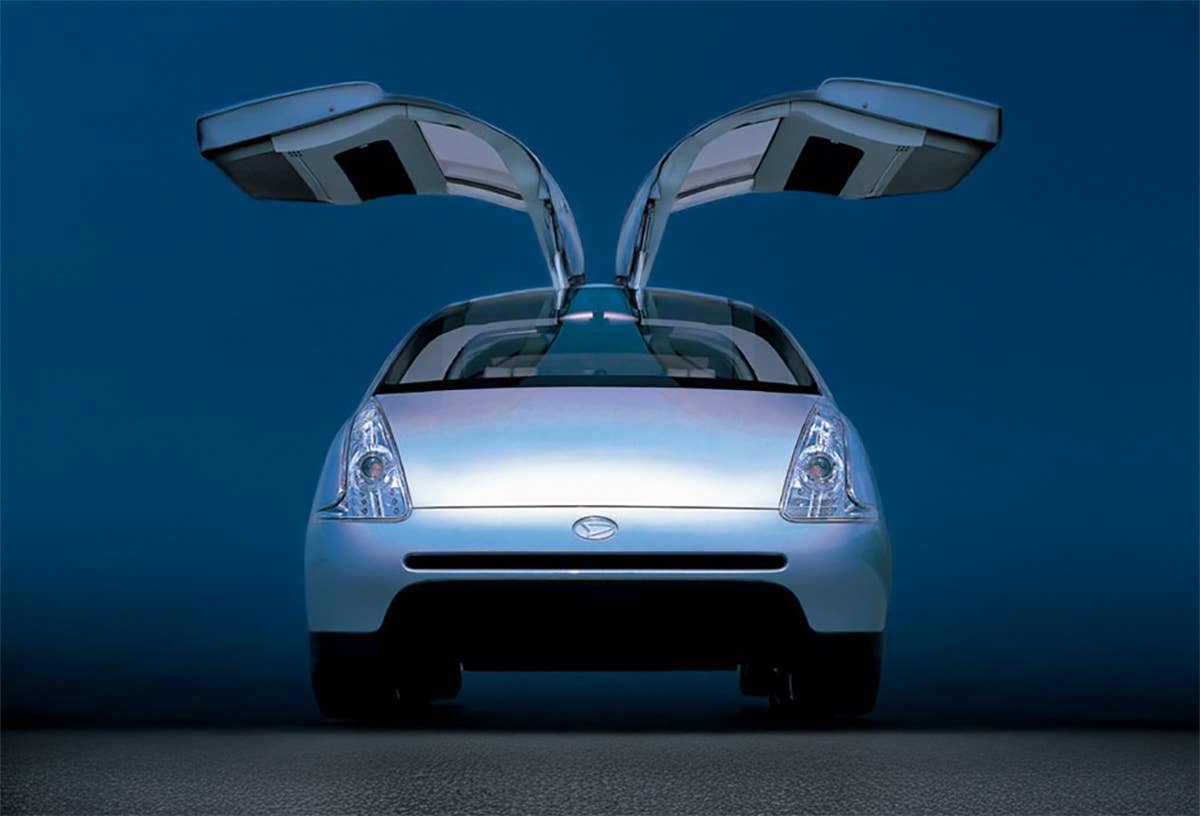
A Little Coupe Made for Efficiency
Daihatsu may be best known as Toyota’s kei car division, quietly handling the brand’s smallest and most efficient models. It’s the company behind the Copen, that playful two-seater roadster, sort of Japan’s miniature sports car.
But beyond the Copen, Daihatsu’s engineers have a long history of experimenting with efficiency-focused prototypes that rarely make it to market. One of the most ambitious of those efforts was the UFE-II, a concept shown at the 2003 Tokyo Motor Show that aimed for an almost unbelievable fuel economy figure of 141 miles per gallon.
Daihatsu
Slippery As a Supercar
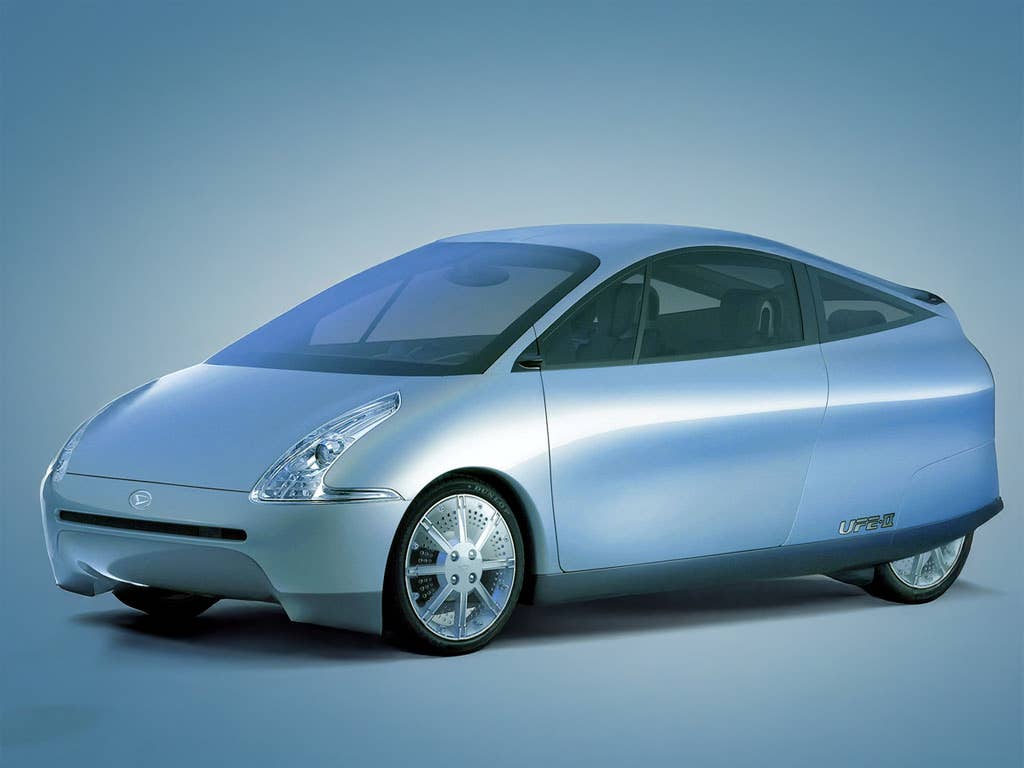
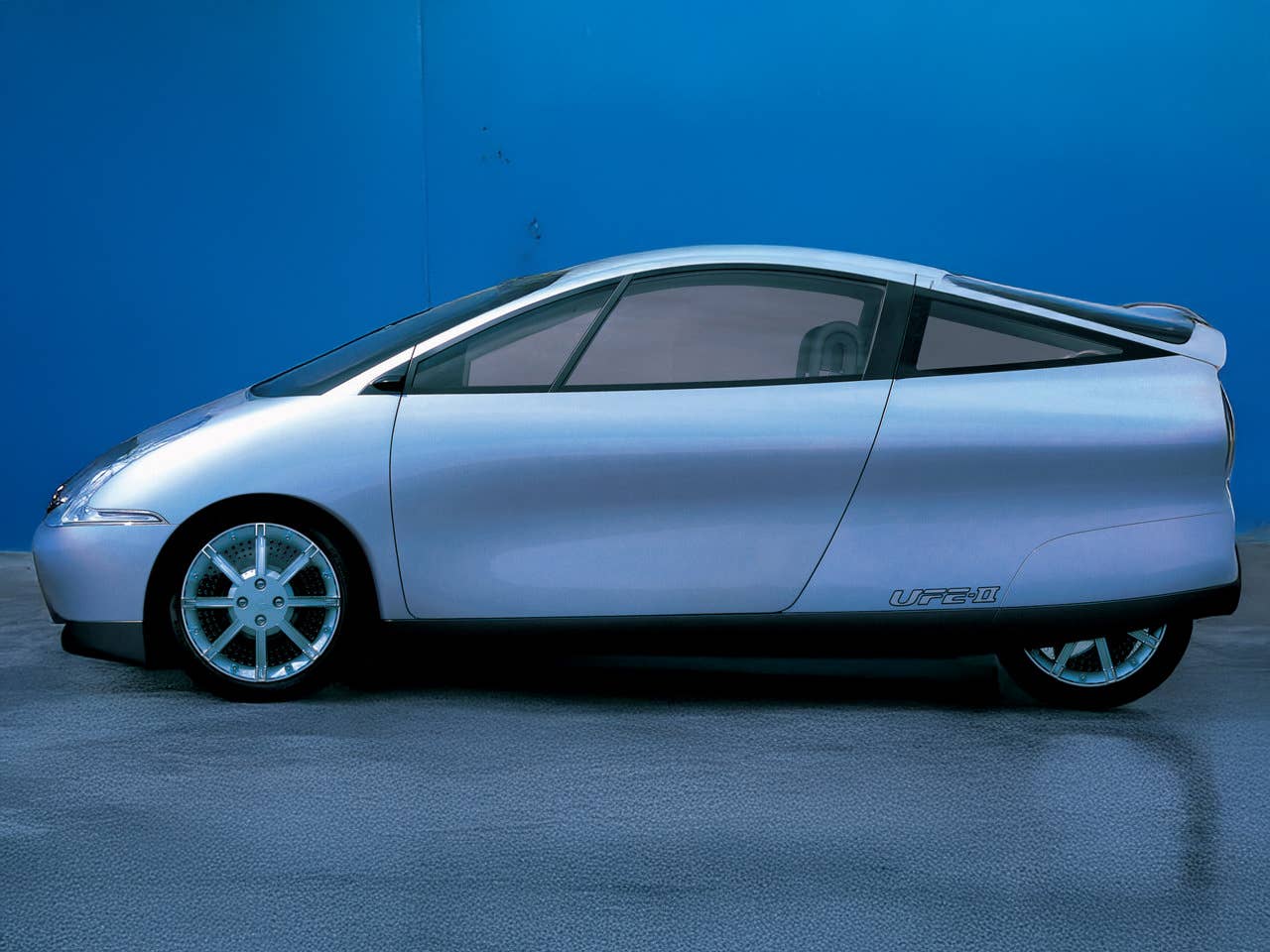
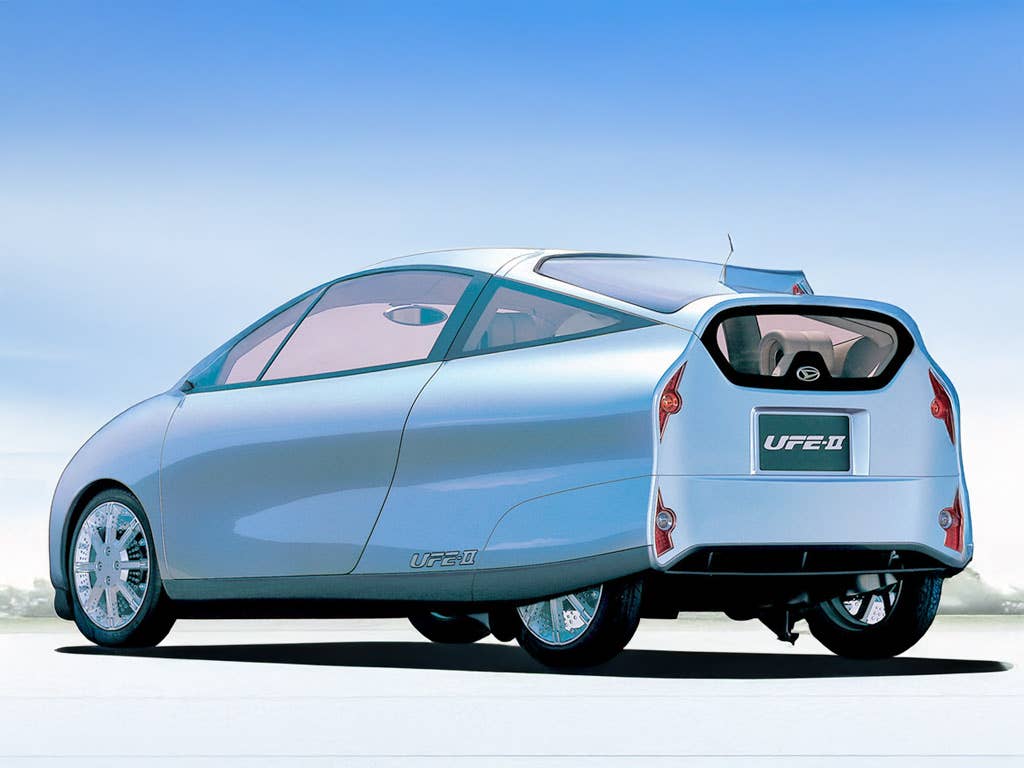
As the name suggests, the Ultra Fuel Economy II was a concept car built around a single obsession: extracting every drop of energy possible. The UFE-II was a four-seat micro coupe measuring just about 133.7 inches long, 58 inches wide, and 47.2 inches tall. It weighed roughly 1,257 pounds, thanks to a structure made almost entirely from aluminum and resin. Its teardrop-shaped silhouette helped it achieve an astonishing drag coefficient of 0.19, giving it the slipperiness of a supercar.
Underneath, the UFE-II used a 660cc Atkinson-cycle three-cylinder engine paired with two electric motors and a nickel-metal hydride battery – essentially a scaled-down version of Toyota’s hybrid system at the time. The setup was tuned purely for efficiency, not speed. Its gullwing doors, digital instrument panel, and drive-by-wire steering made it look and feel far more advanced than anything else in the kei segment.
Daihatsu
Never Sold, but Not Forgotten
Despite its forward-thinking design, the UFE-II never reached production. The main obstacle was cost: its lightweight materials, hybrid complexity, and unconventional doors would have pushed it well beyond the price ceiling for Japanese kei cars. Around the same period, Suzuki’s hybrid Twin struggled in showrooms, which likely reinforced Daihatsu’s caution.
Even so, the lessons learned from the UFE-II didn’t disappear. Its aerodynamic philosophy and lightweight engineering influenced later models such as the 2006 Sonica and the 2011 Mira e:S, the latter becoming a genuine success with an achievable 70.6 mpg rating.
Daihatsu
About the author

Jacob Oliva
Senior Editor, Autoblog