
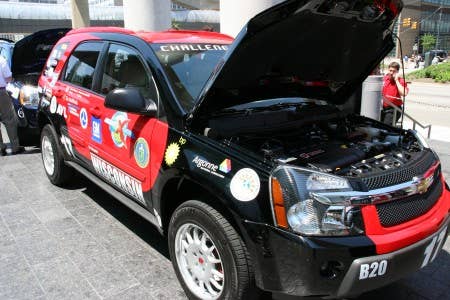
At the award press conference for Year three of the Challenge-X competition General Motors provided the opportunity for attendees to ride and drive in some of the competitor vehicles. I had time to drive the vehicles from Michigan Tech University, University of Wisconsin-Madison and the Ohio State University. The UWM and OSU vehicles both used the same 1.9L Opel diesel engine as the winning team from Mississippi State. The Michigan Tech team used a Ford 2.0L gas engine.
All three vehicles used a through-the-road hybrid configuration. That means that the internal combustion engine drove the front wheels through a conventional automatic (MTU, OSU) or manual transmission (UWM) while an electric motor drove the rear wheels. The only mechanical connection between the ICE and electric drives is through the tires and road.
Continue reading after the jump
Featured Gallery
Should the average car buyer be as bullish on General Motors as billionaire investor Warren Buffet?
Buffet has upped his stake in General Motors to 25 million shares in the fourth quarter. But it’s questionable whether or not GM will be able to keep up its solid results. Even though it posted its second straight year of earnings in North American, its European brand Opel is dragging things down.
American taxpayers should have an interest in what’s happening at GM, since we still own a big chunk of it. The government has announced its plan to unwind its ownership stake in GM this year, a process that may drag into early 2014.
But is GM on solid footing to go it alone? To not get itself back into the financial soup that caused it to fold in 2009?
From a product standpoint, we think on the whole that GM’s cars and trucks have never been better. But there are still some examples of vehicles that they have launched that have serious problems and have disappointed. Check out our gallery for three GM losers and winners, and why we have dubbed them thus.
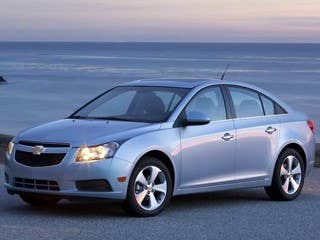
The Chevy Cruz has been lauded by several automotive outlets, including AOL Autos. Our favorite version is the Cruze Eco, which gets 42 mpg to a reduction in weight and a turbo-charged 1.4 liter inline four cylinder engine. It also has a six-speed manual, which is not everyone’s cup of tea, but we like it. We saw highway fuel economy of 50 mpg when we were cursing in sixth gear. That’s just awesome with a non-hybrid and non-diesel car.
The Cruze does, of course, come with an automatic transmission as well. And this year, the compact sedan will also come as a diesel. Yup. Chevy is finally giving us a clean-diesel passenger car, just like Volkswagen and other Germans have been offering U.S. drivers for years.
The Cruze is a taut driver, with sufficient backseat room and trunk space for a car in this class. It stacks up perfectly well to stalwarts in the category, such as Toyota Corolla and Honda Civic, and many of our staff prefers it to both of those models. Chevy nailed it with the Cruze. The company should put the team that engineered and planned it on the next Malibu sedan to make that car as good.
The base Cruze starts at $17,130, and goes up to $23,550 for the top of the line six-speed automatic LTZ trim level. The sweet-spot for value here is the Cruze ECO automatic for $20,875.
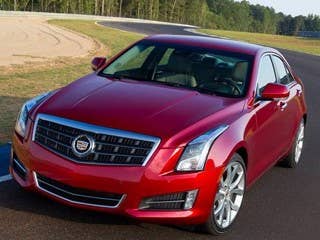
A new entry level Cadillac to take on the BMW 3 Series. It is rear-wheel drive, like a BMW 3 Series, and the styling is very modern and sleek. It handles and accelerates like a first-tier sports car. And it was good enough to be North American Car of the Year, as voted on by fifty journalists.
The only thing holding back the ATS will be a less than wonderful dashboard control set-up that has replaced knobs and witches with capacitive-touch controls that can at times be frustrating and badly functioning.
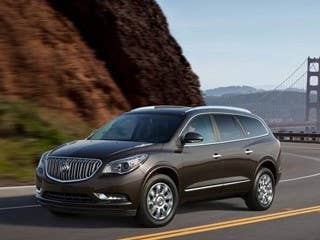
This is a full-sized crossover, a kind of vehicle that GM pioneered after it got rid of its truck-based SUVs like the old Chevy Trailblazer.
The Enclave sits seven like a minivan, but without the sliding doors. The ride is more car-like than van like thanks to the front-drive (all-wheel-drive is optional) set up.
Buick is on a comeback roll, and it started with the Enclave, which is about to get a major upgrade and redesign.
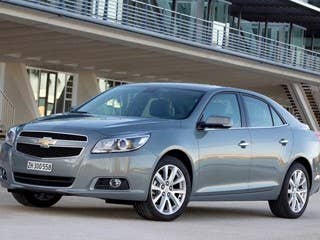
It’s not that the Chevy Malibu is a rotten vehicle. It’s not bad at all. It’s pretty okay. But that’s not a ringing endorsement, is it? It also came out around the same time as an all-new Nissan Altima, Ford Fusion, Honda Accord and not long after an all-new Toyota Camry. And all of those mid-sized sedans had nicer interiors, cooler styling and better performing engines.
It’s tough to figure out how GM could have bolloxed such an important new car, though perhaps going through critical engineering while also going through bankruptcy impacted it.
Chevy is choking on a 150-day-plus supply of Malibus, and is busy, we hear, trying t a quick, emergency upgrade to aspects of the car they can still change before redesigning it again. We hope GM succeeds. But we also lament the choice of sticking with the Malibu name. It sounds so 1970s.
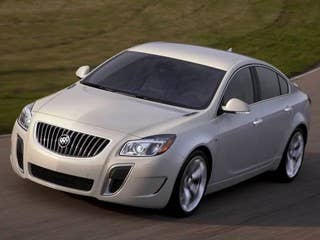
We questioned the comeback of the Regal name for what is a pretty nice new sedan. The Regal, after all, became everyone’s least favorite rental car in the 1990s as GM flooded rental fleets with base model Regals.
But when it debuted, we were impressed, especially with the curious decision to offer a turbo-charged manual shifter as as option.
The Regal is battling in a bit of a no-man’s land price -wise. It’s more expensive than mid-size sedans like Chevy Malibu and Honda Accord, but less than models like Toyota Avalon and Buick LaCrosse.
And then GM went and gave Buick dealers a sedan we like a lot, the Verano, which is priced less than the Regal. Since the Verano arrived, the Regal has been dying on dealer lots. It’s not that we don’t ilk the Regal, it is that we question the product planning chops at GM these days off the decision to give dealers both the Regal and Verano and not think the lesser priced one would cannibalize the more expensive sibling.
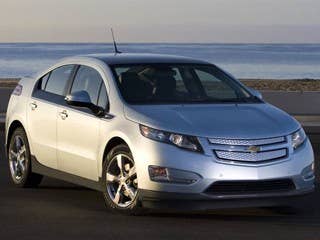
There is nothing wrong with the Chevy Volt in our books except that too few people want it. That’s a problem.
It retails for almost $40,000, but that number comes down to around $32,000 after federal tax credits for buying an extended-range electric vehicle. That means you can drive the car about 35 miles on an electric charge. When that runs out, a gas-powered motor keep the battery powered until you can plug-in again. Easy.
Except people are stubborn to change. Chevy has juiced sales of the Volt a couple of times with cheap leases that ranged from $199 to $239. But now people eke waiting for the cheaper deals to come back. Today’s lease deals run $299 or more. Still a good deal, but not when you think GM is going to go back to $199 to clear out inventory.
Nobody wants to sign up for $299 or more a month if you think $199 is around the corner.
GM and the feds have done a terrible job of selling the public on the benefits of an extended range EV. But it’s also possible that the American pubic just won’t bite on EVs just like they fight against exercise, calorie counts on menu boards, getting rid of bio-engineered crops and assault rifles. But lousy marketing hasn’t helped.
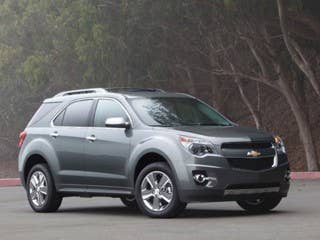
The current Equinox was good enough to win AOL Autos Best CUV under $30,000 designation last year. No easy task since it had to best Hondas CRV, Toyota RAV4, Hyundai Santa Fe, Mazda CX-5, Ford Escape and more.
The Equinox has it all–styling, fuel economy, especially in the four-cylinder version, space and a very nicely appointed interior. Chevy has been producing and selling the Equiniox full out since it launched, and there is good reason for that.
The MTU and OSU vehicles also had a belt-alternator starter system similar to the GM mild-hybrid system on the production Saturn Vue and Aura. The Michigan Tech vehicle started off in electric mode pulling away from a stop silently before the engine fired up once we were in motion. The engine started up smoother than some of the production hybrids I’ve driven recently. The team from northern Michigan finished 11th overall and lagged behind in areas like handling, emissions and fuel economy.
The Ohio State team finished fourth overall and their diesel-powered machine and scored well in the handling, acceleration and on-road emissions tests. Like the MTU vehicle it also had smooth engine restarts and had better low speed acceleration thanks to the torque of the diesel engine.
The University of Wisconsin team didn’t use a start-stop system but apparently made up for it with their manual transmission. The UWM Equinox had basically the same drivetrain as the winning vehicle including the engine, transmission, motor and battery. The cheeseheads finished second overall and performed consistently in most tests.
You can listen to the teams describe their cars right here
- University of Wisconsin – Madison
- the Ohio State University
- Michigan Tech University