
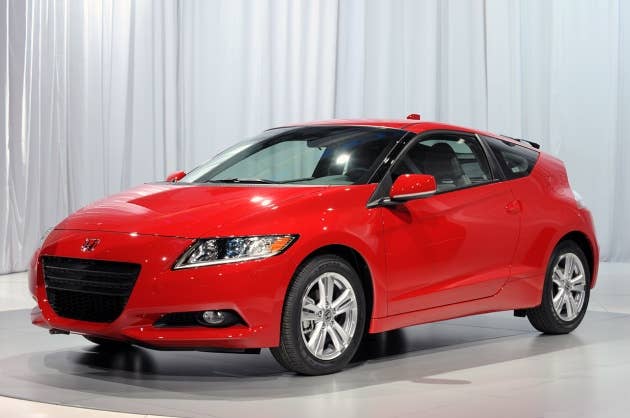
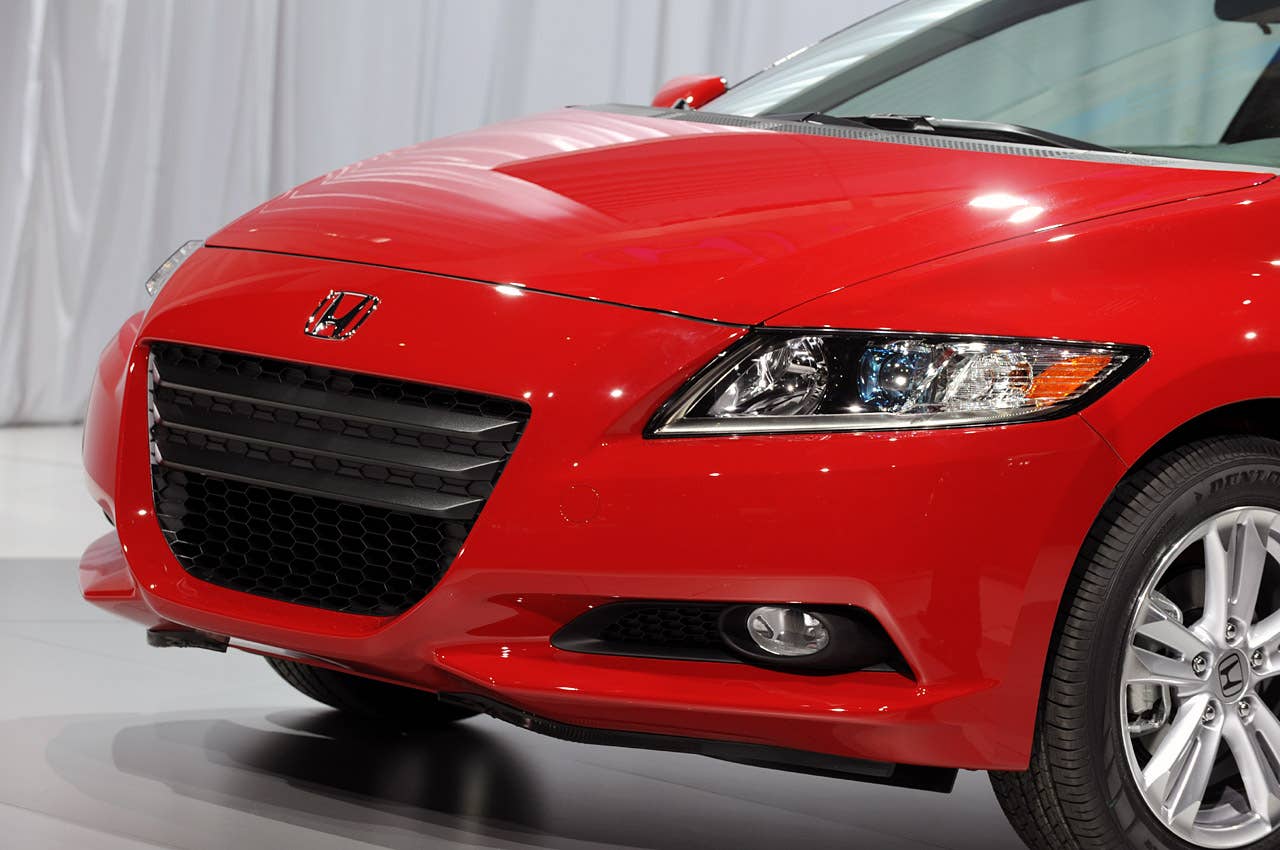
2011 Honda CR-Z – Click above for high-res image gallery
After a few weeks worth of leaked images and brochure fluff, Honda has finally pulled the covers off its next new production hybrid hatchback. The Japanese automaker claims the CR-Z will bring back the kind of driving joy that hasn’t been felt since the CRX last left dealer lots in 1991, saying that owners will embrace this new mild hybrid with both their hearts and minds. We certainly hope they’re right.
While we’re really digging the looks of the CR-Z and the way it hearkens back to the classic CRX – and even the original Insight hybrid – we’ve gotta admit that we’re a tad bit disappointed with the specifications. With 122 horsepower on tap and just 128 lb-ft of torque from the 1.5-liter VTEC four-cylinder with Integrated Motor Assist, shouldn’t we expect more than 36 miles per gallon in the city and 38 on the highway from the CR-Z?
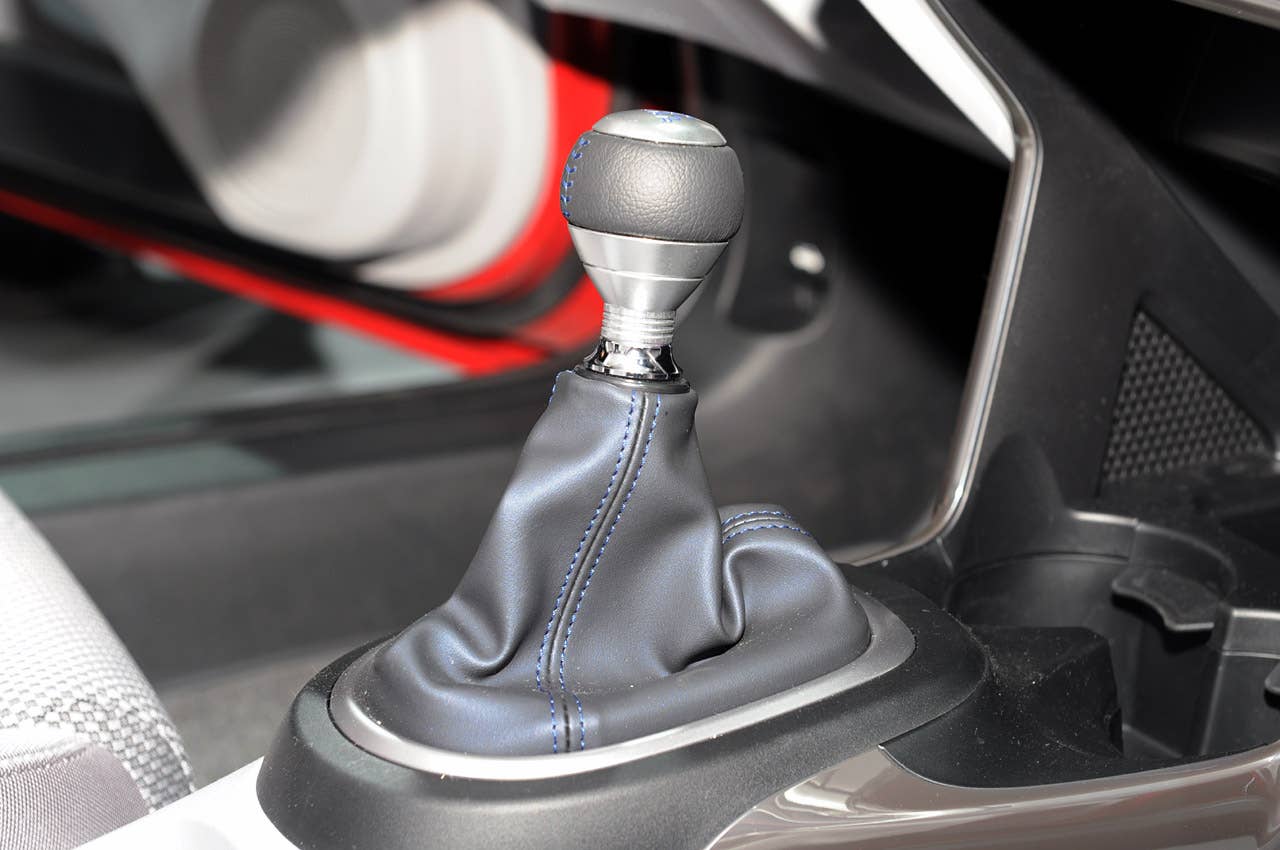
Let’s just hope that the car’s driving dynamics live up to the lofty standards to which Honda is eluding – at least there’s an optional six-speed manual transmission to go along with the expected CVT automatic. We’ll know soon enough know how it goes down the road, as the 2011 CR-Z is slated to hit the ground running in the summer. In the meantime, check out our live images below and click past the break for the press release.
Featured Gallery
Featured Gallery

Honda is touting the 2011 CR-Z as the first vehicle to bridge the not-insubstantial gulf between a fuel-efficient hybrid and a fun-to-drive sports car. Imagine it as a crossbreed of an Insight with an S2000, and you’re thinking like Honda. But you’re also thinking crazy, as performance and parsimony remain diametrically opposed. No amount of quixotic engineering can overcome the limitations of physics, so the CR-Z remains a compromise, just like every other car. And in this case that means it’s a pretty good hybrid but not much of a sports car.
- Research the 2011 Honda CR-Z
- 2011 Honda CR-Z Photos
- 2011 Honda CR-Z Available Trims
- 2011 Honda CR-Z Pricing & Quotes

This is not so surprising, given Honda’s last attempt at something similar, the unpopular Accord Hybrid that lasted just three model years, from 2005-2007. Its promise was murky at best: The hybrid Accord had only marginally improved fuel economy compared to the standard sedan, but it was more powerful and, of course, more expensive. And if that car was a puzzler, Honda is going to have an even greater challenge explaining its latest impossible dream even if it seems to have erred in the opposite direction this time around. That’s because the CR-Z is available only as an impractical two-seat coupe, making it an absolute nonstarter with the vast majority of car buyers. The rest will likely be nonplussed by its meager 122 horsepower – which would only be impressive if the CR-Z were a motorcycle.
- Research the 2011 Honda CR-Z
- 2011 Honda CR-Z Photos
- 2011 Honda CR-Z Available Trims
- 2011 Honda CR-Z Pricing & Quotes

Fuel economy is the CR-Z’s strongest suit, as its combined 37 miles per gallon rating is better than any non-hybrid on the market. Though not as miserly as the Toyota Prius’ 50, or even Honda’s own Insight, which is rated at 41, the CR-Z is indeed sportier than either of those hybrids. But that’s not saying a whole lot now, is it?
- Research the 2011 Honda CR-Z
- 2011 Honda CR-Z Photos
- 2011 Honda CR-Z Available Trims
- 2011 Honda CR-Z Pricing & Quotes

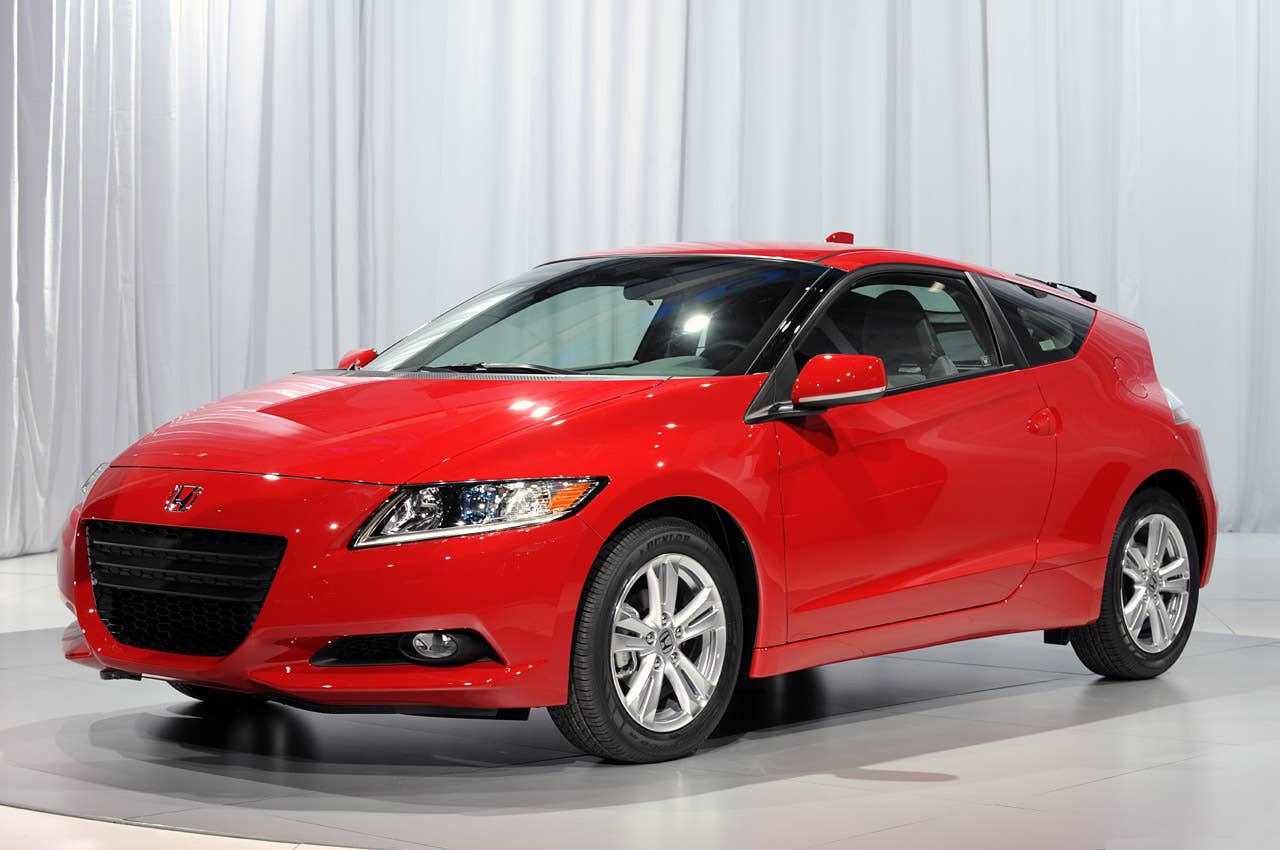
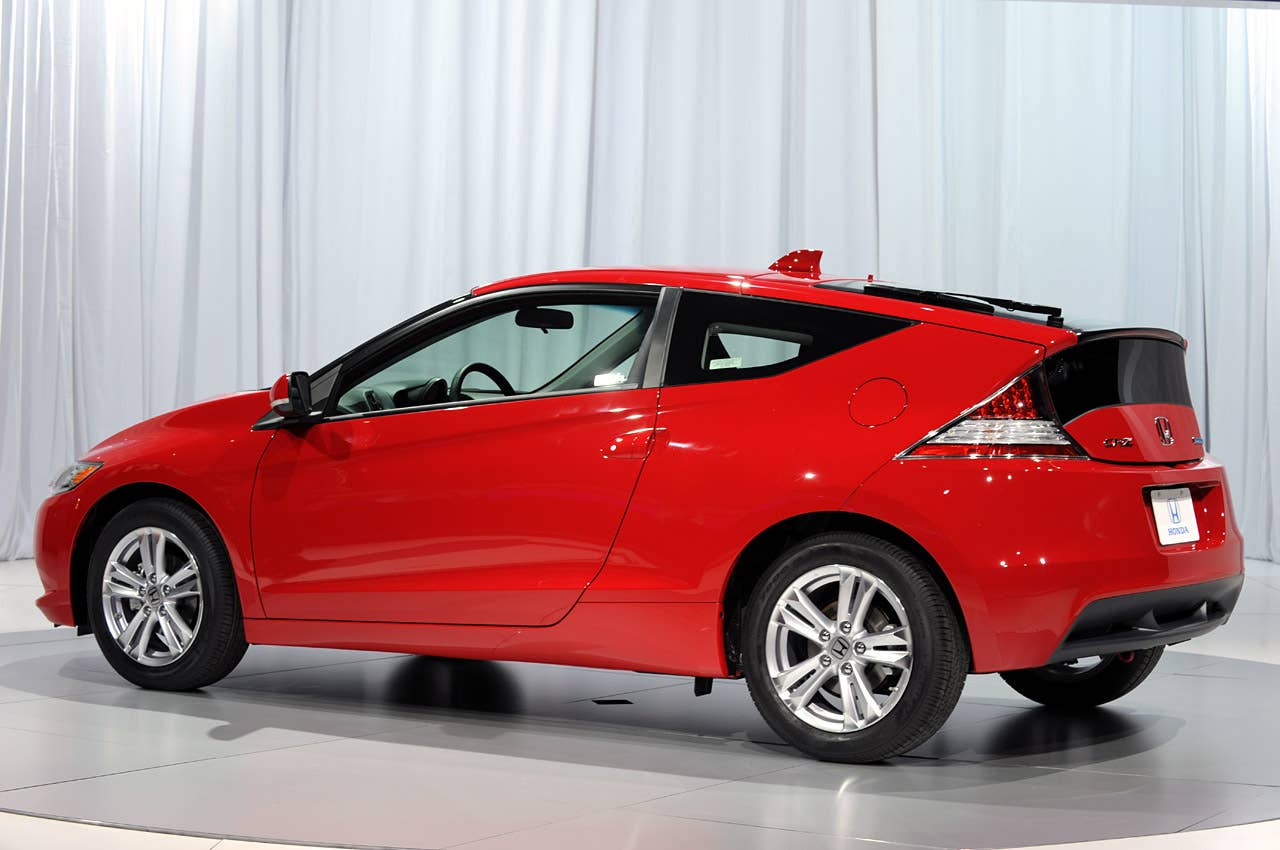
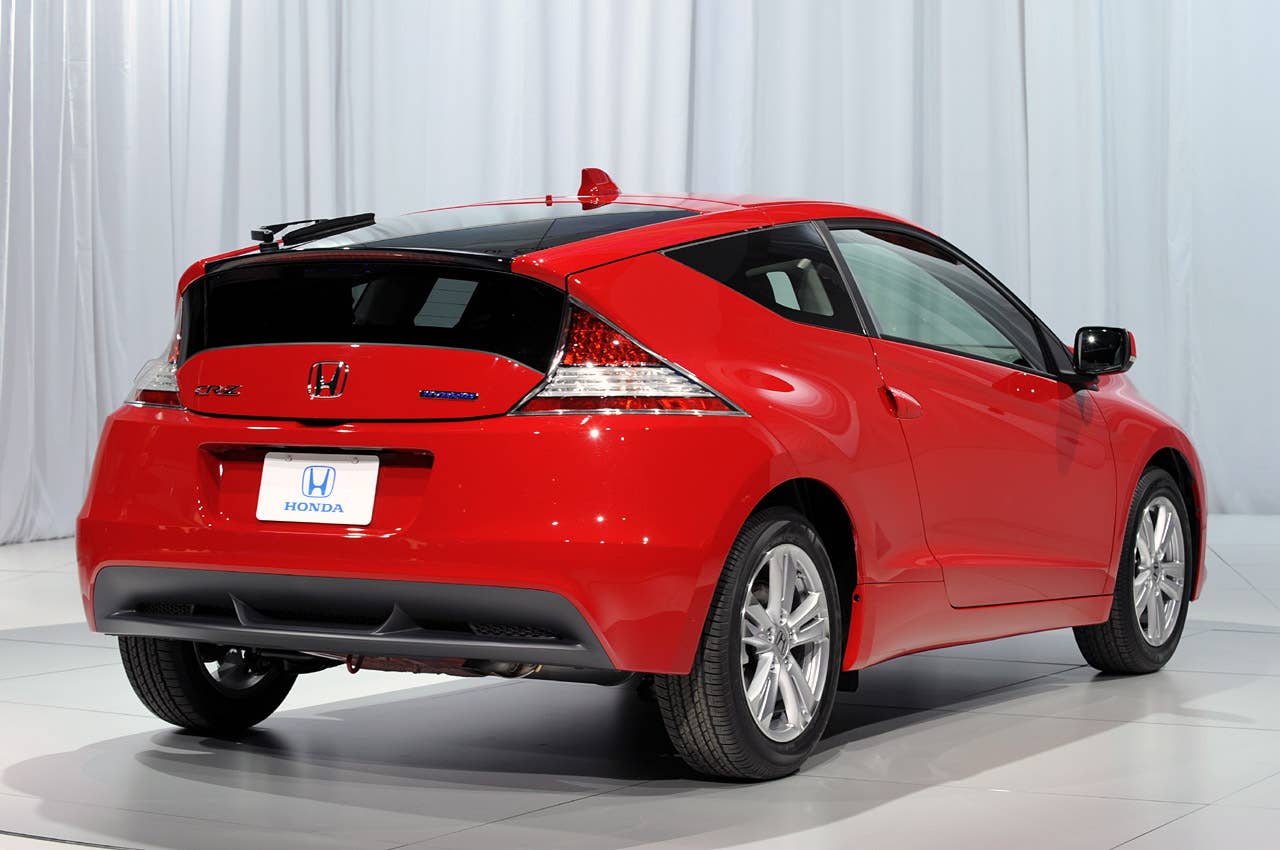
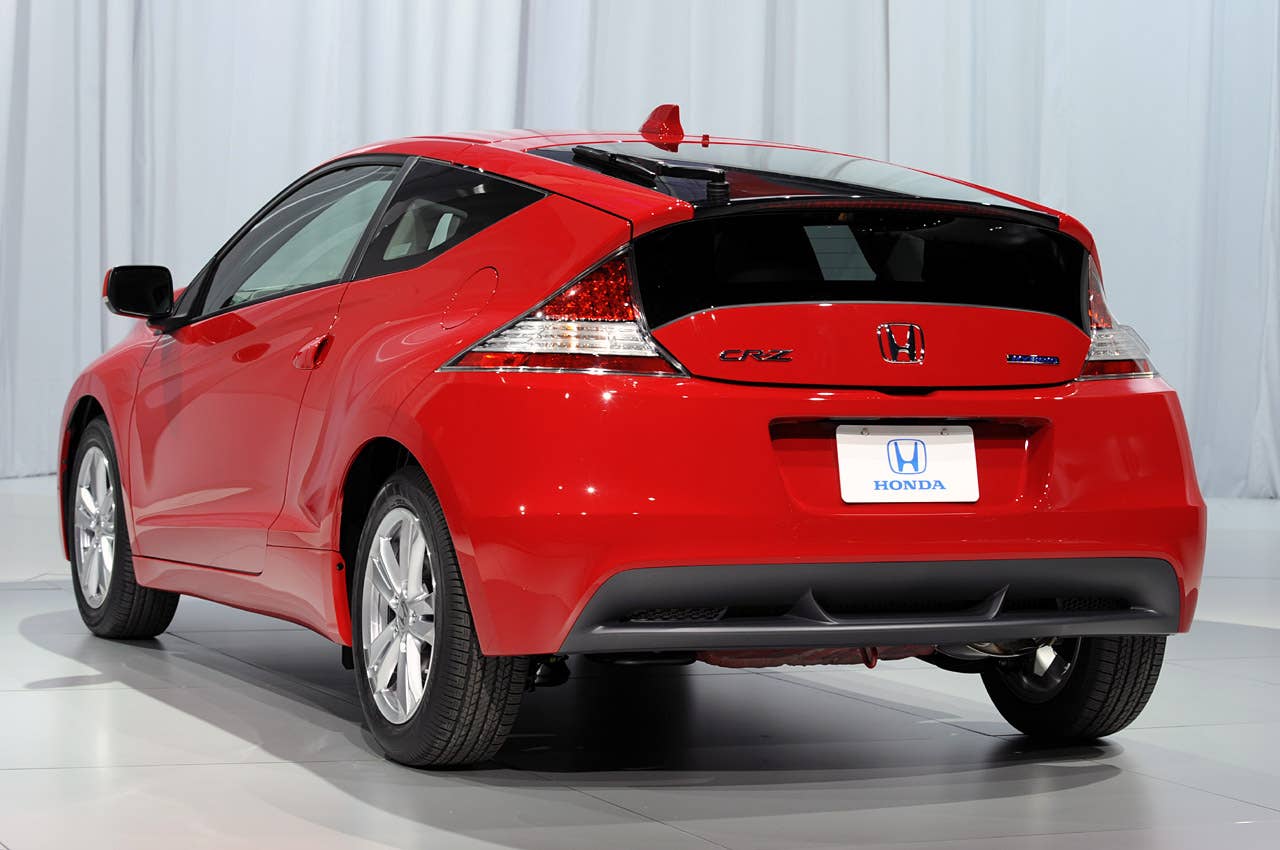
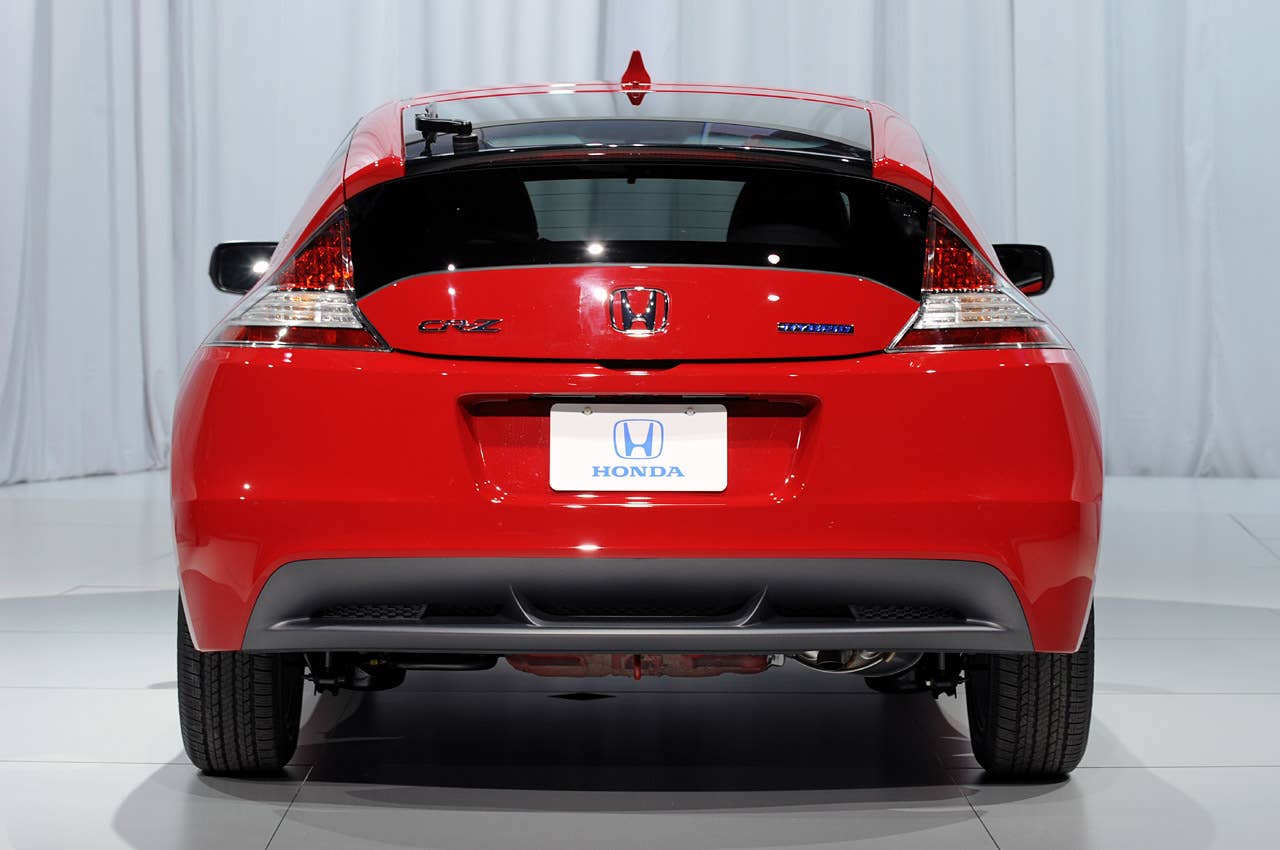
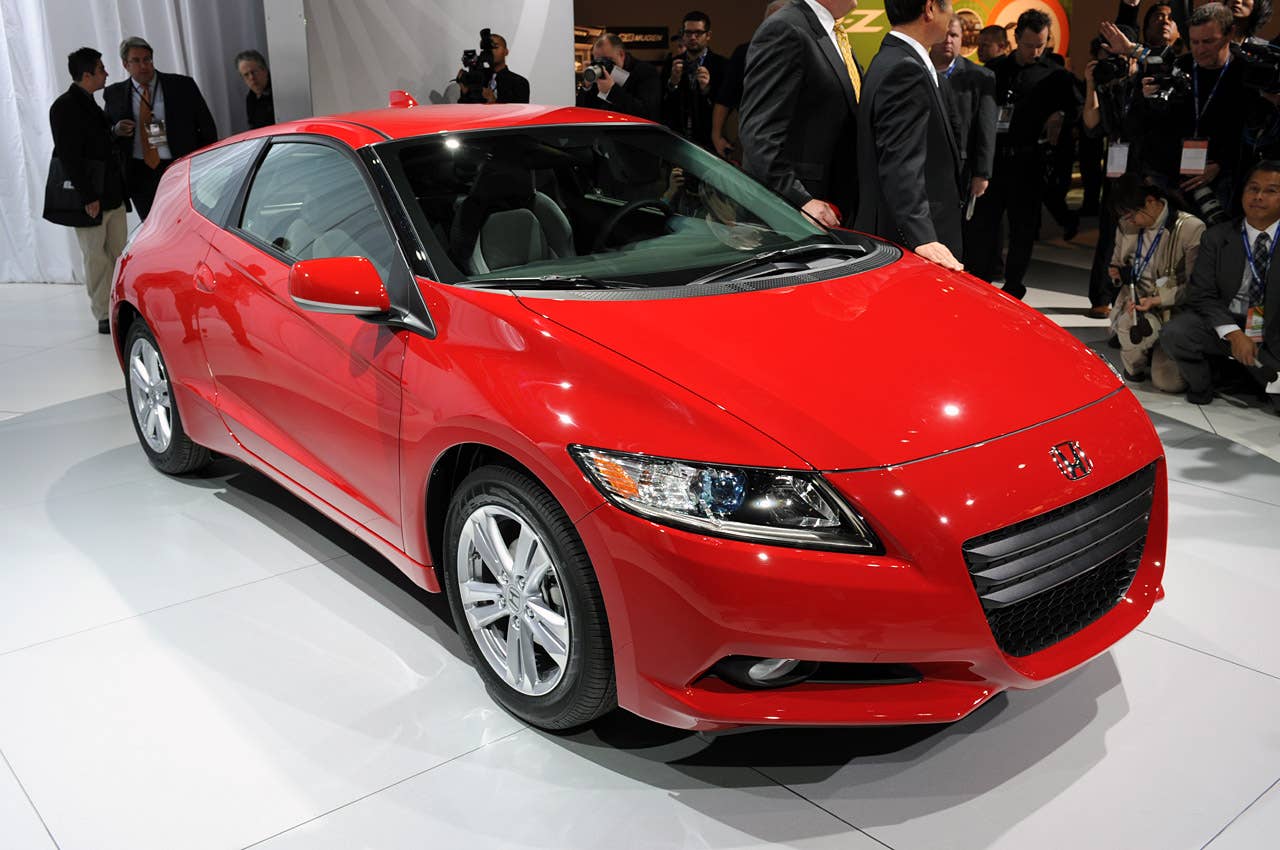
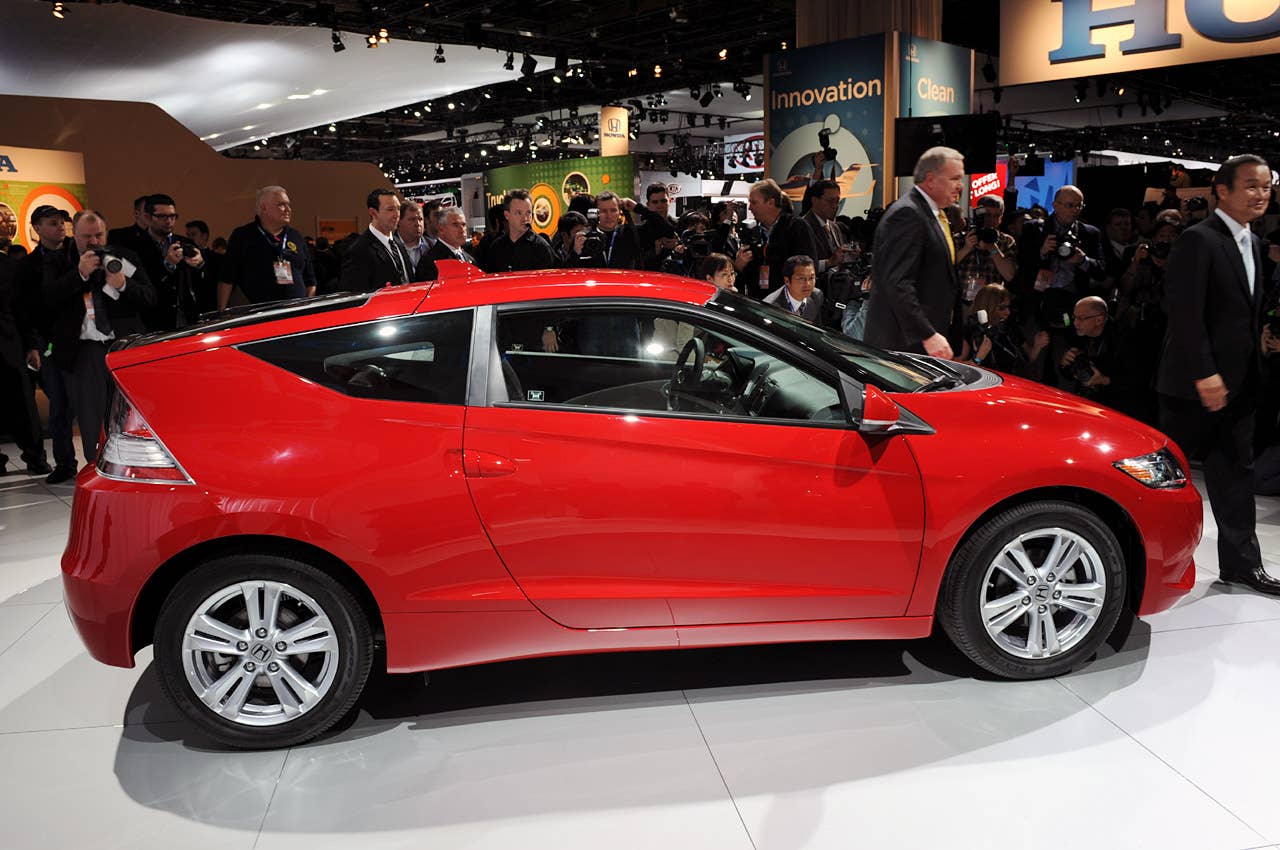
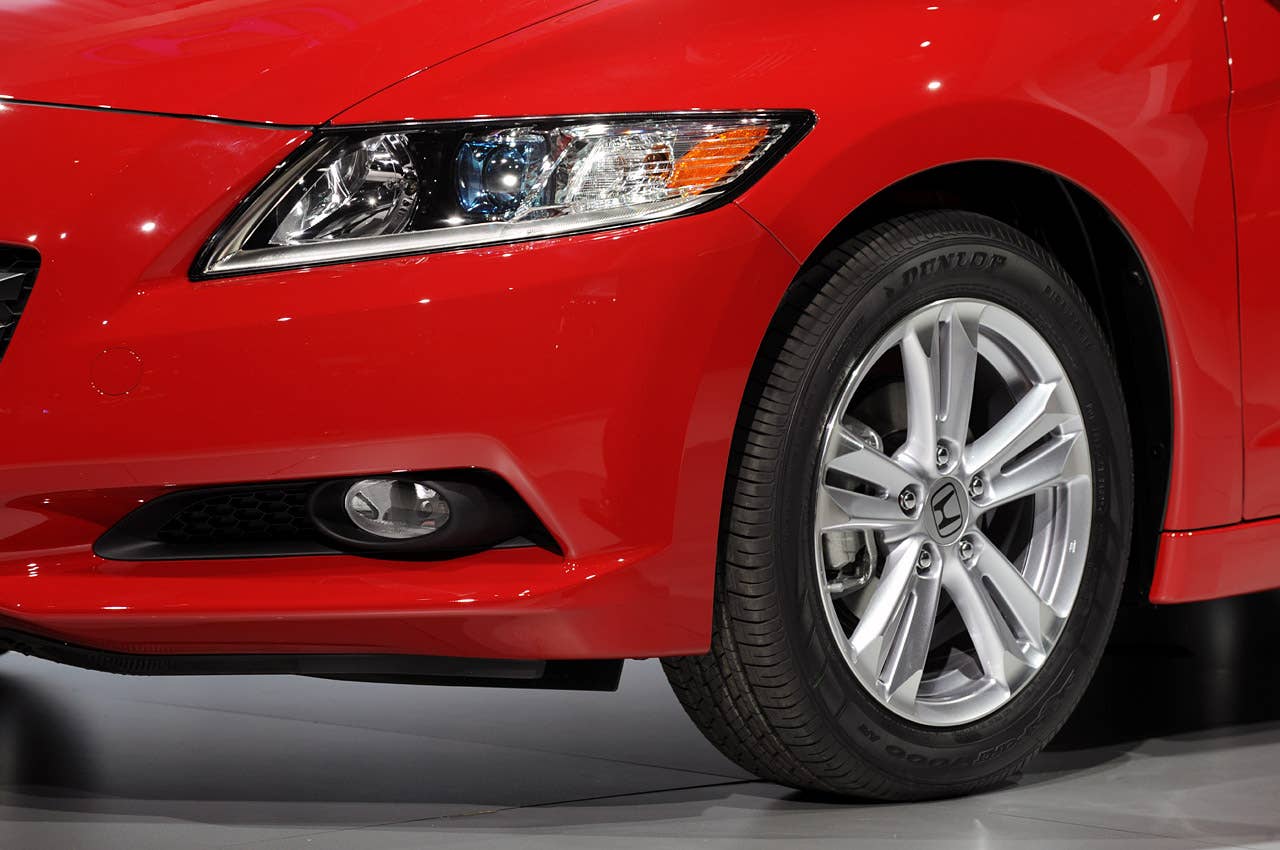
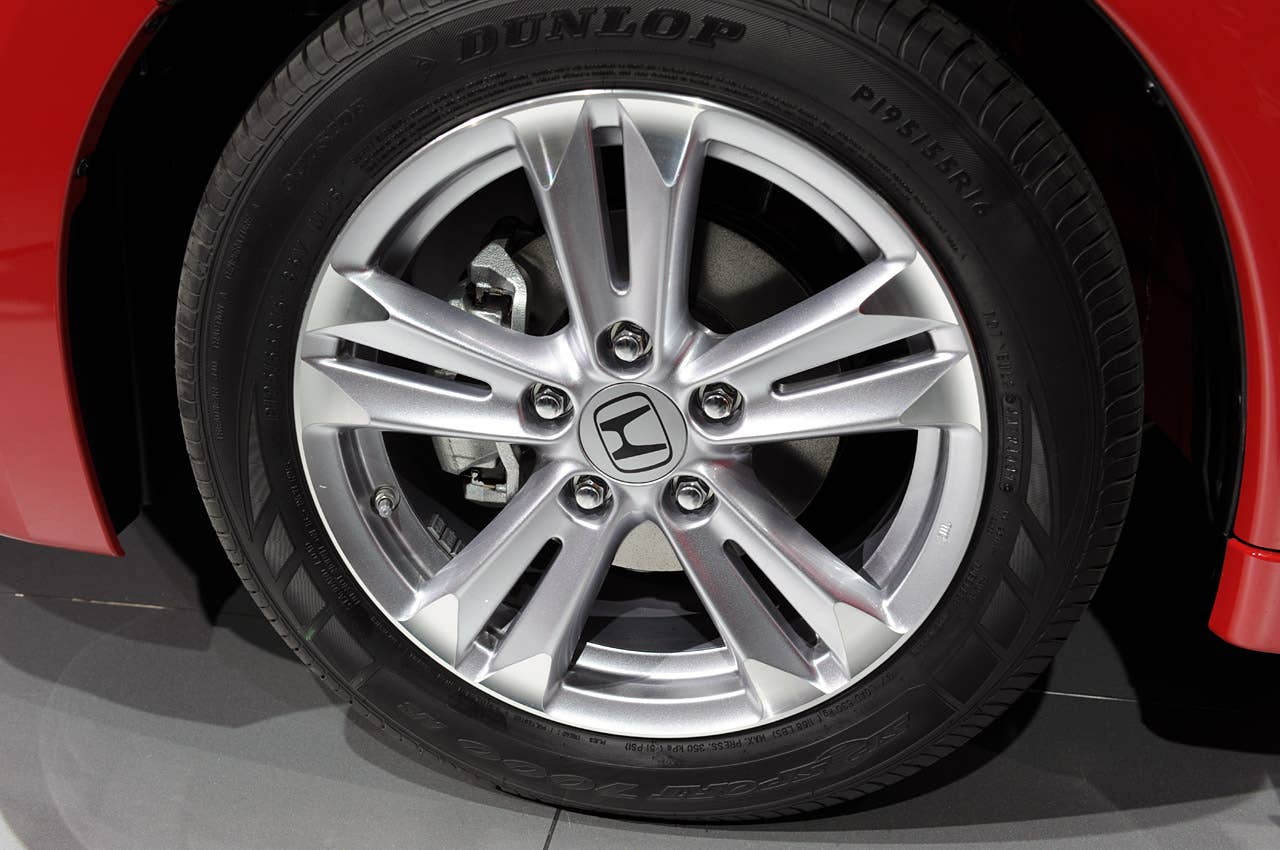
The CR-Z’s greatest asset is its design, as the short, squat, and aggressively styled little coupe looks like it’s going fast even while parked. Multiple character lines sweep back from a wide front grille opening, up and back to the high rear hatchback. The hatch features a tinted vertical glass panel for rearward visibility, while the larger window is nearly parallel to the ground, almost as an extension of the roof. If there is a fault to the exterior design, it would be in the standard 16-inch wheels, which appear too small, especially in the back.
- Research the 2011 Honda CR-Z
- 2011 Honda CR-Z Photos
- 2011 Honda CR-Z Available Trims
- 2011 Honda CR-Z Pricing & Quotes

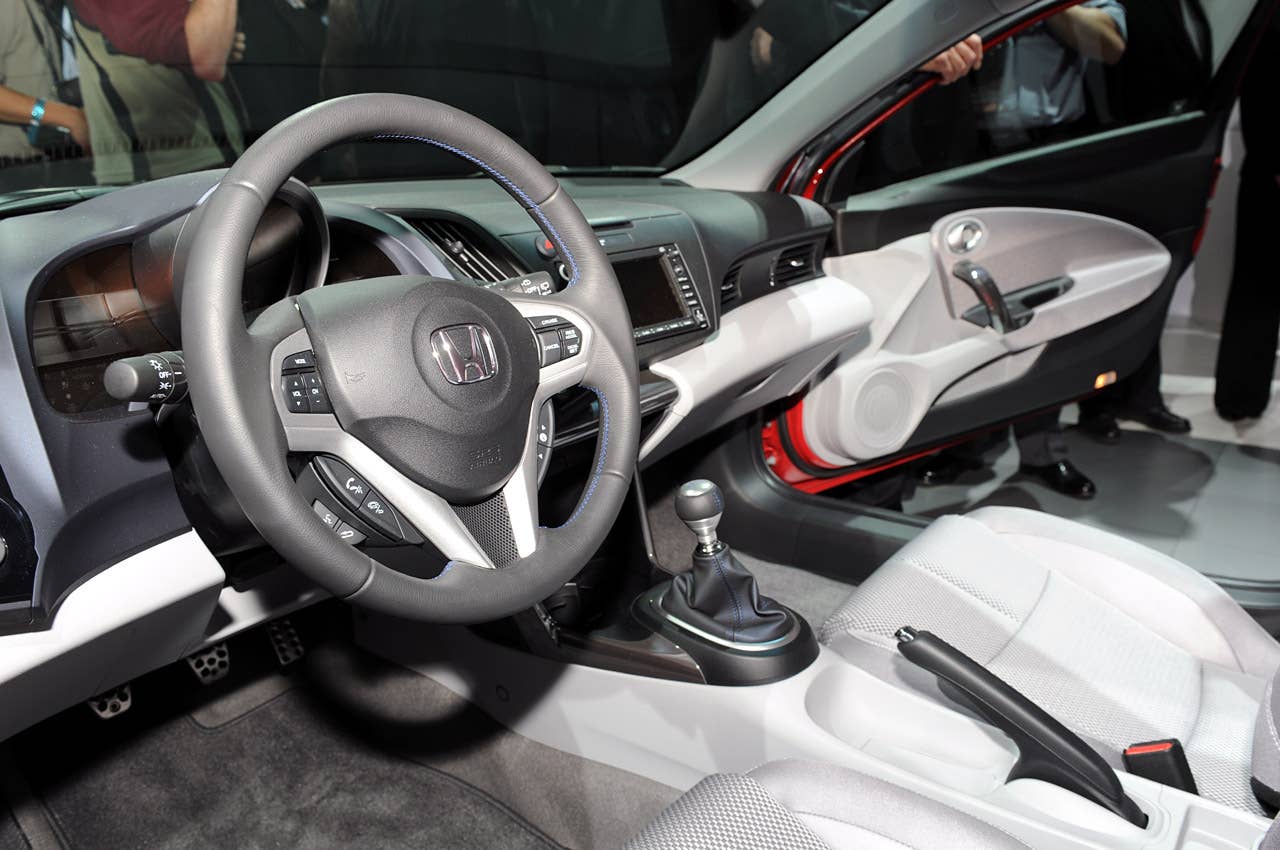
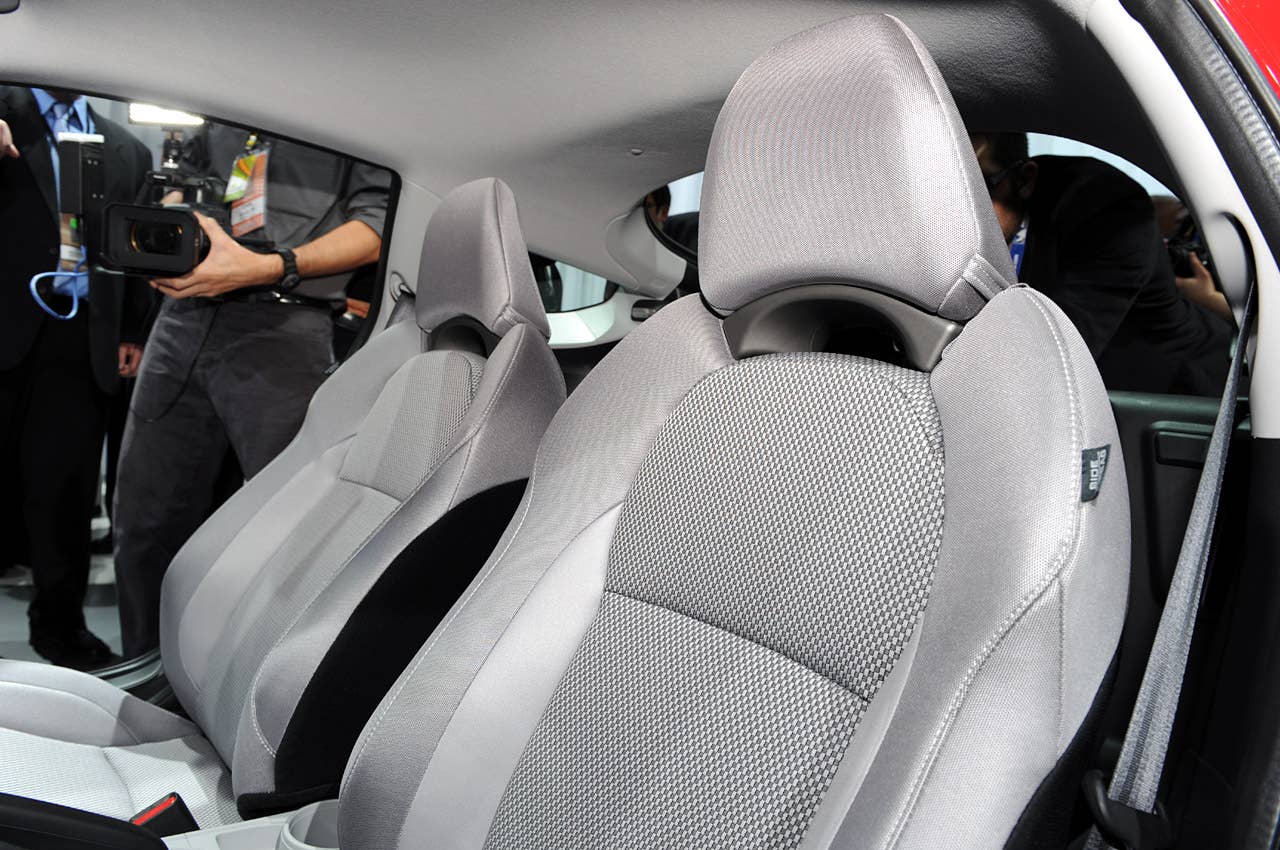
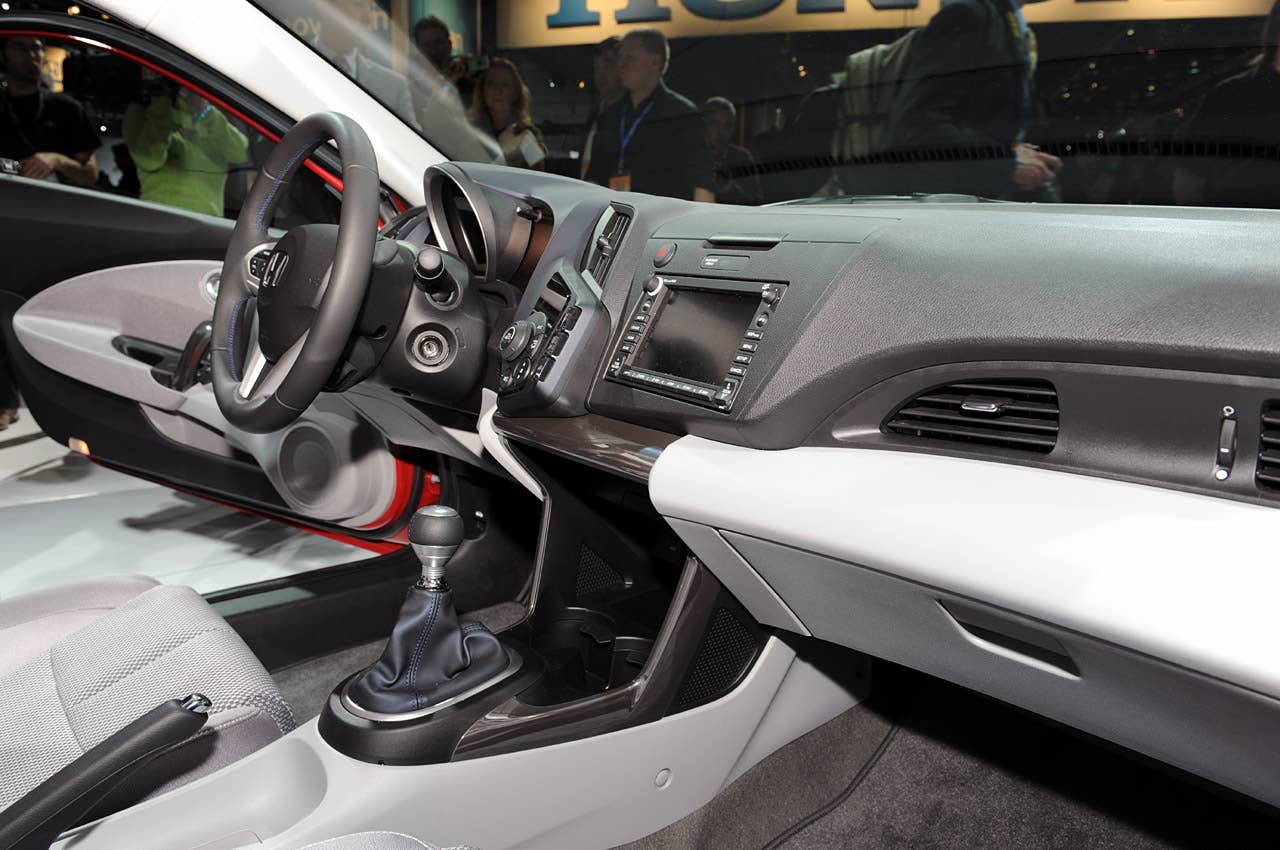
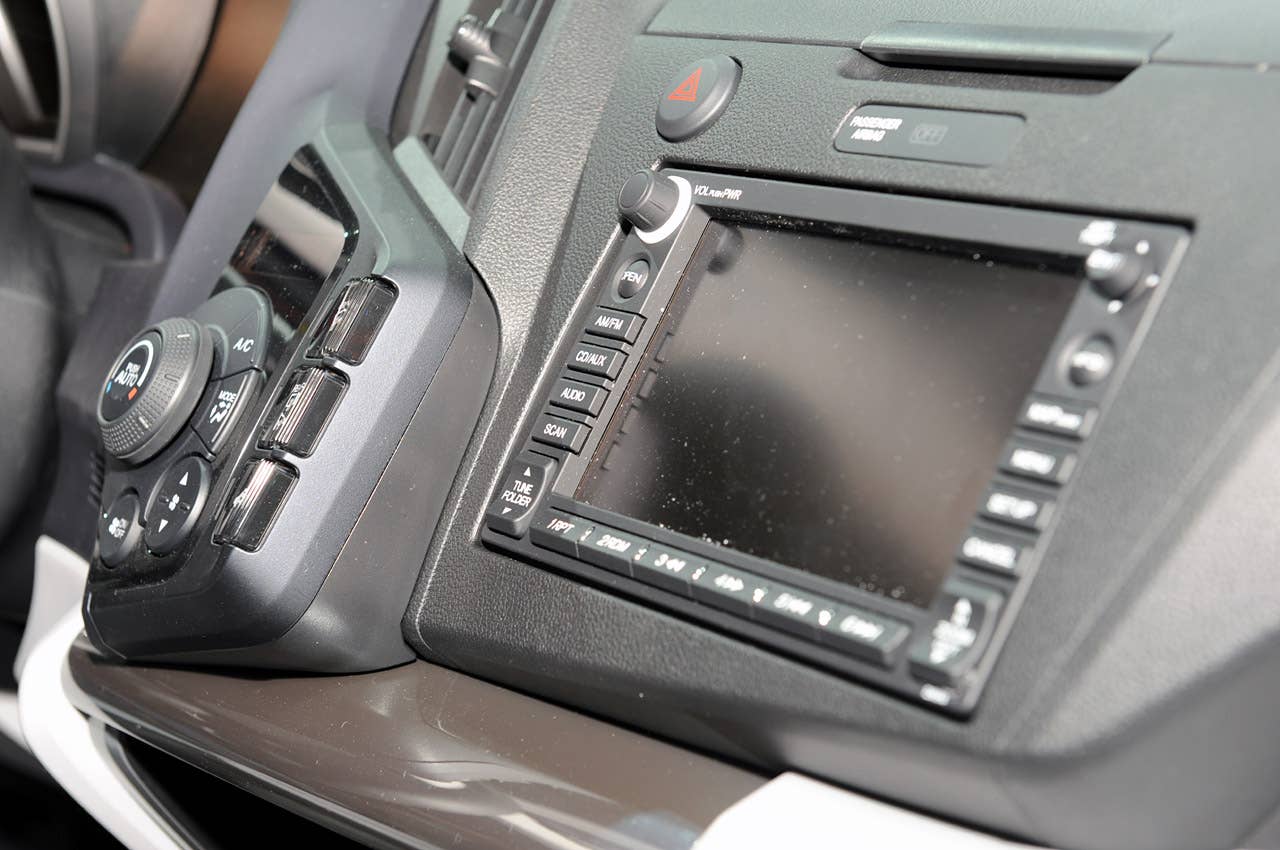
Inside, the CR-Z doesn’t deviate too far from standard Honda fare, which is a good thing. A three-spoke steering wheel protruding from a driver-centered instrument panel is the highlight. Honda has incorporated its Eco-Assist fuel economy information system from the Insight into the CR-Z’s instrument panel, and we are particularly fond of the green-blue-red glow of the center-positioned tachometer, which surrounds the digital speedometer display, and changes colors depending on how the car is being driven. It all looks racy, and complements the sporty, high-backed bucket seats, which are snug, well bolstered and comfortable. The rest of the interior is fairly standard soft-touch plastic, save for the door handles and some other small pieces on the center console that are coated in a unique and attractive metal film.
- Research the 2011 Honda CR-Z
- 2011 Honda CR-Z Photos
- 2011 Honda CR-Z Available Trims
- 2011 Honda CR-Z Pricing & Quotes

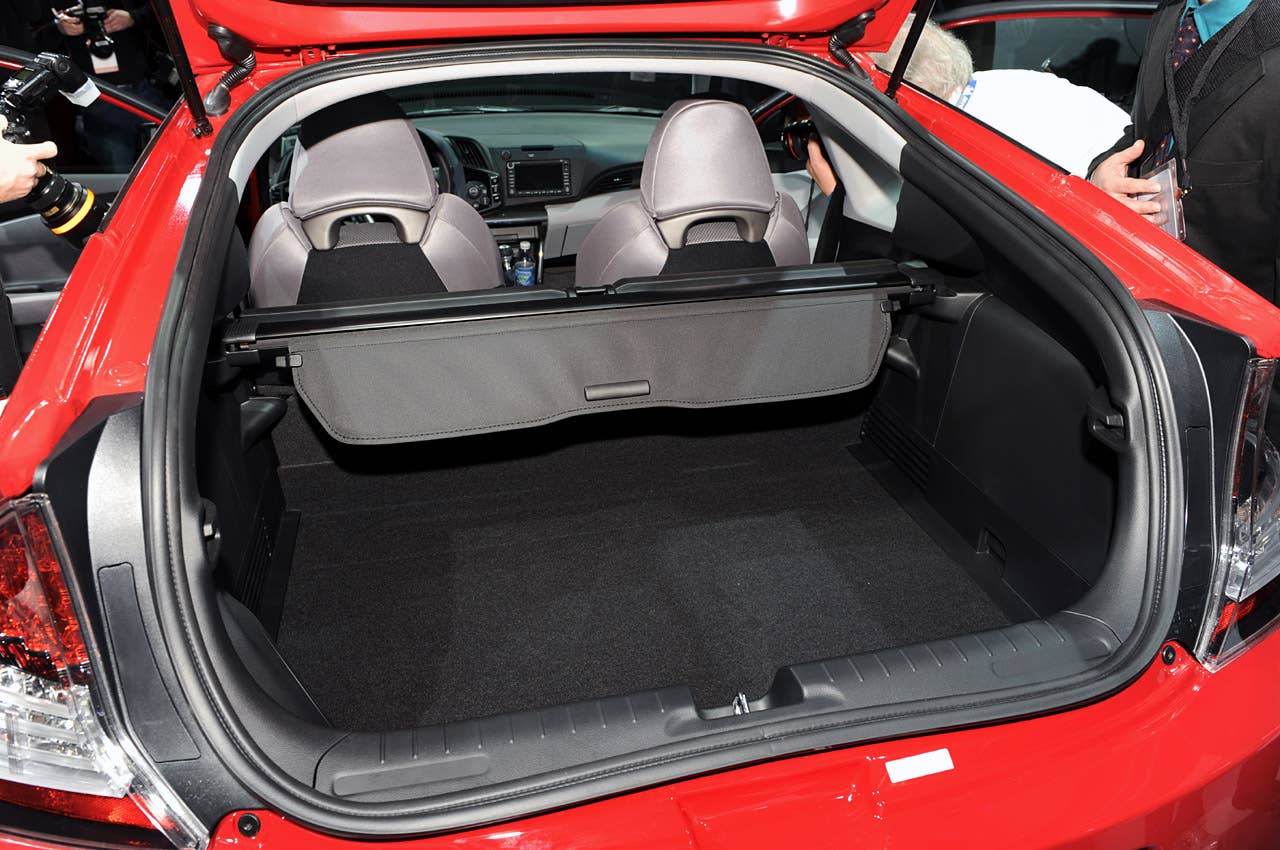
For as slick as the CR-Z’s interior is, what’s most notable is what’s missing: The back seat. In other markets, this two-seater will be sold as a “2+2,” but in North America we get two odd storage cubbies and a fold-down “cargo cover” (the vestigial seatback) instead of the kid-size seating. While Honda’s product planners probably see this as part of the car’s sportiness, it seems more likely to relegate the CR-Z to performing the same sort of commuter car duty as most first generation Insight two-seaters.
- Research the 2011 Honda CR-Z
- 2011 Honda CR-Z Photos
- 2011 Honda CR-Z Available Trims
- 2011 Honda CR-Z Pricing & Quotes

Under the skin, the CR-Z most closely resembles its sibling, the Honda Insight, from which is borrows its hybrid parts, including Honda’s Integrated Motor Assist system and a nickel-metal hydride battery pack. But the CR-Z employs a larger, 1.5-liter four-cylinder engine, which, once you add in the additional power provided by the electric motor, is rated at 122 horsepower and 128 lb-ft of torque. The other major difference from the Insight is that a close ratio, six-speed manual transmission is standard in the CR-Z, giving the car at least the pretense of sporting potential. (While a continuously variable transmission with steering wheel-mounted paddle “shifters” is available for an additional $650, it will cost you five lb-ft of torque as well.)
- Research the 2011 Honda CR-Z
- 2011 Honda CR-Z Photos
- 2011 Honda CR-Z Available Trims
- 2011 Honda CR-Z Pricing & Quotes

Behind the wheel, the CR-Z offers three distinct driving modes: economy, normal and sport. Economy is designed to maximize fuel efficiency by curtailing throttle response, limiting the air conditioning system, and aggressively cutting the engine at idle. When compared to normal mode, the effect on driving is as subtle as sport is dramatic. It’s this mode that gives the CR-Z what bona fides it can claim. Sport mode makes the electric assist feel sort of like a supercharger, providing extra power at even slight throttle angles, and ramping up that power as rapidly as you can depress the accelerator.
- Research the 2011 Honda CR-Z
- 2011 Honda CR-Z Photos
- 2011 Honda CR-Z Available Trims
- 2011 Honda CR-Z Pricing & Quotes

Sport mode also firms up the electric power steering, giving it a more precise feel, though the CR-Z provides more feedback to the driver through its low-slung seat than through the steering wheel. The car leans quite a bit under heavy cornering and is prone to front-wheel-drive understeer, but overall the CR-Z actually handles pretty well. It brakes better than any other hybrid we’ve driven, with no noticeable transition between the regenerative braking system and the friction brakes.
- Research the 2011 Honda CR-Z
- 2011 Honda CR-Z Photos
- 2011 Honda CR-Z Available Trims
- 2011 Honda CR-Z Pricing & Quotes

While our initial impressions of the CR-Z were positive, the longer and harder we drove it, the less we liked it. Just trundling along, the effect of pressing the sport button is an immediate rush of electric motor assist that certainly makes it seem like you’re behind the wheel of a performance machine. This boost is short-lived, however, as once the Integrated Motor Assist is providing its full torque output, you realize that the CR-Z can be woefully slow. Climbing hills or pulling out to pass requires downshifting a gear or two and really flogging the little four-cylinder. There is fun to be had in the CR-Z, but only in small doses.
- Research the 2011 Honda CR-Z
- 2011 Honda CR-Z Photos
- 2011 Honda CR-Z Available Trims
- 2011 Honda CR-Z Pricing & Quotes

Now let’s put this commentary in its proper perspective: The CR-Z is plenty powerful enough for everyday driving, and compared to most inexpensive compact cars it’s actually got enough juice under the hood and delivers it in such a way to put a smile on your face. But hop out of this “sporty” hybrid and into a car with even a modicum of performance — like, say, the base Hyundai Genesis Coupe — and that grin will be elevated to uncontrollable laughter. Even compared to Honda’s other models, the performance of the CR-Z is questionable. Do some quick back-of-the-envelope math and you’ll find that the 2,637-pound CR-Z’s power-to-weight ratio trails both the Fit and the Civic coupe, both of which undercut the CR-Z by thousands of dollars.
- Research the 2011 Honda CR-Z
- 2011 Honda CR-Z Photos
- 2011 Honda CR-Z Available Trims
- 2011 Honda CR-Z Pricing & Quotes
This is the point in the conversation — and we had this same one quite a few times during the press preview — where someone will mention how the CR-Z is meant to evoke the much-beloved (though thoroughly overrated) Honda CRX of the late 1980s. While that’s a nice thought and one Honda particularly likes, it’s nothing more than a red herring, distracting us from the fundamental question: Who is this car for?
- Research the 2011 Honda CR-Z
- 2011 Honda CR-Z Photos
- 2011 Honda CR-Z Available Trims
- 2011 Honda CR-Z Pricing & Quotes
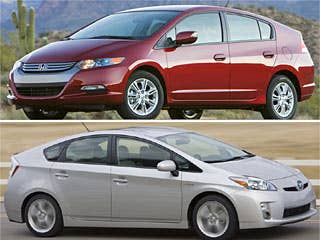
Let’s start by taking a look at the CR-Z opportunity cost: What else you can buy for the kind of money Honda is asking? The base price of the CR-Z is $19,200, ranging up to $23,210 if you opt for the EX trim with navigation and a continuously variable transmission. In that price range, there are certainly better hybrids to be had, like the aforementioned Insight and Prius, both of which have back seats.
- Research the 2011 Honda CR-Z
- 2011 Honda CR-Z Photos
- 2011 Honda CR-Z Available Trims
- 2011 Honda CR-Z Pricing & Quotes

Taking a look at sporty cars in the low $20k range is even more unflattering to the CR-Z. The Mazda Miata starts in that ballpark and it’s a true sports car, weighing in a few hundred pounds under Honda’s hybrid pretender and boasting all of 167 horsepower. A few sporty coupes in that price range embarrass the CR-Z both in terms of performance, but also utility. Take your pick of the base model Ford Mustang or Chevy Camaro and you can have well over twice the horsepower, plus a back seat. When similarly equipped, the CR-Z may undercut the pair of pony cars on price, but not by much.
- Research the 2011 Honda CR-Z
- 2011 Honda CR-Z Photos
- 2011 Honda CR-Z Available Trims
- 2011 Honda CR-Z Pricing & Quotes
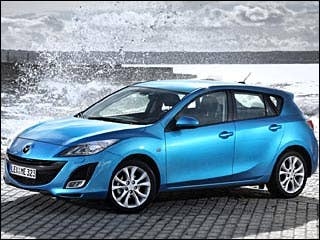
There’s also the reigning champion of sporty, sub-$20k hatchbacks, the Mazda3, and the new Ford Fiesta and forthcoming Ford Focus to contend with. And we might as well throw all those Mini Coopers into the mix, while we’re at it. What this goulash of makes and models says is that no matter how you slice, dice, or julienne your desire to own a CR-Z, there’s probably something else on the market for you, should you decide you want your sporty looking new car to actually have the power to go with its looks.
- Research the 2011 Honda CR-Z
- 2011 Honda CR-Z Photos
- 2011 Honda CR-Z Available Trims
- 2011 Honda CR-Z Pricing & Quotes

So it’s pretty clear that the CR-Z doesn’t cut it as a sports car, even if it has a lot of the trappings: The looks, the interior, the transmission, the chassis. It’s enough to make us wonder why Honda doesn’t just stick its high-revving four-cylinder from the Civic Si underhood and forget about the hybrid business altogether?
- Research the 2011 Honda CR-Z
- 2011 Honda CR-Z Photos
- 2011 Honda CR-Z Available Trims
- 2011 Honda CR-Z Pricing & Quotes

But considering the car as a hybrid, the CR-Z is much harder to evaluate. Is the point of a hybrid to maximize fuel economy, while maintaining the standard five-passenger utility of most cars? That’s the modus operandi of the hybrid standard-bearer Prius, but the CR-Z isn’t written to those rules. What Honda has produced here is actually the first vehicle to bridge the gap between the first decade of hybrids and the second, in which carmakers become more willing to hybridize anything and everything in their lineups in order to achieve the greater fuel efficiency demanded of them by more stringent federal regulations.
- Research the 2011 Honda CR-Z
- 2011 Honda CR-Z Photos
- 2011 Honda CR-Z Available Trims
- 2011 Honda CR-Z Pricing & Quotes
Live photos by Drew Phillips / Copyright ©2010 Weblogs, Inc.
Follow our coverage of the 2010 Detroit Auto Show live all day on Twitter at https://twitter.com/therealautoblog
%Video-963%
Show full PR text
Production Version of 2011 Honda CR-Z Sport Hybrid Coupe Makes Official Debut
All-new hybrid model set to go on sale in the U.S. this summer
DETROIT, Jan. 11, 2010 – The all-new 2011 Honda CR-Z sport hybrid coupe, making its U.S. production debut at the North American International Auto Show in Detroit, introduces sleek styling and sporty handling to the hybrid segment, American Honda Motor Co., Inc., announced today.
“The CR-Z is a personal sport hybrid coupe for people with a spirit of adventure and an elevated sense of responsibility toward the environment,” said John Mendel, executive vice president of sales for American Honda. “It’s the first hybrid designed to maximize style and fun, in addition to efficiency and economy.”
Set to go on sale late summer in the U.S., the CR-Z is powered by a 1.5-liter i-VTEC engine with Honda’s compact and lightweight Integrated Motor Assist (IMA) hybrid-electric system. The two-passenger CR-Z introduces a new three-mode drive system that allows the driver to select between Sport, Econ (Economy) and Normal driving modes.
The exterior’s distinctive “one-motion” wedge form originates from its low-slung hood to form a broad forward stance. A side profile with a deeply inset beltline conveys a dynamic tension, while the short wheelbase and large, wide front grille accents the vehicle’s athletic presence.
The futuristically styled interior offers a high-tech appearance and ergonomically intuitive controls. Instrument panel meters illuminate with a three-dimensional, vibrant blue color theme resulting in a multi-layered appearance. Set against a motif of textured black materials and aluminum-style trim accents, the upper portion of the dashboard extends toward the driver to provide a wrap-around cockpit environment. The passenger zone offers an open, comfortable space. Premium sport-oriented cloth seats are designed to provide excellent lateral support along with everyday driving comfort. A mid-ship console behind the front seats optimizes cargo space. A hard-shell separator can be closed to create additional hidden storage.
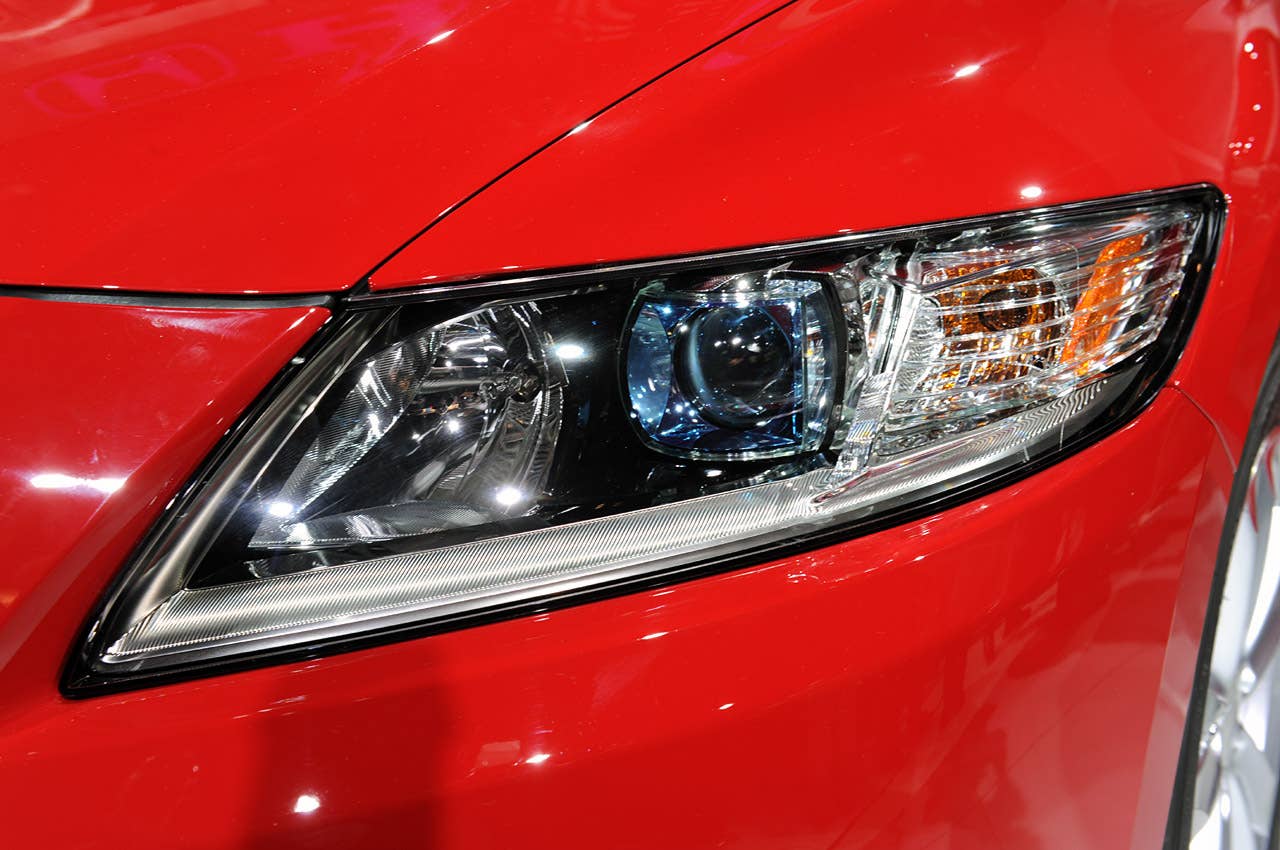
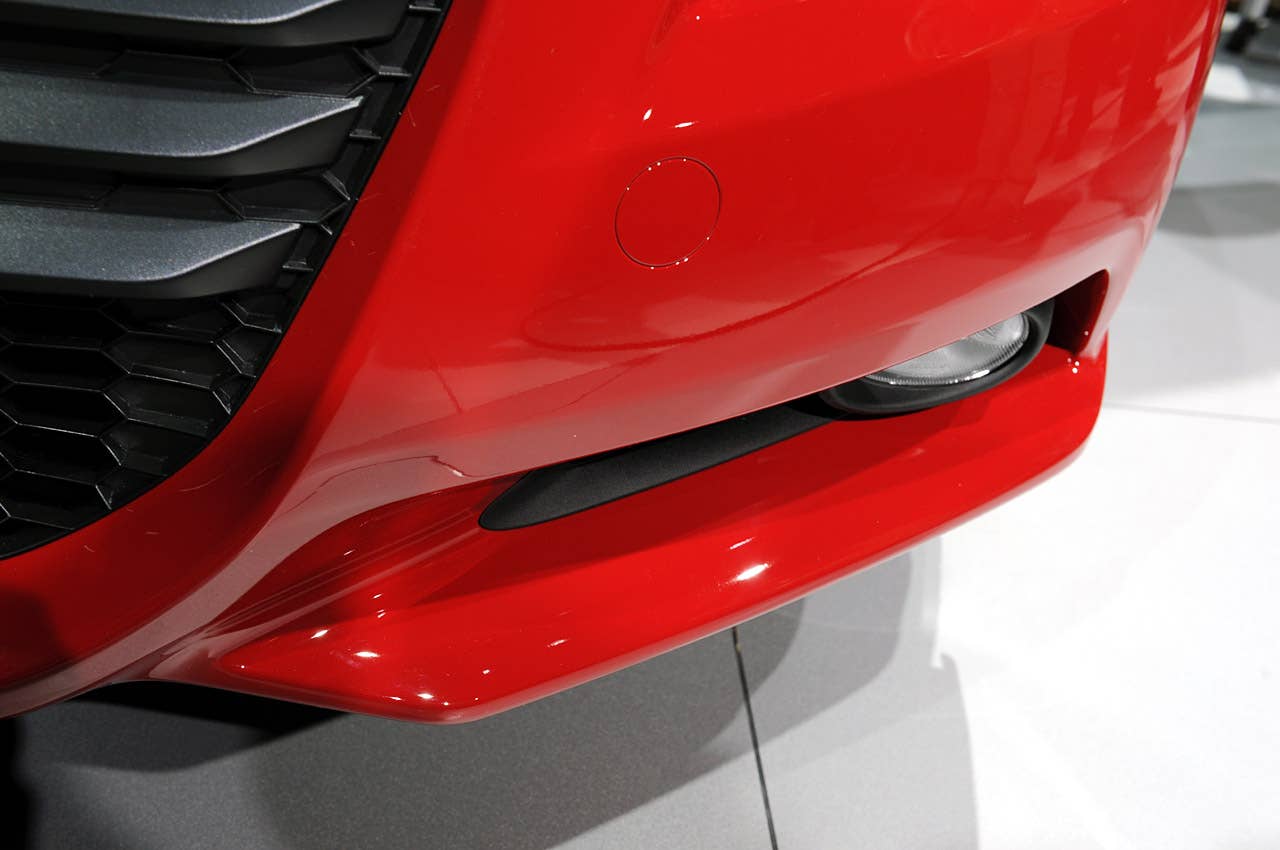
The two trim levels include the well-equipped CR-Z and the feature-rich CR-Z EX. A six-speed manual transmission is standard equipment and a Continuously Variable Transmission (CVT) is available. Standard features on the CR-Z include Vehicle Stability Assist, an AM/FM/CD/USB audio system with six speakers, automatic climate control, power windows and door locks, remote entry, cruise control, and more. The CR-Z EX adds, High-Intensity Discharge (HID) Headlights with Auto-On/Off, fog lights, a 360-Watt AM/FM/CD premium audio system with seven speakers including subwoofer, Bluetooth® HandsFreeLink®, perforated leather-wrapped steering wheel, center console with an armrest and storage compartment, and more. The CR-Z EX is available with the Honda Satellite-Linked Navigation System[1] with voice recognition.
The CR-Z represents the sixth unique version of Honda’s original IMA technology since the launch of the 2000 Insight, the first hybrid vehicle available in North America in December 1999. The foundation of the CR-Z’s hybrid powertrain is a 4-cylinder, 16-valve, single overhead cam engine with “intelligent” Variable Valve Timing and Lift Electronic Control (i-VTEC) that receives additional power from the IMA system’s DC brushless electric motor. The i-VTEC system controls the opening and closing of one intake valve per cylinder to enhance combustion at low RPMs. The 10-kilowatt electric motor assists in acceleration and also acts as a generator during braking or coasting to capture kinetic energy that recharges the 100-volt IMA nickel-metal hydride battery pack. The gasoline engine can automatically turn off during vehicle stops to improve efficiency.
The system delivers a combined peak output of 122 horsepower[2] at 6,000 rpm and 128 lb-ft. of torque2 at 1,000 to 1,500 rpm (123 lb-ft on CVT-equipped models). Preliminary fuel economy estimates are anticipated to result in a rating of 36 city/38 highway miles per gallon[3] on CVT-equipped models. Manual transmission models are anticipated to achieve an EPA-estimated fuel economy rating of 31 city/37 highway miles per gallon3. The CR-Z is rated as an Advanced Technology Partial Zero Emissions Vehicle (AT-PZEV) in states that adhere to California Air Resource Board (CARB) ZEV standards (EPA Tier 2, Bin 2 in all states).
The standard six-speed manual transmission is engineered for optimal acceleration performance in gears one through five and for optimal fuel economy in sixth gear. When starting on steep inclines from a stop, hill start assist temporarily prevents the vehicle from rolling backwards during the moment between releasing the brake, depressing the throttle and releasing the clutch (for a duration of approximately 1.5 seconds). The available CVT provides the convenience of an automatic transmission with a seamless transition between minimum and maximum ratios, while also keeping the engine within an optimal RPM range for overall efficiency. To increase the performance potential of the CVT, paddle shifters located on the steering wheel allow the driver to manually simulate the stepped holding pattern. In Sport mode, the paddle shifters will hold and maintain a selected ratio.
The CR-Z’s three-mode drive system allows the driver to select between individual modes of performance for Sport, Normal and Economy driving styles. The system is activated via three backlit buttons to the left of the steering wheel.
The Sport mode enhances multiple vehicle systems for performance including the engine throttle responsiveness, electric power steering effort and the electric motor power assist. The inner ring of the tachometer illuminates red when the vehicle is in Sport mode.
During Econ mode operation, the engine’s responsiveness is tuned for optimal economy, the electric motor assist gives priority to fuel efficiency and the air conditioning system can reduce its overall load on the engine. The inner ring of the tachometer transitions between blue and green when the vehicle is in Econ mode, with the green representing more ecological driving.
Normal mode provides standard settings for steering, engine response, motor assist and air conditioning. The tachometer ring remains blue in normal mode. Like the Honda Insight, the CR-Z offers an Eco Guide and Eco scoring feature to help drivers track progress of efficient driving styles.
The front MacPherson strut suspension and rear H-shaped torsion beam suspension settings are tuned to provide a sporty, solid and dynamic driving experience. All models are equipped with 16×6-inch aluminum wheels with 195/55 R16 86V tires. Accessory 17×7 alloy wheels with 205/45R17 84V tires with are available. The standard anti-lock braking system (ABS) with electronic brake distribution (EBD) uses ventilated front discs and solid rear discs. The low vehicle height and placement of the battery and other hybrid components beneath the rear cargo area further contribute to a low center of gravity, which is key to the new CR-Z’s responsive, sporty handling. Electric power-assisted rack-and-pinion steering enhances steering performance and improves efficiency.
In addition to being environmentally responsible, the CR-Z demonstrates a commitment to safety in its design and construction. The Advanced Compatibility Engineering™ (ACE™) body structure helps protect vehicle occupants in a frontal collision. Additional safety technologies include standard dual-stage, multiple-threshold front airbags; standard front-side airbags with passenger-side Occupant Position Detection System (OPDS); side-curtain airbags, active head restraints; an anti-lock braking system; a tire pressure monitoring system; and a pedestrian injury mitigation design in the front of the vehicle.
[1] The Honda Satellite-Linked Navigation System™ is available on the CR-Z EX in the United States, except Alaska. Please see your Honda dealer for details.
[2] Preliminary estimate provided by Honda. Final specification is subject to change.
[3] Preliminary EPA mileage estimates determined by Honda. Final EPA mileage estimates not available at the time of printing. Use for comparison purposes only. Do not compare to models before 2008. Your actual mileage will vary depending on how you drive and maintain your vehicle.